
Badminton lines are narrow, closely spaced and easily lost among the other sports sharing a hall. Get the colour or the hierarchy wrong and players spend the evening arguing about whether a shuttle landed in.
Courtship Flooring marks and re-marks badminton courts across the UK to Badminton England specifications, as a standalone visit or as part of a wider refurbishment. Commercial and institutional facilities only.
Badminton courts are normally set out as part of a full multi-sport plan. See our sports hall line marking service for how we balance every sport on one floor.
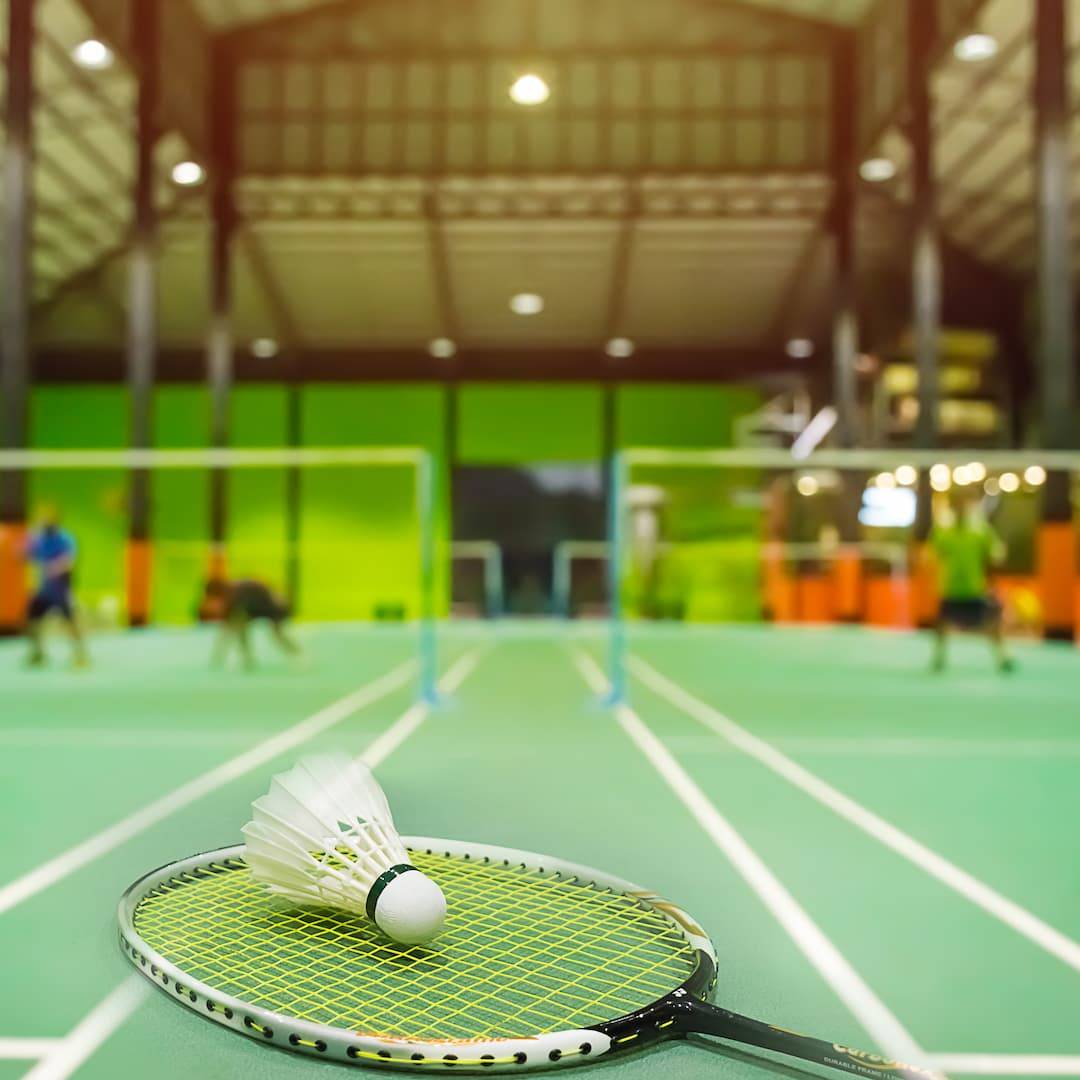
A badminton court is 13.4 metres by 6.1 for doubles, and the number you can fit depends on clear floor area and the run-off needed around and between courts. Ceiling height matters as much as floor space, since a hall that cannot take a full-height clear is not really a badminton hall whatever the markings say.
We set out realistic options for your space, including how the courts sit alongside netball, basketball and five-a-side, and mark net post positions correctly.
Because badminton lines are close together, colour choice does more work here than in any other sport. Sitting them too near the basketball or netball colour makes the tramlines genuinely hard to read at pace.
We choose a colour that separates clearly from everything else on the floor and plan line weights so the court reads instantly. In halls where badminton is the primary sport, the other layouts are worked in behind it rather than the other way round.
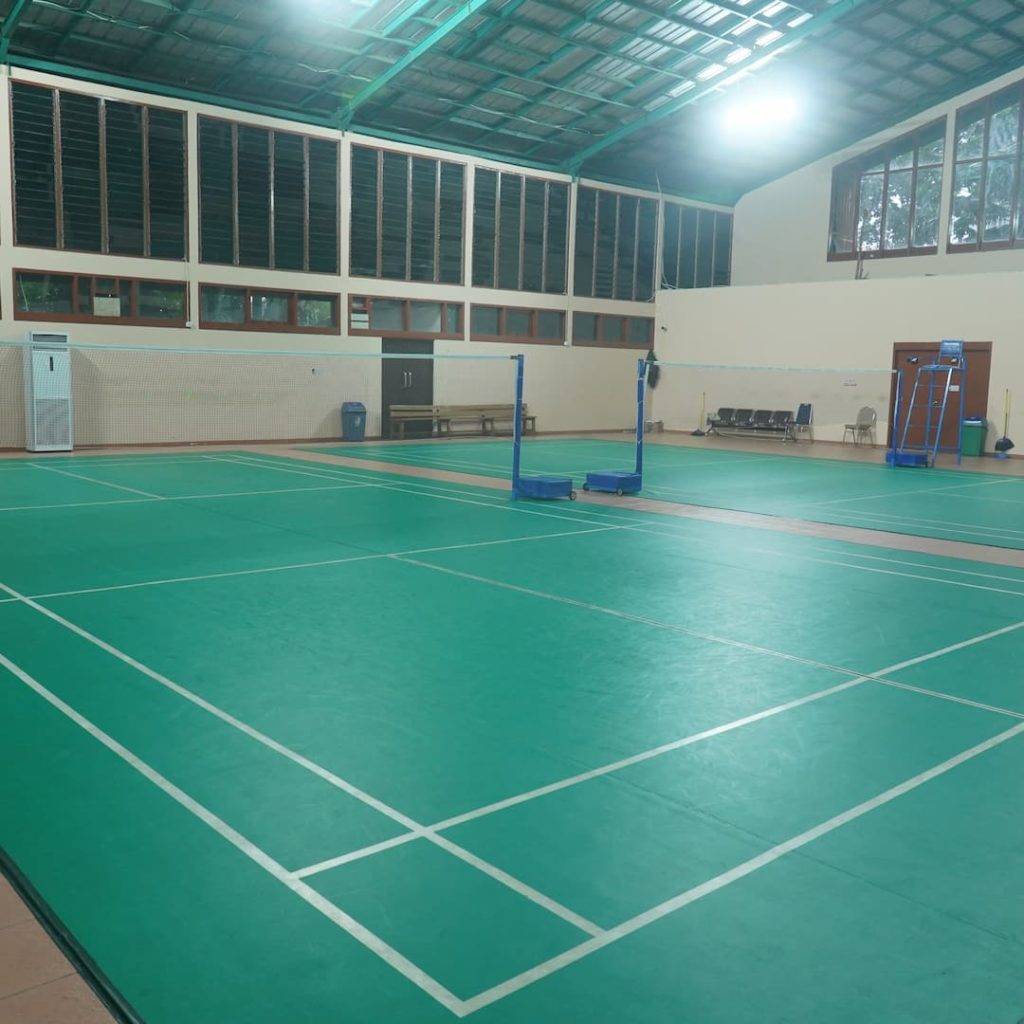
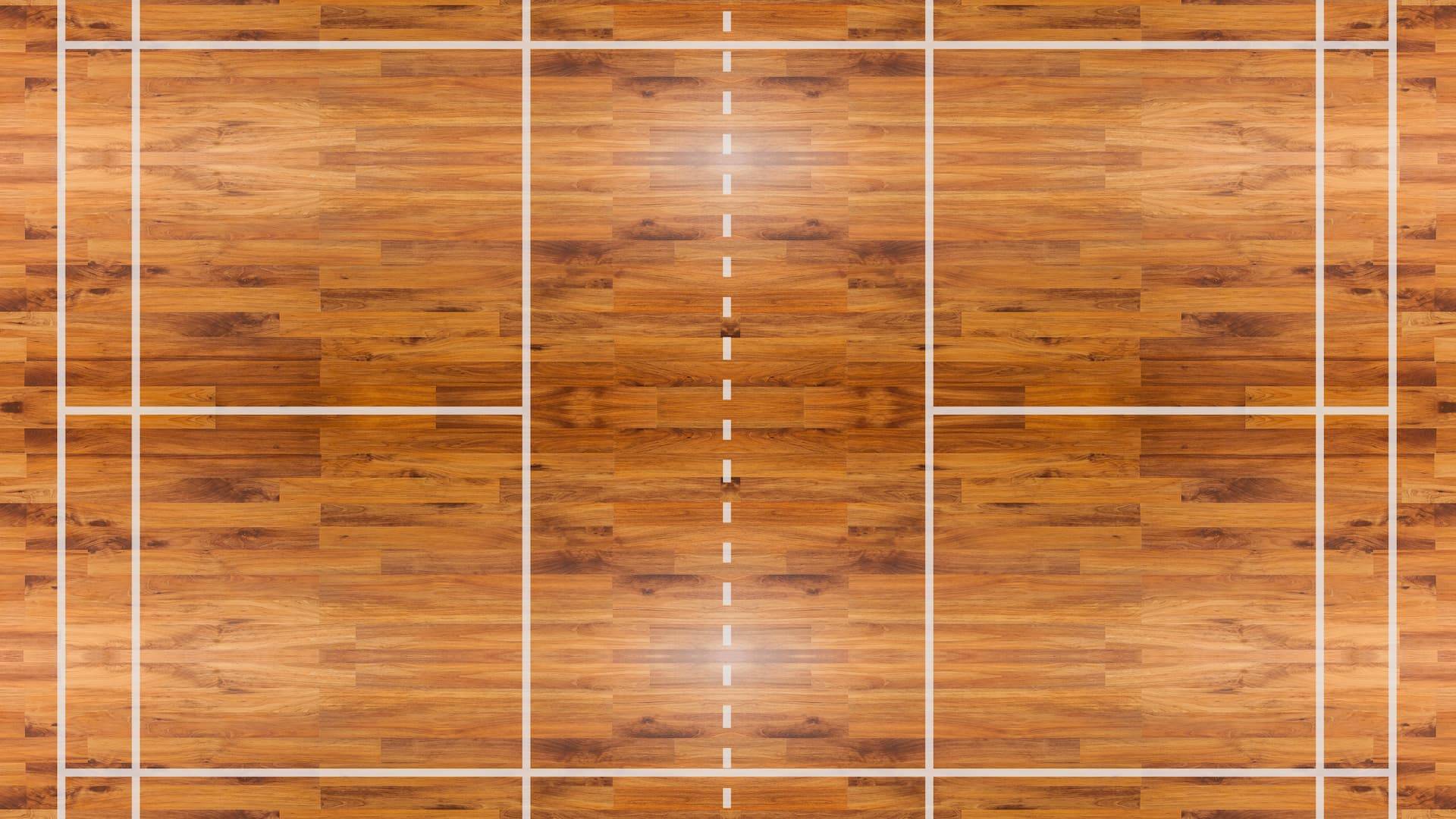
Clubs running leagues need every court on the floor marked identically, which sounds obvious and frequently is not the case where courts have been added or re-marked piecemeal over the years.
We mark the full set in one visit to identical dimensions, and where a hall has accumulated inconsistencies we will point them out at survey rather than reproducing them.
Badminton players lunge, plant and change direction at full stretch more than almost any other indoor sport, which is why they notice a slippery floor before anyone else does. Marking paint that changes the friction underfoot is therefore a real hazard.
Our lines are applied within the seal so friction stays consistent across the playing surface, and we can document the result with a pendulum slip test. If courts feel slippery, the cause is usually cleaning residue rather than the floor, and we will tell you so.
A badminton court is unforgiving about dimensions in a way that most hall sports are not, because the service courts are small and an error of a few centimetres changes where a shuttle lands.
A full court measures 13.4 metres by 6.1 metres for doubles, narrowing to 5.18 metres for singles. The short service line sits 1.98 metres from the net, the long service line for doubles 0.76 metres inside the back boundary, and the net itself stands 1.55 metres at the posts and 1.524 metres at the centre. Those are the numbers we set out from, and we set out from the numbers rather than from the lines already on your floor.
That last point matters more than it sounds. A great many halls carry badminton lines that were laid slightly out decades ago and have been faithfully copied every time the floor has been remarked since. If your courts have always felt cramped at the back, or the tramlines do not quite line up between courts, that is usually why. We measure the room and set out fresh.
Run off is the other consideration. Ideally you want two metres behind each baseline and a clear metre at the sides, and where a hall cannot give that we will lay the courts out to make the best of the space you have.
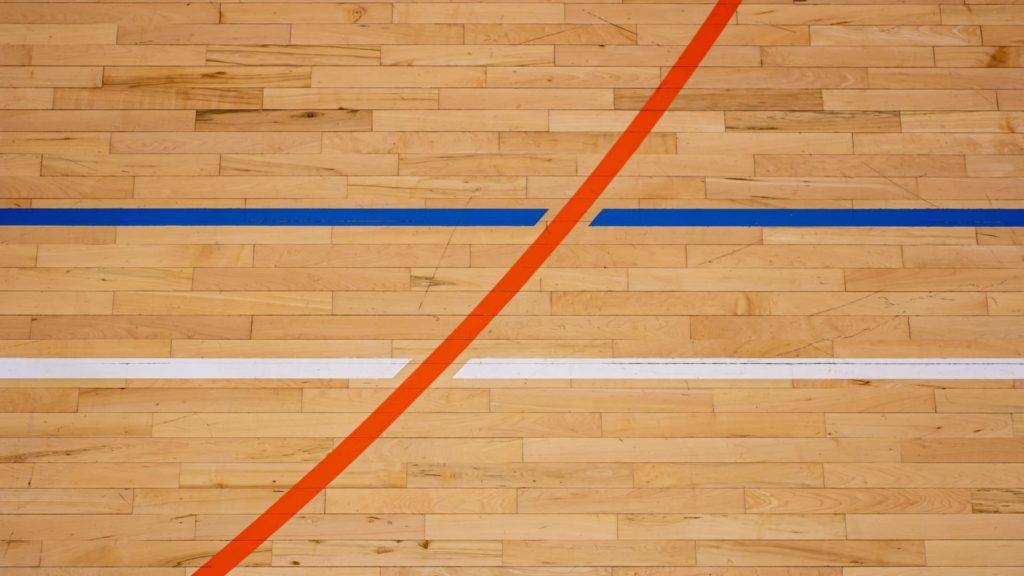
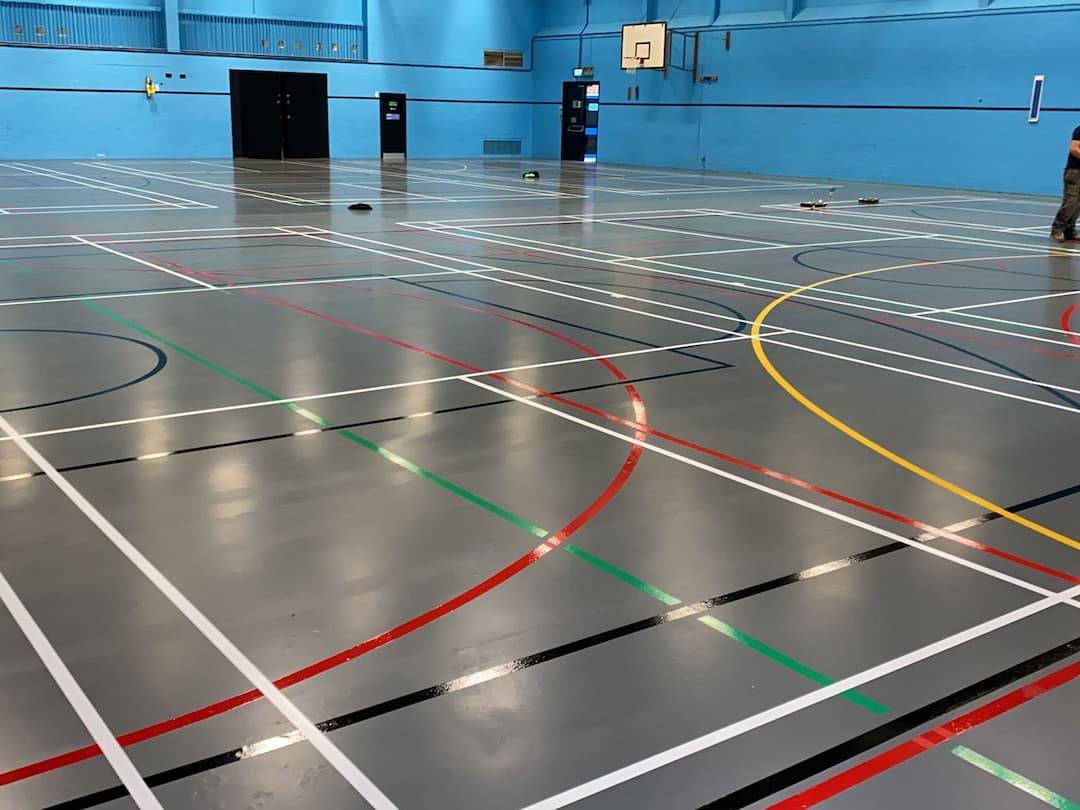
Most sports halls run badminton across several courts at once, and the way those courts are arranged decides whether the hall works or feels permanently congested.
A four court hall is the common arrangement, laid crossways so that all four run parallel with a shared side. The critical dimension is the gap between courts. Too tight and players from adjacent courts collide chasing wide shots. We aim for a clear separation that lets both courts play properly, and where the hall is genuinely too narrow we will tell you that three courts laid out correctly beats four laid out badly.
Colour is the other decision. Badminton is conventionally marked in white or yellow, and in a hall that already carries netball, basketball and five a side markings the colour has to be chosen so that the badminton lines read clearly against everything else on the floor. We keep a scheme that separates the sports rather than adding another set of lines into the same colour family.
Where a hall is used for club or county level play we will set the primary court in a dominant colour and drop the recreational courts back, so the match court reads instantly.
The difference between markings that last a decade and markings that peel in a season is almost entirely about where they sit in the coating system.
On a timber floor we apply the lines between coats of seal, so the paint is locked under the final layer of lacquer rather than sitting exposed on top of it. That is why our markings do not lift under trainers, trolleys or a scrubber drier. Applying lines onto a finished floor is quicker and cheaper, and it is why so many halls need remarking every few years.
The paint itself is a purpose made sports line marking product, compatible with the seal above and below it. Using an ordinary floor paint is the other common shortcut, and it fails because the seal will not key to it properly.
Setting out is done with laser and tape rather than by eye, and every court is checked corner to corner and diagonally before a drop of paint goes down. On vinyl and polyurethane surfaces we use systems matched to that surface instead, since the chemistry is completely different from timber.
Lines go down in a single working day for a typical hall, though the seal either side of them governs how long the room is out of use.
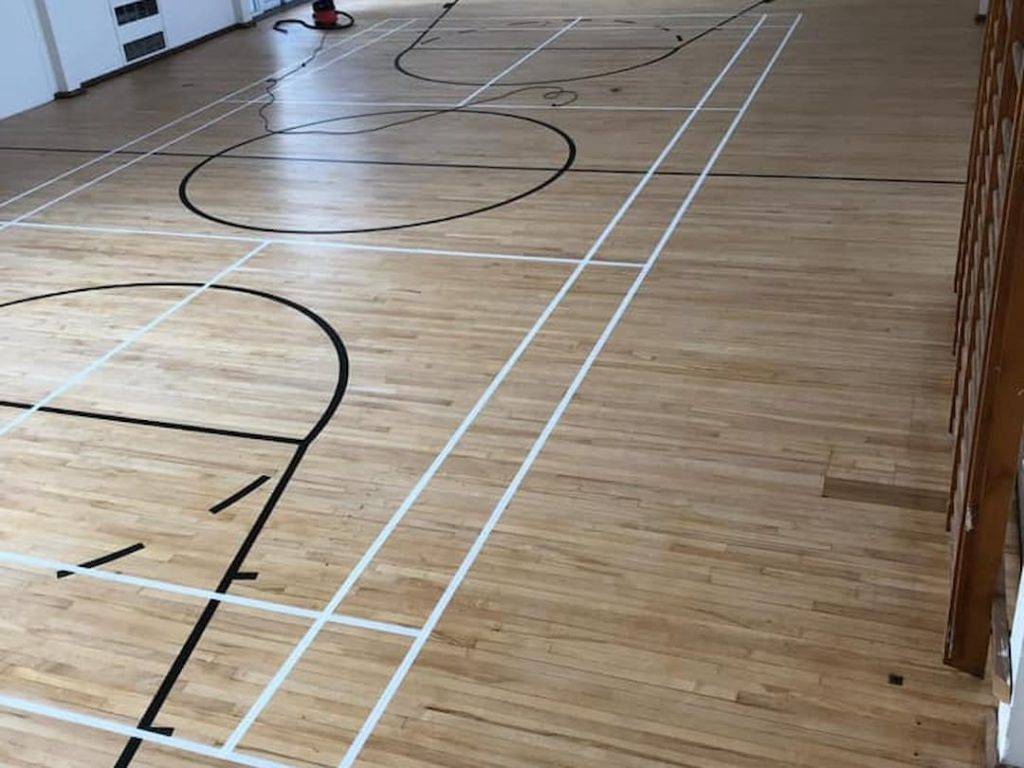
Very few halls we mark are blank. Usually there are already lines for four or five sports and the question is how to add badminton without turning the floor into a maze.
The first thing we do is ask what actually gets played. Halls routinely carry markings for sports that stopped being taught years ago, and removing two redundant sets does more for clarity than any amount of clever colour choice. Redundant lines come off during a sand, or can be over sealed where a full sand is not warranted.
Where lines have to coexist, we work to a hierarchy. The sport played most often gets the clearest colour and the most visual weight, and secondary sports step back. Badminton usually sits high in that order in school and community halls simply because it is played constantly.
If your hall is due a sand and seal anyway, that is by far the best moment to rationalise the markings. The floor goes back to bare timber, everything redundant disappears, and the new scheme goes down under fresh lacquer at no extra visit. Doing it as a standalone job is perfectly possible, it is just a second closure you could have avoided.
Court marking is one of the cheapest interventions available to a facility, and it is often the one that makes the most visible difference for the money.
Price is driven by the number of courts, whether the lines are going down as part of a reseal or as a standalone visit, and how much redundant marking has to be dealt with first. Adding badminton courts during a sand and seal is always the best value, because the setting out and painting happen inside a programme you are already paying for. A standalone remark of a four court hall is a modest job and usually completed inside two days including drying.
On the day, the hall needs to be clear and stay clear. Posts, sockets and equipment come out, and we ask that nobody walks the floor while the paint is curing, which is the single most common cause of a marking job needing touching up.
We will confirm before we start exactly which sports are going down, in which colours and to which governing body dimensions, and we put that in writing so there is no debate afterwards about what was agreed.
Usually a colour clash with the other sports on the floor, or line weights that were never planned as a set. Re-marking with a properly planned hierarchy fixes it without touching the rest of the floor.
Yes. On a sound floor we prepare the marking areas only and apply the new lines, typically in a day or two including curing.
Rarely. It is almost always cleaning residue reducing grip across the whole surface. A professional deep clean usually restores it, and a slip test before and after tells you objectively.
A doubles court is 13.4 metres by 6.1 metres, with the singles sidelines set in to 5.18 metres. The short service line is 1.98 metres from the net and the doubles long service line is 0.76 metres inside the back boundary.
Yes. The setting out is identical but the paint system is different, because vinyl and PU need products formulated to bond to those surfaces. We match the system to the floor rather than using one product everywhere.
Applied between coats of seal on a timber floor, markings routinely last as long as the seal itself, which is typically eight to ten years before a full refinish. Lines applied on top of a finished floor last a fraction of that.
Yes. On timber the reliable method is to sand the floor back, which removes them completely. On vinyl and PU we can overpaint, though the result depends on the condition of the existing surface.
Send us the internal dimensions and we will tell you honestly. As a guide a standard four court hall needs roughly 34 metres by 20 metres to give proper separation and run off between courts.
Yes. We set out to current Badminton England dimensions and check every court before painting. If a hall cannot achieve full run off we will tell you what standard of play it can realistically support.
Tell us your hall size and how many courts you need, and we will advise on layout and price the work. Call 01823 674562.