
A dance floor has one job above all others: protecting the dancer. Every jump and landing sends force through ankles, knees and hips, and a properly built sprung floor absorbs a meaningful share of it. Courtship Flooring installs and maintains dance studio flooring across the UK, from single studios to multi-room performance schools.
We build sprung sub-floors matched to the discipline, whether that is ballet, contemporary, tap or street, and finish with the surface your teachers ask for. Our piece on sprung floor essentials for injury prevention explains what separates a real sprung floor from a bouncy imitation, and our guide to what a sprung floor actually is covers the basics. Existing studio floors can be sanded, resealed and brought back to their best.

Re-lacquering your studio floors is recommended every 18 months, to avoid losing traction ability and to maintain a fresh finish. We also offer sanding, sealing and lacquering services combined to improve the lifespan of your dance floor, allowing you to avoid costly repairs or replacements down the line. Depending on the type of flooring you have, this is usually recommended every 7–12 years. Our expert contractors are also available to provide routine inspections, identifying and rectifying problems before they occur.
Choosing the right floor is crucial to optimising your dance studio. Synthetic flooring is more durable than wooden floors and is lower maintenance. However, traditional wooden floors will often have greater sprung system capabilities and provide a classic aesthetic appeal. Also, with the proper installation and care, they will last several years, providing enhanced performance for your dancers.
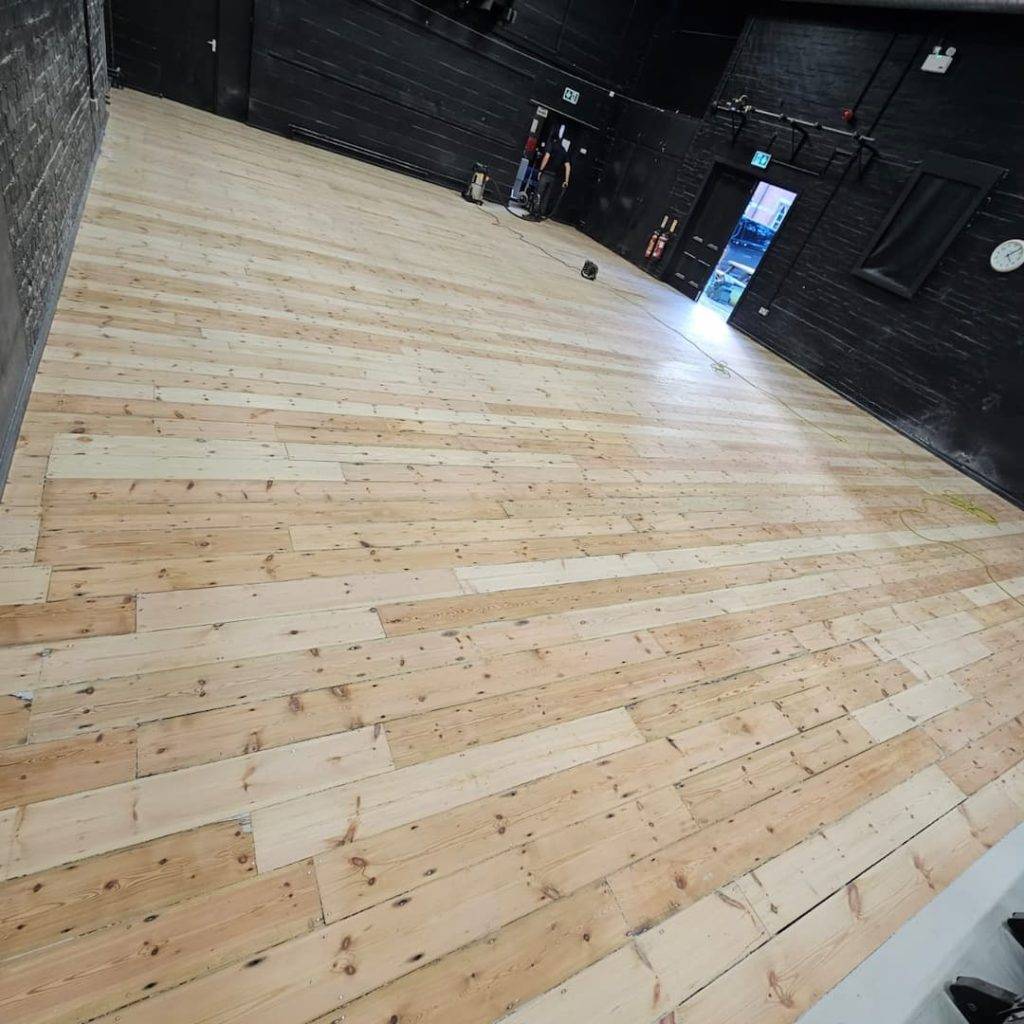
The phrase sprung floor gets used loosely, and a floor that simply feels bouncy is not the same as one engineered to protect a dancer. A proper sprung floor is built over a resilient sub-structure, foam pads, battens or a cradle system, that compresses under impact and recovers, absorbing a meaningful share of the force from every landing before it reaches ankles, knees and hips.
Get it wrong in either direction and you cause problems: too little give and the dancer takes the full impact; too much and it becomes unstable to turn and balance on. Our guide to what a sprung floor actually is covers the principle, and we build systems tuned to the discipline being taught.

The sub-floor protects the dancer; the surface determines how the work feels. Ballet and contemporary generally want a degree of controlled slide for turns and floor work, usually a vinyl performance surface over the sprung build-up. Tap needs a harder, more responsive top layer for sound and articulation. Street and commercial classes are hardest on a floor and want durability above all.
Studios teaching several disciplines in one room need a considered compromise rather than a default, and multi-use halls doing both dance and sport need a specification that genuinely serves both. We will assess your timetable and recommend accordingly, and refurbish or reseal existing studio floors that have gone dull or lost their consistency.
In terms of performance, both options are perfectly suited. As long as there is a sprung subsystem, they will provide excellent dance spaces. Ultimately, the choice you make comes down to the space itself, and your preference.
Depending on the size of the space and the materials you have chosen, the time it takes to install your new floor will vary. Please get in touch for a more detailed breakdown of how long these aspects may take.
Of course, we offer comprehensive inspection and maintenance services for all floors. We will methodically check your floor for any faults and rectifying them as they appear, improving your floor’s lifespan.
In most cases, yes. The main constraint is build height, since a sprung system adds depth and has to work with existing door thresholds and access. We measure that at survey and, where height is tight, specify a lower-profile system that still delivers genuine shock absorption.
Regular cleaning with the right product for the surface, prompt attention to any lifting seams, and periodic resealing or refinishing depending on the top layer. We provide a routine for your own team and can carry out the periodic work as part of a maintenance plan.
See sprung floor installation and restoration and acoustic flooring where a studio sits above teaching or office space.