
Flooring Professionals To The Leisure Industry
Courtship Flooring is a commercial sports flooring contractor working in Bath and across the UK. A good deal of our work involves older buildings where the existing timber is better than anything that would replace it, and the job is to prove that rather than assume it.
We have been specialising in indoor sports and commercial timber floors since 1987. The business is family-run, nothing is subcontracted, and the crew who survey a building are the crew who work on it. Domestic and residential projects fall outside what we do and are looked after by our sister company, Ryan’s Restorations.
In Bath, as elsewhere, a sports hall floor refurbishment is often the most cost-effective option: a full sand, reseal and reline that brings an existing floor back for a fraction of the cost of replacement.
Overnight/Weekend Installations
Professional Cleaning Demonstrations
Squash Court Maintenance
Recommended Cleaning Products
Professional Pendulum Slip Testing
Deep Clean & Reseal Service
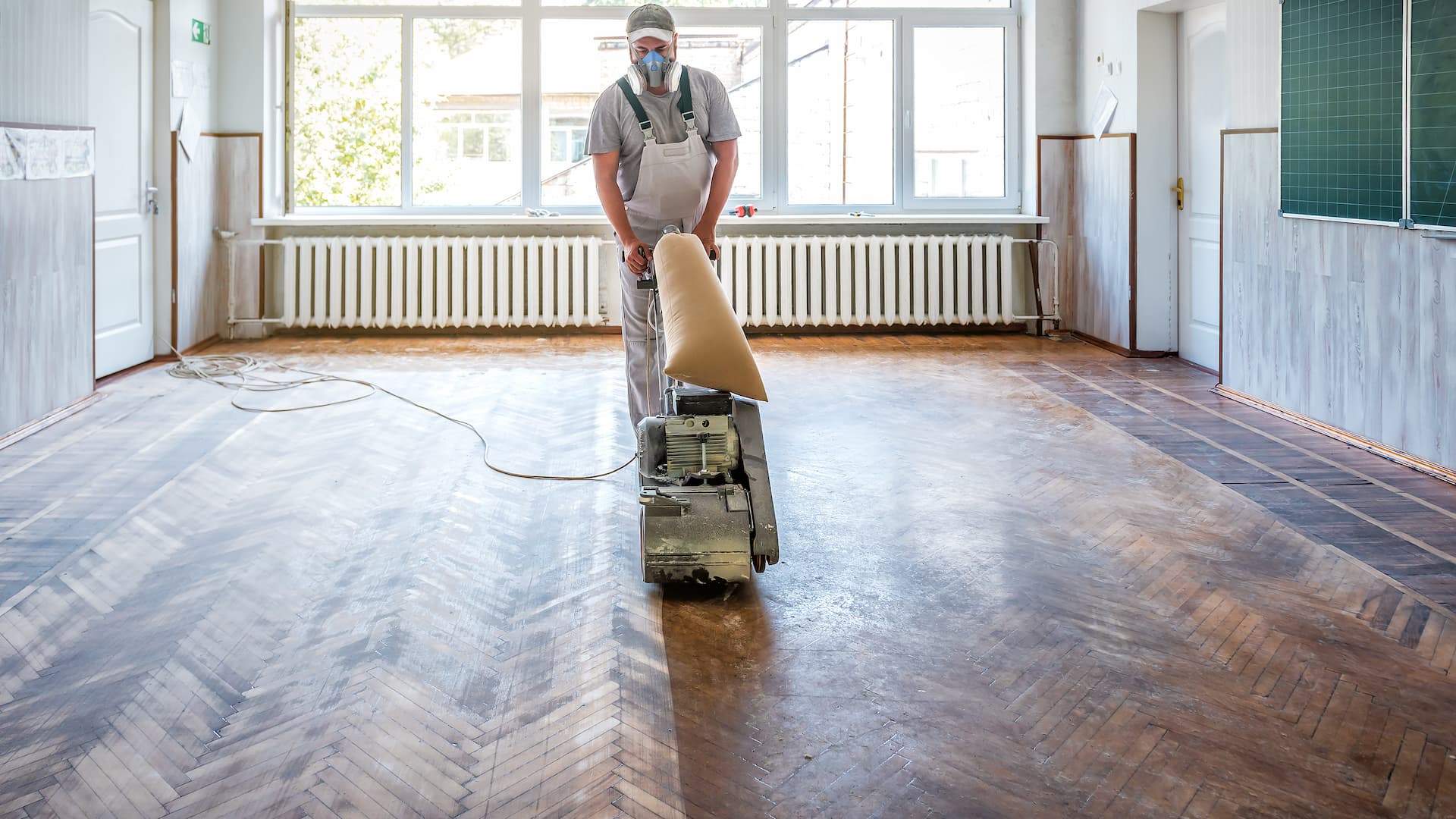
Committees and estates teams are frequently told a floor needs replacing when it does not. The honest test is measurable: how much board remains above the tongue, whether the fixings and sub-floor are sound, and what the moisture readings show.
Where there is depth left and the structure is stable, restoration wins on cost, disruption and material waste every time. Where it cannot be saved we say so and show you the readings, rather than either overselling a refurbishment or defaulting to replacement.
Older floors were frequently laid in timber of a quality that would be prohibitively expensive today, and stripping one out to fit a modern equivalent is often a downgrade dressed up as an upgrade.
We sand progressively rather than heavily, match replacement boards by species and grade, and choose a finish suited to both the building and its use. The result keeps the character and the material while making the surface safe and serviceable again.
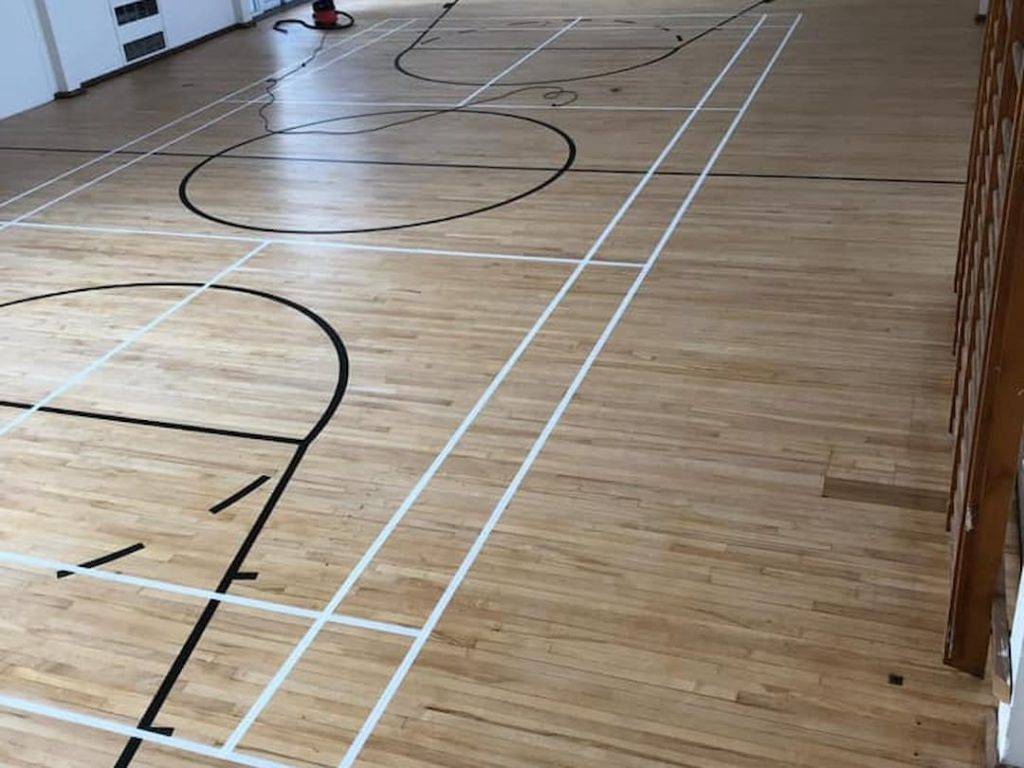

Older buildings are rarely empty and frequently have neighbours, events and services to work around. Our machinery runs with dust extraction throughout and we plan the noisier stages sensibly, so the rest of the building continues to function.
Programmes are agreed in writing with a fixed handover date, and we phase work where a space cannot close completely.
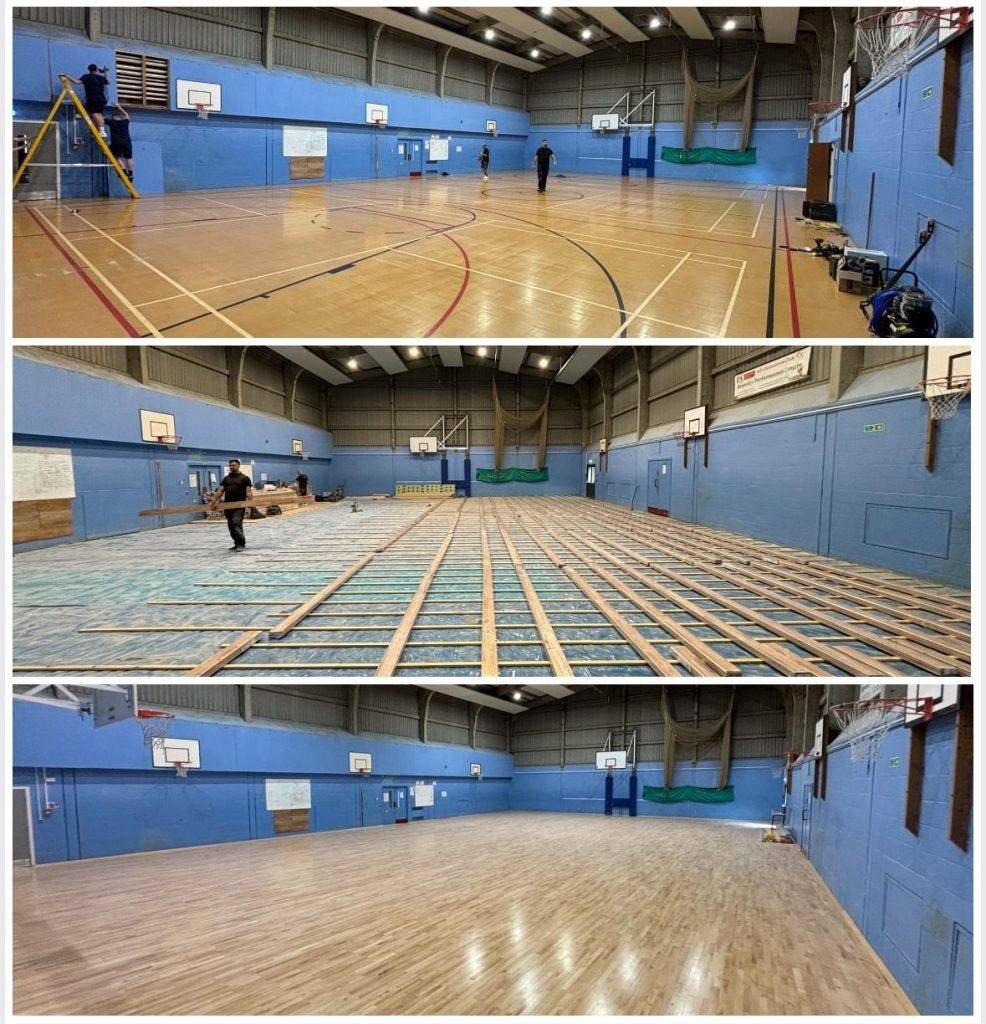
Harris Academy wanted a sports floor to match its ambitions, so we fitted a complete Junckers solid-beech sports system, the same Danish flooring specified in elite competition venues, finished with full multi-sport line markings.
An installation like that is a long-term statement: properly maintained, it will outlast every pupil currently on the roll. The project ran to programme from bare sub-floor to handover.
~ Matthew Evans
An outstanding company to deal with and they couldn’t have been better to work with. St George’s Ascot now has a stunning new sports hall floor and we are delighted. From quote, support, delivery and after sales, the Team has been brilliant. Thank you. 
~ James Anderson







Facilities managers are usually asked to obtain three quotations, and comparing them fairly is harder than it looks because contractors describe the same work in very different ways.
The first thing to check is whether each price is for the same scope. A quotation for a full sand and one for a screen and recoat are not comparable, and the cheaper is not necessarily worse: it may simply be the right answer. Ask each contractor which they are pricing and why.
The second is what happens to repairs. A price that excludes board replacement will rise once the old finish comes off and the damage becomes visible. A price that includes a stated allowance will not.
The third is the finish itself. Two pack polyurethane and single pack lacquer are not the same product and will not last the same time, so ask what is being applied and how many coats.
The fourth is markings. Setting out from measured governing body dimensions costs more than tracing the existing lines, and produces a correct court rather than perpetuating an old error.

Bath has a strong racquets tradition, and many of the independent schools and members clubs we visit have a block of squash courts sitting beside the main hall, usually in worse shape than the hall because they are out of sight.
A squash court floor wears in a band across the T, where every rally begins and ends, and the boards there polish smooth while the front and back walls stay untouched. The World Squash specification asks for a light coloured, matt, high grip surface, so the finish is nothing like a sports hall seal. Sand too fine and the timber itself becomes glassy before any coat goes on.
We take each court to the correct openness, apply a matt high grip system and reinstate the red 50 millimetre lines between coats. Because every court is its own room, a club can keep the others in play while we work through the block.
An independent school hall in Bath earns its keep well beyond PE. It sits exam desks in May and June, hosts speech day, takes a Christmas fair and is let to outside groups at weekends, and every one of those uses puts furniture and outdoor shoes on a surface finished for trainers.
The damage is quiet and cumulative. Desk feet without pads score the seal, grit walked in from the car park grinds through it, and gaffer tape used to hold down cables lifts the lacquer when it comes off. By September the traffic lanes are grey and nobody remembers why.
A protective covering laid before the desks arrive, with joints taped so grit cannot travel underneath, prevents most of it. We advise on which coverings and tapes are safe on a two pack seal, and on desk pads that cost pennies against a sand.

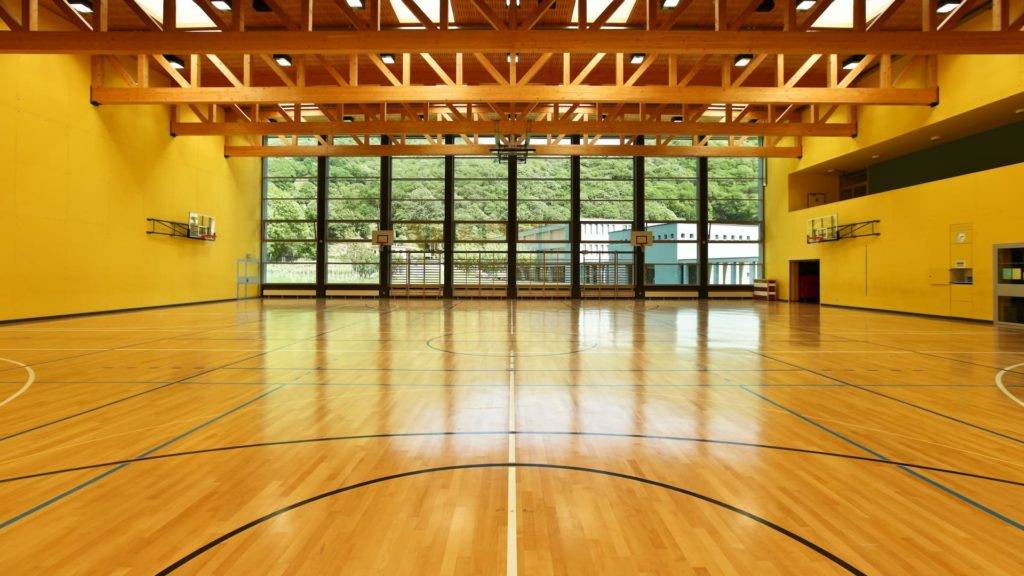
Bath and the surrounding area gives us a particular mix of work, weighted towards independent schools, university facilities and older community buildings.
Independent school sports halls and gymnasia are a significant part of it. These are usually well maintained buildings where the expectation of finish quality is high, and where the hall is in use for curriculum sport, club training and lettings across a long day. The work almost always happens in holidays, and the dates are fixed a long way ahead.
University sport is the second strand, with the same year round pressure on the timetable that every campus has, and the same narrow windows.
The third is the older stock: church halls, village halls and school assembly halls with timber floors that are often eighty or a hundred years old. Those floors are frequently in far better condition than people assume, and restoring rather than replacing them is usually both cheaper and better.
Across all three the common theme is that a proper survey changes the recommendation. We have talked more than one client out of a replacement they had already budgeted for.
The enquiries that reach us from Bath tend to fall into a few recognisable categories, and it is often useful to see whether yours is among them.
The most frequent is an independent school hall where the finish has become patchy rather than uniformly worn, usually because the traffic lanes have gone through while the corners are untouched. That pattern responds well to a full sand rather than a recoat, because a recoat over an uneven base stays uneven.
The second is old timber in listed and period buildings, of which the city has a great many. Those floors need a light touch and a realistic conversation about what will and will not come out, because a century of use leaves marks that no machine removes entirely.
The third is halls that have been polished for decades. That build up has to come off chemically before sanding, or it clogs every abrasive we put on the floor, and it is the most common reason a quotation from elsewhere turns out to have missed something.
We survey free of charge and tell you which of these you have before anything is committed.
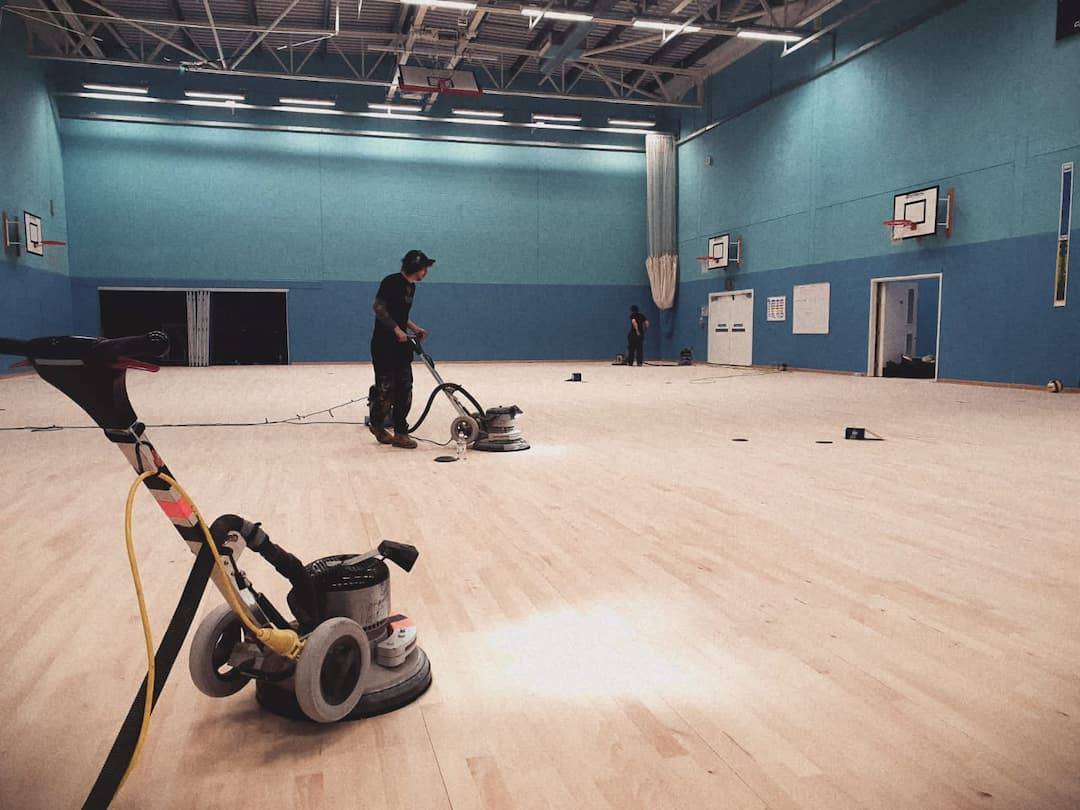
When a pupil or a member slips, the first question from the insurer is whether the floor was tested. A pendulum test to BS 7976 gives an objective friction value, repeated at several points and in several directions, and we issue a certificate that records where and when each reading was taken.
Old timber halls in the Bath area are often the ones that get asked about, because a century of polish and a worn seal both push readings down. The test tells you which. A floor that fails on polish build up needs a deep clean, not a refinish, and a floor that fails on seal wear needs a recoat, not a replacement.
We test after every refinish so the handover file shows the floor met the standard on the day, and we test independently for facilities that want a number before deciding what to do.
It depends less on the size of the hall than on what the floor needs. A recoat of a sound seal costs a fraction of a full sand with repairs, and both cost a fraction of replacement. We survey without charge and give a fixed, itemised price for each realistic route.
Yes. Bath sits close to our base, so surveys are quick and follow up visits are no trouble, and we cover the wider area from Bristol across to Wiltshire in the same way. Travel is included in the price rather than added on later.
We stop, show you and price the options in writing before going further. Because the survey looks under the floor as well as at it, surprises are rare, but if one appears nothing is sealed over and no extra work is done without your written agreement.
Yes. We run a short demonstration with your caretaker or cleaning contractor at handover, showing the product, the dilution and the method, and leave a written sheet. Most of the care a floor receives is between our visits, so getting that routine right matters more than anything we do.
Yes. We check the slab for level and moisture, install a damp proof membrane where the readings call for it, and specify the sprung system against the sports played and the height available. New installations are planned to the holiday window like any other job.
No. Our work is limited to commercial and institutional buildings, and the machinery, finishes and insurance are set up for that scale. Domestic timber floors, including period houses in the city, are handled by our sister company Ryan’s Restorations, who can be contacted directly.
Often, yes. Where the seal is sound we screen the surface, set out the courts fresh from governing body dimensions, paint the lines and apply a new top coat over them. The old lines remain faintly beneath, so where they are badly wrong a full sand is the cleaner answer.
Heating dries the air, the timber gives up moisture and shrinks, and the gaps appear. They close again as humidity returns in spring. It is normal seasonal movement, not a fault, though keeping the hall within a steadier humidity range reduces how far it goes.
Book a free survey of your floor in Bath and we will tell you plainly whether it can be saved, what the work will cost and when we can do it. Call 01823 674562 or send us a message.