
Flooring Professionals To The Leisure Industry
Courtship Flooring is a commercial sports flooring contractor working in Bedfordshire and across the UK. We work across the county on school, community and leisure facilities, frequently on halls serving several purposes.
Our clients are schools, academy trusts, universities, leisure operators, councils and clubs, and have been since 1987. We cover the full lifecycle of a floor with our own team rather than a chain of subcontractors. Private homes are outside our scope and are served by Ryan’s Restorations.
Clients in Bedfordshire get the specification, workmanship and aftercare that have underpinned our sports hall flooring work since 1987.
Overnight/Weekend Installations
Professional Cleaning Demonstrations
Squash Court Maintenance
Recommended Cleaning Products
Professional Pendulum Slip Testing
Deep Clean & Reseal Service
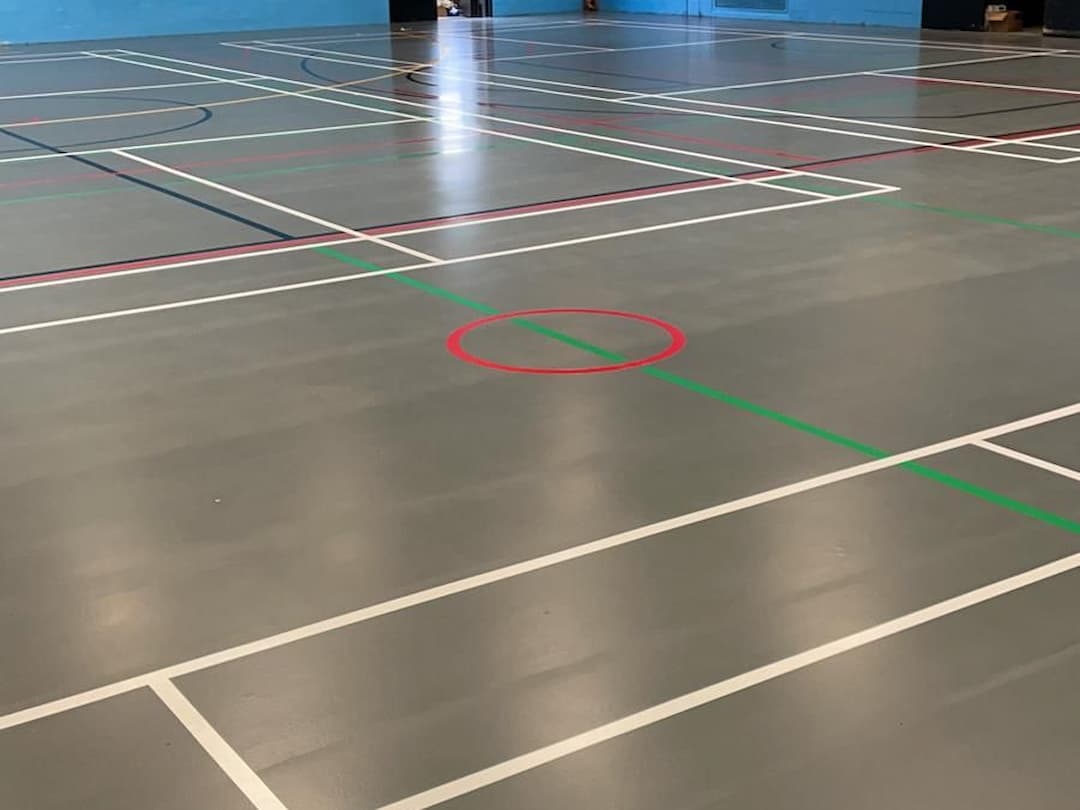
Court marking paint is a technical product, not decorating paint. It has to bond to a sealed sports surface, survive constant foot traffic, resist cleaning chemicals, and crucially maintain the same friction as the floor around it.
A line with different grip from the surrounding surface is a hazard precisely where players plant and turn. We use specialist proprietary systems applied between coats of seal, so markings sit within the finish rather than on top of it.
Marking one sport is straightforward. Marking five so each remains legible at speed is a design exercise. The method is hierarchy: establish which sport leads, mark it so it reads instantly, then work the others in behind using colour and line weight.
Sports sharing similar court runs are deliberately separated by colour, and where a hall hosts competitive fixtures the relevant court is marked to the current governing body specification rather than an older one.
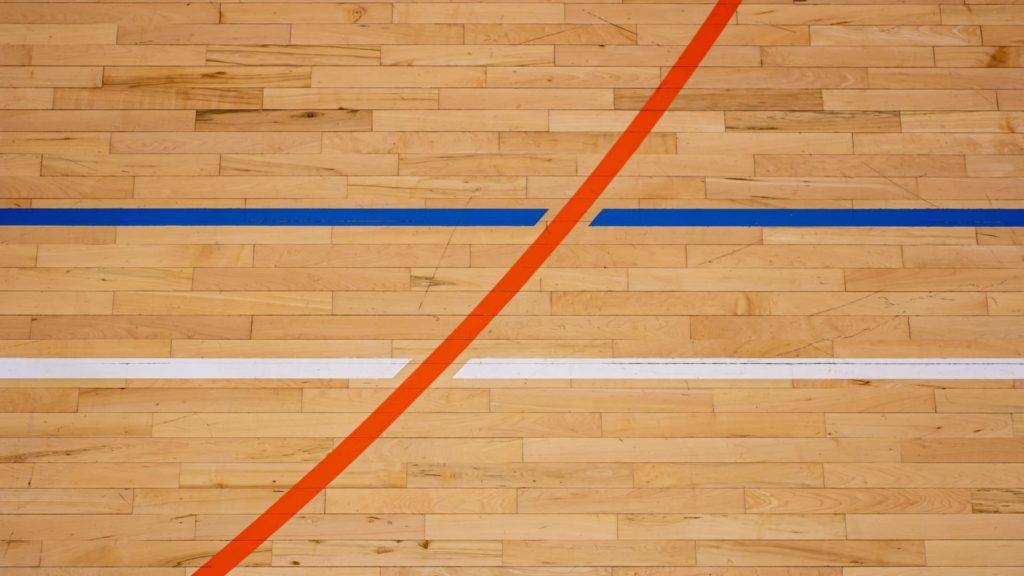
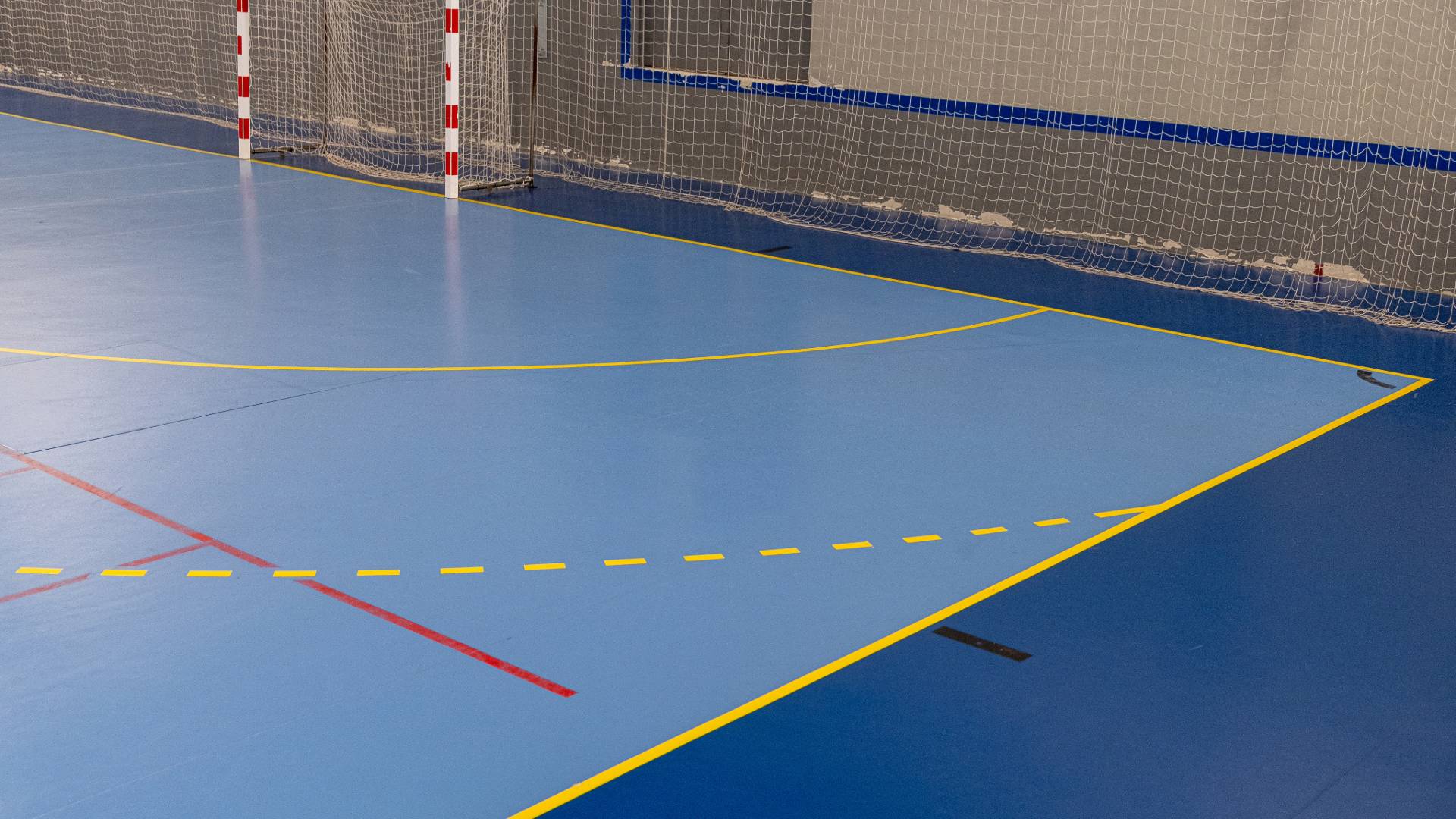
Timetables change, and new sports arrive. Adding a court to an existing floor is usually straightforward, provided the layout has room and the colour palette has not already been exhausted.
Removing old lines completely is harder: on timber it requires sanding, on synthetic surfaces it is more limited. We will explain what can be achieved without a full refurbishment and plan the new layout to work with what is already there.
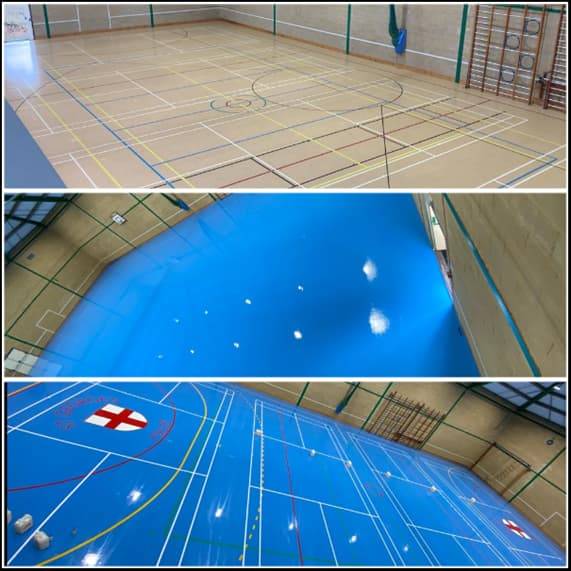
The sports hall at St George’s had a Granwood block floor that decades of use had left dull and tired. Granwood cannot be sanded like timber, so we restored it correctly: careful preparation, a modified epoxy coating system and crisp new markings.
The school kept a serviceable floor out of a skip and spent a fraction of what replacement would have cost.
~ Matthew Evans
An outstanding company to deal with and they couldn’t have been better to work with. St George’s Ascot now has a stunning new sports hall floor and we are delighted. From quote, support, delivery and after sales, the Team has been brilliant. Thank you. 
~ James Anderson







Netball and basketball are the two courts that most often turn out to be wrong when we measure a hall, because both were laid decades ago and copied at every remark since. A netball court is 30.5 by 15.25 metres with three equal thirds and a 4.9 metre shooting circle.
A basketball court is 28 by 15 metres with a three point arc at 6.75 metres, and that arc is the line most often found short or out of true. In a hall too small for the full court we scale from the basket end so the key and the arc stay correct.
We set out with laser and tape from the governing body figures, check the diagonals, and only then paint. Bedfordshire schools that play fixtures against other schools have every reason to want the court their opponents will recognise.
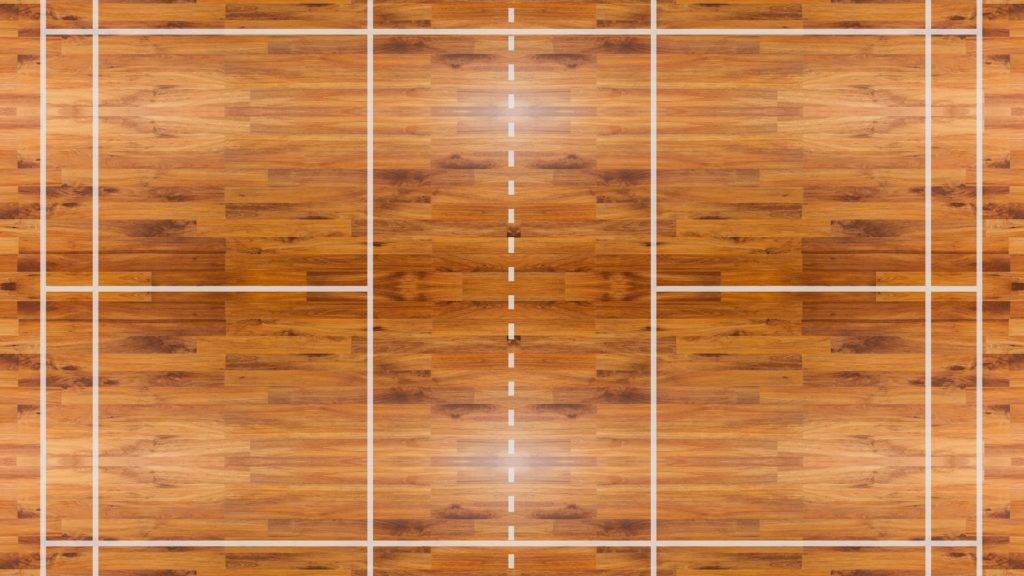
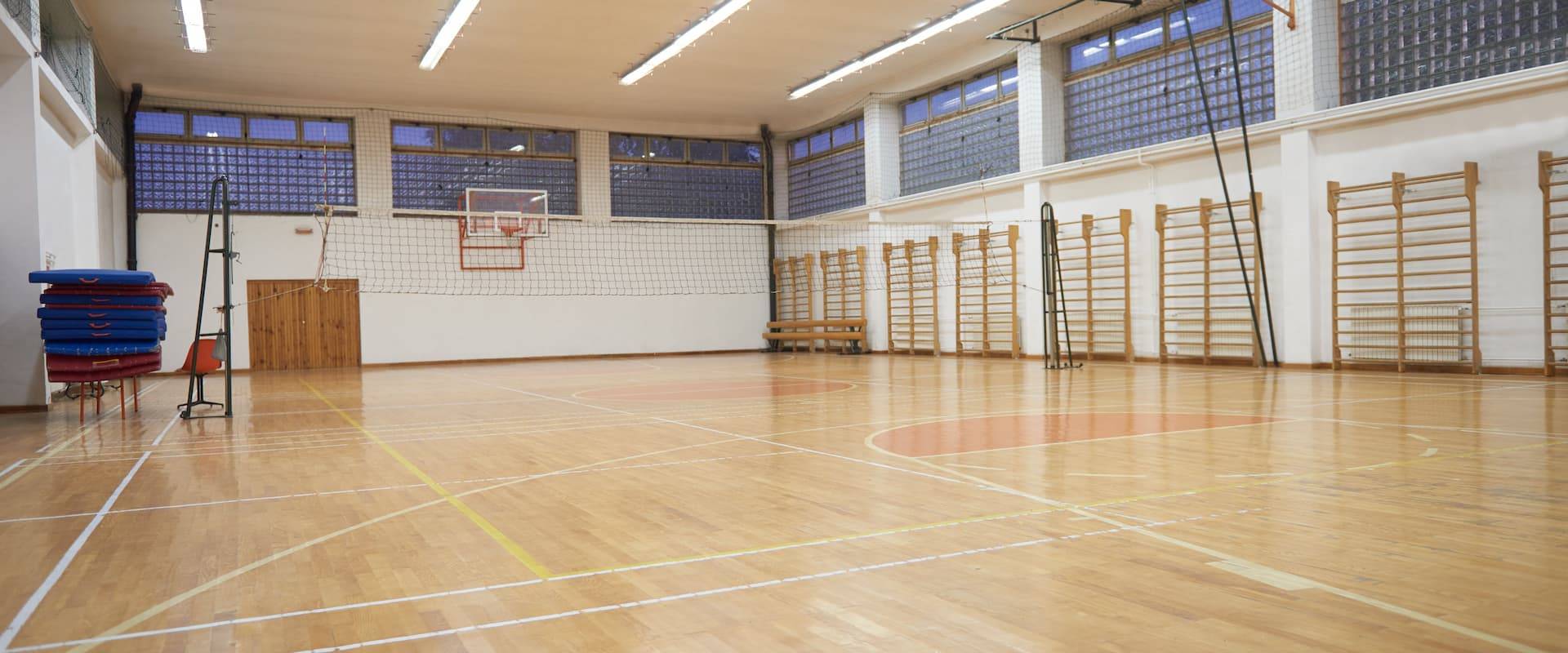
Five a side is one of the most heavily played indoor sports in the country and one of the least carefully marked, largely because it is usually added to a hall as an afterthought.
The pitch itself is simple: a rectangle with a halfway line, centre circle and two penalty areas. What causes trouble is that the markings run across the full hall and therefore cross every other sport already on the floor. A five a side line laid in a colour close to the badminton or netball markings turns a busy hall into a puzzle.
We treat it as part of the marking hierarchy rather than an addition. If five a side is played constantly, it deserves a clear colour and proper visual weight. If it is occasional, it should sit back so the sports played more often read first.
The other frequent request is rebound boards or wall padding interfacing with the floor, and those fixings need setting flush and making good properly rather than being sealed around.
A screen and recoat is a light abrasion of the existing seal followed by a fresh top coat of two pack polyurethane. It takes days, not weeks, restores grip and appearance, and removes no timber. It is the right answer whenever the seal is worn but still intact.
Done every two to three years it pushes the full sand out to roughly every ten, and every full sand you avoid is timber kept in the floor for the future. A hall that skips the recoats and goes back to bare board every few years runs out of wear layer early.
For a leisure centre or a school with a busy lettings programme it is also the easier job to fit in, because a half term or a long weekend is enough. Across Bedfordshire most of the halls we recoat are on a cycle we agreed with the site some years ago.
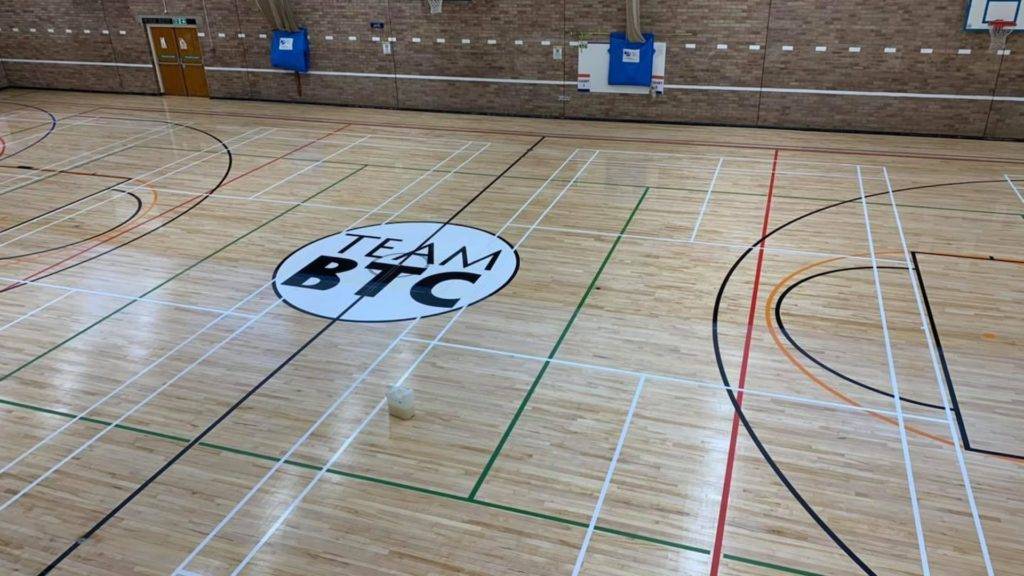
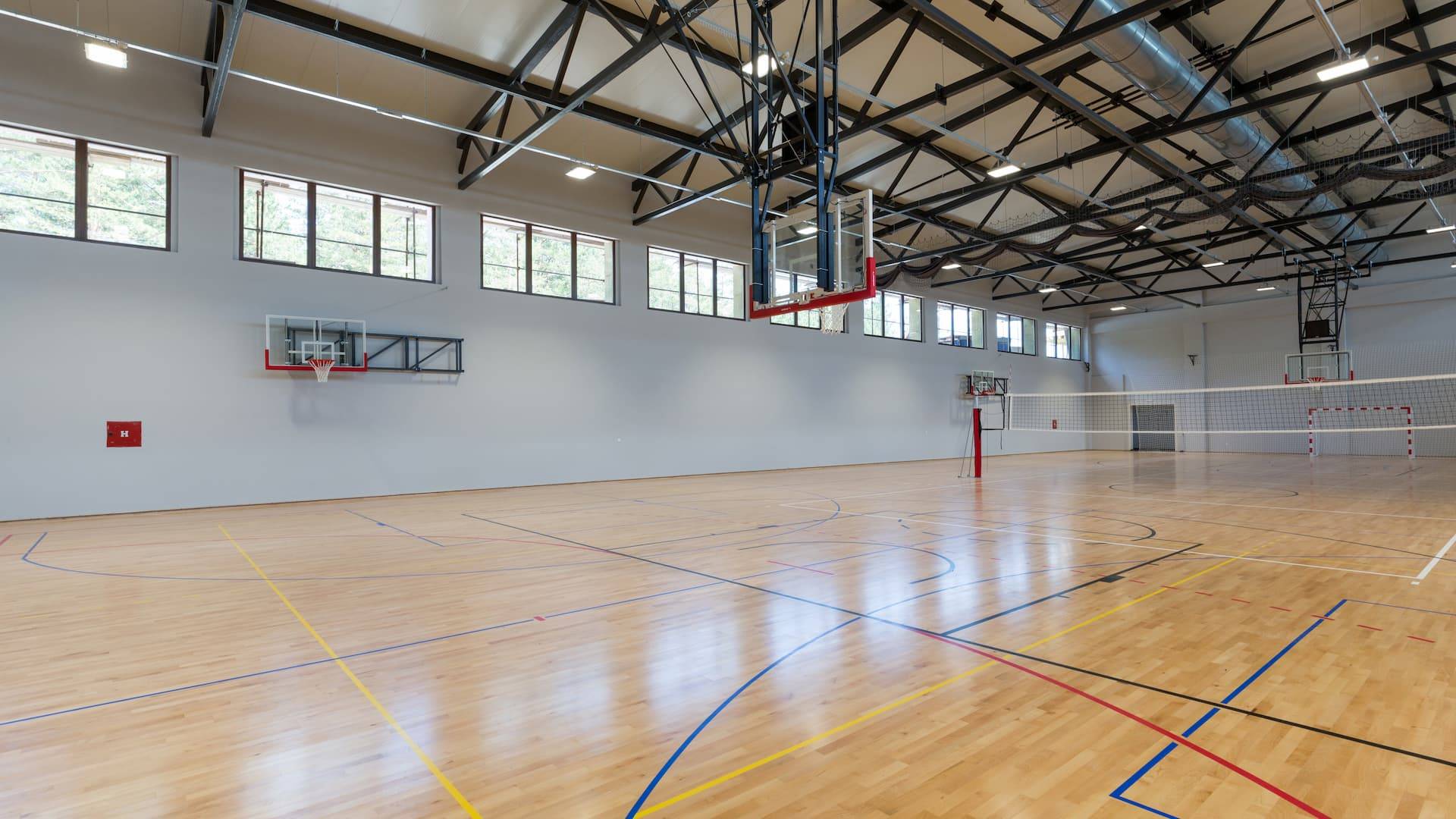
Volleyball and indoor cricket both turn up regularly in school and leisure halls, and both have marking requirements that are routinely got wrong.
A volleyball court is eighteen metres by nine, with an attack line three metres from the centre on each side. The detail most often missed is that the court needs proper free zone around it, and in a hall that is already tight the sensible answer is often to mark one court properly rather than two badly.
Volleyball also relies on floor sockets for the net posts, and those have to finish flush and stay watertight. During a refinish we lift the covers, clean out the accumulated debris and reset them to the new floor level rather than sealing over them and leaving a raised ring.
Indoor cricket is marked less consistently, and it is worth agreeing exactly what is required before setting out, because club and school formats differ. Ball rebound off the surface matters here more than in most hall sports, which makes the condition of the floor as relevant as the lines on it.
Most of what we are asked to do in Bedfordshire comes from school and academy trust estates, with leisure operators and community halls making up the rest.
Trust work is the pattern we see most. A trust holding eight or fifteen schools has that many sports halls, usually built decades apart and in wildly differing condition, and almost never a single record of what state they are in. That is exactly the situation where a condition survey across the estate pays for itself, because it turns an unpredictable cost into a phased programme.
Individual school halls come to us for the usual reasons: a finish that has worn through in the traffic lanes, markings nobody can read, or a hall that has become slippery and is now an insurance concern rather than an inconvenience.
Leisure centre work is generally about keeping the doors open, which means overnight and weekend working rather than a fortnight closed.
Community and village halls are the fourth group, and those tend to be committee decisions with money that has been raised rather than budgeted. We quote those by element so they can be phased if the funds require it.
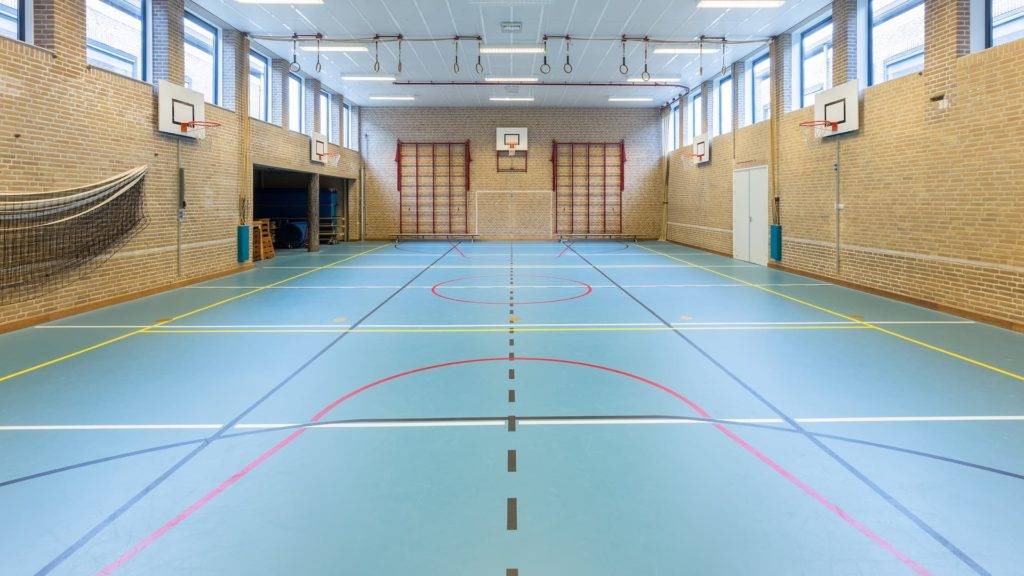
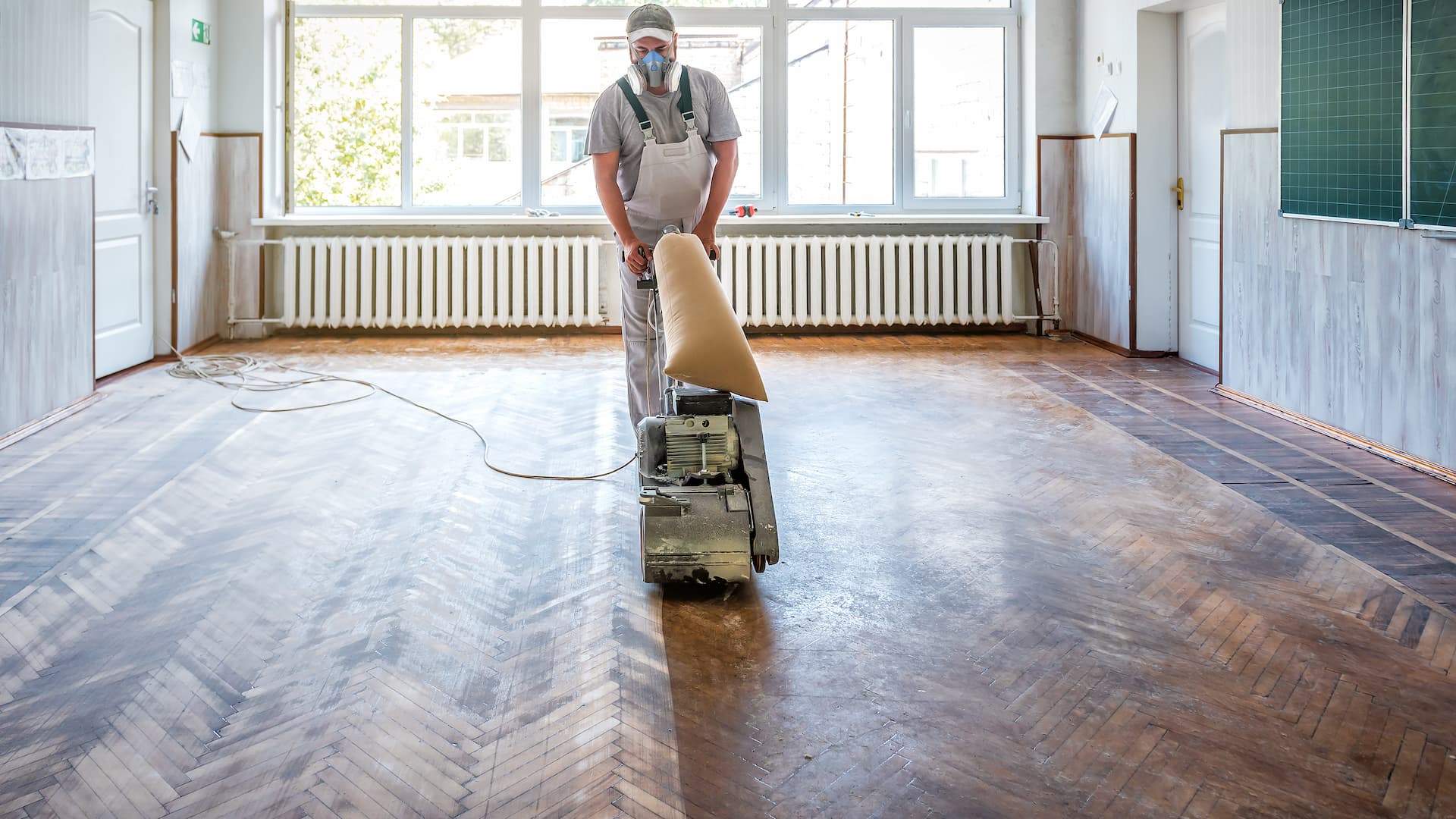
Most Bedfordshire enquiries arrive as a symptom rather than a specification, and there are three that come up repeatedly.
The first is a hall that has become slippery. In almost every case the cause is either polish build up from the wrong cleaning product or a seal worn smooth in the busiest routes. Both are fixable, and both are worth dealing with before an incident rather than after, because it becomes an insurance question very quickly.
The second is markings that no longer make sense. Halls in the county frequently carry lines for four or five sports, several of which are no longer taught, laid down in colours that merge under the LED lighting most schools have since fitted. Rationalising those is cheap and transforms how a hall reads.
The third is trust estates discovering that several halls need work in the same year. That is the situation a phased programme exists to prevent, and it starts with surveying all of them rather than the one that shouted loudest.
Around twenty four hours before anyone walks on the final coat and seventy two hours or more before equipment goes back and sport resumes. Winter conditions extend both. We build these times into the programme, confirm them in writing and lock the room where the site allows it.
No. Every machine, including the edge sander, runs on sealed extraction and the hall is screened off with doorways taped. We agree ventilation isolation with your site team beforehand, because shared air handling is where dust escapes, and we vacuum down at the end of every shift.
Yes. We seal at the end of the night shift so the floor is walkable by opening and bring the noisy sanding forward to the quietest hours. It costs a little more in labour and saves far more in lost bookings. Access and alarm arrangements are agreed in writing first.
Always. Moisture readings are taken in the boards and the slab at several points, because a seal applied over a damp floor fails no matter how well it is put on. If readings are high we trace the cause and price the remedy before any finish is quoted.
Usually. Granwood is a composite block of wood flour and cement in a bitumen bed, and it is destroyed by timber sanding methods. Restored correctly, with loose blocks rebedded and a modified epoxy coating, it lasts many more years at a fraction of replacement. Older bitumen beds are tested for asbestos first.
Yes, with a pendulum tester to BS 7976-2, wet and dry, at several points across the hall including the busiest lanes. You receive a dated certificate for the facilities file, which is the evidence an insurer or a governor will ask for after a fall.
None. The team that surveys your hall carries out the preparation, repairs, sealing, marking and testing with our own machinery, and comes back for the maintenance. That is why we can commit to a finish date and why one warranty covers the whole floor.
Photographs of the whole hall and close ups of anything worrying you, the approximate size or the number of badminton courts, the age of the floor if known, and the dates the room could be closed. From that we can give a budget steer before the free survey.
Book a free survey of your hall in Bedfordshire. We measure the courts, check the seal and the structure, and give you a fixed price broken down by element so a trust or committee can plan around it. Call 01823 674562 or send us a message.