
Flooring Professionals To The Leisure Industry
Courtship Flooring is a commercial sports flooring contractor working in Belfast and across the UK. Projects here are planned as complete programmes, fully surveyed, agreed and priced before we travel.
We are specialists rather than generalists, which after nearly forty years means a depth of knowledge on sports and commercial timber floors that a general contractor cannot match. Every stage is completed in-house. We do not quote for domestic work; Ryan’s Restorations handles that side.
If you are comparing contractors, our sports hall flooring overview explains how we approach installation, refurbishment and aftercare in Belfast and nationwide.
Overnight/Weekend Installations
Professional Cleaning Demonstrations
Squash Court Maintenance
Recommended Cleaning Products
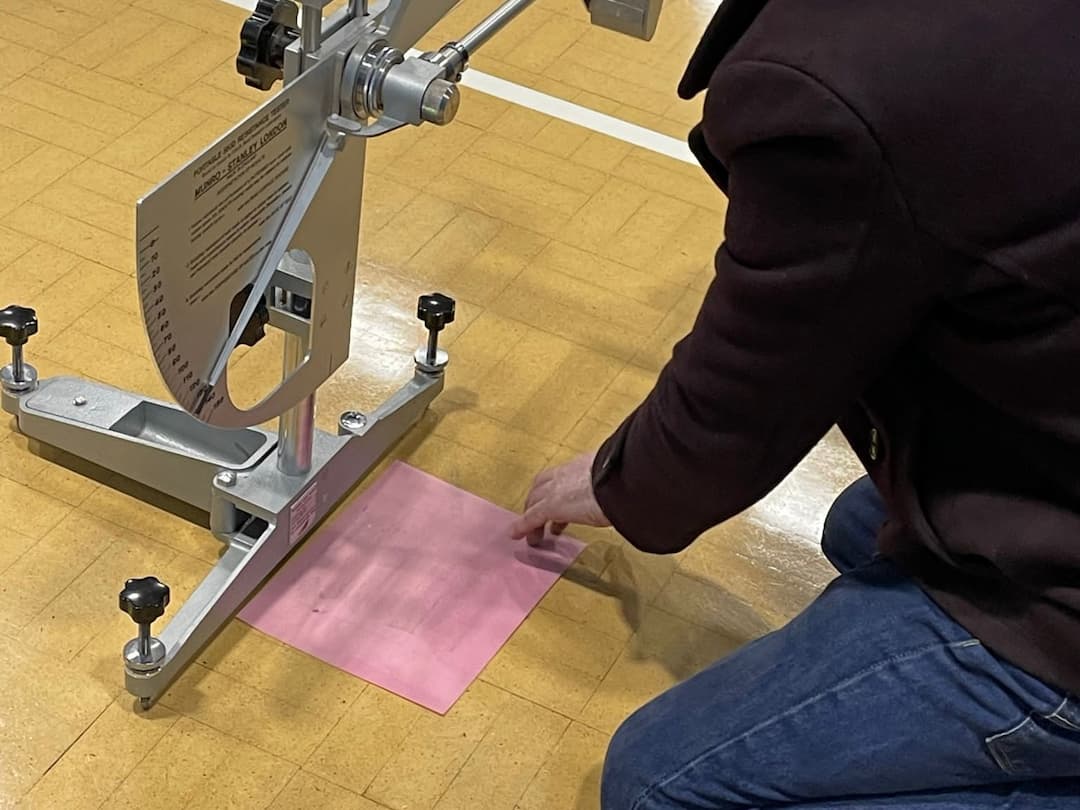
Professional Pendulum Slip Testing
Deep Clean & Reseal Service

Work involving a sea crossing is a planning exercise. Machinery, materials and crew travel together, contingency stock is included, and the programme is organised as a continuous block rather than a series of visits.
Travel and mobilisation are stated openly in the quotation rather than added afterwards, and the work is completed in one window so nothing waits on a return trip.
Because a second visit is expensive, everything happens together: survey findings acted upon, repairs completed, sanding, sealing, marking and any testing, with the handover date agreed before we set off.
It concentrates disruption into one period rather than spreading it across months, which most facilities prefer regardless of the logistics.

We would rather have an honest conversation early than travel to a project that was never a good fit. Some work is better served by a contractor already established locally, and we will say so.
Where the work suits our specialism, timber restoration, sports hall refurbishment, court marking and specialist coatings, distance is a logistics question we have answered for nearly four decades.
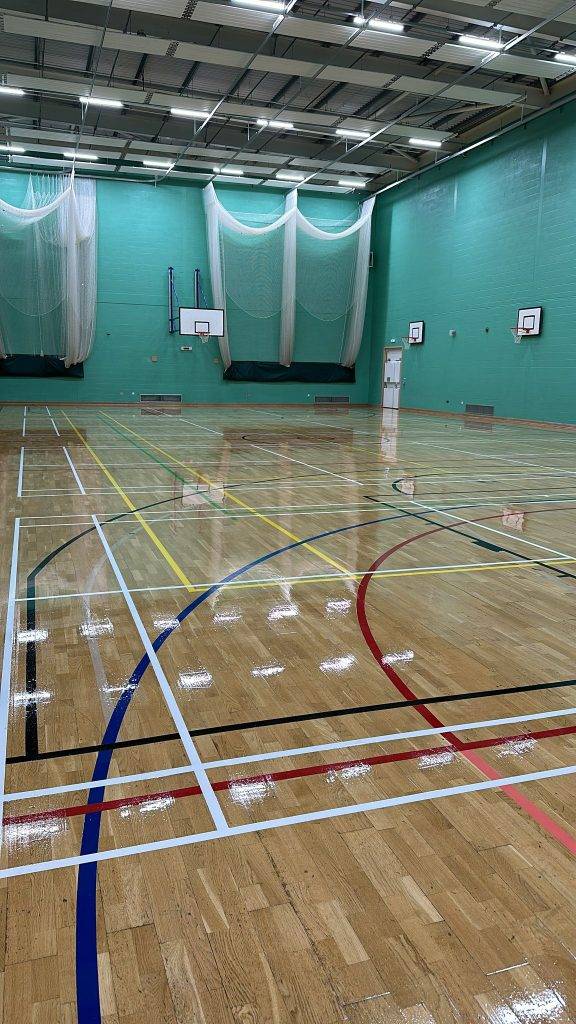
The sports hall floor at De Wint School had reached the end of its seal: grey through the middle, markings closer to guesswork than instruction, and a surface that felt slippery however often it was cleaned.
We sanded it back to clean timber, repaired what needed repairing, resealed and re-marked. The hall reopened with a deep, glossy finish that reads as newly installed, delivered inside a planned holiday window.
~ Matthew Evans
An outstanding company to deal with and they couldn’t have been better to work with. St George’s Ascot now has a stunning new sports hall floor and we are delighted. From quote, support, delivery and after sales, the Team has been brilliant. Thank you. 
~ James Anderson







The finish we leave behind will last as long as the cleaning allows it to. Most floors that come back to us early have been polished, flooded or scrubbed with the wrong product, none of which is use.
The regime is short. Dust mop or vacuum every day the hall is used. Damp mop with a neutral pH cleaner, well diluted, when it needs it. A scrubber drier is fine on low water with a soft pad. No polish, no wax, no silicone sprays and no steam.
We walk the cleaning team through it at handover and leave a written sheet, because on a Belfast site we cannot call in a week later to check. Follow it and the recoat interval stretches, the grip stays even and the floor looks cared for between our visits.

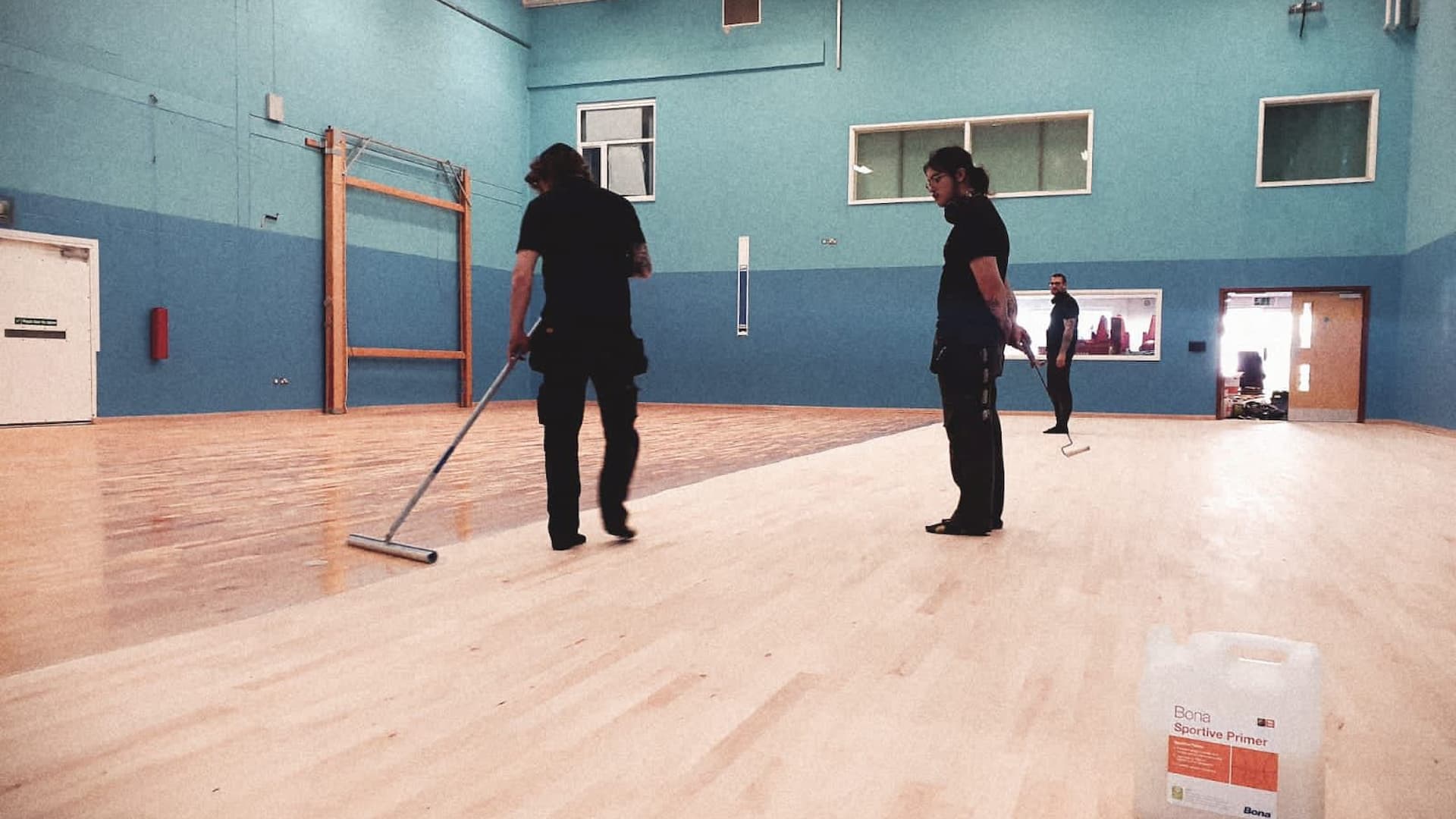
Every coat needs time before it takes traffic, and on a project that involves a sea crossing the cure sits inside a programme with no slack. We build it in from the start so the final coat goes down with the days it needs before the hall reopens.
Light foot traffic is possible around twenty four hours after the final coat. Equipment, posts and full sport wait seventy two hours or longer, and a cold or humid hall extends both. We put the exact times for the system used in writing at handover.
The room is signed and, where possible, locked for that period, because footprints in a curing seal do not polish out and a Belfast hall opened a day early is a hall that needs a return visit nobody wants to pay for.
University sport in Belfast does not stop for the summer. Conferences, sports camps and external hire fill the weeks between terms, so the window for floor work is narrow and set months ahead. We plan campus projects to that calendar and staff them to finish inside it.
Campus halls are also among the busiest floors we see, with intramural sport, club training and performance programmes on the same surface, which shortens the recoat cycle. A screen and recoat in the quietest fortnight every two to three years keeps them off the full refinish list.
Where a campus has more than one hall, or a hall alongside dance and fitness spaces, we sequence them in a single visit so the crossing and mobilisation are paid for once and every space reopens on the same agreed date.

Belfast has a damp climate and a good share of older buildings, and moisture is the fault that ends more sports floors than wear ever does. It comes up through slabs without a membrane, in through walls below ground level and out of unheated halls when the heating goes on.
We take readings in the timber and the slab at survey with meters and, where needed, hygrometer boxes left in place. The numbers decide whether the floor is ready to seal, whether a surface damp proof membrane is needed under a new floor and whether a building defect has to be fixed first.
Sealing over a damp floor gives a finish that clouds, peels and blackens within a season. Finding the moisture first costs a little time and saves the whole job.
Work in Belfast comes to us mainly from schools, university sport and the leisure estate, and the practical difference from a mainland job is the planning rather than the work itself.
Because a crossing is involved, we programme these projects as continuous blocks rather than a series of short visits. Machinery, abrasives and coatings all travel with the team, and we carry more spare than we would on a job an hour from base, because a missing item cannot be collected in the afternoon. In practice that makes the job tighter rather than looser, since everything has to be thought through in advance.
School sports halls make up the largest share, and the constraint is the same everywhere: the hall must be back for the first day of term. University and further education facilities follow, with the narrow year round windows that campus sport always has.
Leisure centres are the third group, and there the priority is keeping the building trading, which usually means overnight working.
If you have more than one floor, or you know of another facility considering work, it is worth mentioning it. Sequencing two or three projects into one trip brings the cost down for all of them.
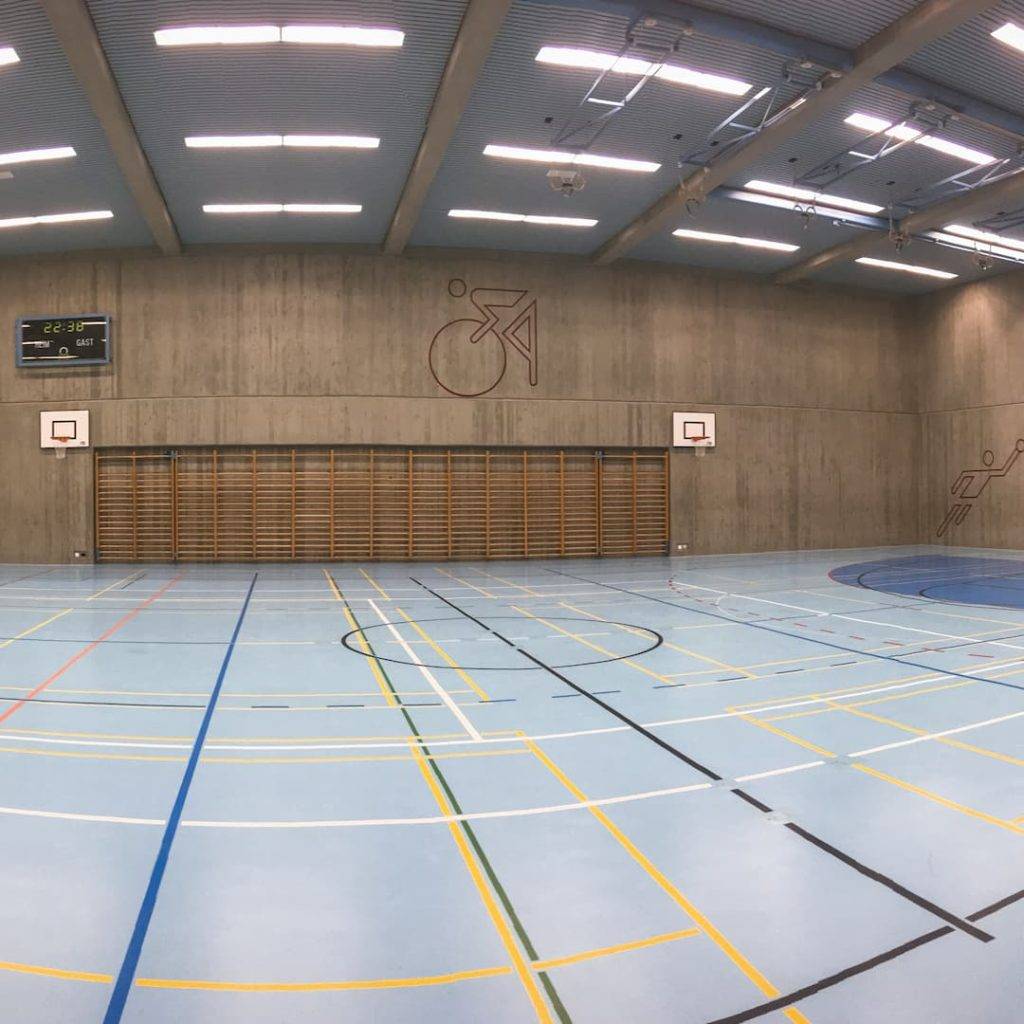
The enquiries we get from Belfast tend to cluster around a few recurring problems, and knowing which one you have shapes the answer considerably.
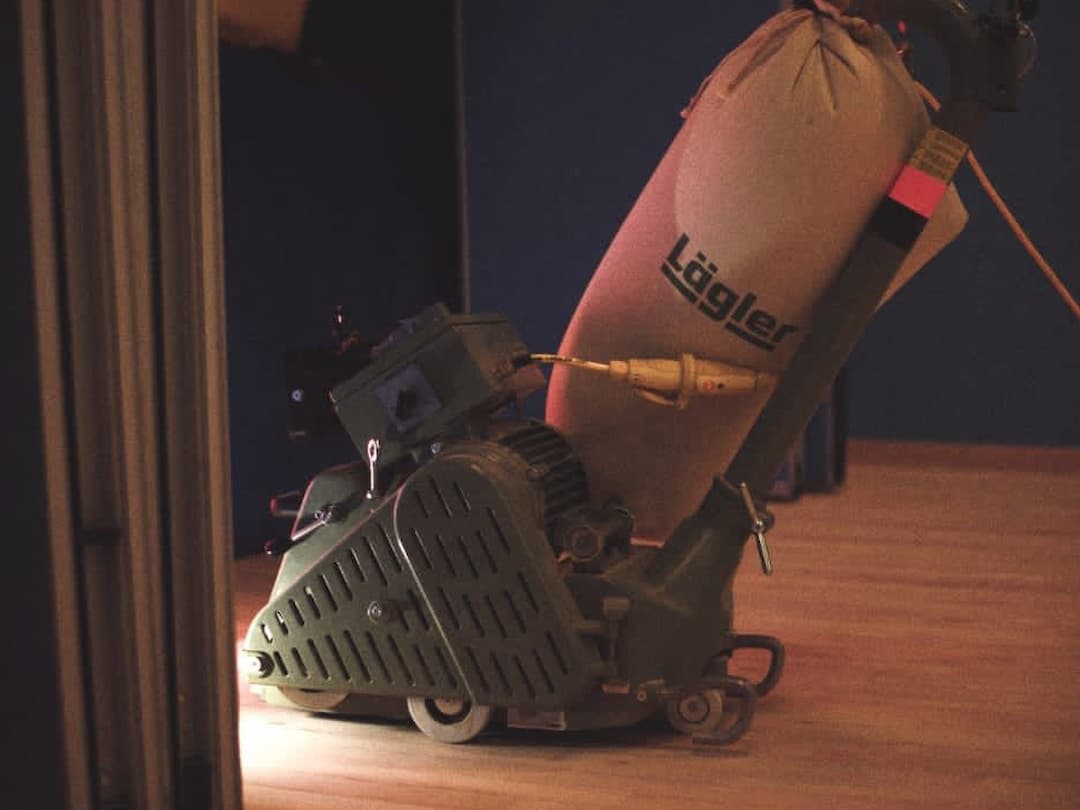
Worn traffic lanes are the most common. The lacquer has gone through where players actually run, dirt is now sitting in open timber, and mopping spreads it rather than lifting it. Caught early that is a straightforward refinish. Left too long, the staining goes deep enough that sanding will not fully remove it.
The second is dead spots and movement, which point to the structure rather than the surface. A failed pad or cracked batten needs the boards lifting locally, and no amount of sanding will change how that part of the floor feels.
The third is halls where somebody has applied coat after coat over the years without ever taking the floor back. Those build ups eventually go cloudy and peel in sheets, and the only real answer is to strip it properly and start again.
We will tell you which of these you are dealing with at survey.
A refinish is the moment to give a hall an identity, because the setting out and masking are being done anyway. A crest at centre court, a filled key in the school colour or a coloured perimeter zone changes how the room reads for a modest addition to the price.
The artwork is scaled from your own files, painted between coats of seal so the finish protects it and matched to your brand colours under the hall lights. Anything applied on top of a finished floor scuffs and lifts within a season.
For Belfast schools and clubs we send a scaled layout for approval before any paint goes down, so the size, position and colours are agreed while changes still cost nothing. Most schools use the moment to retire an old badge and set the current one in the floor.
Yes. We install area elastic timber systems on battens and pads or cradles, and point elastic vinyl and polyurethane systems, to BS EN 14904. On a Belfast project the sub floor is surveyed first so the build height, levels and moisture are known before the system is chosen.
Usually within a few weeks, and we combine the visit with other work in Northern Ireland where we can. If you send dimensions and photographs first we can give an indicative figure straight away, so the survey confirms detail instead of starting from nothing.
Yes. Lifting, segregating and disposing of the old surface and its fixings is included in the quotation, with waste transfer documentation supplied. Where an old bitumen bed may contain asbestos we arrange testing and licensed removal before our own work begins.
Yes. The composite blocks are cleaned back mechanically, loose ones are re bedded and a specialist coating restores colour, grip and markings. Sanding is not an option on Granwood, so the coating system is what does the work. We check the bitumen for asbestos first.
No. We only work for organisations: schools, universities, leisure operators, clubs and councils. Private homes are looked after by our sister company, Ryan’s Restorations, and we can pass an enquiry across if that is what you need.
Yes. We regularly deliver the sports floor package within a larger build or refurbishment, working to the main contractor programme, attending site meetings and providing the paperwork the contract needs. The sub floor handover and moisture condition are agreed in writing beforehand.
Because the boards give up moisture when the heating runs and shrink slightly. Small, even gaps that close again in spring are normal for timber. Wide or uneven gaps point to a floor laid too wet, a humidity swing that is too large or a heating system run too hard.
Public and employer liability certificates, a site specific method statement and risk assessment, COSHH data for the coatings and DBS certificates for the team. We issue the pack with the order so your file is complete before we travel.
Book a free survey of your sports hall in Belfast and we will set out what the floor needs, the fixed cost including travel and the dates we can hold. Call 01823 674562 or send us a message.