
Flooring Professionals To The Leisure Industry
Courtship Flooring is a commercial sports flooring contractor working in Birmingham and across the UK. A large share of our work here is for multi-academy trusts and university estates, where several halls are assessed, specified and programmed together rather than one at a time.
Our clients are schools, academy trusts, universities, leisure operators, councils and clubs, and have been since 1987. We cover the full lifecycle of a floor with our own team rather than a chain of subcontractors. Private homes are outside our scope and are served by Ryan’s Restorations.
Clients in Birmingham get the specification, workmanship and aftercare that have underpinned our sports hall flooring work since 1987.
Overnight/Weekend Installations
Professional Cleaning Demonstrations
Squash Court Maintenance
Recommended Cleaning Products
Professional Pendulum Slip Testing
Deep Clean & Reseal Service

Trusts rarely have one floor to worry about. They have several, in wildly different condition, and pricing them individually produces inconsistent specifications, inconsistent quality and a budget nobody can plan against.
We survey the estate as a single exercise, produce one specification and one packaged price, then work through the sites in a single programme. Each hall receives the same standard and its own documented handover, and the trust receives one set of paperwork rather than eight.
Sports floor performance is measurable, not a matter of opinion. BS EN 14904 sets out how shock absorption, vertical deformation, ball bounce and friction are tested, and a properly specified floor is built to hit those figures rather than to look right.
Ball rebound should reach at least ninety per cent of the bounce achieved on solid concrete, consistently across the whole playing area. Inconsistency usually indicates a failure in the build-up beneath rather than the surface above, which is why we test across the floor rather than in one convenient corner.
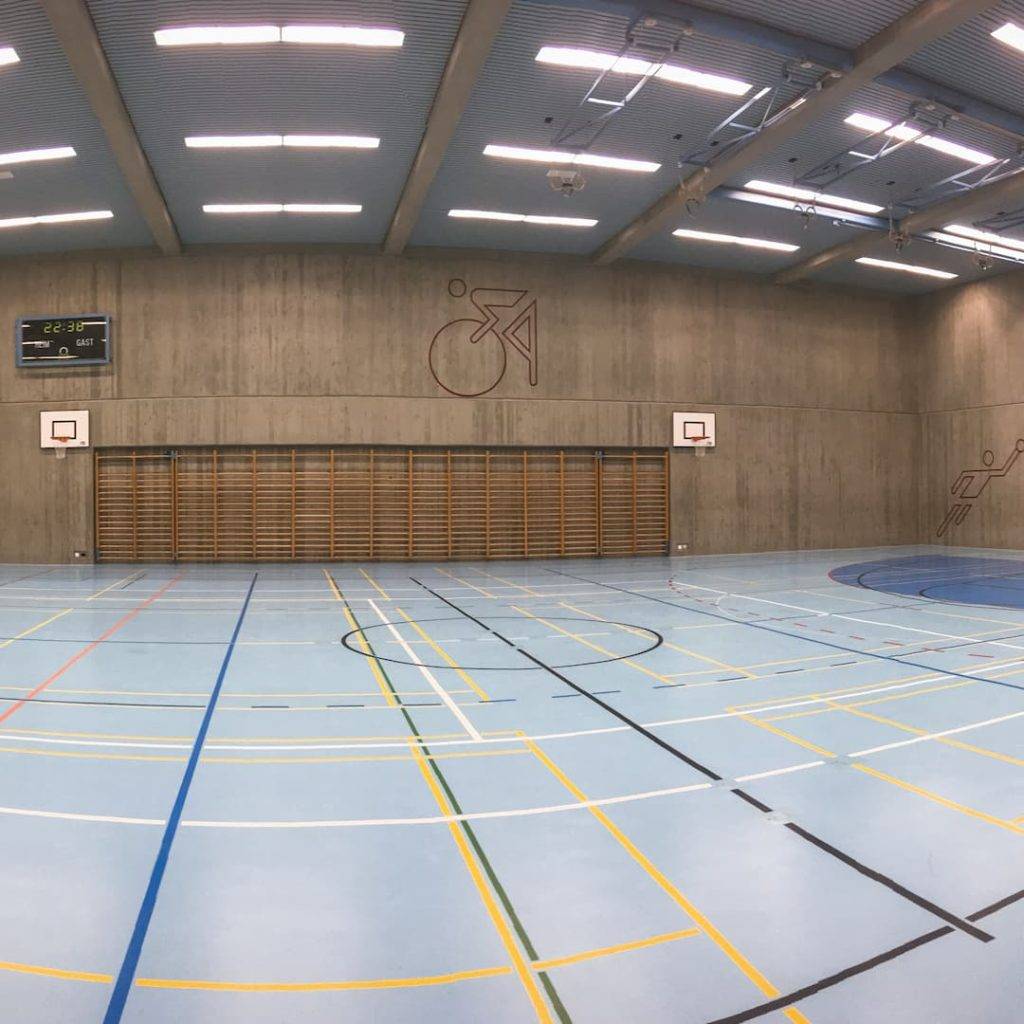
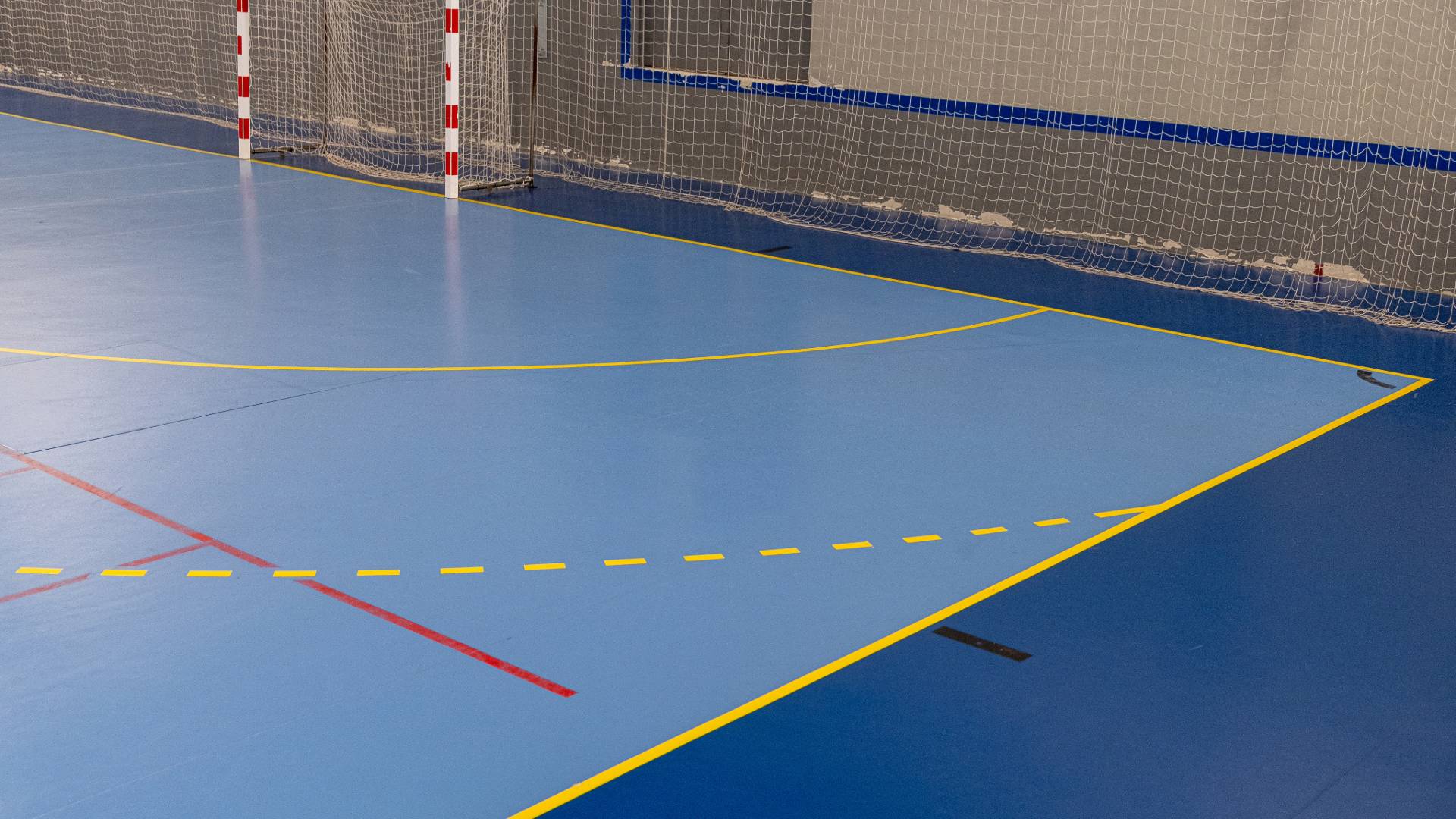
Where a hall hosts league or representative fixtures, the markings have to satisfy the relevant governing body, and several have revised their dimensions in recent years. A court marked to a superseded rulebook can be challenged, which is an avoidable and embarrassing problem.
We confirm the current specification before any paint goes down, plan the multi-sport hierarchy so the competitive court reads instantly, and can seal club or school branding in at centre court. Detail is on our line marking page.
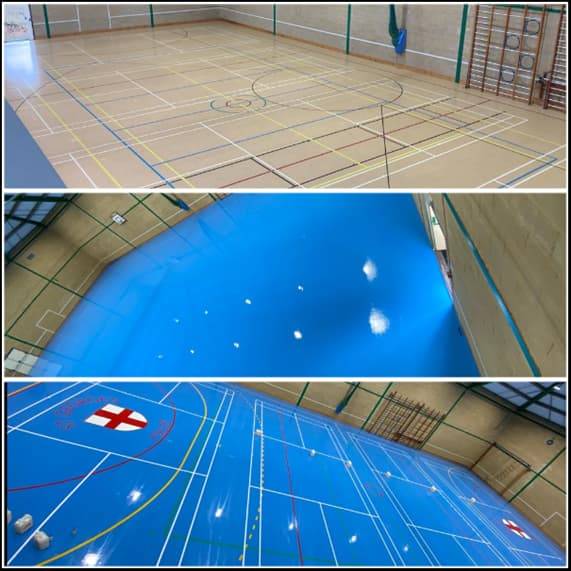
The sports hall at St George’s had a Granwood block floor that decades of use had left dull and tired. Granwood cannot be sanded like timber, so we restored it correctly: careful preparation, a modified epoxy coating system and crisp new markings.
The school kept a serviceable floor out of a skip and spent a fraction of what replacement would have cost.
~ Matthew Evans
An outstanding company to deal with and they couldn’t have been better to work with. St George’s Ascot now has a stunning new sports hall floor and we are delighted. From quote, support, delivery and after sales, the Team has been brilliant. Thank you. 
~ James Anderson







Most of our Birmingham school work happens in the summer holiday, and the trick is not fitting one hall into six weeks but fitting several halls across a trust into the same six weeks without any of them slipping into September.
We fix the sequence in the spring term. Surveys are done, materials are ordered and delivery dates confirmed while the halls are still in use, so the only thing that happens in the holiday is the work itself. Halls with exam furniture stored in them or summer school bookings are placed where they fit.
Half terms take the smaller jobs: a screen and recoat over a long weekend, a relining, a repair to a socket cover or a run of boards. Easter suits a full sand if the hall can be cleared, and a cold February half term is best left for inspections and planning.

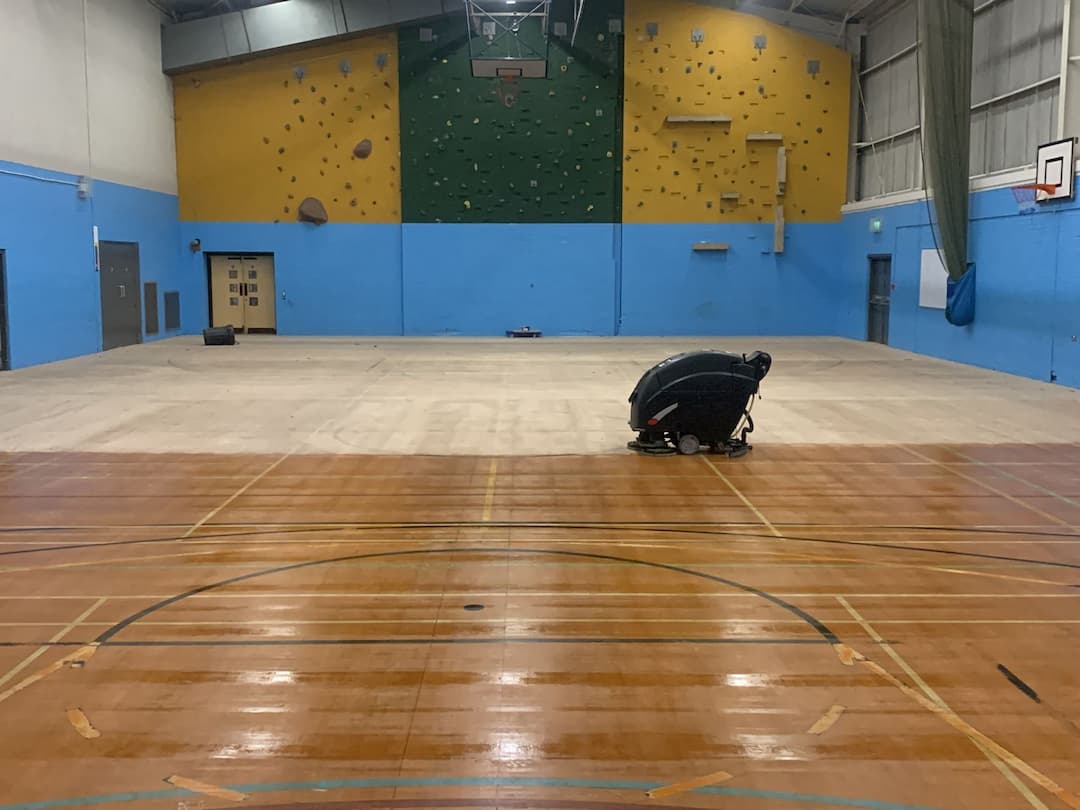
The last coat going on is not the job finished. Two pack polyurethane seals reach a walkable hardness in about 24 hours, and that is when we hand over for light foot traffic in clean shoes. Full chemical cure takes longer, and the floor is still soft enough to mark for several days.
We ask for 72 hours or more before anything heavy returns: benches, trampolines, badminton posts, portable goals and the caretaker’s floor machine. Dragging a stack of chairs across a floor that is two days old leaves tracks that will be there until the next full sand.
On a tight programme we plan the coats so the final one goes down on a Thursday, giving the weekend for cure, and we tell the site team in writing what can and cannot go back on each day.
Sanding a sports hall produces a surprising quantity of fine timber dust, and in a building where classrooms, a kitchen or a nursery sit along the same corridor that dust has to be managed, not just swept up afterwards.
Our sanding machines run on continuous extraction into sealed bags, which removes most of the dust at source. Doorways, hatches and ventilation grilles into the hall are sheeted and taped before the first pass, and we set up a single controlled route in and out for the team.
Where the rest of the building is in use we agree the noisy phases with the site manager and keep them out of exam sessions and assemblies. At the end of each day the corridor outside the hall is left cleaner than we found it, because that is what the caretaker notices first.


Timber sports floors breathe. In a Birmingham school hall that is heated hard through the winter and left unheated in August, the boards give up moisture in one season and take it back in the next, and the floor moves as they do.
A little movement is normal and no cause for alarm. Fine gaps opening between boards in January and closing again by June is exactly what a solid strip floor is designed to do. What causes trouble is a floor laid without an expansion gap at the perimeter, or with the skirting or a threshold trim fixed hard against the boards, so that summer expansion has nowhere to go and the floor lifts in the middle.
At survey we check the perimeter detail and take moisture readings across the hall. If the building is going to change, with new heating or a large glazed extension, we say so before the floor is refinished.
Birmingham gives us the widest mix of any city we work in, because the building stock spans a century and the facilities range from single school halls to full university sports centres.
University and college sport is a substantial part of it. We refinished the sports hall at Aston University, and that job is a fair illustration of the type: a heavily booked hall with the finish worn through in the traffic lanes, no long summer shutdown because of conference and external use, and a fixed window to work in.
School and academy halls are the largest group by number. Many are from the nineteen sixties and seventies, with sprung timber floors that are structurally sound but have gone too long between refinishes. Those are usually excellent candidates for restoration rather than replacement.
Leisure centres and community sports centres follow, where the priority is keeping the building trading and most of the work happens overnight.
We also see a good deal of Granwood in this part of the country, particularly in older school and church halls, and it is worth saying that most Granwood described as beyond saving is not.
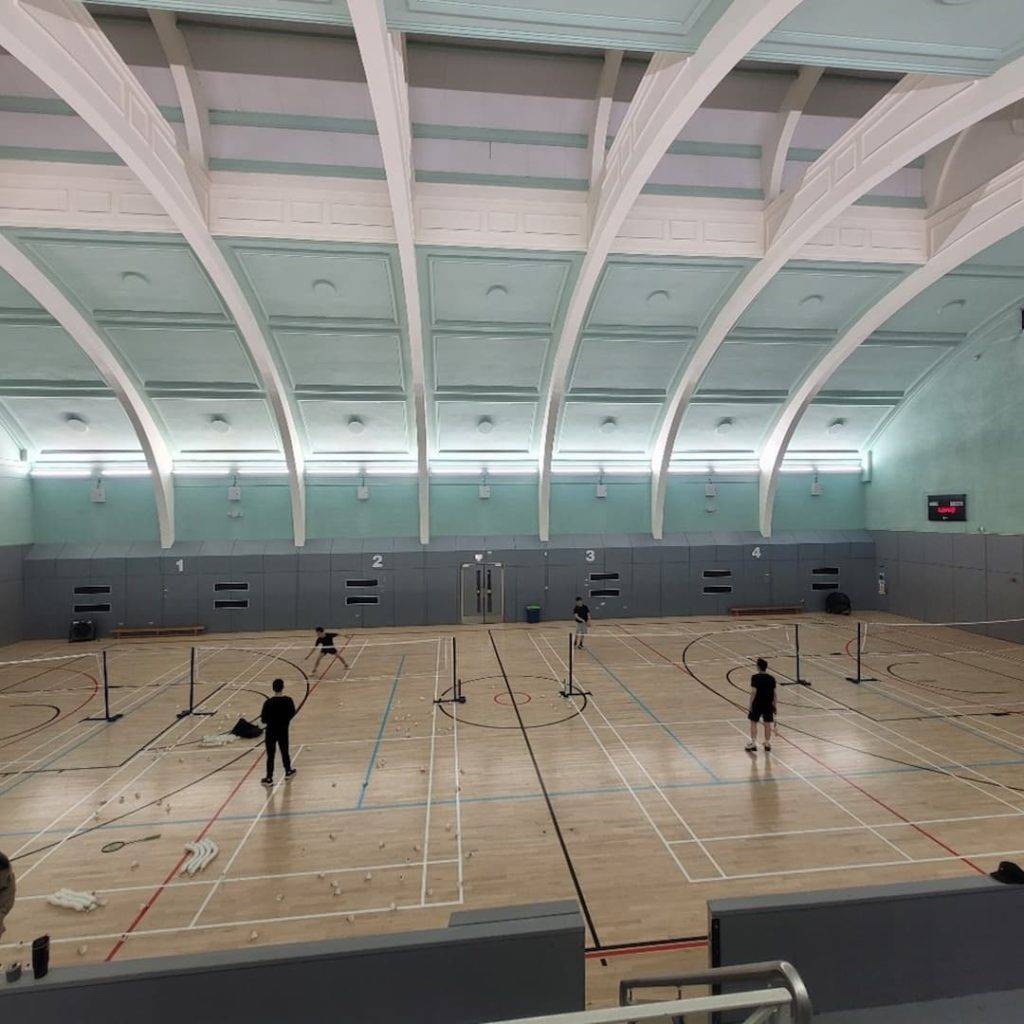
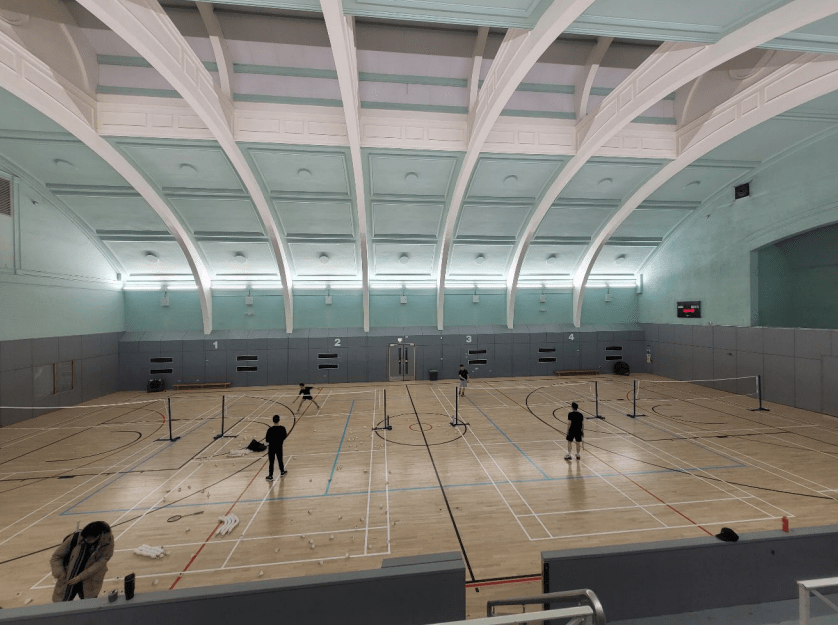
Because the building stock here spans a century, the problems we are asked to solve in Birmingham are unusually varied.
In the post war school halls the recurring issue is a sprung floor that has lost its bounce in patches. Dead spots mean a pad or batten has failed underneath, and the fix is to lift the boards locally and replace the components rather than refinish a floor that will still feel wrong afterwards.
In the older stock, Granwood is the recurring find. It gets mistaken for timber, sanded like timber and permanently damaged, or written off entirely and quoted for replacement. Neither is usually necessary. A Granwood floor with sound blocks and an intact bed restores well with the right preparation and a modified epoxy system.
In the modern university and leisure facilities the issues are different again: heavily used surfaces where the seal has worn evenly and the question is timing rather than diagnosis. Those want catching on a cycle before the finish fails.
The range is wide because the work varies from a two day screen and recoat to a full sand with repairs and new markings. We survey without charge, then give you a fixed written price broken down by element, so you can choose which parts to do now and which to hold.
Yes. We work across the region and nationally, and travel is included in the price you are given rather than added afterwards. For trusts with sites spread across several boroughs we sequence them into one programme so the team moves from hall to hall without gaps.
Yes. A planned agreement usually pairs an annual inspection and deep clean with a screen and recoat every two to three years, plus relining and pendulum testing when needed. You get a written record after each visit, which makes budgeting predictable and keeps the warranty on the finish valid.
Yes, and it makes sense to do so. The stage is usually in worse condition than the hall floor because it is rarely cleaned and often used for storage. One visit, one set of equipment and one matching finish costs much less than two separate jobs.
We do. Synthetic surfaces are deep cleaned, repaired where seams or blisters have opened, recoated in the existing or a new colour and remarked. A worn polyurethane floor recoated correctly gains several more years before replacement becomes the sensible option.
We guarantee our workmanship and the products we apply, and because the same team carries out every stage there is nobody else to point at if something is wrong. The guarantee assumes the floor is cleaned with a neutral cleaner and no polish, which we set out in writing at handover.
No. Courtship Flooring works only on commercial and institutional floors, from school halls and university sports centres to leisure operators and clubs. Domestic timber floors are looked after by our sister company Ryan’s Restorations, who take on that work directly.
Yes, if the system is designed for it from the outset. Surface temperature has to be limited and brought up slowly each autumn, the timber has to be specified as suitable, and the build up must allow heat through without trapping moisture. Retrofitting under an existing sprung floor is rarely practical.
Book a free survey of your floor in Birmingham and we will set out what it needs, what it will cost and when the work can be programmed around your term dates. Call 01823 674562 or send us a message.