
Flooring Professionals To The Leisure Industry
Courtship Flooring is a commercial sports flooring contractor working in Cambridgeshire and across the UK. Our work ranges from university and college facilities to fast-expanding academy estates, with moisture assessment central to almost all of it.
A family business established in 1987, working exclusively on commercial indoor sports and timber floors. We survey, install, restore, mark, test and maintain, keeping every stage in our own hands so one warranty covers the whole system. Domestic work is handled separately by Ryan’s Restorations.
For halls in Cambridgeshire that are worn but structurally sound, our sports hall floor refurbishment service restores grip, appearance and line markings, usually within a school holiday.
Overnight/Weekend Installations
Professional Cleaning Demonstrations
Squash Court Maintenance
Recommended Cleaning Products
Professional Pendulum Slip Testing
Deep Clean & Reseal Service
A moisture reading is only useful if it is taken correctly and interpreted with care. Surface readings alone tell you very little; what matters is relative humidity within the slab and what is happening beneath the floor covering over time.
We take readings at multiple points and depths as part of every survey, provide them in writing, and specify a barrier only where they demand one. Adding one unnecessarily is money wasted; omitting one where it is needed destroys the floor.
Timber moves with the seasons, and a floor laid without adequate expansion allowance will either gap in winter or buckle in summer. It is entirely predictable and entirely preventable.
We set expansion gaps according to the species, board width and the building environment, and advise on ventilation and humidity control where a hall swings widely between heating seasons. Most buckled floors we are called to were installed correctly in every respect except this one.


Higher education work has its own constraints: short vacation windows, facilities shared between departments and clubs, and estates teams who need documentation as much as they need the work done.
We plan around the academic calendar, phase larger projects so part of a facility stays available, and provide the documented handover, testing reports and maintenance schedules that estates records require.
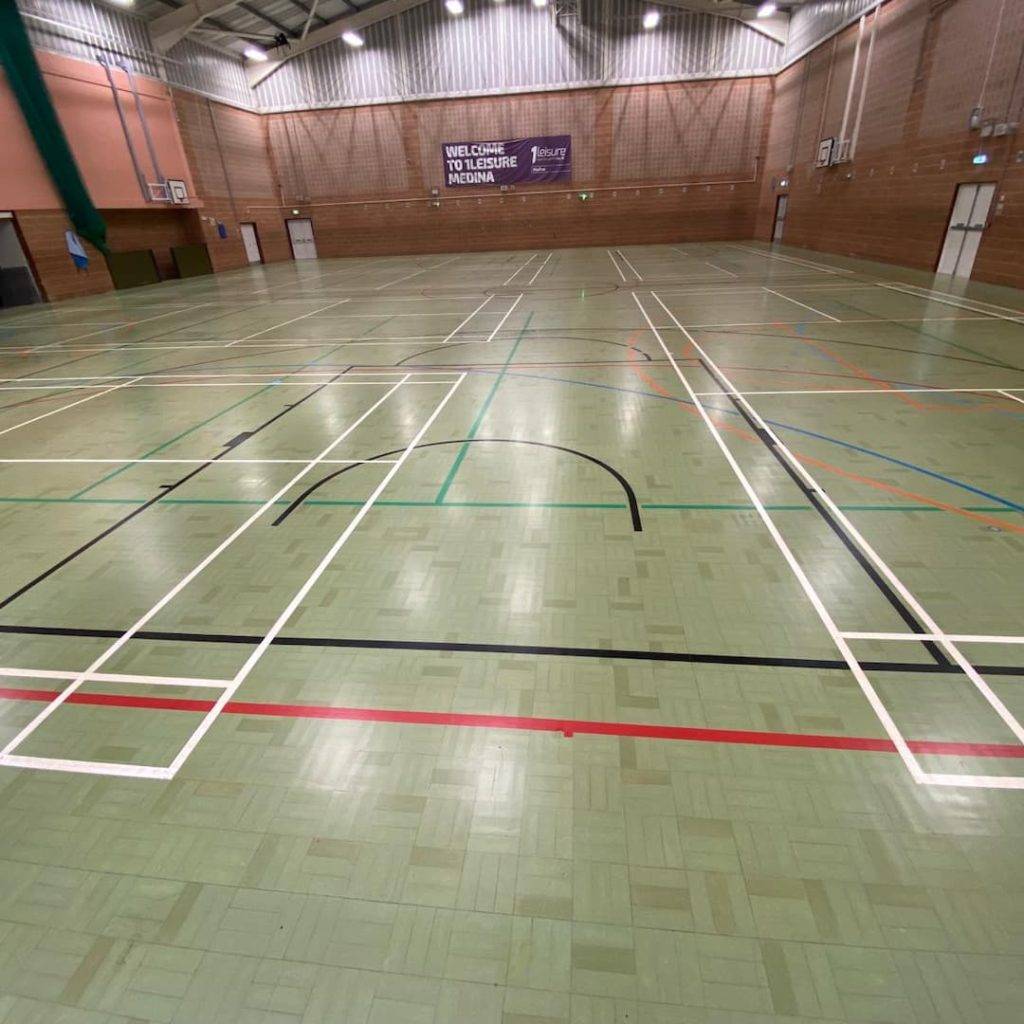
At Medina Leisure Centre we refurbished the main sports hall floor completely: sanding, repairs, resealing and a full set of new markings, with the logistics planned down to the last detail so the centre lost as little bookable time as possible.
The after photographs show a hall transformed, and the programme finished on the date agreed at the outset.
~ Matthew Evans
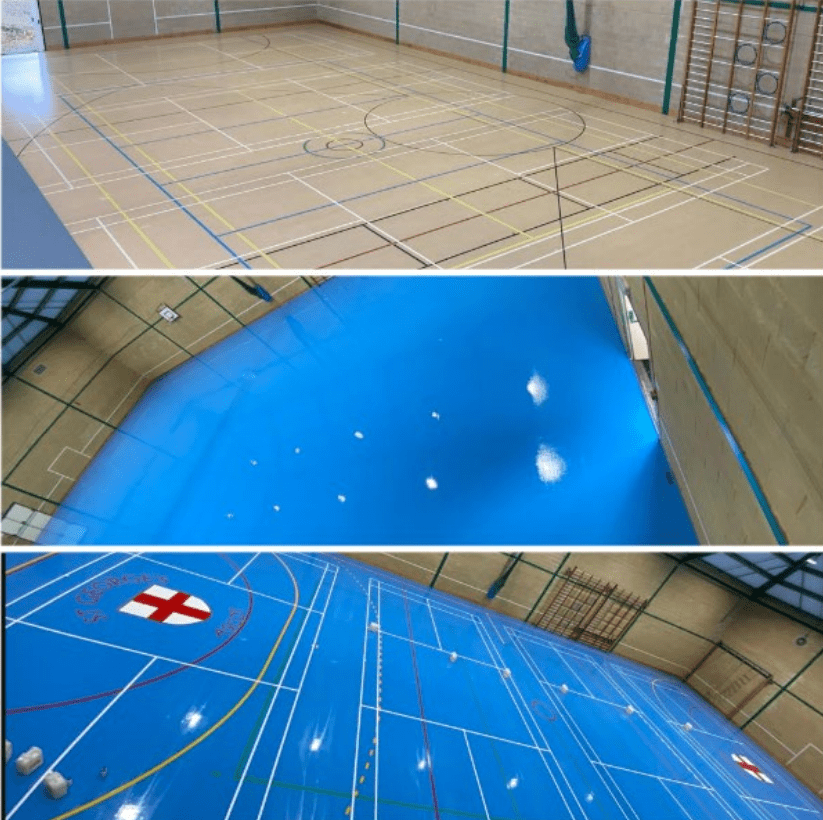
An outstanding company to deal with and they couldn’t have been better to work with. St George’s Ascot now has a stunning new sports hall floor and we are delighted. From quote, support, delivery and after sales, the Team has been brilliant. Thank you. 
~ James Anderson







A sprung timber sports floor is a system, and the boards you see are the smallest part of it. Beneath them sit battens on resilient pads or cradles, set at spacings that give the floor its bounce, so the whole assembly deflects across an area when a player lands. That is what area elastic means, and it is the construction BS EN 14904 describes for halls used for fast court sport.
Point elastic surfaces behave differently. A vinyl or polyurethane layer over a foam backing gives only where a foot lands, which suits fitness rooms and dance studios more than basketball. Combined systems put a point elastic surface over an area elastic base for halls that need both.
We specify from how a Cambridgeshire hall is actually used, and we install every layer ourselves, so pads, battens and boards sit under one warranty instead of three.
Sanding a sports hall produces a great deal of fine timber dust, and in an occupied school or college the question is never whether it is produced but where it goes. Our machines run on continuous extraction, which captures the bulk of it at source before it reaches the air.
The rest is managed by containment. We screen doorways, tape off ventilation grilles that serve other rooms, and agree with your site team which air handling needs isolating for the duration. Corridors stay clean, adjacent classrooms stay usable, and cleaners are not left with a film on every surface.
On a Cambridgeshire campus where a hall shares a plant room with laboratories or a library, we walk the building before we start and put that plan in writing. Then we vacuum between every pass, because a seal applied over dust fails early.

A floor that feels slippery is a complaint. A floor with a measured pendulum test value is a fact, and the difference matters when an insurer, a governing body or a parent asks what you knew and when. We carry out pendulum testing to the method the HSE recognises and issue a certificate for the file.
The test swings a rubber slider across the surface and records the friction it meets, in dry and wet conditions, at several points around the hall. Entrances, the centre circle and the traffic lanes to the store tend to give the lowest readings, so those are always included.
For a Cambridgeshire college or academy the useful pattern is a test at handover, then again at each annual inspection, so the record shows the floor holding its grip over time and not just on the day we left.
Cambridgeshire work comes to us from three fairly distinct directions, and the flooring problems differ noticeably between them.
University and college sport is the first. These are year round facilities with no long summer shutdown, because the conference and summer school programme fills the gap, so the working window is narrow and fixed. We plan those jobs months ahead and staff them to finish inside the window rather than hoping.
School and academy halls are the second and the largest by number. We completed work at De Wint School in the county, and the pattern there is common across the region: a hall in constant curriculum use, a finish that had gone too long, and a fixed date to be back for term.
The third is the rural stock. The county has a very large number of village halls and church halls, many with timber floors laid a century ago that are still perfectly sound under decades of polish. Those restore for a fraction of what committees usually expect, and much of that work reaches us by recommendation from one hall to the next.
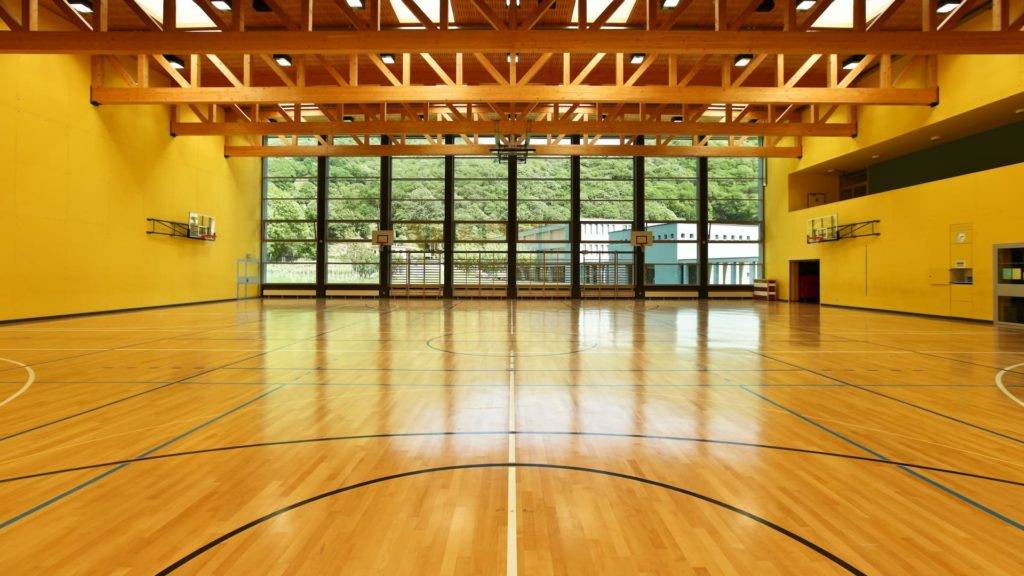
The project most often relevant to Cambridgeshire enquiries is De Wint School, which we completed in the wider region.
It is a fair illustration of the type we see across the county: a hall in constant curriculum use, a finish that had been left considerably longer than it should have been, and a fixed window with no flexibility at the end of it. The floor was sanded back to bare timber, damaged boards were cut out and replaced, and the hall was resealed with markings set out fresh from measured governing body dimensions rather than traced from the faded originals. Several redundant sets came off at the same time, which cost nothing while the floor was open and made the hall considerably clearer to use.
For collegiate and university facilities the closer parallel is Aston University, where the constraint was a year round timetable with no summer shutdown, solved by surveying early and staffing the job to finish inside the window.
Most sports halls in Cambridgeshire spend several weeks a year as exam rooms, and a few more as dining halls, concert venues and open evening spaces. Rows of desks and chairs, staging, trolleys and stacked furniture do more damage to a seal in a fortnight than a term of badminton.
The answer is protective covering, chosen for the use. Breathable roll out covering suits exam desks and general events. Heavier boarded systems are needed under staging, catering and anything wheeled. What matters is that the covering is dry when it goes down, lifted promptly, and that nothing is dragged across bare timber in between.
We advise on a covering system at survey, and we would rather you spend a modest sum on protection than a larger one on sanding out chair leg scoring every third year.

The price depends on the size of the hall, the state of the seal and boards, and whether repairs, markings or testing are included. We measure and inspect first, then give a fixed itemised figure with the cheaper option priced alongside the full one so you can compare.
For a summer or Easter slot, contact us in the winter before. University and college halls in Cambridgeshire often have conference programmes filling the vacation, so the earlier we know your true window, the more likely we can staff the job to fit it exactly.
As a guide, a screen and recoat every two to three years and a full sand back to bare timber roughly every ten. Halls with heavy community lettings sit at the shorter end, and an annual inspection tells you which year you are actually in.
Site specific risk assessments and method statements before we arrive, COSHH data for every product used, insurance certificates and DBS details for the team. We send the pack in advance so your bursar or estates office has it on file before the first van appears.
Light foot traffic after twenty four hours from the final coat. Wait seventy two hours or more before wheeling equipment, staging or heavy furniture back in, because the seal is still hardening beneath the surface. We give exact times for the product used at handover.
Yes. Where a hall cannot close for a week we sand and seal in shifts, applying finish at the end of each so the floor is walkable by morning. It costs a little more in labour and usually far less than lost bookings.
Yes. Logos and coloured zones are painted from your own artwork and sealed under the final coats, so they wear with the finish instead of scuffing off. Doing it while the floor is already open for a refinish is by far the cheapest time.
Dry mop daily to remove grit, damp mop with a neutral cleaner made for sealed timber, and never apply polish, wax or any product that promises shine. Polish makes the floor slippery and has to be stripped chemically before anyone can reseal it.
Book a free survey of your sports hall floor anywhere in Cambridgeshire. We measure, inspect and report in writing, then give you a fixed price and a realistic date. Call 01823 674562 or send us a message today.