
Flooring Professionals To The Leisure Industry
Courtship Flooring is a commercial sports flooring contractor working in County Durham and across the UK. Our work spans university and college facilities working to tight vacation windows and community buildings working to tight budgets.
Our clients are schools, academy trusts, universities, leisure operators, councils and clubs, and have been since 1987. We cover the full lifecycle of a floor with our own team rather than a chain of subcontractors. Private homes are outside our scope and are served by Ryan’s Restorations.
Clients in County Durham get the specification, workmanship and aftercare that have underpinned our sports hall flooring work since 1987.
Overnight/Weekend Installations
Professional Cleaning Demonstrations
Squash Court Maintenance
Recommended Cleaning Products
Professional Pendulum Slip Testing
Deep Clean & Reseal Service

Academic vacations are short and immovable, which makes sequencing everything. A full refurbishment has to be planned so that sanding, repairs, sealing and curing all complete with contingency left, because a floor that is not ready when term starts is a serious problem rather than an inconvenience.
We build that contingency in deliberately and confirm the handover date in writing. Larger facilities are phased so part of the space remains available throughout.
Where funds are tight, the question is not what the floor ideally needs but what will deliver the most benefit for the money available. That is usually a deep clean and reline rather than a refurbishment, or a recoat rather than a full sand.
We will always price the cheapest option that works and explain what it does and does not achieve, rather than presenting a single expensive recommendation and leaving you to negotiate downwards.

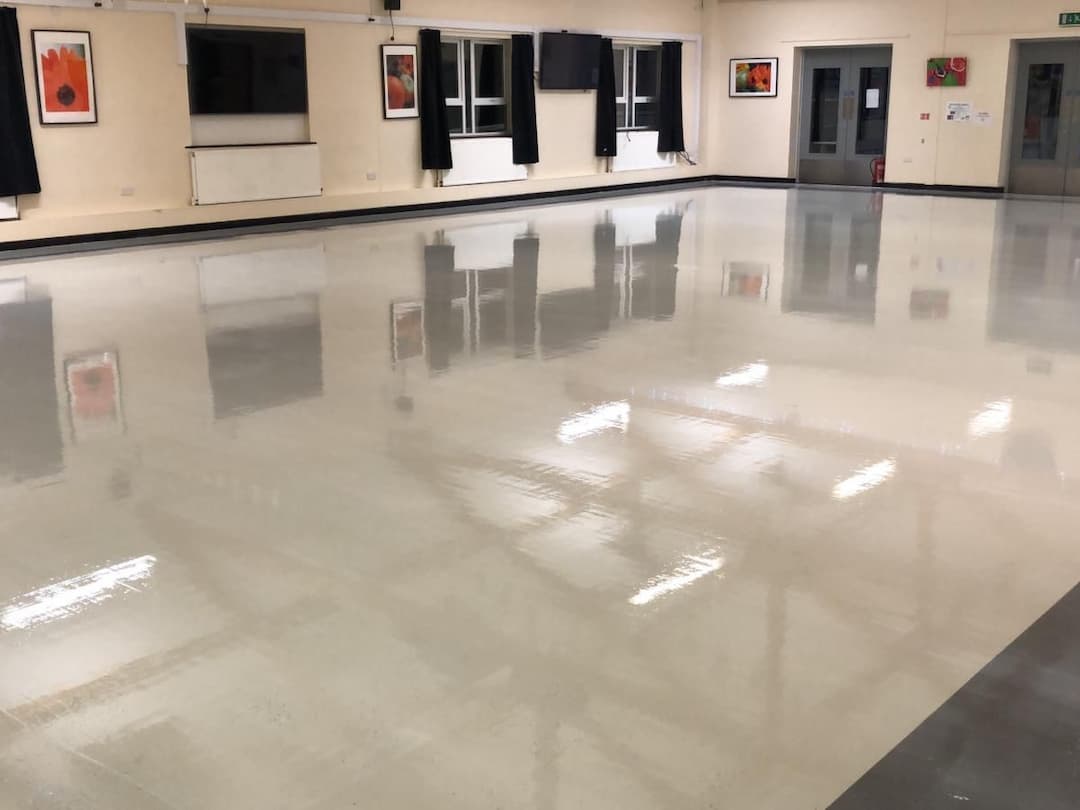
An old floor with limited depth left can still give years of service if it is managed rather than machined. Recoating instead of sanding, addressing entrance wear, correcting the cleaning routine and repairing damage locally all extend life without spending timber.
We will tell you how many refinishing cycles a floor has left, so replacement can be planned and budgeted rather than arriving as an emergency.
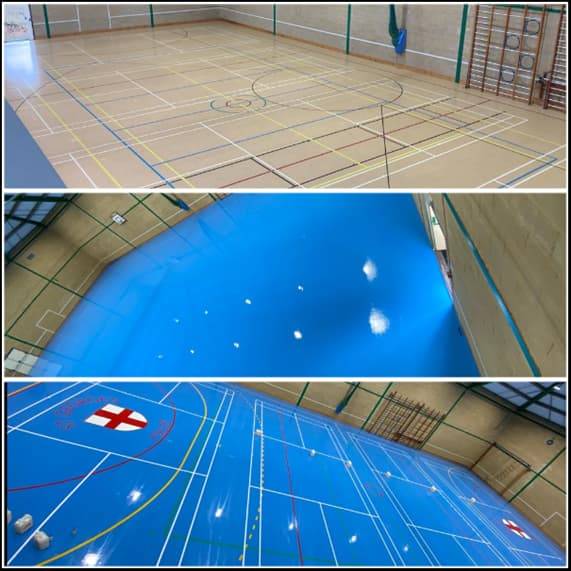
The sports hall at St George’s had a Granwood block floor that decades of use had left dull and tired. Granwood cannot be sanded like timber, so we restored it correctly: careful preparation, a modified epoxy coating system and crisp new markings.
The school kept a serviceable floor out of a skip and spent a fraction of what replacement would have cost.
~ Matthew Evans
An outstanding company to deal with and they couldn’t have been better to work with. St George’s Ascot now has a stunning new sports hall floor and we are delighted. From quote, support, delivery and after sales, the Team has been brilliant. Thank you. 
~ James Anderson







If a pupil or a member slips in your hall, the first question an insurer asks is whether the surface was tested. We carry out pendulum testing to BS 7976-2, the method the HSE recognises, and we leave you a certificate rather than an opinion.
The instrument swings a rubber slider across the floor and records how much it is slowed. A Pendulum Test Value of 36 or more shows low slip potential. We test at several positions in dry and wet conditions, because a single reading by the door tells you very little about the centre court.
The test also settles arguments. A hall that feels slick may simply have cleaning residue on it, and a reading before and after a deep clean shows whether the seal itself needs attention. For academy trusts across County Durham an annual test on each hall builds a record that stands up if it is ever needed.
Sanding a hall produces a great deal of fine dust, and where it ends up depends on the equipment and the preparation. Our machines run on sealed vacuum extraction rather than bags, which captures most of it at the drum before it reaches the air.
Edges and corners are where dust escapes on a poorly run job, because hand machines are harder to extract. We use extracted edge sanders for exactly that reason, and we screen doorways and tape off vents before the first pass.
In a college that stays open around us, or a leisure building where the sports hall shares air handling with a pool or gym, we agree with your site team which routes to isolate. The hall we are working in will be dusty for a few days. The corridor outside it should not be, and that is the standard we hold ourselves to.
A sports floor that feels dead in one corner, squeaks along a line or bounces under a running player has a problem under the surface. Sanding the top changes nothing, because the fault is in the battens, pads or cradles that carry the boards.
Foam pads compress and perish over decades. Battens crack where a heavy piece of equipment has been dragged, and cradles work loose where fixings have rusted. Each one leaves a patch that no longer springs back with the rest of the floor.
We lift boards locally, replace the failed components with matching parts and refit the same boards where they are sound. The repair disappears into the refinish. In the mid century halls that are common across County Durham, a handful of these repairs, done during a sand and seal, is often what turns a tired floor into a good one.

The easiest way to reline a hall is to trace the lines already on it, and it is the most common way courts end up wrong. Every remark that copies the last one carries its errors forward and adds a few of its own.
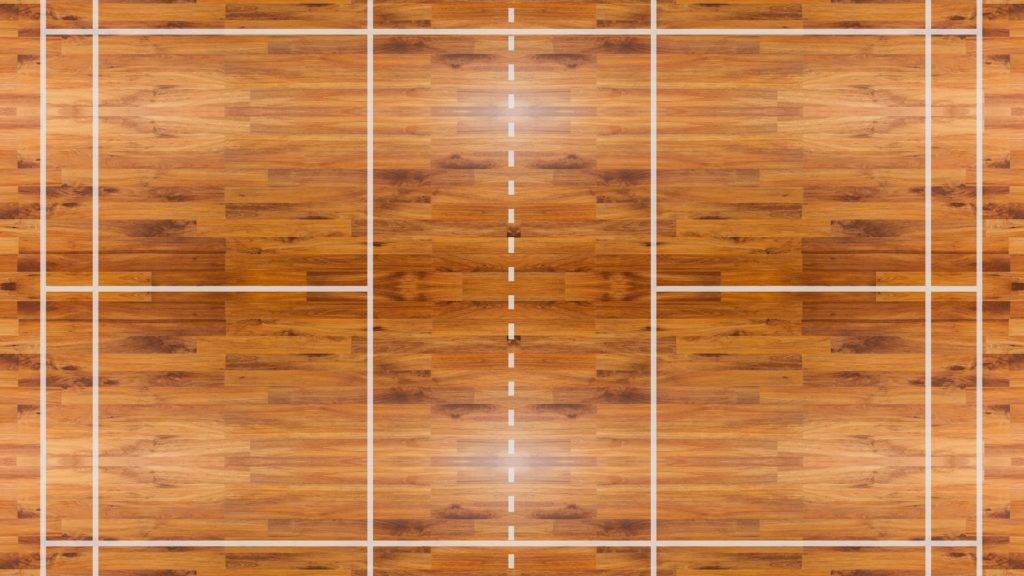
We set out from the governing body dimensions with laser and tape. A netball court is 30.5 by 15.25 metres with equal thirds, a basketball court 28 by 15 metres with the three point arc at 6.75 metres, a badminton court 13.4 by 6.1 metres. Both ends are checked against each other before any paint goes down.
On timber the lines go on between coats of seal, so they sit beneath the final lacquer and last as long as the finish does. Lines painted on top of a finished floor start lifting within a season, which is why some halls in the region seem to need relining every year.
County Durham and Teesside bring us a mix of academy trust estates, council leisure facilities and university sport, with a good proportion of older building stock.
Academy trust work is the pattern we see most. A trust with a dozen schools holds a dozen sports halls of widely differing ages and conditions, usually with no single record of what state any of them are in. A condition survey across the estate is generally the most useful first step, because it converts an unpredictable cost into a phased programme rather than a series of emergencies.
The older halls in the region are frequently Granwood or timber laid in the middle of the last century. Both are often written off unnecessarily. A Granwood floor with sound blocks and an intact bed is almost always worth restoring, and it costs a fraction of replacement, particularly once the cost of lifting a bitumen bed is taken into account.
Leisure centre and community sport work makes up the rest, and there the priority is keeping the building trading, which usually means overnight or weekend working rather than a long closure.
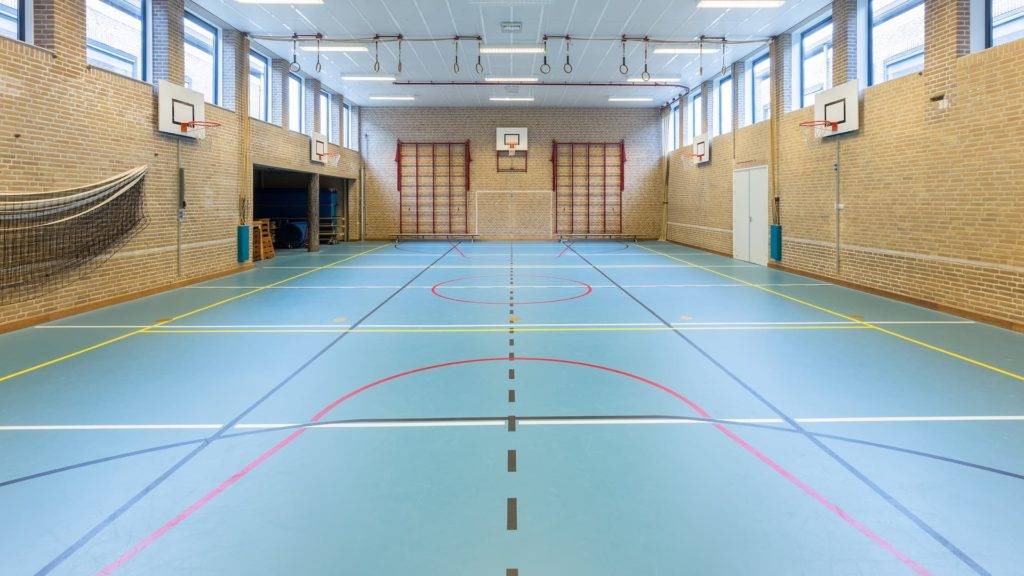
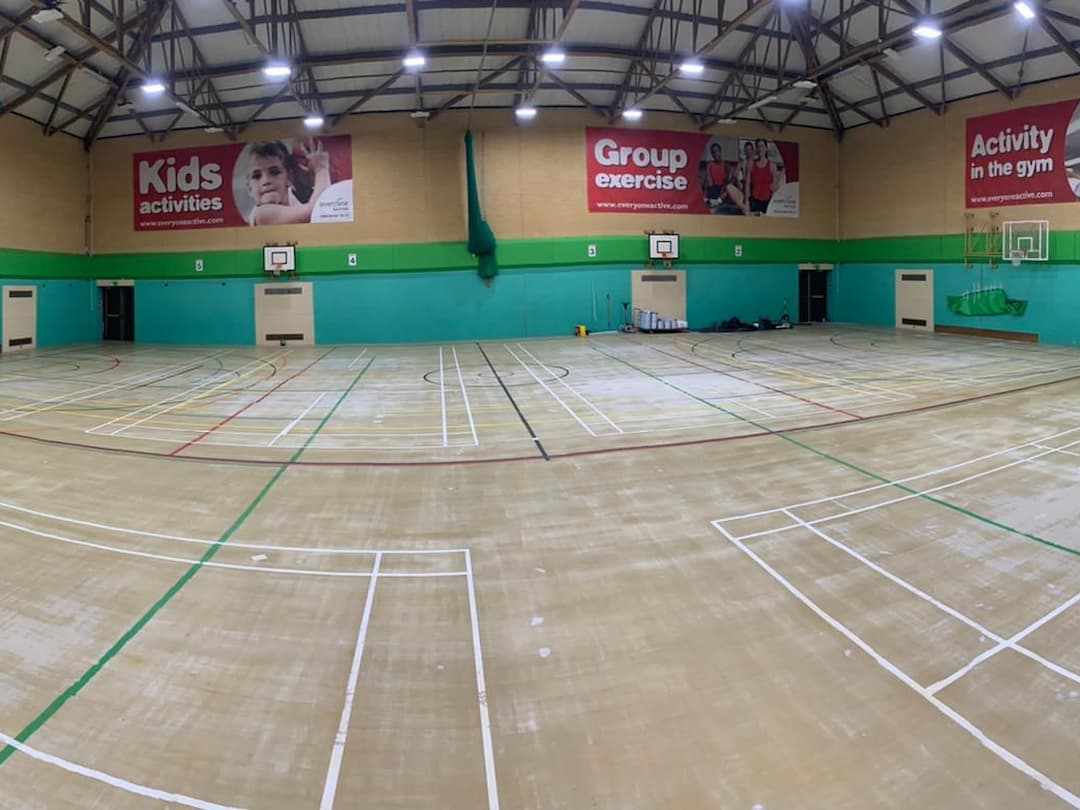
The enquiries that reach us from County Durham and Teesside have a fairly consistent shape, shaped by the age of the building stock.
The most common is a mid century school hall whose floor has never been properly refinished, only recoated. Layer upon layer of sealer eventually goes cloudy, peels at the edges and lifts in sheets, and the only real answer is to take it back to bare timber and rebuild the finish properly.
The second is Granwood, which appears here more than in many regions. It is regularly condemned when it should not be. The blocks are usually sound, the bed is usually intact, and restoration costs a fraction of a replacement that would also mean lifting a bitumen bed that may need specialist handling.
The third is trusts finding that several halls need attention at once, which is what a phased estate programme exists to prevent. That starts with surveying all of them and producing a costed priority order.
Light foot traffic is usually fine 24 hours after the final coat. Equipment, posts and trolleys should stay off for at least 72 hours, longer in a cold building. We give you exact times for the system used and put them in the handover.
Yes. Coloured keys, zones and crests are painted between coats of seal so they are protected by the final lacquer. Send us your artwork and we work it up to the correct scale and show you a layout before anything is painted.
Surface marks and worn lacquer lift out easily. Deep water staining that has soaked into open grain may stay faintly visible after sanding. We tell you at survey which marks will go and which will not, so there are no surprises when the floor is bare.
Yes. Much of our leisure work is done between the last session and the first, with the final coat timed so the hall is walkable by opening. It costs more in labour than a daytime programme and almost always costs less than the lost bookings.
That depends on the board thickness and what previous contractors have taken off. A solid strip floor might stand six to eight full sands over its life. We measure the remaining wear layer above the tongue at survey and tell you how many cycles are left.
Rarely. Restoring a sound timber floor costs a fraction of any new installation, and timber can be refinished again in ten years while vinyl is replaced when it wears out. Vinyl earns its place where the timetable is mostly fitness or the sub-floor is unsuitable for timber.
We lift the covers, clean out the debris, protect the sockets from sealer and reset them flush with the new surface. Post fixings, wall bar mounts and floor boxes get the same attention. A raised socket ring is a trip hazard and a sign of a rushed job.
Yes, as standard. Site specific risk assessments and method statements come before we start, along with COSHH sheets for every product and our insurance certificates. Every member of the crew on a school or college site holds an enhanced DBS check.
Arrange a free survey of your sports hall floor in County Durham. We take moisture readings, measure the remaining timber and give you a fixed written price with a realistic date. Call 01823 674562 or send us a message.