
Flooring Professionals To The Leisure Industry
Courtship Flooring is a commercial sports flooring contractor working in Dorset and across the UK. Our work spans schools, leisure facilities and community buildings, with a good deal of specialist restoration among it.
We have been specialising in indoor sports and commercial timber floors since 1987. The business is family-run, nothing is subcontracted, and the crew who survey a building are the crew who work on it. Domestic and residential projects fall outside what we do and are looked after by our sister company, Ryan’s Restorations.
In Dorset, as elsewhere, a sports hall floor refurbishment is often the most cost-effective option: a full sand, reseal and reline that brings an existing floor back for a fraction of the cost of replacement.
Overnight/Weekend Installations
Professional Cleaning Demonstrations
Squash Court Maintenance
Recommended Cleaning Products
Professional Pendulum Slip Testing
Deep Clean & Reseal Service
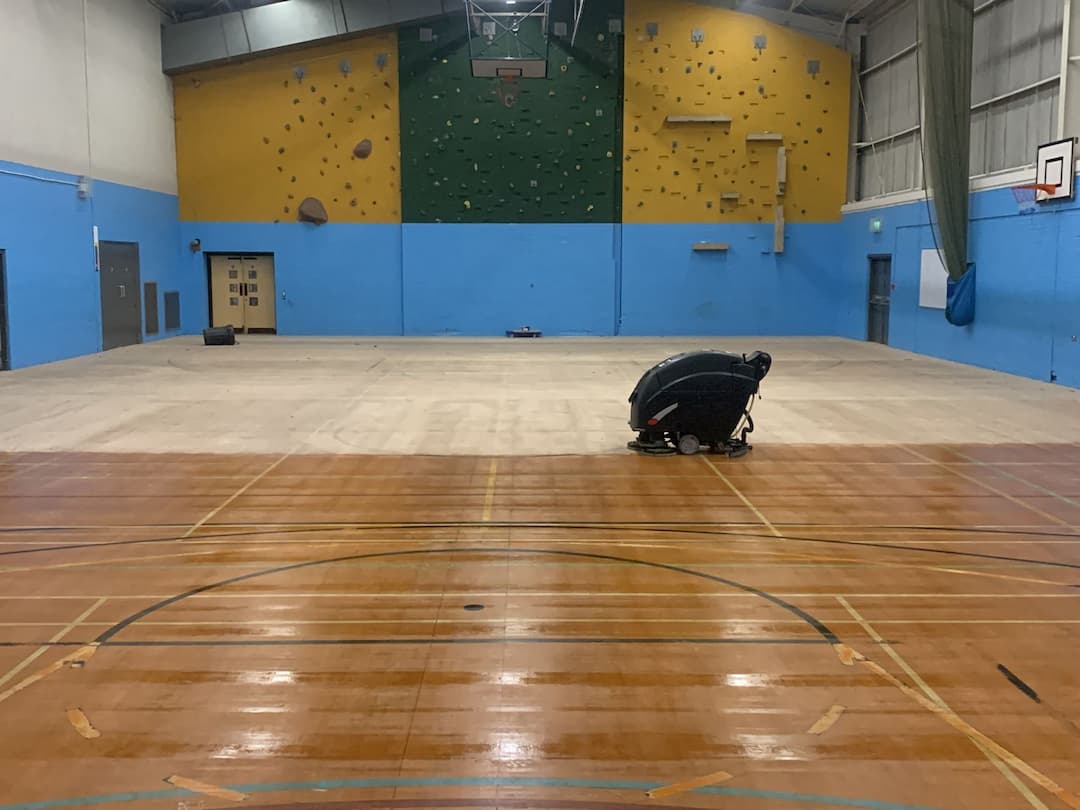
Routine mopping removes surface dirt but leaves embedded residue behind, and that residue is what dulls a floor and reduces grip. Machine deep cleaning uses appropriate solutions and mechanical agitation to lift it out of the surface texture.
The result is frequently mistaken for a refurbishment. Starting from £2 per square metre, it is the cheapest intervention available and regularly removes the need for anything more drastic for another year or two.
Most floor problems we attend were caused with good intentions. Stronger product seems logical when a floor looks dull, but over-concentration and incorrect pH leave precisely the film that caused the dullness in the first place.
We recommend products matched to your specific finish and to local water hardness, demonstrate correct dilution and method to your own team, and leave written guidance. It is unglamorous advice that saves more money than anything else we offer.
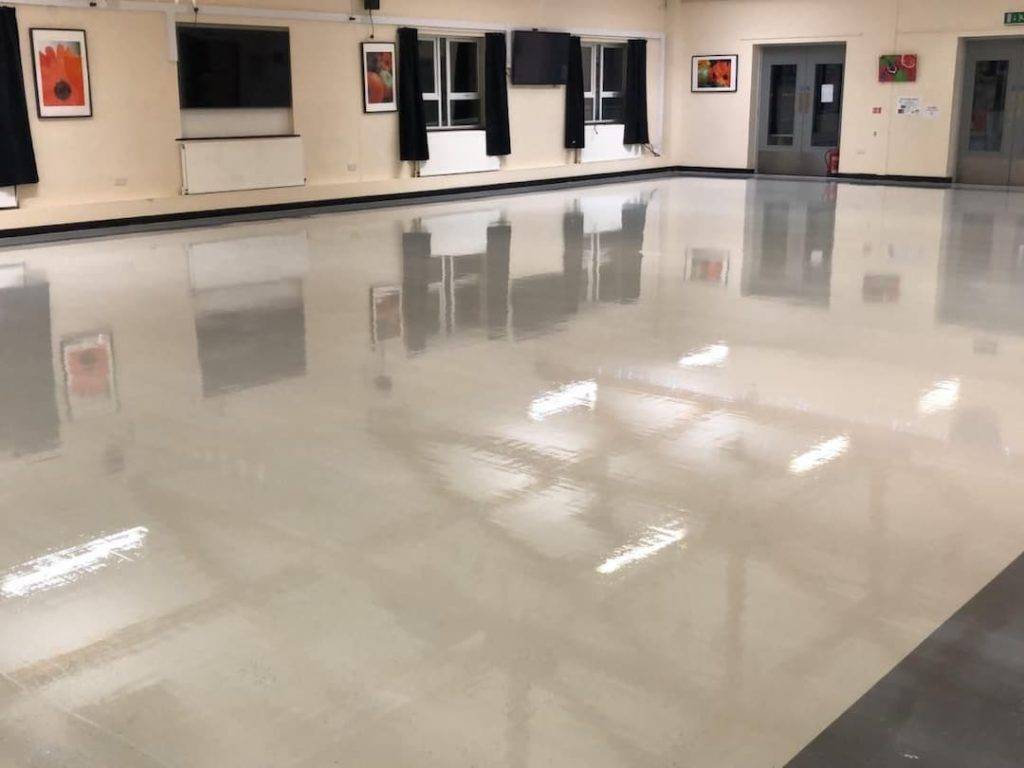

There is no universal schedule. A hall used six hours a day needs different attention from one used sixteen, and a building with a gravel car park needs different attention from one with a paved approach.
We set intervals against your actual usage and environment: how often to deep clean, when a recoat becomes worthwhile, and roughly when a full sand should be budgeted. Getting that interval right is what keeps a floor out of the expensive cycle.
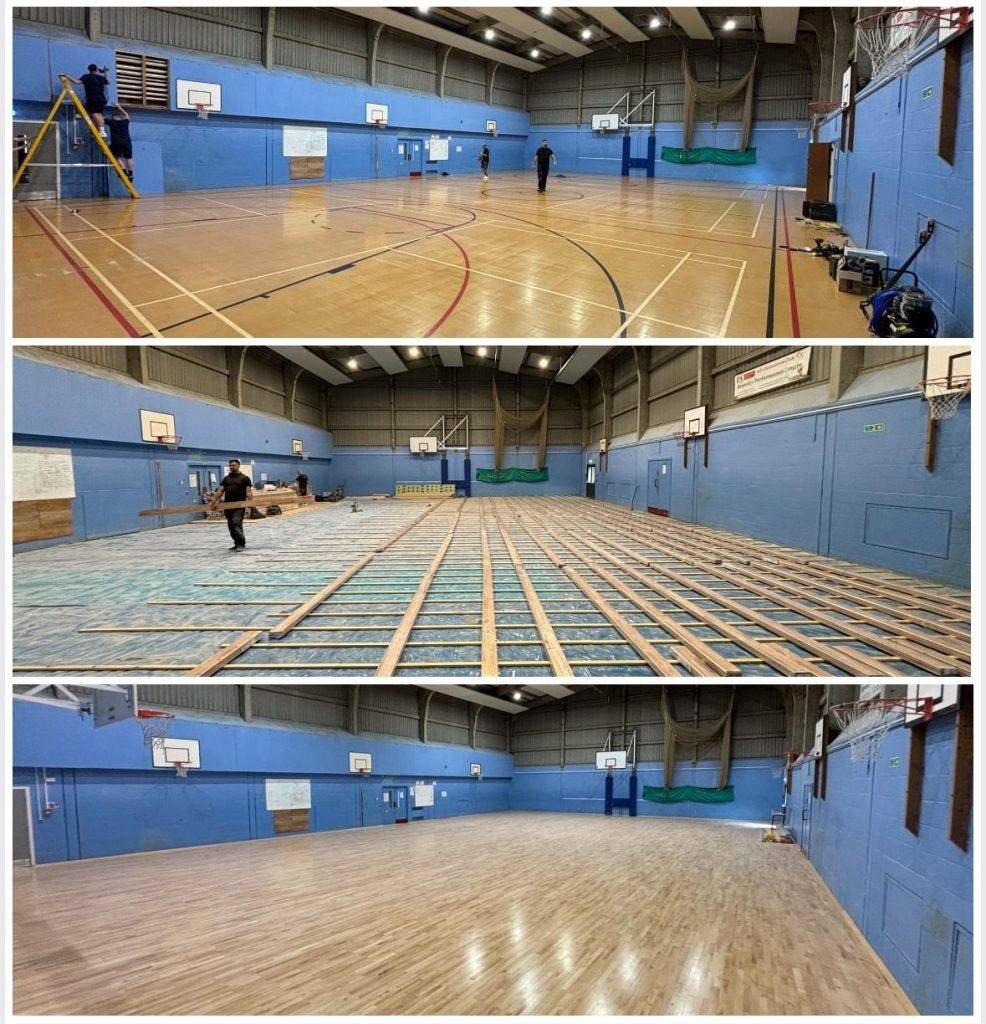
Harris Academy wanted a sports floor to match its ambitions, so we fitted a complete Junckers solid-beech sports system, the same Danish flooring specified in elite competition venues, finished with full multi-sport line markings.
An installation like that is a long-term statement: properly maintained, it will outlast every pupil currently on the roll. The project ran to programme from bare sub-floor to handover.
~ Matthew Evans
An outstanding company to deal with and they couldn’t have been better to work with. St George’s Ascot now has a stunning new sports hall floor and we are delighted. From quote, support, delivery and after sales, the Team has been brilliant. Thank you. 
~ James Anderson








Granwood turns up in a great many halls built between the 1950s and the 1980s. The blocks are wood flour and cement, pressed and laid in a bitumen bed, and they are far harder than timber. They also carry almost no surface material, so a sanding machine ruins them.
A sound Granwood floor is restored by careful preparation followed by a modified epoxy coating system, with court markings applied within the same programme. The result is an even, bright surface that most people take for a new floor, at a fraction of the cost of lifting and replacing it.
The bed is the caution. Bitumen laid before the mid 1980s may contain asbestos, so we treat it as suspect until tested and plan the work so it stays undisturbed. If you are unsure what your Dorset hall has underfoot, a photograph is enough for us to tell you.
Boards in a hall near the Dorset coast live in damper air than boards inland, and they show it. Timber takes on moisture through a wet autumn and gives it up once the heating runs, changing width a fraction each time. Across a whole floor that becomes visible movement.
Fine gaps that open in January and close by May are normal and need nothing doing. Trouble starts when the swing is extreme: a hall left cold and damp all summer, or heating brought up hard in October, can cup or split boards that were sound.
The remedy is steadiness rather than more heat. Keep the hall within a sensible band of temperature and humidity through the year, bring heating up gradually, and make sure the ventilated gap around the edge of the floor has not been blocked by a new skirting or threshold.


Copying the lines already on a floor is the quickest way to reline a hall and the surest way to keep every error the previous contractor made. Netball thirds drift out of equal, three point arcs flatten, and nobody notices until a coach with a tape measure complains.
We set out from the current governing body dimensions with laser and tape. Netball at 30.5 by 15.25 metres. Basketball at 28 by 15 metres with the arc at 6.75 metres. Badminton at 13.4 by 6.1 metres. Both ends are checked against each other before paint goes down.
On timber the lines are applied between coats of seal, so the final lacquer protects them and they last as long as the finish. Lines painted on top of a finished floor start lifting within a season, which is usually why a hall seems to need relining far too often.
Dorset is close enough to our base for us to be on site quickly, and the work divides between school sport, leisure facilities and a large number of community halls.
School and academy sports halls are the biggest group. The recurring issue is halls that have gone a decade or more without a proper refinish, where the seal has worn through in the traffic lanes and dirt is now sitting in open timber. Left much longer, the staining goes deep enough that sanding will not fully remove it, which is why we encourage schools to plan on a cycle rather than waiting for a complaint.
Leisure centres and community sports facilities follow, where the driver is keeping the building trading and most work happens overnight or across a quiet week.
The third group is village halls, church halls and club buildings. These are usually committee decisions funded by hire income and fundraising, so we quote by element and phase the work where it helps.
Because we are local to this part of the country we can survey quickly and often fit smaller jobs around larger programmes, which helps on both cost and timing.
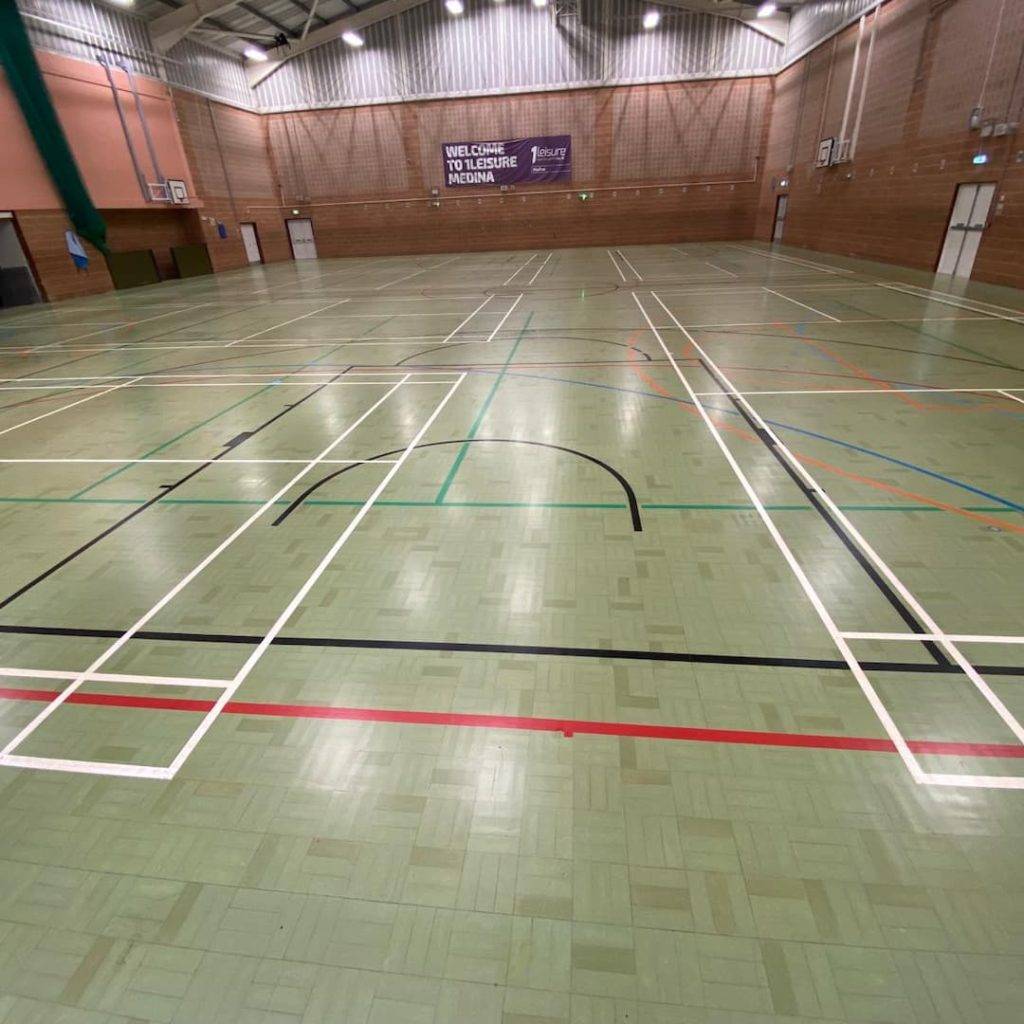
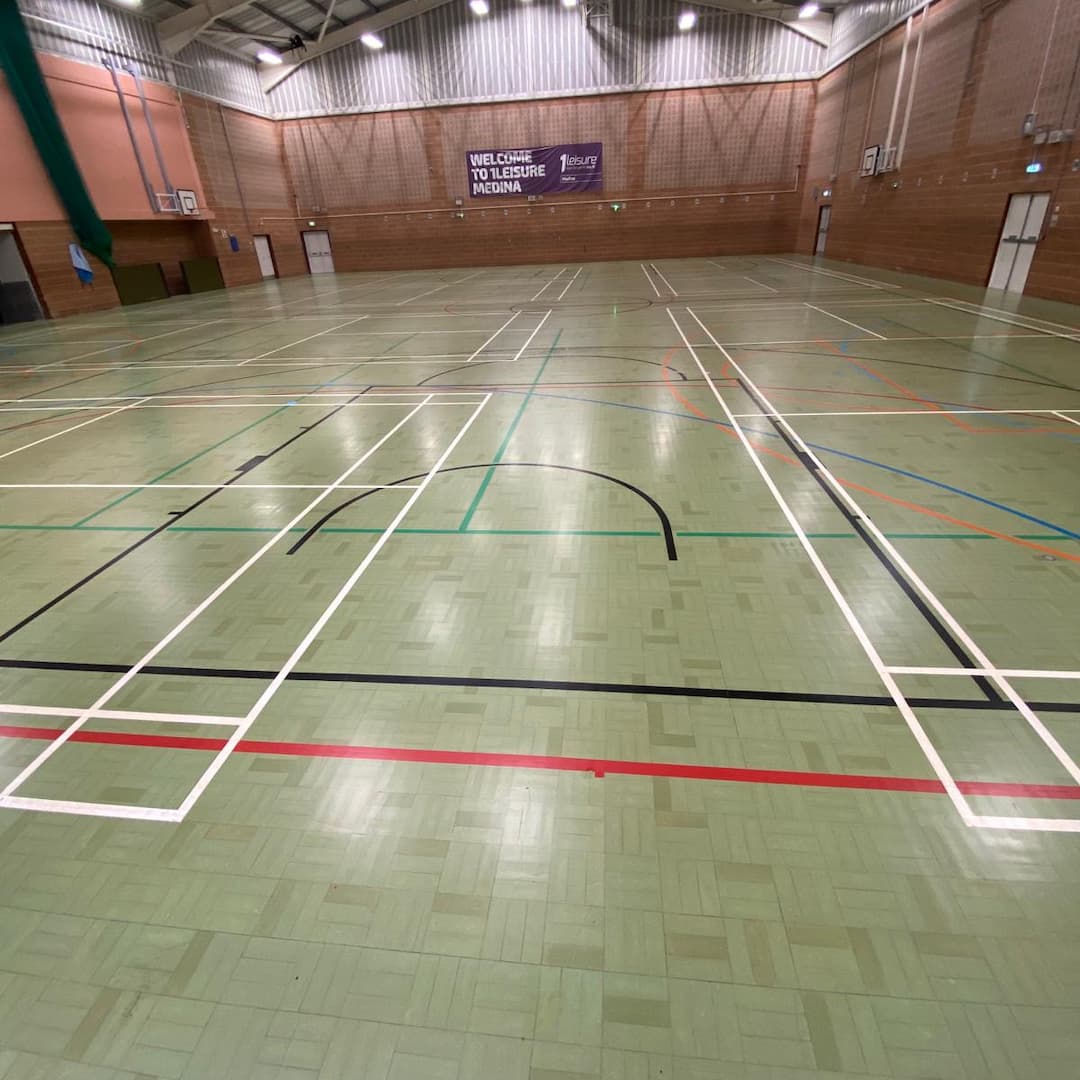
Because Dorset is close to our base, the projects we point to for comparison are ones many local facilities managers already know of.
St Katherine Hall is the closest for community buildings. An old timber floor carrying badminton one evening and a community event the next, under decades of accumulated polish, with chair and table scoring across the whole area. The polish came off chemically before sanding, the boards underneath had plenty of depth, and the hall is now good for another few decades.
Medina Leisure Centre is the comparison for operator run facilities, where the constraint was booking income rather than budget, solved by programming around the centre timetable rather than asking the centre to work around us.
For schools, De Wint School is the closest: a hall long overdue a refinish, with a fixed term date and no flexibility at the end of it.
Being local, we can usually get to a survey within days rather than weeks.
Sanding a hall generates fine dust in quantity, and the difference between a job that leaves the rest of the school clean and one that does not is equipment and preparation. Our machines run on sealed vacuum extraction, which takes most of it at the drum.
Edges are where dust escapes on a careless job, so we use extracted edge sanders too. Doorways are screened, vents are taped, and we agree with your site team which corridors and air handling routes to isolate before the first pass.
In a Dorset leisure centre where the hall shares ventilation with a pool, or a school running a summer club next door, that conversation happens before we arrive. The room we work in will be dusty for a few days. The rest of the building should not notice we are there.
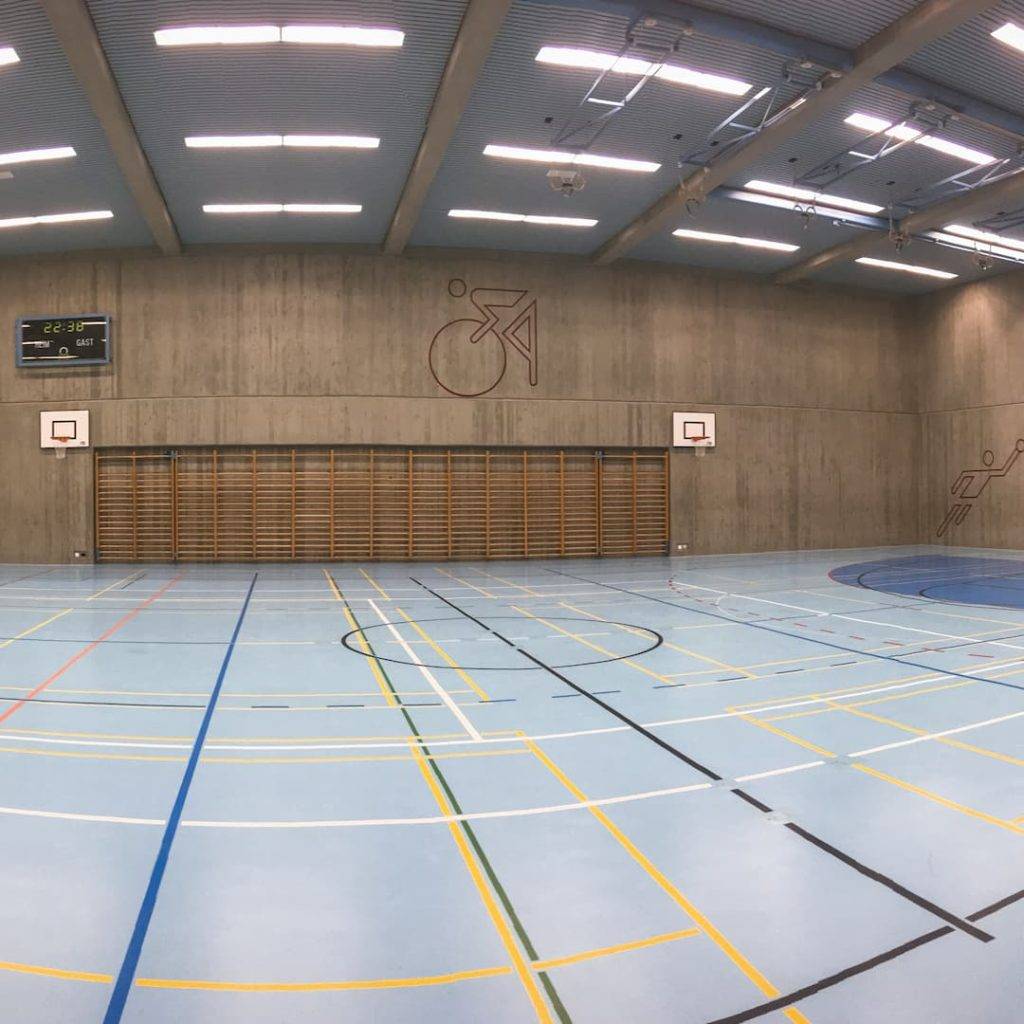
Around 24 hours for light foot traffic and 72 hours or more before posts, trolleys and mats go back. Cold rooms take longer. We give exact times for the seal used and suggest the hall is locked until they pass.
Yes. We paint crests, keys and zones from your artwork between coats of seal so they are protected by the final lacquer and wear evenly with the floor. During a refinish it adds very little to the cost.
Yes. A soft or dead patch means a pad, batten or cradle under the boards has failed. We lift the boards locally, replace the failed parts and refit the boards, usually as part of a wider refinish. Surface work alone will not change it.
Yes. We sand and seal between the last session and the first, timing the final coat so the hall is usable by morning. The extra labour is priced openly and is usually small against the income a closure would lose.
If the seal is worn but still intact everywhere, a screen and recoat restores grip and appearance in a few days. If the lacquer has gone through to bare timber in the traffic lanes, only a full sand will do. The survey tells us which.
Yes. We keep original timber wherever it is sound, sand progressively rather than aggressively, match repairs by species and grade, and choose a finish that suits the building. We can advise on what conservation officers usually accept.
Yes, and it makes sense to do both in one visit. Stages are often a different timber and usually in worse condition. A matt seal keeps lighting from reflecting into the audience and hides scuffing from scenery.
Yes. Everything is itemised, so a committee can take the sanding and sealing this year and the relining or stage next year. Our survey report ranks the work by urgency and says plainly what should not wait.
Book a free survey of your sports floor in Dorset. We are close enough to be on site within days, and we will tell you plainly what it needs, what it costs and when. Call 01823 674562 or send us a message.