
Flooring Professionals To The Leisure Industry
Courtship Flooring is a commercial sports flooring contractor working in Dundee and across the UK. We work with universities, colleges, schools and leisure operators, planning each project as a complete visit.
Since 1987 we have worked on indoor sports floors the length of the country and internationally. We remain family-run and deliberately specialist, covering installation through to long-term aftercare with our own team and machinery. We take no domestic work; Ryan’s Restorations covers that.
Before replacing a floor in Dundee, it is worth asking whether a sports hall floor refurbishment would do the job; on sound timber it usually will.
Overnight/Weekend Installations
Professional Cleaning Demonstrations
Squash Court Maintenance
Recommended Cleaning Products
Professional Pendulum Slip Testing
Deep Clean & Reseal Service

An education sports hall is rarely used only for sport. Examinations, assemblies, catering and events all land on the same floor, and furniture rather than activity causes most of the damage we repair.
Specifying means choosing a finish tough enough for chairs and staging while retaining acceptable grip and shock absorption for activity, and being explicit about that compromise rather than pretending it does not exist.
Protective covering laid over the playing surface for exams, events and catering prevents almost all furniture damage and lifts quickly afterwards. It costs a fraction of the repairs it avoids and is routinely skipped.
We advise on the right type for your surface, how to handle and store it so the covering itself does not mark the floor, and where it is not worth the effort.

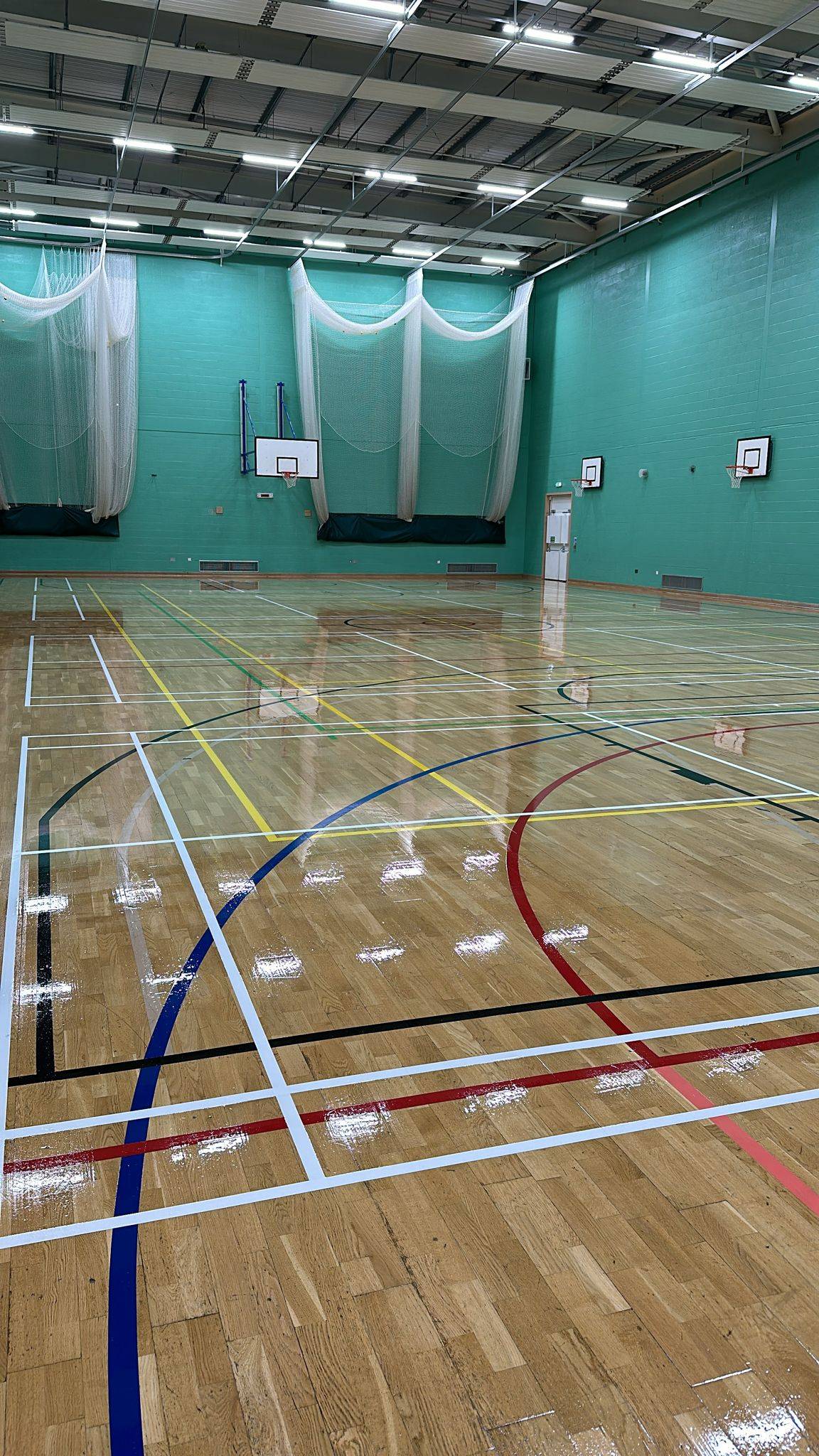
Vacation periods are short and immovable, so a refurbishment has to be sequenced with contingency deliberately built in rather than assumed. Curing cannot be rushed without damaging a finish that has just been paid for.
We confirm the programme and handover date in writing before starting, and phase larger facilities so part of the space stays usable throughout.
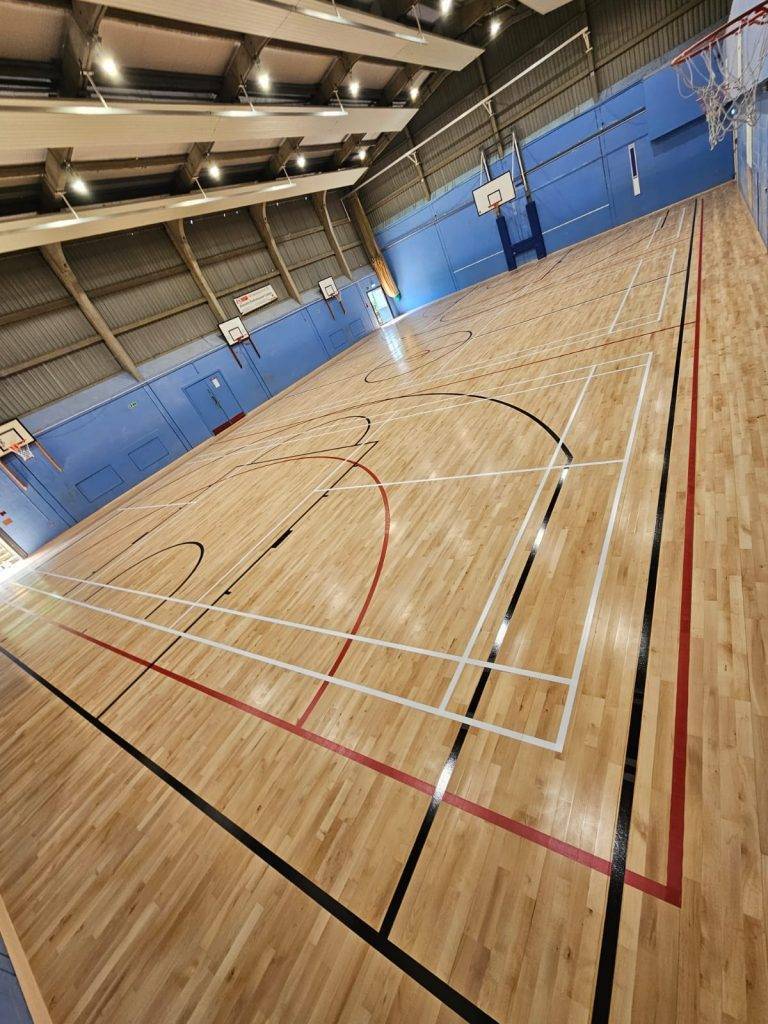
The sports hall floor at Treguib had given years of service and looked it. Our team took it back to clean timber, repaired the wear, then resealed and re-marked the full hall.
The result is a floor that plays and looks like new for a fraction of replacement cost, delivered a long way from our base and still on the date we promised.
~ Matthew Evans
An outstanding company to deal with and they couldn’t have been better to work with. St George’s Ascot now has a stunning new sports hall floor and we are delighted. From quote, support, delivery and after sales, the Team has been brilliant. Thank you. 
~ James Anderson







A slippery sports hall floor is the complaint we hear most often from leisure managers, and the first step is to measure it rather than argue about it. We carry out pendulum slip resistance testing to the recognised method, taking readings in the busiest routes, at the centre of each court and near the doors where grit collects.
Each reading gives a pendulum test value that sits either side of the accepted threshold for low slip risk, and the pattern across the room usually tells us more than any single number. Low values at the doorways point to contamination. Low values everywhere point to polish build up or a seal worn smooth.
You receive a written certificate with the values, the locations and the date, which is useful evidence for your insurer and your safety file. Many Dundee operators now test annually so the record shows a floor being managed.
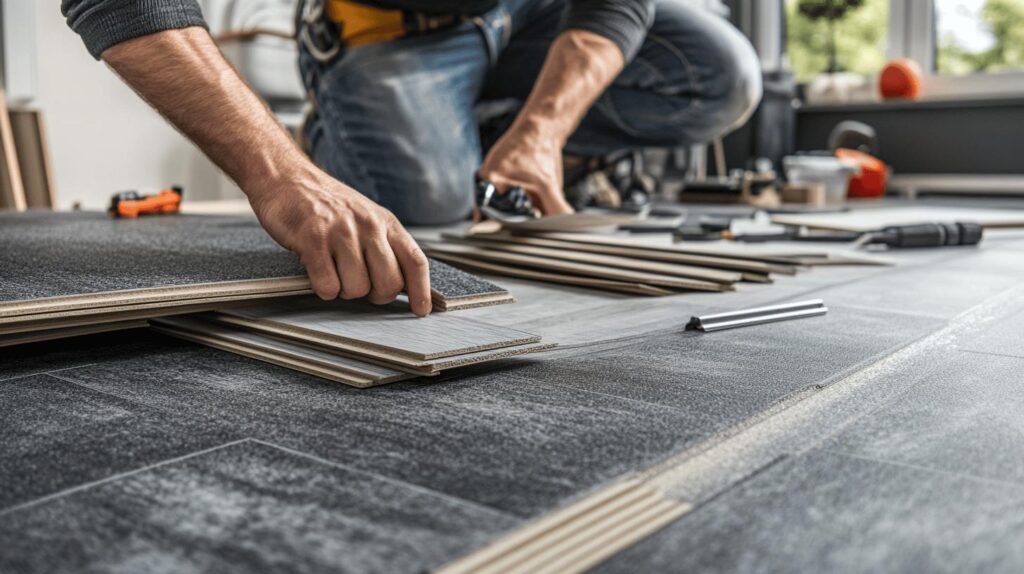
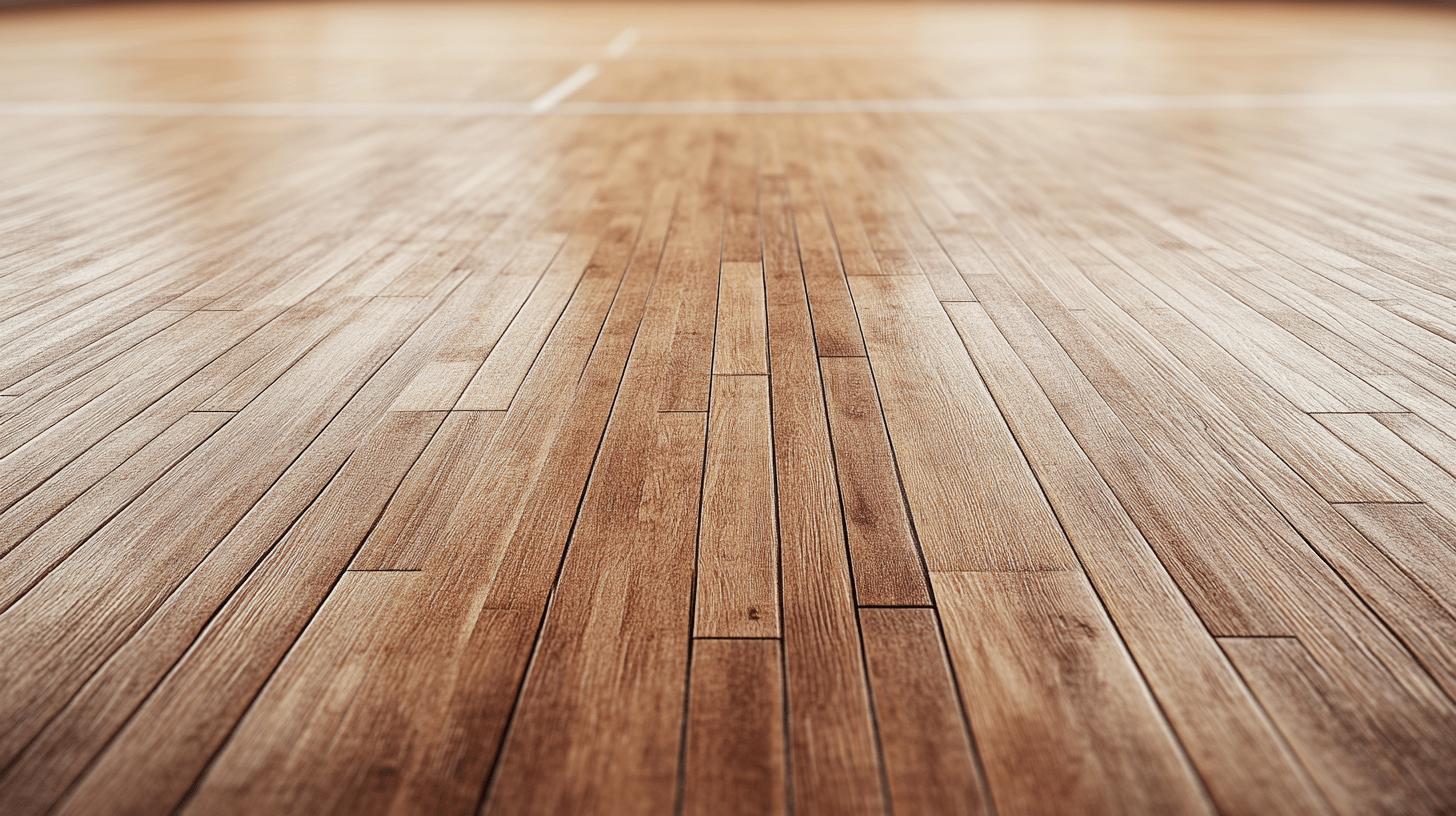
There are two ways to refinish a timber sports floor and they are not interchangeable. A screen and recoat abrades the existing seal with a fine mesh, cleans the surface and applies fresh two pack polyurethane over the top. It takes a day or two, removes almost no timber and is the right answer while the old seal is still intact.
A full sand takes the floor back to bare wood, removes every scratch and stain the seal has trapped, and is followed by new markings and three coats of seal. It is the answer once the lacquer has worn through in the busy routes, or when the courts need moving.
As a rule a hall wants a screen and recoat every two to three years and a full sand roughly every ten. Leave the recoat too late and you have bought the full sand early.
A quotation from us is priced from measured facts, and we are happy to explain each line. The area of the floor sets the base. The condition sets the process, because a full sand carries more labour, more abrasive and more seal than a recoat.
Markings are priced by the number of courts and colours, since each set is a separate masking and painting operation. Repairs are itemised on their own, so a dozen replacement boards or a run of failed battens shows as a distinct figure you can accept or defer.
Access, the working pattern and travel to Dundee sit in the preliminaries, and a job done overnight to keep a leisure centre trading costs more than the same job done in a clear week. What you do not get is a single lump sum with the logic hidden inside it.

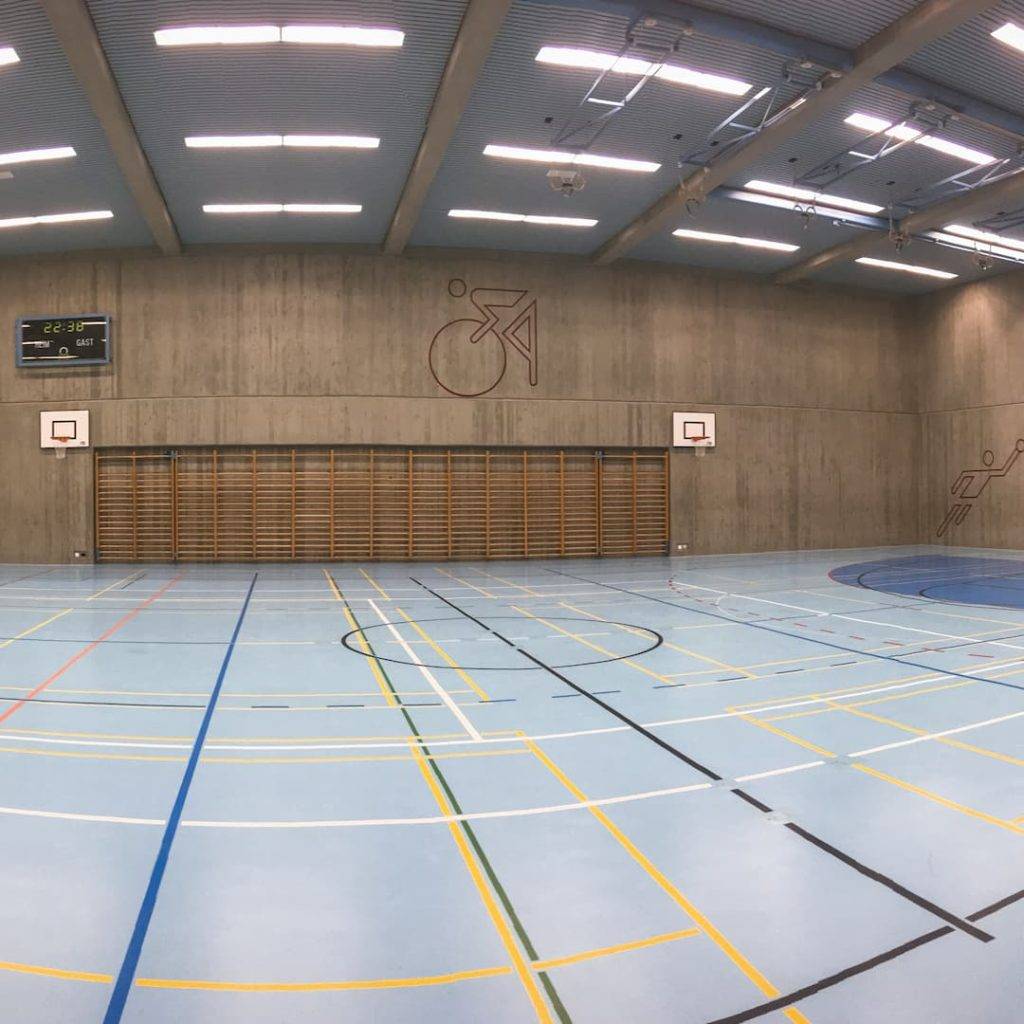
Dundee work comes to us mainly from university and college sport, the council leisure estate and secondary school facilities.
University sport is a substantial part of it. Campus facilities are busy year round, with summer conference and external hire filling what would be a shutdown elsewhere, so the working windows are narrow, fixed and non negotiable. We plan those jobs well ahead and staff them to finish inside the window.
Leisure and community sports centres come next. Booking income makes a long closure expensive, so most of that work is done overnight, with the floor sealed at the end of a shift and walkable by opening time.
School sports halls follow the fixed term calendar, and the hall has to be back for the first day whatever else happens.
Because we travel to reach the area, these projects are planned as continuous blocks with everything brought with us rather than collected locally. It also means that sequencing two or three jobs into one trip is worth doing, and it brings the cost down for all of them. If you know of another facility considering work, it is worth mentioning.
The enquiries we take from Dundee tend to fall into three groups.
University and college facilities usually come to us with an even wear pattern across a heavily used hall, where the question is timing rather than diagnosis. Those floors want catching before the seal goes through, which keeps them on a screen and recoat cycle rather than a full sand.
Leisure centre halls more often arrive with a specific complaint, most commonly that the floor has become slippery. The cause is nearly always polish build up or a seal worn smooth in the busiest routes, and both are straightforward to correct once identified.
School halls tend to present with markings rather than surfaces. Courts remarked repeatedly by copying the previous set drift over time, and a hall that has been done several times that way can be measurably out. We set out from measured governing body dimensions, which often turns out to be the first time in decades.
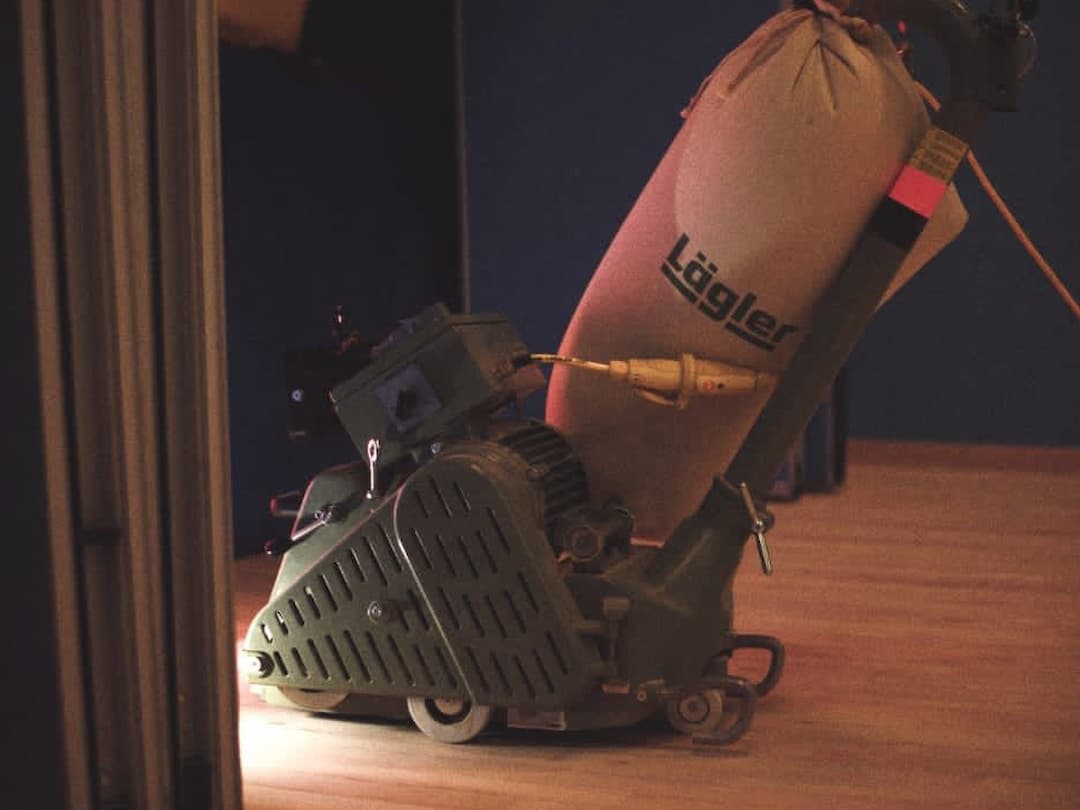
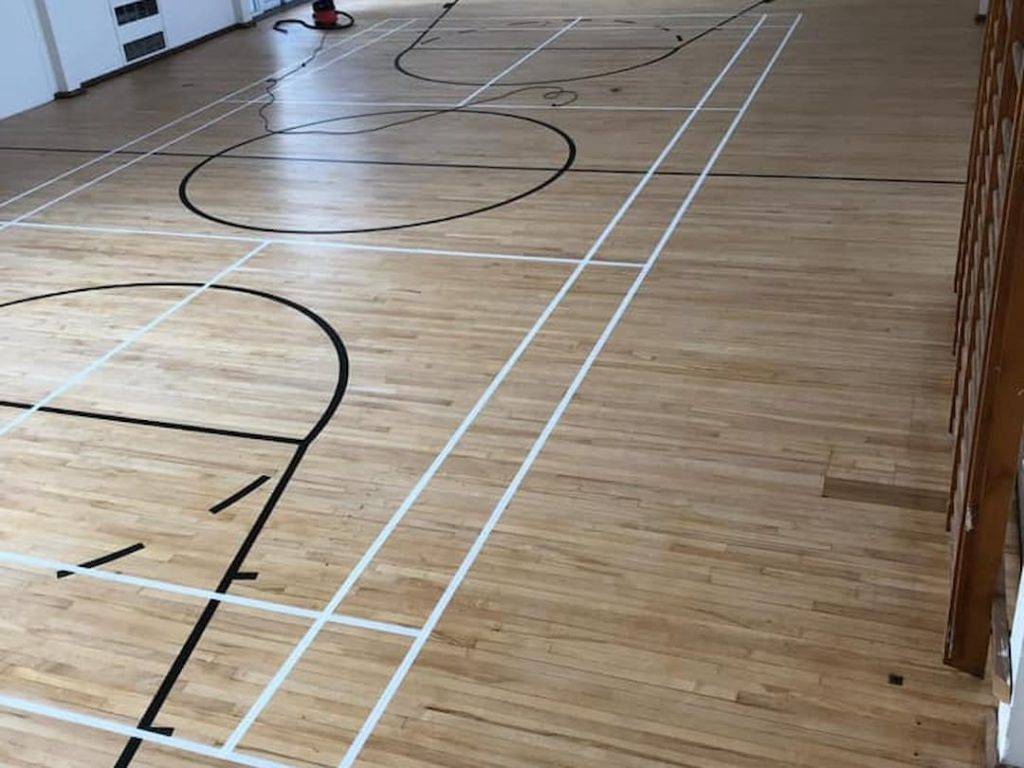
Every job we do is carried out by our own employed floor layers using sanding machines, edgers and dust extraction that we own and maintain. That sounds like a small point until a contractor arrives with a hired machine nobody on site has used before, or subcontracts the marking to somebody who has never met the person who sealed the floor.
Because the same crew survey, sand, mark and seal, there is nobody to blame but us, and the quality of the finish reflects that.
It also matters for a site a long way from our base. A crew travelling to Dundee brings everything with it, including spares for the machines, so a breakdown on a Tuesday night does not become a hall that is shut on Wednesday. The people who quote the work are the people who stand behind it afterwards.
We stop and tell you before any sanding starts. Moisture readings are taken at survey, and if the subfloor is wet we trace the source with you, because sealing a damp floor locks the problem in. Once the cause is fixed and the timber has dried back, the refurbishment goes ahead as planned.
The blocks themselves are wood flour and cement, but the bitumen bed some older floors sit in can contain asbestos fibres. We never disturb that layer without a test result. Refurbishing the surface with a sand and epoxy coating leaves the bed untouched, which is usually the safest and cheapest route.
Light foot traffic is fine after 24 hours, which is why an overnight shift can hand a floor back for morning. Trolleys, mats, benches and posts wait 72 hours or longer so the two pack seal has hardened through. We put the exact times in the handover note.
A dry mop every day to lift grit, then a damp mop with a neutral cleaner made for sealed timber or vinyl. No polish, no wax, no products that promise a shine, because they build up and make the surface slippery. We leave a one page regime with every job.
We guarantee our workmanship and the materials we apply, and we put the terms in writing with the quotation. If a seal fails or a marking lifts through a fault of ours, we come back and put it right. Damage from furniture, water or the wrong cleaning products is outside that, and we say so clearly.
Yes. Our team hold enhanced DBS certificates, and we issue risk assessments, method statements and COSHH sheets for every product before we arrive. Insurance certificates are sent with the paperwork so your bursar or estates office has a complete file before the first van pulls in.
Yes. Squash court floors are usually maple or beech strip laid as a floating panel, and they need a specific finish that plays correctly under a squash shoe. We sand, seal and re-mark courts, replace damaged strips and sort out the tin and door detail if it has worked loose.
Yes. Loose or corroded sockets for netball and badminton posts are lifted, the timber around them made good and new fittings set flush with the finished surface. It is far easier to do this during a full sand than afterwards, so tell us at survey if any are moving.
Book a free survey of your sports hall floor in Dundee and we will tell you plainly what it needs, what it will cost and when we can do it. Call 01823 674562 or send us a message today.