
Netball is the sport British sports halls most often get wrong. Court dimensions and line specifications have been revised over the years, and a great many school and community courts are still marked to layouts that were superseded a long time ago.
Courtship Flooring marks and re-marks netball courts across the UK to current specifications, either as part of a refurbishment or as a standalone visit on a sound floor. Commercial and institutional facilities only.
Netball lines are usually one layer of a wider scheme, and our sports hall line marking service sets out every court in the hall so the colours and priorities work together.
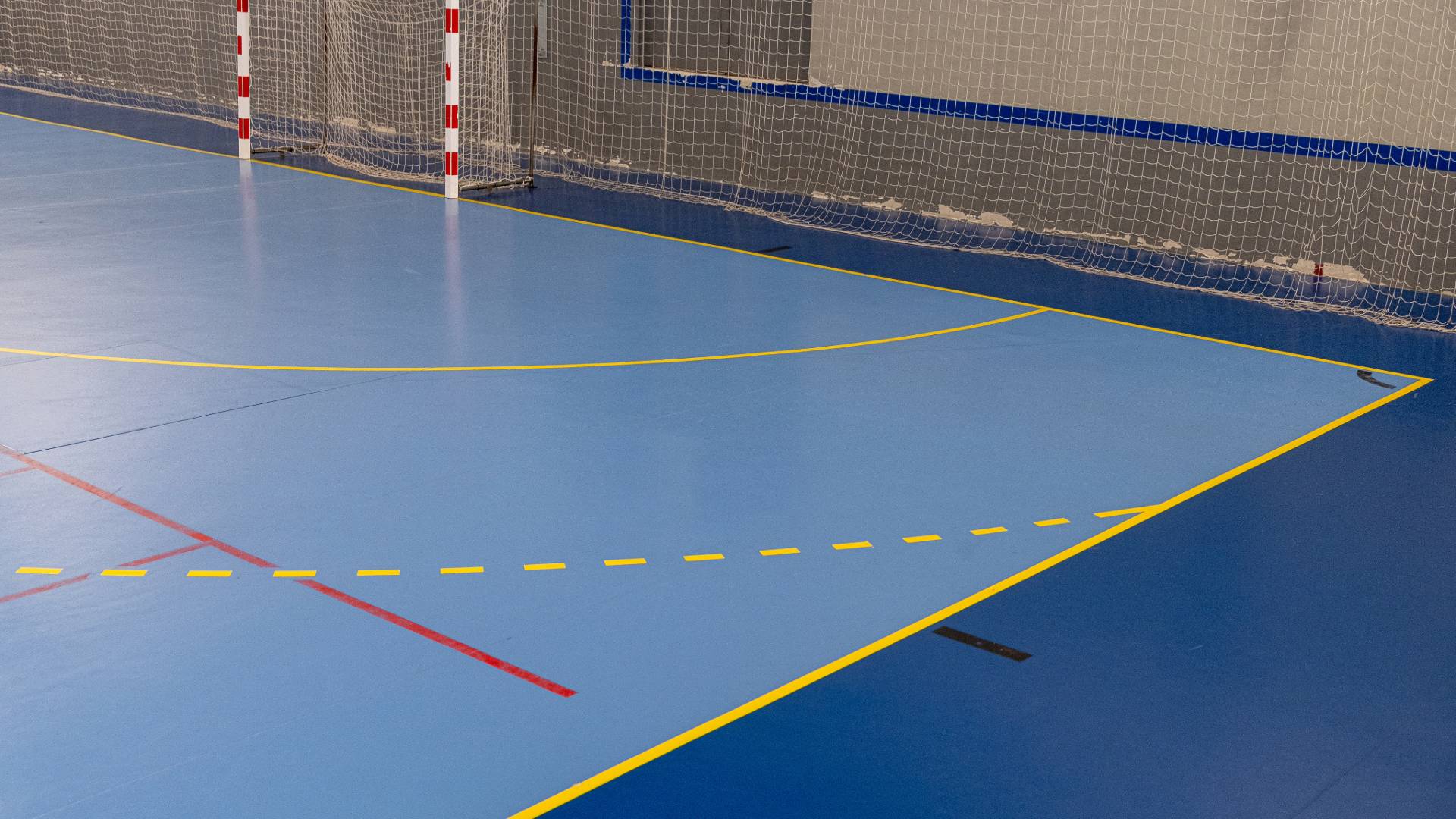
A full netball court is thirty metres by fifteen, divided into thirds with a centre circle and two goal circles, and every one of those elements has a defined dimension. Where a hall cannot accommodate a full court, the sensible approach is a correctly proportioned reduced court rather than an improvised one.
We mark to the current England Netball specification, and where a hall hosts competitive fixtures we confirm the requirements before any paint goes down. The dimensions, line widths and run-off a court needs are set out further down this page.
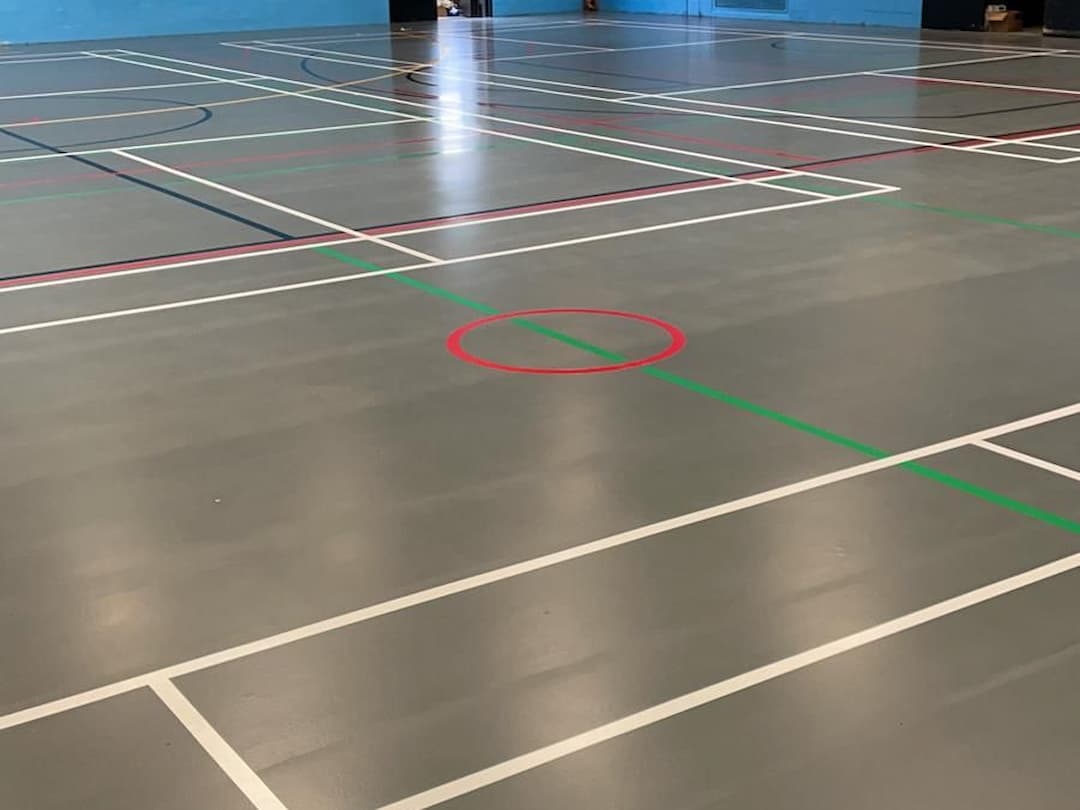
Netball rarely has a floor to itself. It usually shares with basketball, badminton and five-a-side, and the thirds and circles can disappear into a mess of lines if the layout is not planned.
We plan the hierarchy deliberately: the primary sport reads instantly, and netball sits in its own clearly distinguished colour with line weights chosen so the thirds remain legible at speed. Where netball is the primary sport, everything else works around it.
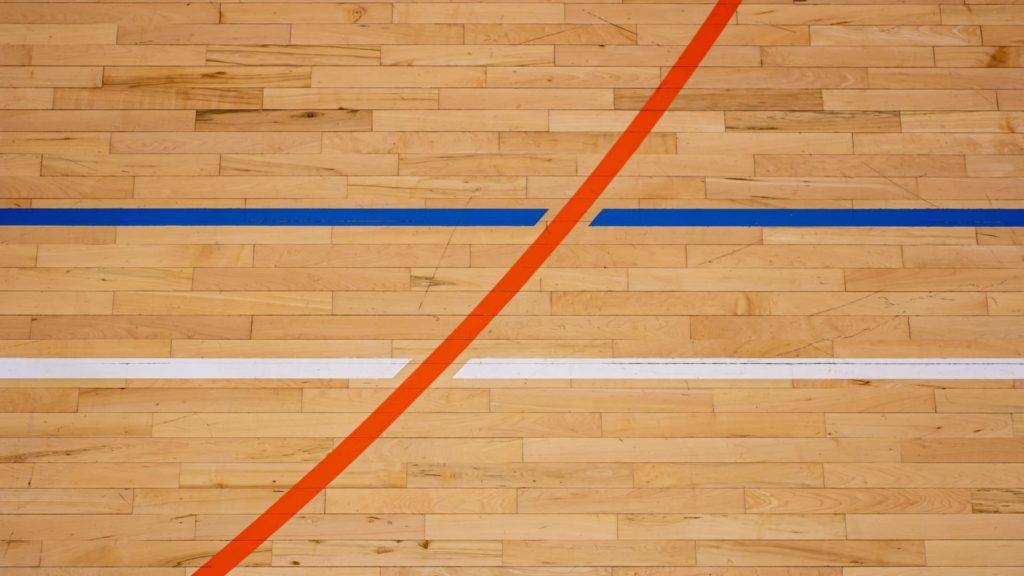
Netball involves hard landings and sudden stops, frequently right on a line. That makes the marking paint a safety component, not a decorative one: a line with different friction to the floor around it is a hazard exactly where players plant.
We use specialist proprietary systems applied between coats of seal so the lines sit within the finish rather than on top of it, keeping friction consistent across the whole playing surface. It can be verified with a pendulum slip test.
If the floor is sound and only the markings have faded, there is no need for a full refurbishment. We prepare the marking areas, apply the new lines and seal over them, typically in a day or two including curing.
It is the cheapest way to correct a court that is out of specification and to make a tired hall look cared for again. Most halls benefit from relining every two to three years.
A netball court is 30.5 metres long and 15.25 metres wide, divided into three equal thirds of just over ten metres each. The centre circle is 0.9 metres in diameter and the goal circles are semi circles of 4.9 metres radius struck from the centre of each goal line.
Those are the headline figures, and most halls get them roughly right. The detail that gets missed is the line width. England Netball specifies lines of 50 millimetres, and the lines are part of the court, so a shooter standing on the goal circle line is in the circle. Mark them too thin and the court plays differently from every other court those players use.
The other frequent error is the thirds. They must be equal, and they must be measured rather than eyeballed from an existing set of lines. We regularly remark halls where the thirds are out by fifteen or twenty centimetres, which has been quietly affecting play for years because nobody had a reason to check.
Run off is the last piece. England Netball asks for a clear 3.05 metres around the court for competitive play, and while very few school halls can offer that, it is worth knowing where you stand before a fixture is scheduled.
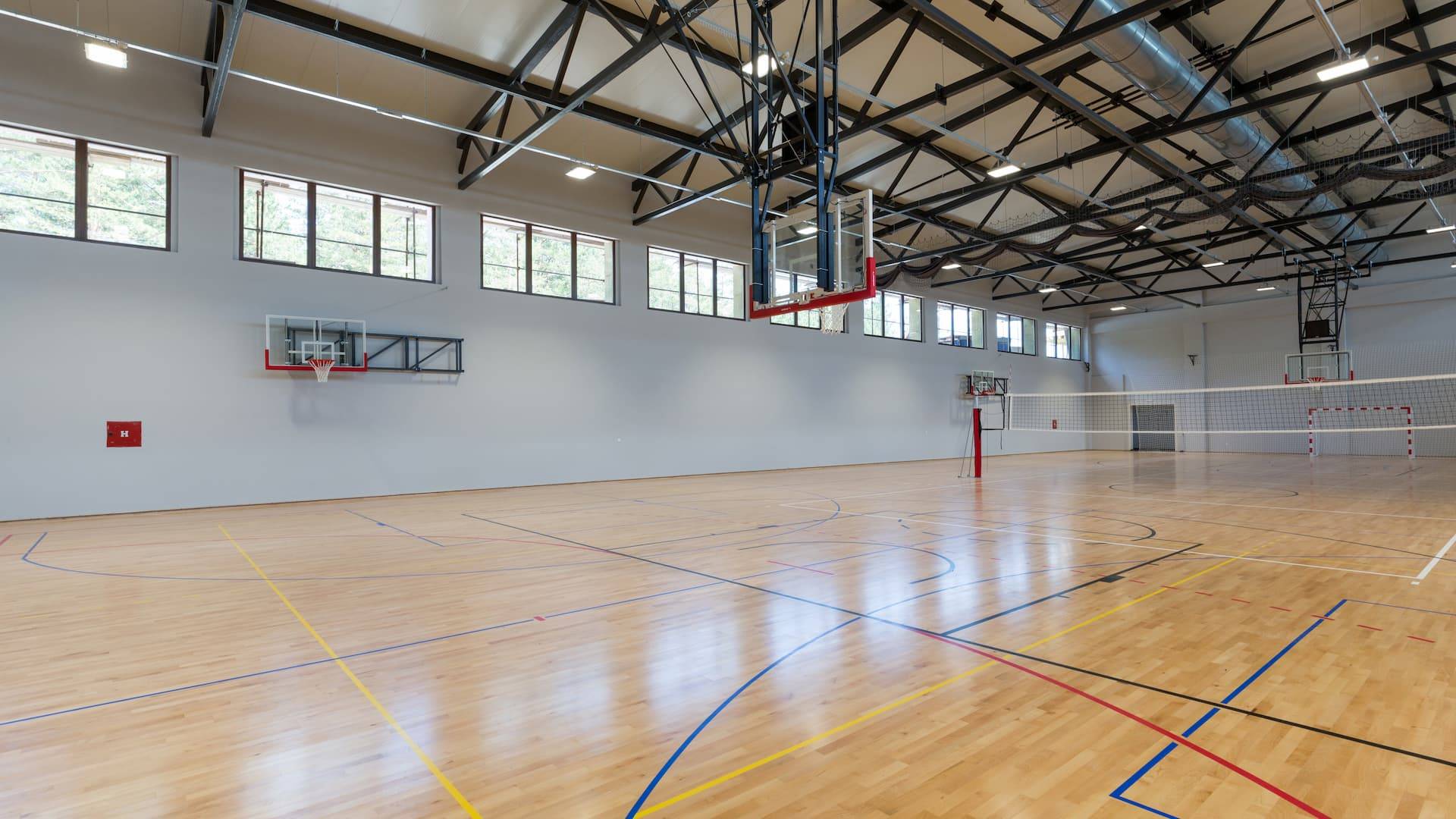
The honest position is that a full size netball court does not fit in a large number of British sports halls, and pretending otherwise helps nobody.
A standard four badminton court hall is usually around 33 by 18 metres, which will take a full court with very little to spare at the sides. Smaller halls, and particularly older school halls, simply will not. When that is the case we have two sensible options, and we will talk you through both.
The first is a proportionally reduced court, keeping the thirds equal and the circles correctly shaped but scaling the whole layout. This plays properly for teaching and recreational use, and it is far better than a full court squeezed to the walls with no run off.
The second is to mark for high five netball or a junior format, which is designed for smaller spaces and is what many primary and lower secondary schools actually play. There is no point marking a senior court in a hall where only younger year groups will ever use it.
What we will not do is mark a court that runs into the walls, because it is unsafe and every coach will know it.
Netball is the sport most likely to clash with everything else on the floor, because it occupies the full hall and its goal circles land exactly where the basketball key sits.
Our starting point is to ask which sport is played most. In a great many school halls that is netball, and if so it should get the dominant colour and the clearest line. Where basketball is equally important we choose two colours with genuine contrast rather than two shades that look distinct on a paint chart and merge under hall lighting.
The goal circles are the pinch point. A netball semi circle crossing a basketball arc and a badminton tramline in the same square metre is confusing to play on and hard to officiate. We resolve it by colour hierarchy and by removing anything genuinely redundant, which is usually the fastest improvement available.
Most halls we visit carry markings for at least one sport nobody plays any more. Taking those out during a refinish makes the netball court read far more clearly than any amount of clever colour selection, and it costs nothing extra while the floor is open.
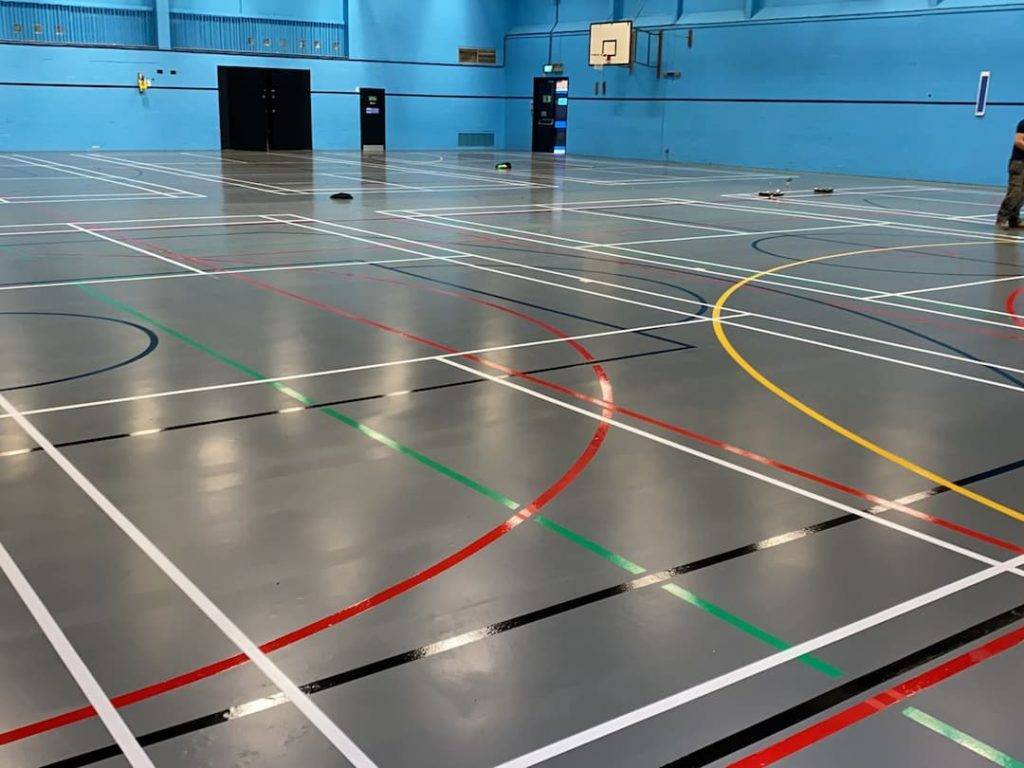
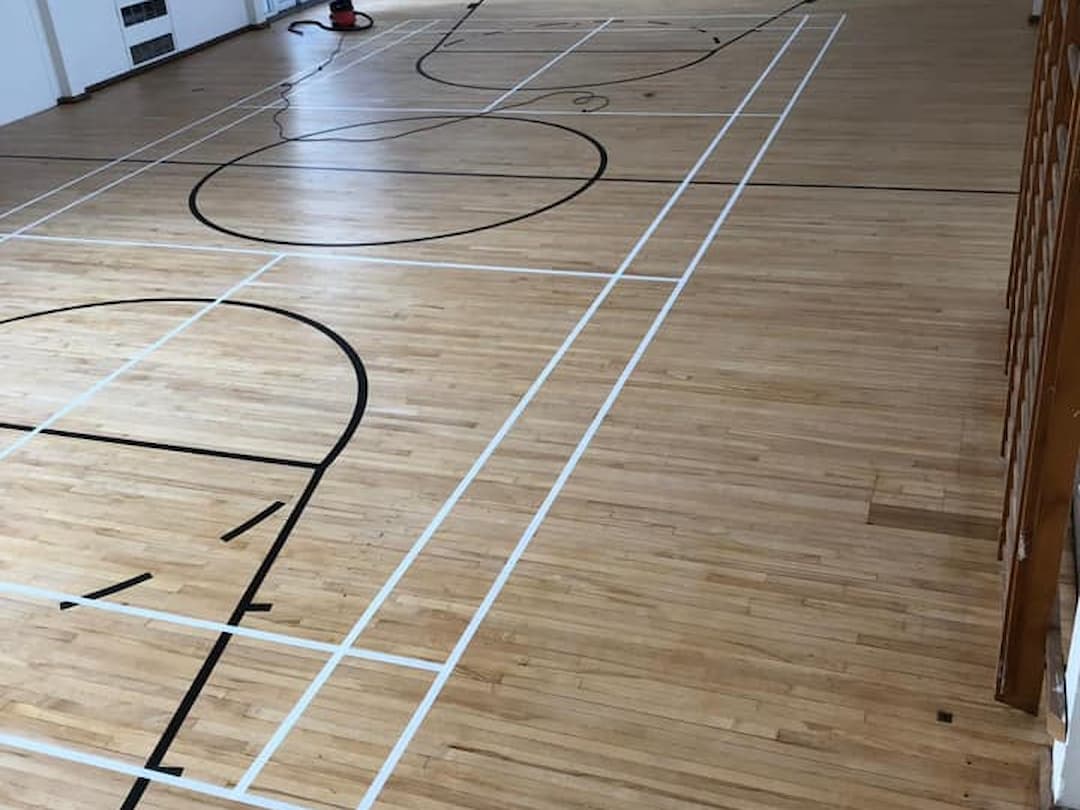
On a timber floor the lines go down between coats of seal, so the paint is sealed under the final lacquer rather than sitting on top of it. That is what makes markings survive years of trainers, trolleys and scrubber driers, and it is the main reason lines applied to a finished floor start lifting so quickly.
The centre circle and the goal circles are struck as true radii with a fixed pivot, not drawn freehand or approximated in segments. Every dimension is checked before painting, and the two ends of the court are compared so the layout is symmetrical.
We use purpose made sports line marking paint, chemically matched to the seal above and below it. On vinyl and polyurethane floors we switch to a system formulated for those surfaces, because a timber product will not bond and will fail within months.
A full netball court in an otherwise empty hall is normally a single day of setting out and painting. What governs how long the hall is closed is the seal either side of the marking, and we give you those cure times in writing before we start.
Netball markings usually need attention for one of three reasons: they have worn, they are wrong, or the hall has changed use.
Wear shows first in the goal circles and the centre third, which take the heaviest traffic. If the lines are still legible but tired, and the floor is otherwise sound, a screen and recoat with fresh markings restores the whole hall for a fraction of a full refinish.
Incorrect dimensions are more common than people expect, particularly in halls that have been remarked several times by copying what was already there. If your thirds have never quite felt equal, it is worth having them checked.
Cost depends mainly on whether the marking is part of a refinish or a standalone visit. Marking during a sand and seal is always the best value because the setting out sits inside work already programmed. A standalone remark of a single court is a short visit and priced accordingly. Removing old markings properly means sanding, which turns a marking job into a refinish, so it is worth combining the two if both are due.
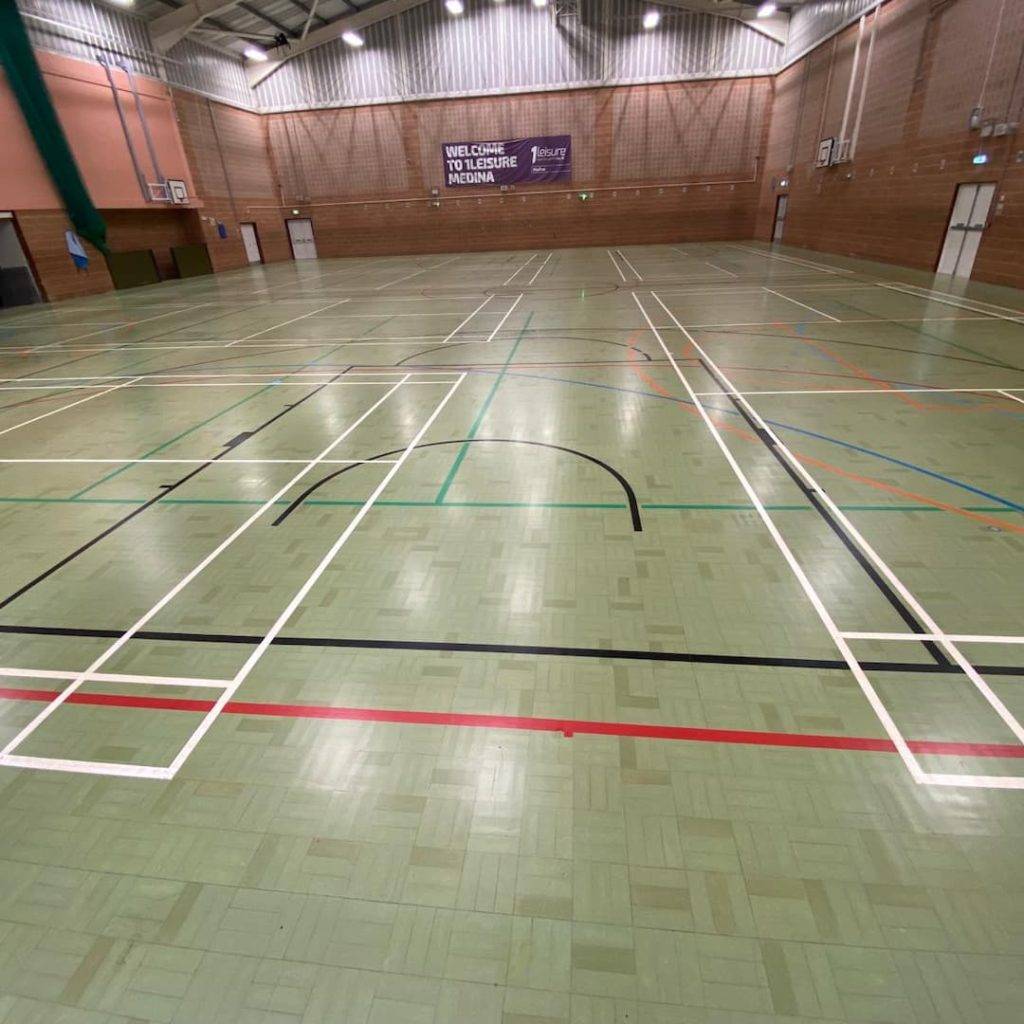
Quite possibly not. Specifications have changed over the years and many school courts still carry superseded layouts. We check against the current England Netball specification at survey and can correct it during re-marking.
Yes, and it usually is. We plan the layout so each sport sits in its own colour with a clear visual hierarchy, so the thirds and circles stay readable even on a hall carrying four or five sets of lines.
Usually a day or two on a sound floor, including curing. If the floor is being sanded and resealed at the same time, marking is built into that programme.
Yes. Where a full court will not fit we mark a correctly proportioned reduced court rather than distorting the dimensions, and advise on what that means for competitive use.
A full court is 30.5 metres by 15.25 metres, split into three equal thirds. The centre circle is 0.9 metres across and each goal circle is a semi circle of 4.9 metres radius. Lines should be 50 millimetres wide.
We can mark a proportionally reduced court with correct geometry, or mark for high five or a junior format instead. Both play far better than a full court crammed against the walls, which we will not mark on safety grounds.
Yes. In netball the lines are part of the area they enclose, which is why line width matters. A player standing on the goal circle line is inside the circle.
Yes, and it is one of the most common combinations we mark. The goal circles and the basketball key overlap, so we separate them by colour hierarchy and agree which sport takes priority first.
A standalone remark is usually one to two days including cure time. If the markings are going down as part of a sand and seal, the marking itself adds very little to the overall programme.
Yes. On timber the reliable fix is to sand the floor and set out fresh from measured dimensions rather than from the existing lines. We check every court corner to corner and diagonally before painting.
The court is 30.5 metres by 15.25 metres, measured to the outside of the lines. UK facility guidance from sportscotland gives a minimum safety run-off of 1.5 metres at the sides and 2 metres at the ends, with 3.05 metres all round recommended for higher-level play. Where a hall cannot provide that, a correctly proportioned reduced court is safer than a full court with too little space around it.
Netball lines are 50 mm wide and need to contrast clearly with the floor. White is common where netball is the main sport, and red is often used in multi-sport halls where white is already taken by badminton. We agree the colour scheme with you before marking so the main sport reads clearly and the others sit behind it.
Send us your hall dimensions and the sports you need marked, and we will price it properly. Call 01823 674562.