
Flooring Professionals To The Leisure Industry
Courtship Flooring is a commercial sports flooring contractor working in Nottinghamshire and across the UK. We work across the county for school trusts, sports clubs and community facilities.
We are specialists rather than generalists, which after nearly forty years means a depth of knowledge on sports and commercial timber floors that a general contractor cannot match. Every stage is completed in-house. We do not quote for domestic work; Ryan’s Restorations handles that side.
If you are comparing contractors, our sports hall flooring overview explains how we approach installation, refurbishment and aftercare in Nottinghamshire and nationwide.
Overnight/Weekend Installations
Professional Cleaning Demonstrations
Squash Court Maintenance
Recommended Cleaning Products
Professional Pendulum Slip Testing
Deep Clean & Reseal Service
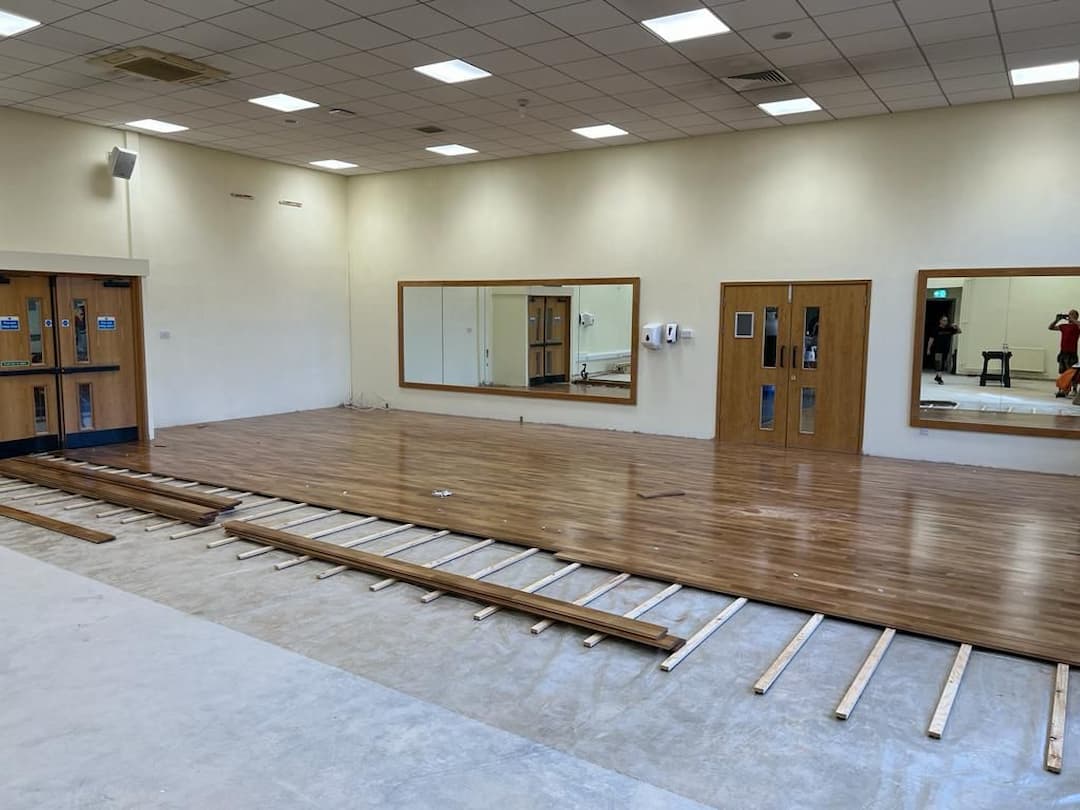
A noisy floor is usually telling you something structural. Squeaking generally traces to fixings working loose or boards moving against one another; a hollow or drumming sound points to loss of contact with the sub-floor beneath.
Neither is fixed by refinishing the surface. We identify the cause during survey and address the fixings or build-up directly, which is frequently far cheaper than the refurbishment people assume they need.
A ball that dies in one part of the court indicates the resilient layer beneath has compressed or failed there, or a batten has lost contact. It is a structural problem and resurfacing will not touch it.
We map dead areas by working across the whole floor rather than spot-checking, then open up and repair the build-up beneath before any surface work. Done properly the area performs identically to the rest of the court afterwards.
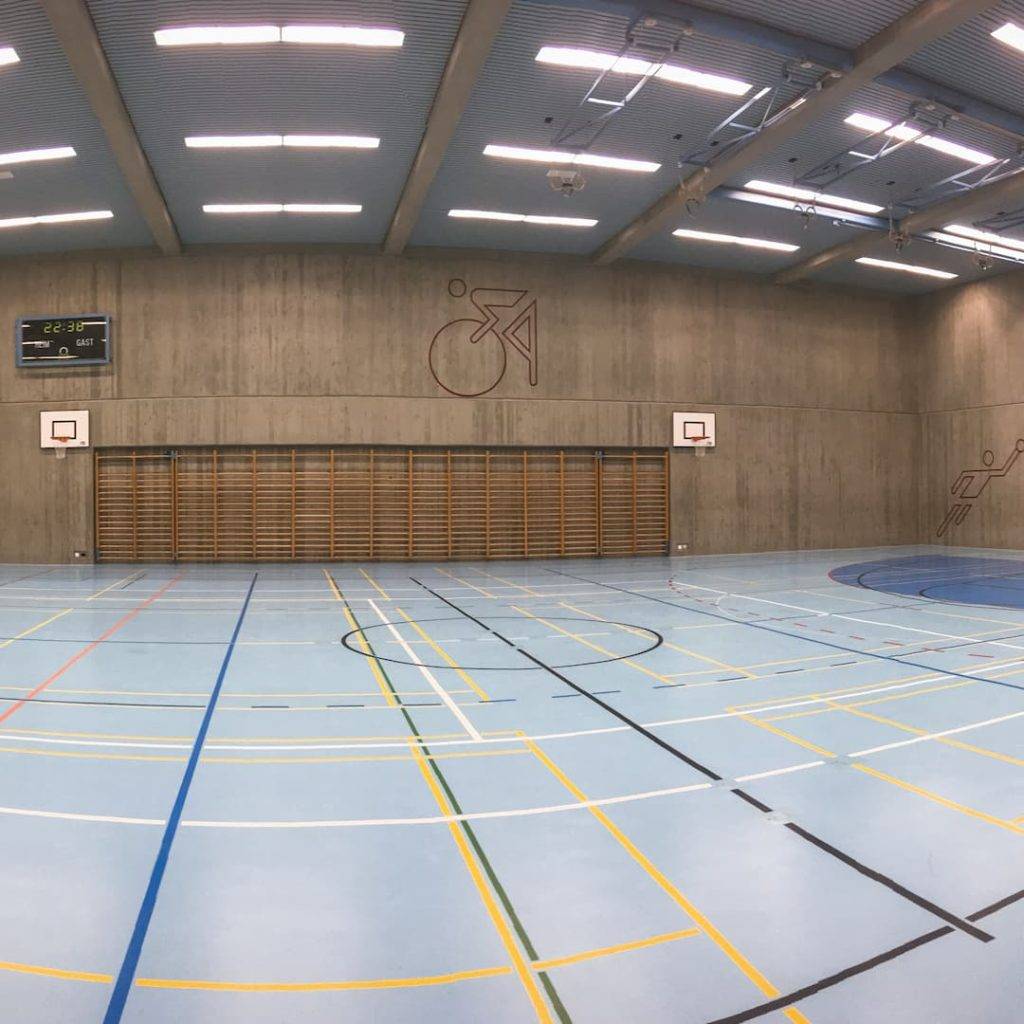
Sanding and sealing addresses the surface, and nothing else. It will not cure movement, dead spots, moisture ingress, failed fixings or a sub-floor that has deteriorated.
Contractors who quote refinishing for those problems either have not diagnosed them or would rather not mention them. We survey for structural causes first, because a beautiful new finish over an unresolved fault is money spent twice.
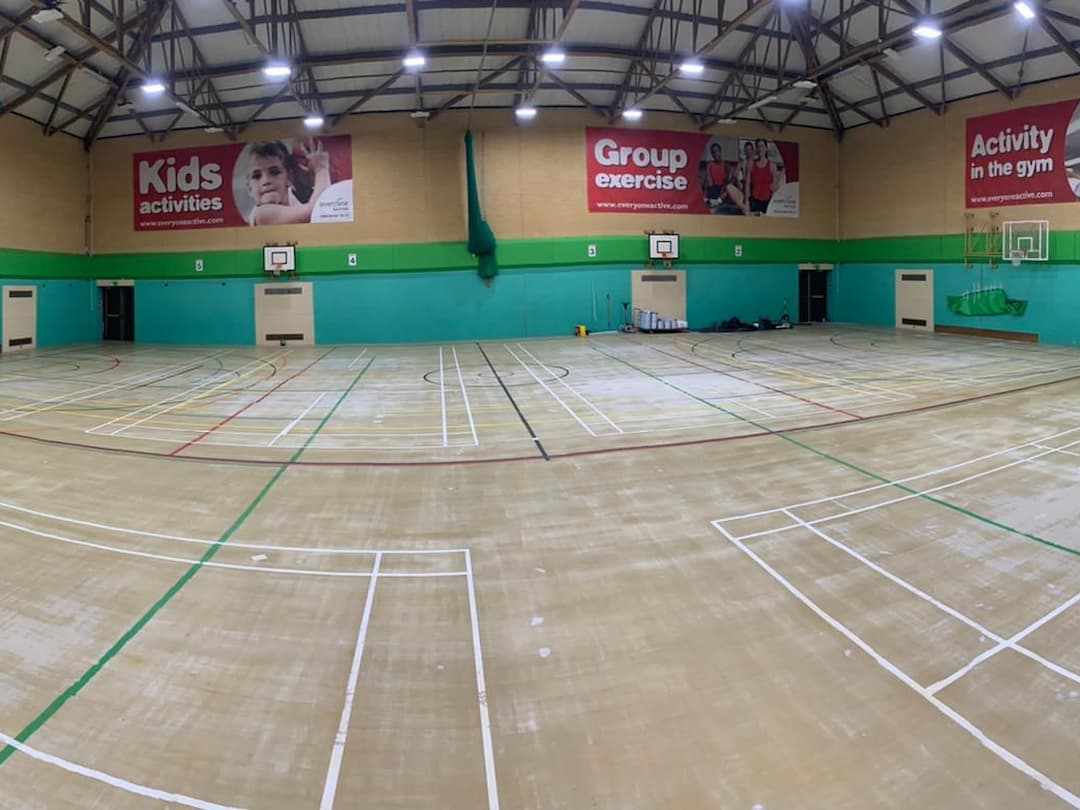
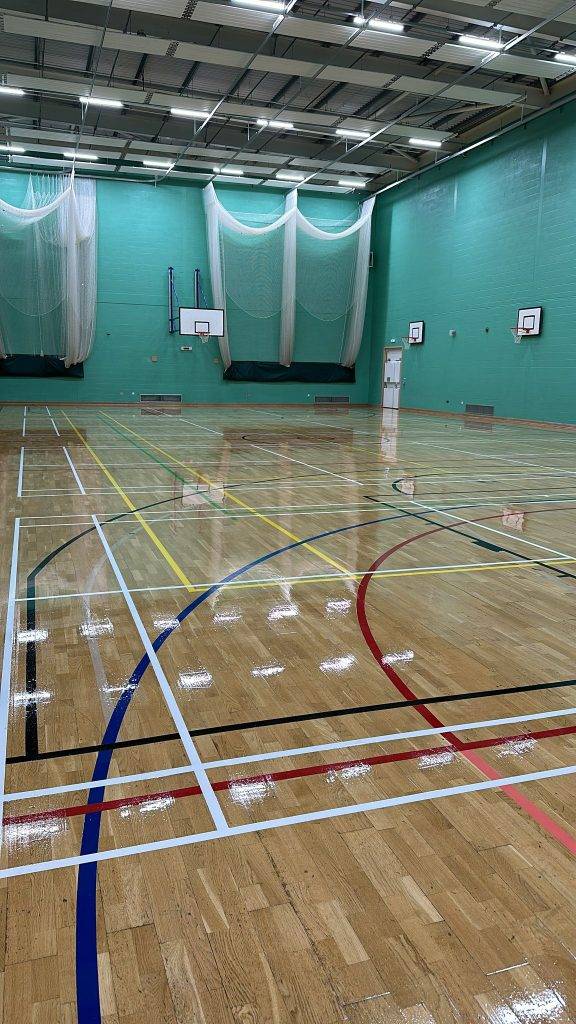
The sports hall floor at De Wint School had reached the end of its seal: grey through the middle, markings closer to guesswork than instruction, and a surface that felt slippery however often it was cleaned.
We sanded it back to clean timber, repaired what needed repairing, resealed and re-marked. The hall reopened with a deep, glossy finish that reads as newly installed, delivered inside a planned holiday window.
~ Matthew Evans
An outstanding company to deal with and they couldn’t have been better to work with. St George’s Ascot now has a stunning new sports hall floor and we are delighted. From quote, support, delivery and after sales, the Team has been brilliant. Thank you. 
~ James Anderson







A timber sports floor lives or dies on what is underneath it. Boards laid over a concrete slab that is still giving up moisture will cup within months, and no seal on the surface can stop it.
So before any new installation in Nottinghamshire we test the slab. A surface hygrometer reading over several days tells us whether the base is dry enough for timber, and if it is not, we install a liquid damp proof membrane or a sheet barrier before a single batten goes down. On older solid floors in church and community halls with no original membrane, this step is the whole difference between a floor that lasts forty years and one that fails in four.
On existing floors we take readings through the boards at survey. A high reading in one corner usually points to a leak, a blocked gully outside, or a wall that needs attention before the floor does.
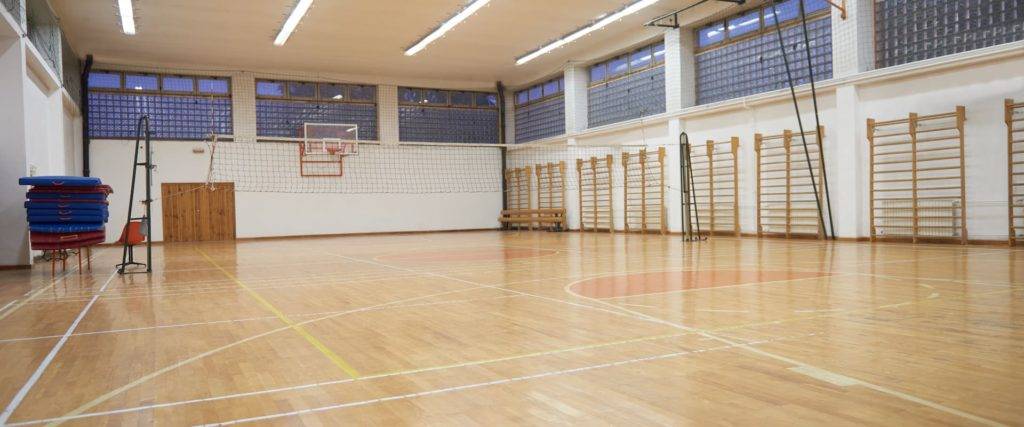
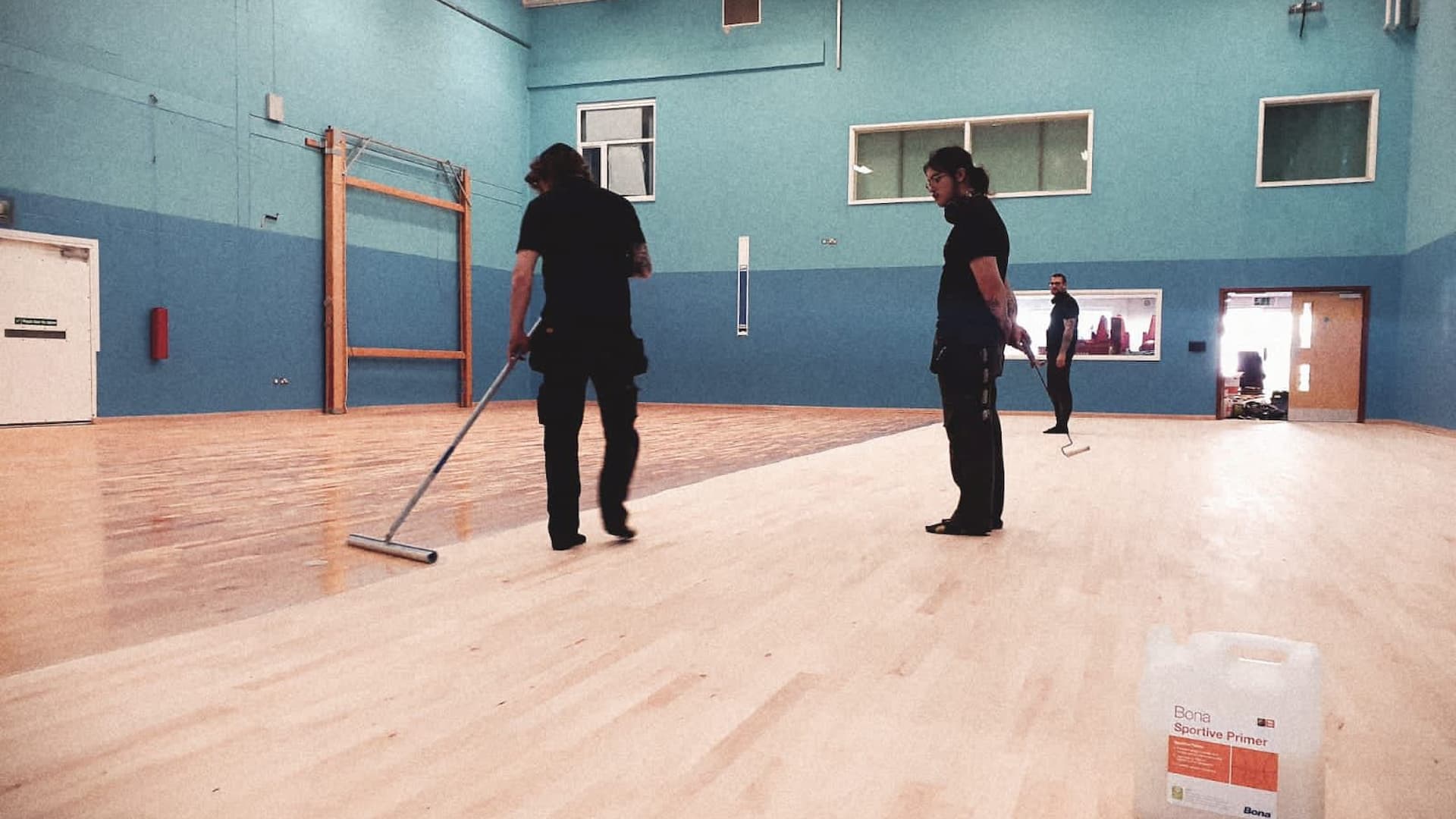
A leisure centre in Nottinghamshire earns money from its main hall every hour it is open, and closing it for a week of daytime work is often the most expensive option on the table.
We run sanding and sealing in overnight shifts instead. The team arrives after the last booking, works through, and hands the hall back cleaned and ventilated before the first session. Coats are timed so each one has reached light traffic strength by morning, with the equipment moved back only when the final coat has fully cured.
Weekend working suits halls with a quiet Sunday, and a long bank holiday weekend can take a screen and recoat from start to cure without losing a weekday at all.
Night work costs a little more in labour. Against the bookings it protects, it is usually the cheaper route, and we quote both so you can see the difference.
Old lines are not a reliable guide to where new ones should go. Halls in Nottinghamshire that have been relined by tracing the previous set are regularly a foot out on a court, and nobody notices until a fixture is questioned.
We set out from the current governing body dimensions every time. Netball at 30.5 by 15.25 metres, basketball at 28 by 15 metres with a 6.75 metre arc, badminton at 13.4 by 6.1 metres. The layout is measured from a fixed datum, squared with diagonals and checked before any paint is opened.
Where the hall is too small for a full sized court plus run off, we say so and mark a reduced or junior court that fits the room rather than one squeezed to the walls. The result is a floor a referee can trust, and the setting out is recorded so the next relining starts from a known position.

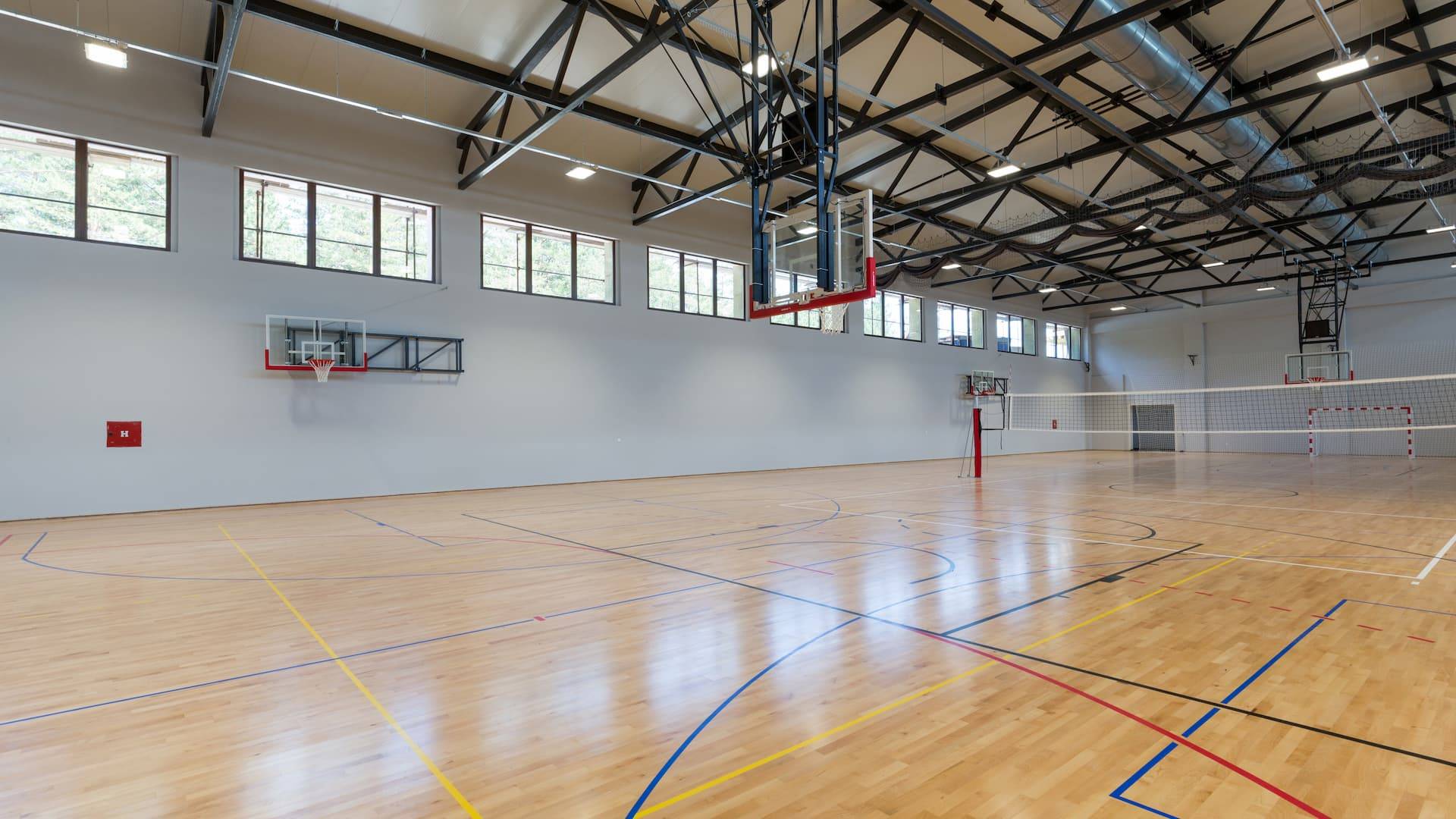
Most halls we refurbish in Nottinghamshire stay inside a building that is still in use: a school with lessons on the other side of the wall, a centre with a gym above, a church hall with a nursery next door.
Dust is dealt with at the machine. Every sander, including the edging equipment, runs on sealed vacuum extraction, and the waste is bagged and taken away rather than swept. The hall doors are sealed with tape and sheeting, the ventilation is isolated by agreement with your site team, and fire exits are kept clear and workable throughout.
Noise is limited to the working hours you set. Solvent odour from the seal is real but short lived, and we time the coats for the end of the day so the room airs overnight.
At the end of each shift the corridor outside the hall is as clean as it was in the morning.
Nottinghamshire brings us academy trust estates, school sports halls, leisure facilities and a considerable amount of older community building stock.
Trust work is the largest strand. Where one organisation holds ten or twenty sports halls of differing ages and conditions, the most useful thing we can do is survey the whole estate and produce a costed priority order. It converts an unpredictable liability into a programme that phases across budget years.
Individual school halls come to us for the usual reasons, and the recurring one is a hall that has gone well over a decade without a proper refinish. Once the seal has worn through, dirt sits in open timber and the staining eventually goes beyond what sanding will remove.
Granwood is common in the older school and church halls here, and it is regularly written off when it should not be. A Granwood floor with sound blocks and an intact bitumen bed is almost always worth restoring, and it costs a fraction of replacement.
Village halls and club buildings make up the rest.
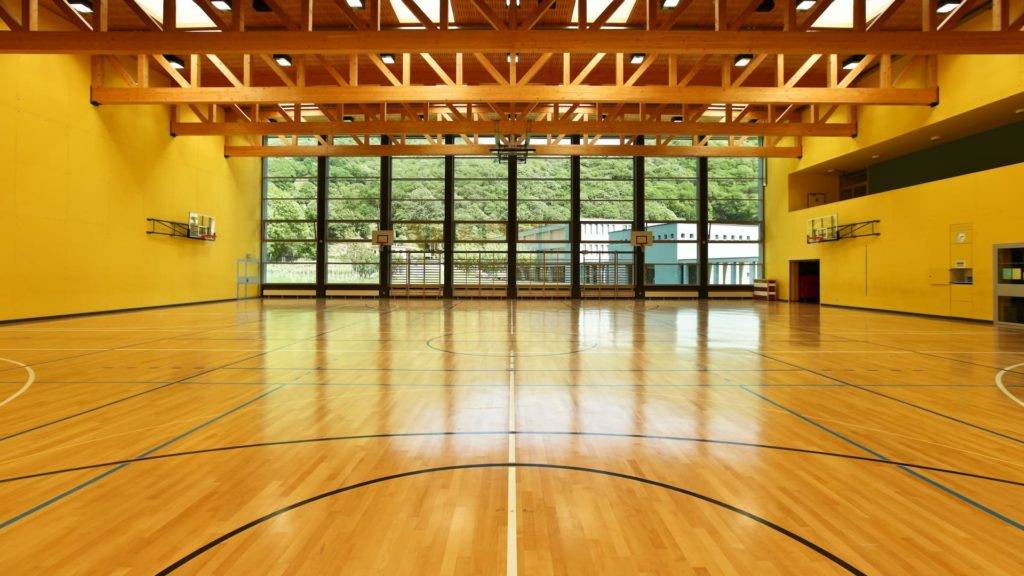
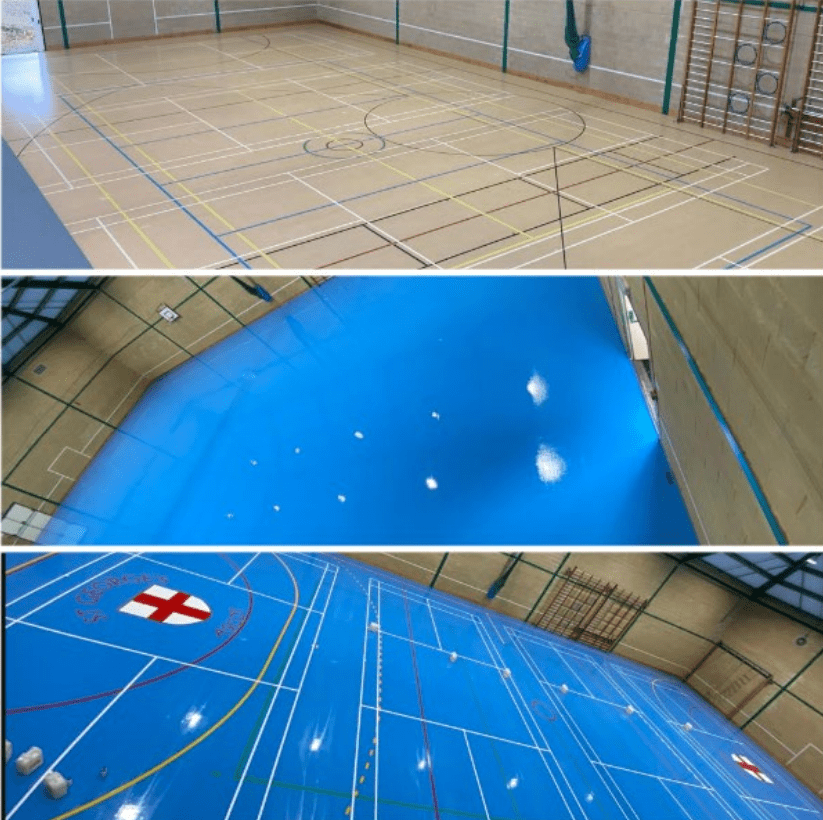
Nottinghamshire has a good deal of older school and church hall stock, so the project worth knowing about is St George School in Ascot.
That hall had a Granwood floor which had been written off by others as due for replacement. Granwood is a composite block of wood flour and cement laid in a bitumen bed, and it behaves nothing like timber. Sanded aggressively it is permanently damaged, and its bed softens with heat. We assessed the blocks, rebedded the loose ones, replaced those that had broken up, prepared the surface with appropriate abrasives and applied a modified epoxy coating with the markings sealed within the system.
The floor now looks renewed and has years left in it, for a fraction of what replacement would have cost once the bitumen bed removal was accounted for.
For academy halls the closer comparison is De Wint School, where the constraint was the term date and the work was a straightforward refinish with markings reset from measured dimensions.
Every full sand removes timber that never comes back, so the aim of a maintenance plan is to make full sands as rare as possible while keeping the floor safe and presentable.
The rhythm that works is simple. A screen and recoat every two to three years, which abrades the existing seal and applies a fresh top coat without touching the wood. A full sand roughly every ten years, when the seal has worn through in the traffic lanes or the markings need moving. Deep cleaning in between, and a written inspection each year to catch a problem while it is still small.
Followed from the start, that cycle gives a solid strip floor in a Nottinghamshire school a working life measured in decades. Skipped for fifteen years, the same floor needs a heavy sand, board replacements and a bigger bill.
We put the cycle in writing and remind you when each stage is due.
Light foot traffic in clean trainers after twenty four hours. Full use, with posts, mats and trampolines back in position, after seventy two hours or more, because the two pack polyurethane is still hardening beneath the surface. We agree the reopening date before we start and sign the room until then.
Yes, before we arrive. You receive job specific risk assessments and method statements, COSHH sheets for every product, our public and employers liability certificates and DBS details for the operatives on site. We sign in, wear identification and stay within the areas your site manager agrees.
Yes, and we recommend it. Satin two pack polyurethane hides scuffs and rubber marks, cuts the glare from LED lighting that gloss produces, and holds its slip resistance well under heavy use. Gloss photographs beautifully on handover day and shows every mark within weeks.
Yes, and it makes sense to. Stage boards are usually in worse condition than the hall because of scenery, staging and painted sets. Doing both in one visit shares the mobilisation and gives a consistent finish, and we can leave the stage slightly less slippery for performers.
It can, provided the heating is a low temperature system, the surface is limited to the manufacturer’s maximum, and the timber is conditioned to the room before laying. Engineered boards cope better than solid ones. We will check your heating specification before recommending either.
We remove the socket covers, protect the sockets during sanding, and reset or replace any that have loosened or sit proud of the surface. Where the new setting out moves a court, the sockets are relocated and the old ones capped flush so there is no trip hazard.
Yes. Repairs, sanding, sealing and marking carry a written guarantee against workmanship and material defects, with the terms on the quotation. It assumes the cleaning guidance is followed and no polish or wax is used. If something is not right, we come back and put it right.
Yes. We price on schedules of rates, respond to tenders from trusts and councils, and supply the full documentation set including insurances, quality procedures, safeguarding policies and references. For estates with several halls we can also price a whole programme so the framework call off is simple.
Book a free survey of your sports hall in Nottinghamshire and you will get a straight answer on what the floor needs, a fixed written price and a programme that fits your calendar. Call 01823 674562 or send us a message.