
Flooring Professionals To The Leisure Industry
Courtship Flooring is a commercial sports flooring contractor working in Perth and across the UK. Our work here covers school, community and leisure facilities across a mixed urban and rural area.
Our clients are schools, academy trusts, universities, leisure operators, councils and clubs, and have been since 1987. We cover the full lifecycle of a floor with our own team rather than a chain of subcontractors. Private homes are outside our scope and are served by Ryan’s Restorations.
Clients in Perth get the specification, workmanship and aftercare that have underpinned our sports hall flooring work since 1987.
Overnight/Weekend Installations
Professional Cleaning Demonstrations
Squash Court Maintenance
Recommended Cleaning Products
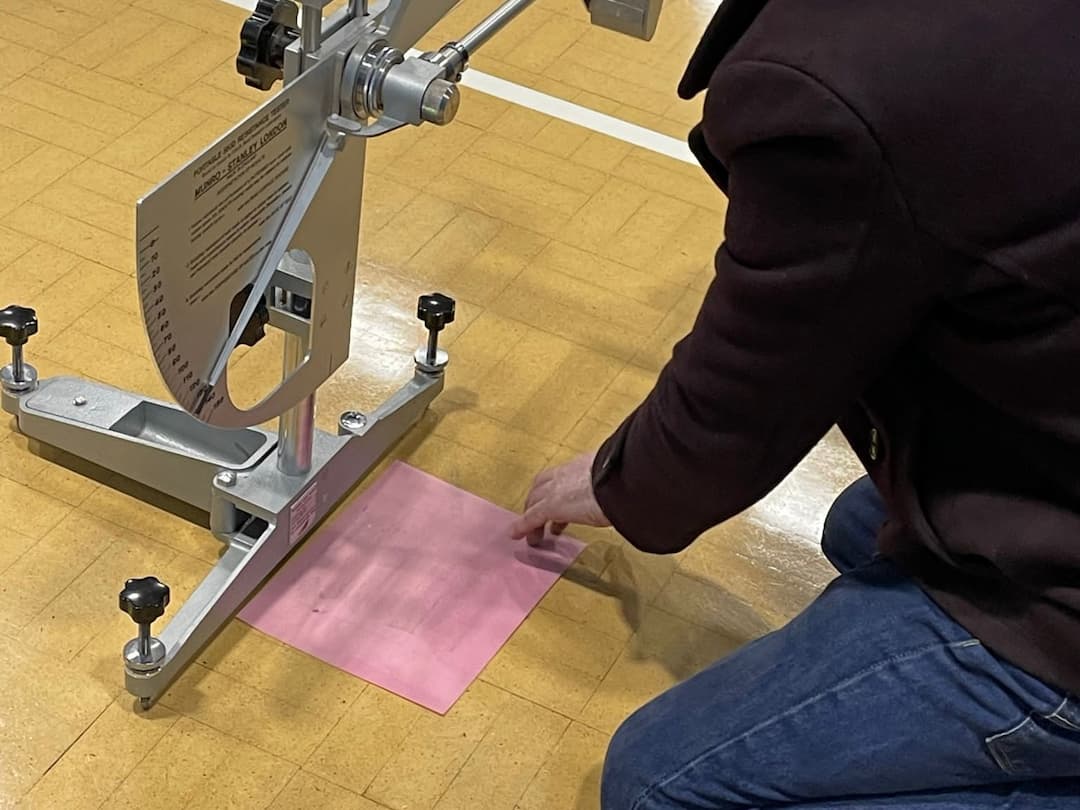
Professional Pendulum Slip Testing
Deep Clean & Reseal Service
Floor deterioration is gradual and easy to miss when you see a hall every day. An annual inspection provides an outside assessment: seal condition, board depth remaining, sub-floor indicators, moisture readings, marking accuracy and entrance-zone wear.
The written record supports budget planning, evidences duty of care, and means decisions are based on trend rather than a single snapshot taken when something has already gone wrong.
Almost every expensive floor failure was inexpensive at an earlier stage. A seal about to break through costs a recoat today and a full sand in two years. A minor leak caught early is a board repair; ignored it becomes a section replacement.
Inspection exists to find those moments. It is the cheapest insurance available on an asset worth tens of thousands of pounds.

Rather than reacting when a floor becomes unacceptable, most facilities are better served by a plan: deep clean annually, recoat at a defined interval, budget for a full sand at a projected point, and replace when refinishing cycles are exhausted.
We set that timeline out based on your floor and its actual usage, so capital planning is informed rather than reactive.
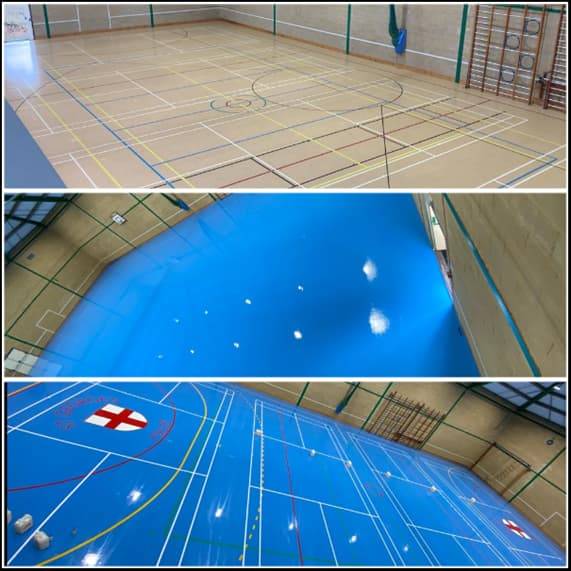
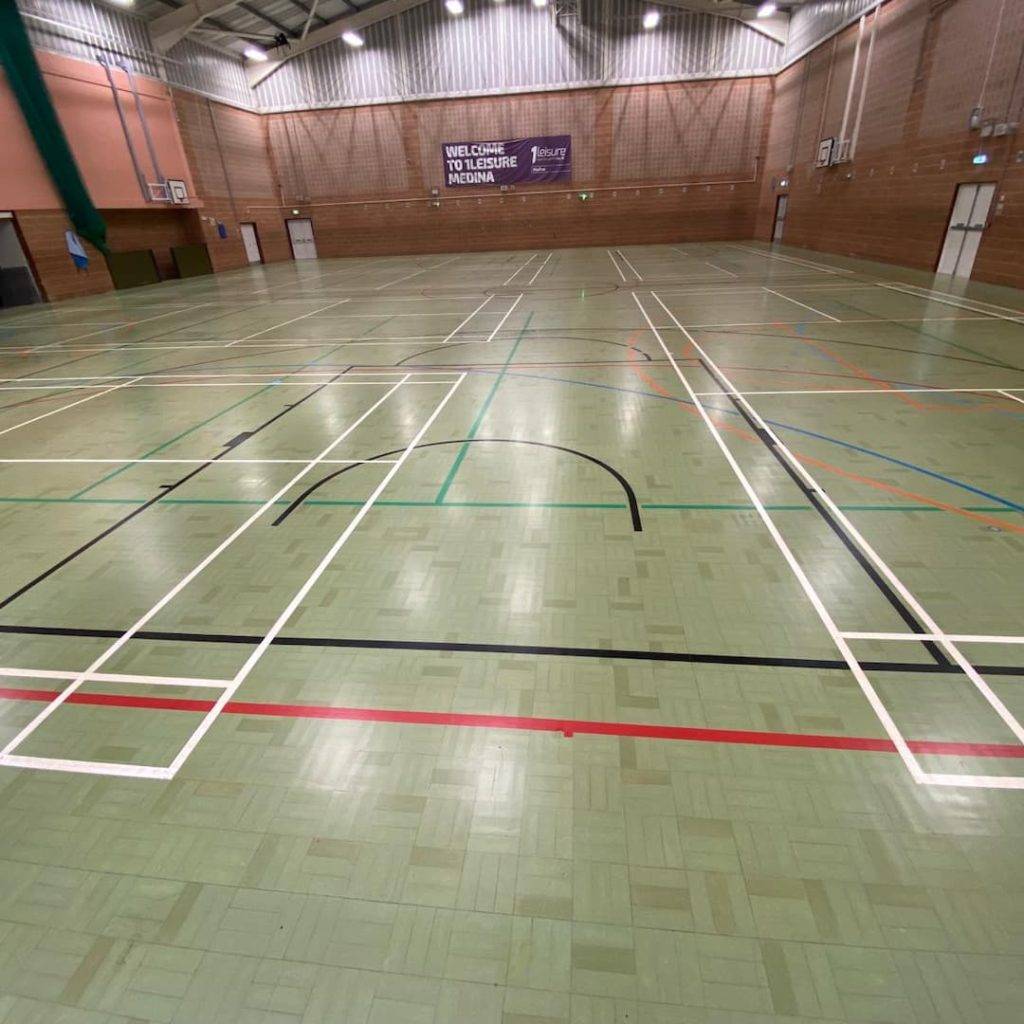
The sports hall at St George’s had a Granwood block floor that decades of use had left dull and tired. Granwood cannot be sanded like timber, so we restored it correctly: careful preparation, a modified epoxy coating system and crisp new markings.
The school kept a serviceable floor out of a skip and spent a fraction of what replacement would have cost.
~ Matthew Evans
An outstanding company to deal with and they couldn’t have been better to work with. St George’s Ascot now has a stunning new sports hall floor and we are delighted. From quote, support, delivery and after sales, the Team has been brilliant. Thank you. 
~ James Anderson







School work is governed by dates that do not move. The summer break is the main window, the October and Easter breaks are just long enough for a screen and recoat, and the hall must be open on the first morning of term regardless of what we found under the boards.
We build the programme backwards from that morning. Materials are ordered and on the van before the holiday starts, repairs are surveyed in advance so there are no surprises, and the last coat goes down with cure time still in hand. If the timber turns out to need more than expected we tell you on day one, when there is still room to adjust.
Perthshire schools, with a mix of independent and council sites, tend to book a year ahead for summer, and the best weeks go first.

Timber is not the only answer, and for some rooms it is the wrong one. Sports vinyl is a layered sheet with a foam or composite backing, welded at the seams, and it suits leisure halls that take a wide range of activities and need a surface that is quick to clean.
Linoleum is a natural product made from linseed oil, cork and jute, and it is a sound choice for dance, drama and general activity rooms where sprung timber would be over specified. Polyurethane is poured in place over a rubber base to give a joint free surface that can be recoloured and re-marked more than once during its life.
All three can be deep cleaned, resealed and relined by us. None can be sanded once worn through, so the cleaning regime and the reseal interval matter even more than they do on timber.
Most of the wear on a sports hall floor walks in through the door. Grit carried on trainers acts like sandpaper under every foot that follows, and the seal in the first few metres inside the entrance wears through years before the rest of the hall.
A run of matting long enough to take three or four strides removes the bulk of it. Two metres is not enough. The mat needs to be recessed or firmly edged so it does not become a trip hazard, and it needs cleaning itself, because a saturated mat sheds grit as fast as it collects it.
On rural sites around Perth where players arrive from car parks and grass pitches, the doorway zone is often the deciding factor between a recoat and a full sand. We can add an extra coat of seal in that zone at little cost.
Nobody in this trade completes several hundred floors without occasionally having to go back, and how a contractor behaves at that point matters more than anything on a brochure.
Our position is straightforward. If the workmanship is not right, we return and put it right, and we do not argue about it. That is the least anybody should offer and it is not as universal in this industry as it ought to be.
What we will be clear about, at the time rather than in small print, is the boundary. A floor sealed over a slab we advised was too wet, a hall where the cleaning regime uses polish despite the written guidance we handed over, or damage from a roof leak are not workmanship failures. We will explain that distinction before the work rather than after.
Equally, where we think a job carries risk we say so at survey. If a stain may not fully lift or a repair may not match perfectly, you hear it before you commit, not afterwards.
Perth and the surrounding area bring us council leisure facilities, secondary school sports halls, independent school sport and a good number of club and community buildings.
Leisure centre halls are usually the busiest floors in the area and the ones that benefit most from a proper maintenance cycle. Catching a floor with a screen and recoat before the seal wears through to bare timber is what keeps it off the replacement list.
School halls follow the fixed term calendar, and independent school sport features here more than in many parts of Scotland, with well maintained buildings, high expectations of finish quality and work planned well ahead into holiday windows.
Community and village halls make up the rest, and those old timber floors are usually in far better shape than they look.
Because we travel to reach the area, projects here are planned as continuous blocks with everything brought with us. Sequencing two or three jobs into one trip brings the cost down for all of them, so it is worth mentioning if you know of another facility considering work.
Enquiries from Perth and the surrounding area tend to fall into three groups.
Independent school halls generally come to us before there is a problem, wanting the screen and recoat booked while the finish is still sound. That is the cheapest way to run a floor and the reason those halls last decades without a full sand.
Council leisure halls more often arrive with a specific complaint, most commonly that the floor has become slippery. The cause is nearly always polish build up from the wrong cleaning product or a seal worn smooth in the busiest routes, and both are correctable once identified.
Community and village halls arrive with fine scoring from chairs and tables under decades of accumulated polish. That build up has to be removed chemically before sanding, and underneath there is usually a very good floor with plenty of depth left.
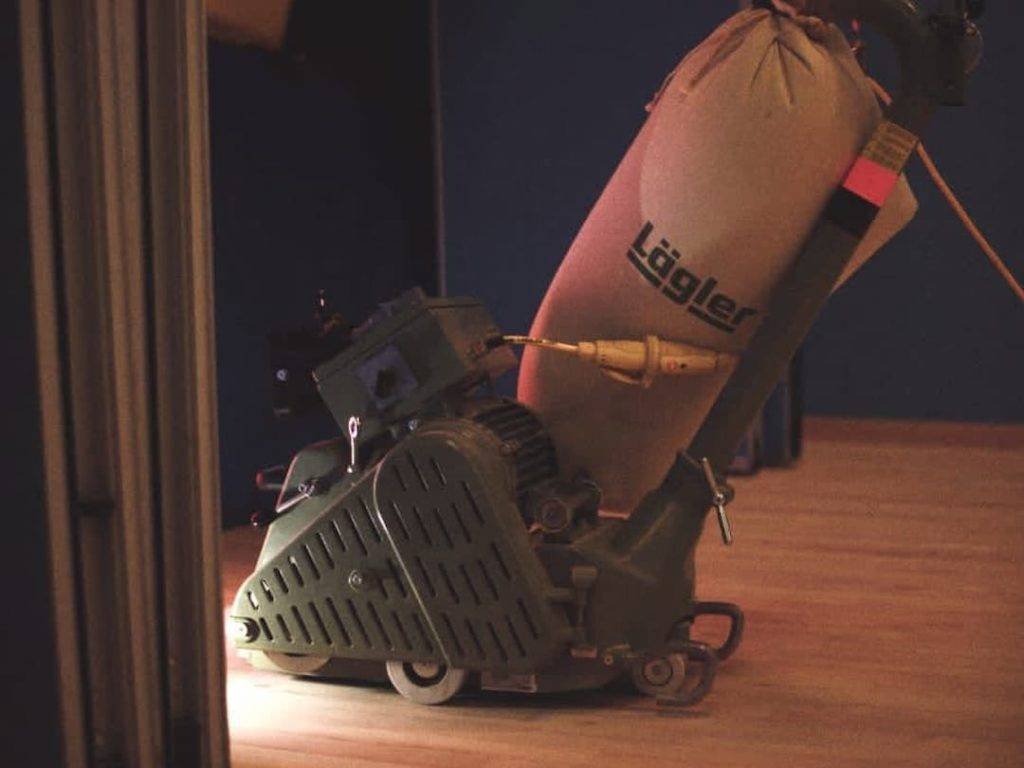
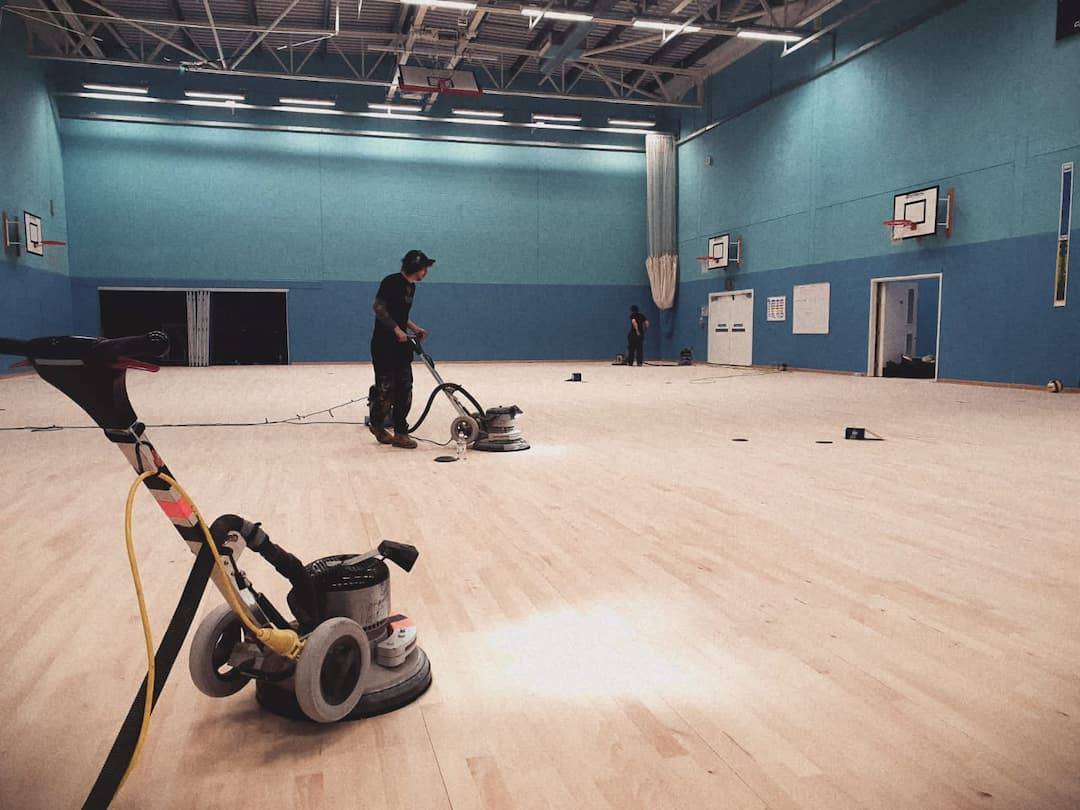
Sanding a hall produces a great deal of fine timber dust, and the question a head of estates asks is where it ends up. Our answer is that it stays in the machine.
Every belt sander and edger we run is connected to sealed vacuum extraction, which captures the dust at the point it is made instead of releasing it into the air and hoping it settles. The hall is screened, the doors to the rest of the building are taped and the ventilation grilles are covered before the first pass.
Where the sports hall shares air handling with a pool, a canteen or a library, we walk the building with your caretaker first and agree what gets isolated. The hall is a dusty place while we are in it. The classroom next door should not know we are there.
Light foot traffic after 24 hours, full sport and equipment after 72 hours or more. The polyurethane keeps hardening for several days beyond that, so benches, mats and trampolines are the last things to go back in. The handover sheet gives the dates for your site.
Yes. Enhanced DBS details for everyone attending, job specific risk assessments and method statements, COSHH data for each product and our insurance certificates all go to your office in advance. The team signs in daily and works within the area agreed with your site staff.
Yes. We start after the last booking, seal at the end of each shift and hand the floor back walkable for opening. It costs more than a clear week would, but a leisure hall that keeps its bookings usually comes out ahead once lost income is counted.
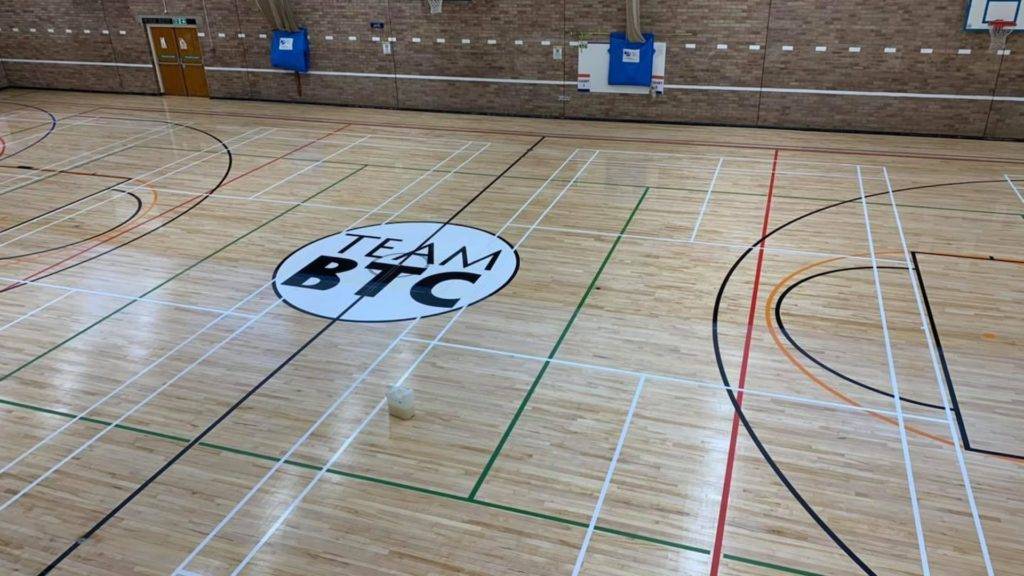
Yes. We scale your artwork to fit the centre circle, agree a layout drawing with you and paint it between the coats of seal so it wears at the same rate as the lines around it. It costs least while the floor is already open for a refinish.
Yes. We test with a pendulum at points across the hall and issue a certificate showing the values and locations. It is worth having on file for your insurer and for governing body affiliation, and it gives a baseline to compare against at the next inspection.
We lift a board at a socket or an edge and measure the timber left above the tongue. A solid strip floor usually starts with enough for six or more sands, and we record the depth at each visit so you know how many are left.
A batten, pad or cradle beneath that corner has failed or lost contact with the boards. It is a structural fault, so resealing the surface will not change it. We lift the affected boards, replace the components and re-lay the timber before the finish goes on.
Yes, and it is the best moment to do it. Sockets that have worked loose or corroded are lifted, the timber around them made good and new fittings set flush before sanding. Tell us at survey which ones move, so they are on the list.
Book a free survey of your sports hall floor in Perth or anywhere in Perthshire. You get a written assessment, a fixed price and a realistic programme. Call 01823 674562 or send us a message.