
Not every floor we restore hosts sport. School assembly halls, church halls, civic rooms and stage floors carry an enormous amount of daily use, and the damage rarely comes from PE. It comes from chair legs, table trolleys, stacked staging and exam desks.
Courtship Flooring restores timber hall floors across the UK for schools, academies, churches, parish and civic buildings. We sand, repair, reseal and where needed re-mark, working around your calendar and delivering a hall that looks transformed. Commercial and institutional work only.

A school hall is a PE space on Monday, a dining room at noon, an exam room in June and a theatre in December. A church hall runs playgroup, badminton, a choir and a wedding reception in the same week. Specifying either purely as a sports floor guarantees disappointment.
We choose finishes with the toughness for furniture as well as the grip and shock absorption for activity, and advise on protective covering for non-sporting use. It is a far cheaper approach than repairing the same damage every second year.
Hall floors are frequently older and better than anything that would replace them, and committees are often told they need ripping out when they do not. Where the boards are sound and there is depth left above the tongue, restoration wins on cost, disruption and character every time.
We measure rather than guess, cut out and match damaged boards properly, and finish to suit the room. Where damp or structural movement genuinely rules restoration out we will say so, with the readings to support it.
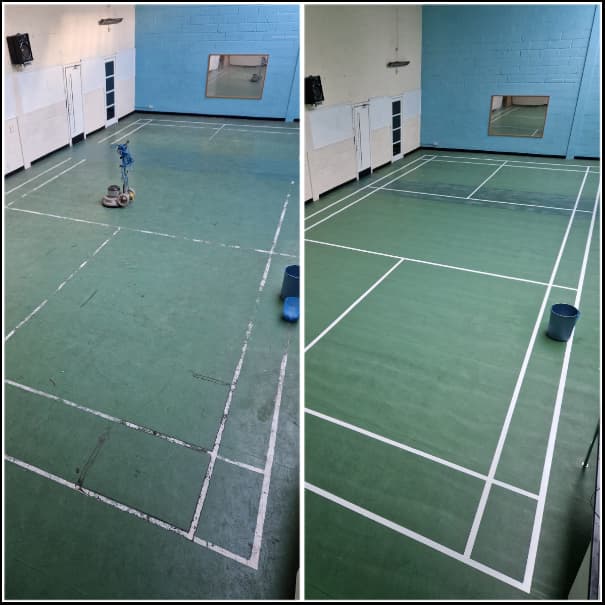
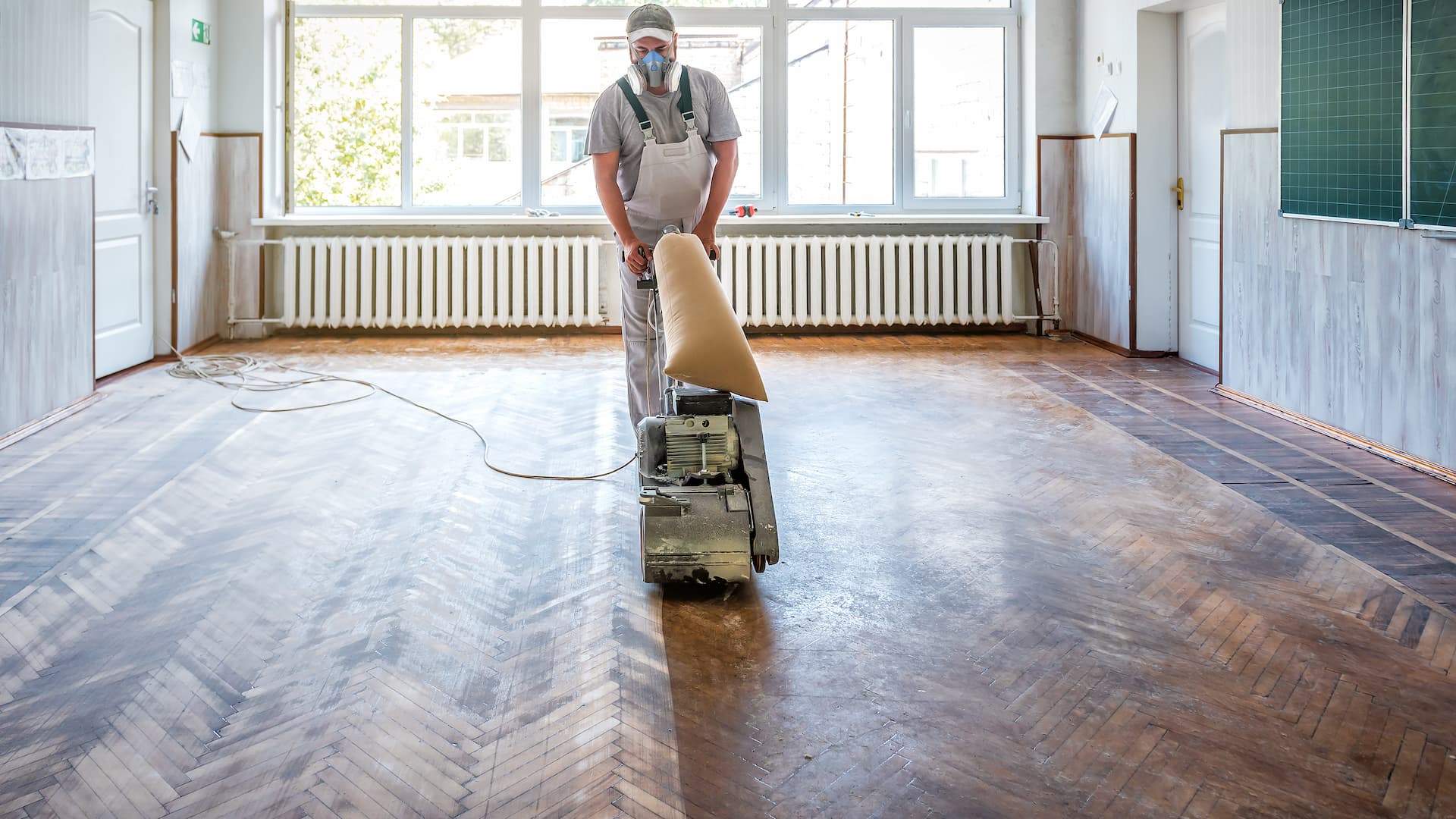
Stage floors have their own requirements: a surface that takes scenery, staging and equipment without marking permanently, and in many halls a matt finish so lighting does not reflect off it into the audience.
We restore stage and performance floors alongside the main hall, and where a space serves both drama and sport we specify accordingly rather than compromising one for the other. Sprung construction is available where dance or gymnastics is part of the picture.
Schools get half term and summer programmes with the reopening date fixed in writing, because September is not a date anyone can afford to gamble on. Churches and civic buildings get work planned around services, bookings and events.
A single hall is typically four to five days including sanding, repairs, sealing and curing. Where a building genuinely cannot close, phased or weekend working keeps part of the space available throughout.
A school or church hall is asked to do more than any other room on the site, and its floor pays for that versatility.
In a school the hall is a gym in the morning, a dining room at midday, an exam hall in May and a theatre in December. Each use damages the floor differently. Sport wears the finish evenly across the traffic lanes. Dining drags chair legs and drops food and drink. Exams bring hundreds of desk feet onto the same square metres. Staging and scenery get wheeled across without protection.
Church and village halls follow the same pattern with different activities. Toddler groups, badminton, wedding receptions, polling stations and coffee mornings all use the same floor, and the tables and chairs go out and back several times a week.
The result is a floor that is rarely worn out in the way a pure sports floor is, but is heavily marked, scratched and tired. That is actually good news, because a floor with plenty of timber left and cosmetic damage is exactly the kind that restoration transforms.
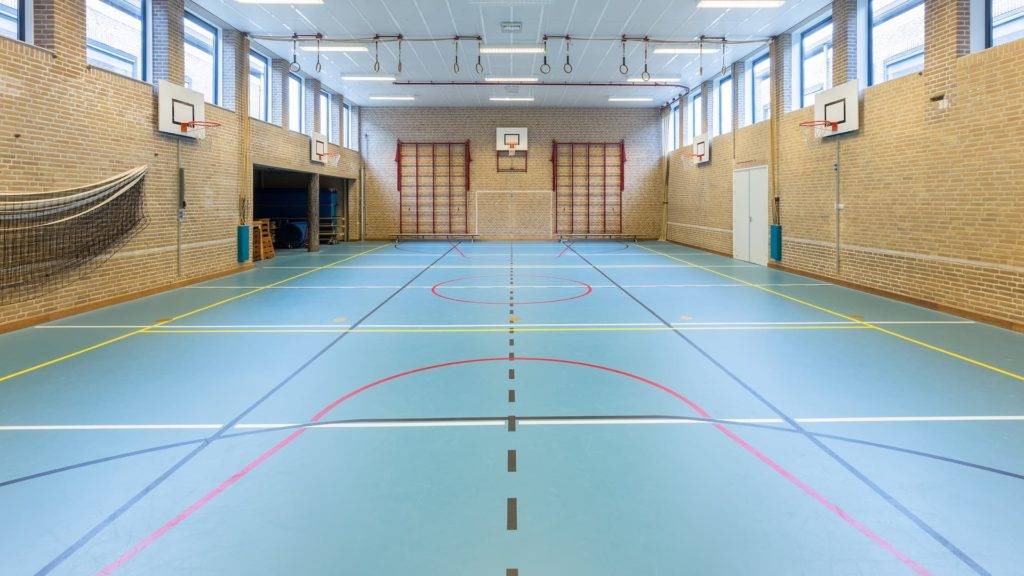

The process follows the usual sequence but the emphasis is different, because a multi use hall has different damage from a dedicated sports hall.
We survey and take moisture readings first. Old halls, particularly church halls with solid floors and limited damp proofing, need checking properly before anything is sealed over the top.
Chair and table damage is the characteristic problem. Years of dragging leaves fine scoring across the whole floor rather than concentrated wear, and it usually sands out well. Deeper gouges from staging and equipment need individual attention, and badly damaged boards are cut out and replaced.
Where a hall has a stage, we generally restore that at the same time. Stages are often a different timber and a different construction from the hall floor, and they are usually in worse condition because scenery gets dragged across them. Doing both together costs less than two separate visits and gives a consistent finish.
The floor is then sealed, and any markings for the sports actually played go back down under the final coat.
Specifying a finish for a multi use hall is a balancing act, and it is where a lot of halls get let down.
A pure sports finish optimised for grip may be too matt and too absorbent for a room that also serves food. A hard commercial lacquer chosen purely for durability may be too slippery for badminton. What is needed is a two pack polyurethane in the middle of that range, tough enough for chairs and tables and grippy enough for sport.
Sheen matters practically as well as visually. Satin hides the scuffing that a multi use hall inevitably collects, and avoids the glare that gloss produces under the LED lighting most halls have been refitted with. Gloss looks impressive at the handover assembly and disappointing by half term.
Where a hall is used for dining we will discuss cleanability specifically, because the regime in a school kitchen area is more aggressive than anything a sports hall sees. And we can pendulum slip test on completion so the certificate is on file before anybody asks for it.
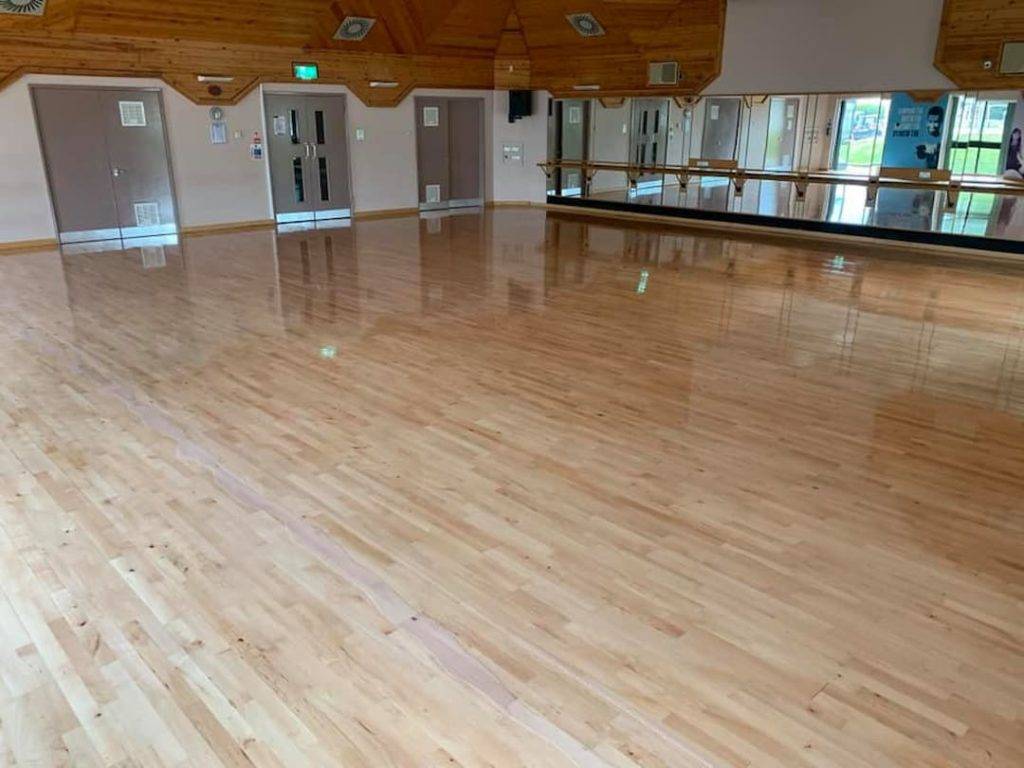

Neither a school hall nor a church hall can simply be closed, so the programme is built around the calendar rather than our convenience.
For schools, the summer holiday is the obvious window and it is when most of this work happens. A full restoration of a typical hall takes one to two weeks, which fits comfortably. Half terms suit smaller jobs and screen and recoat work. We book school summer work months ahead, so it is worth raising it early in the year rather than in June.
Church and village halls are harder, because they rarely have a clear fortnight. We phase the work where we can, and we are used to working around a booking diary that includes a wedding on the Saturday and a toddler group on the Monday. Where a hall genuinely cannot close, a screen and recoat over a long weekend is often the practical answer.
Either way we give you a written programme with the date you get the hall back, and we plan to that date rather than treating it as a hope.
Multi use halls are where good aftercare pays back fastest, because most of the damage comes from things that are easy to change.
Chair and table feet are the single biggest win. Fitting proper glides to every stacking chair and table costs very little and eliminates the scoring that otherwise means another restoration in five years. It is the one recommendation we make on every hall.
Trolleys are the second. Stacking chair trolleys with hard, small wheels concentrate a great deal of weight into a tiny contact patch, and they leave tracks. Larger, softer wheels solve it.
Staging and events need protection sheets laid before anything is wheeled in. We can advise on what is appropriate for the loads involved.
Cleaning should be a dust mop daily and a damp mop with a neutral cleaner for sealed timber. No polish, no wax and nothing promising shine, all of which build up, go slippery and eventually have to be stripped chemically.

Yes. Assembly halls, church halls, civic rooms and stage floors are a substantial part of our work. If it is a commercial or institutional timber floor, we can almost certainly restore it.
Usually, yes. Indentation and scuffing sand out, and genuinely damaged boards are cut out and replaced with matching timber. We will also advise on protective covering so the same damage does not simply return.
A single hall is typically four to five days including curing, which fits inside a school holiday or a quiet week. Phased and weekend working is available where a building cannot close at all.
Regularly. We understand these projects run to tight budgets and committee timescales, and we will always tell you the cheapest option that will genuinely work rather than the largest one.
Yes, and most of the halls we restore are. The finish is specified to handle both, tough enough for chairs and tables and grippy enough for badminton and netball.
Usually completely. Fine scoring from chair and table legs is surface damage and sands away easily. Deeper gouges from staging may need individual boards replacing.
Yes, and we would recommend it. Stages are usually in worse condition than the hall floor and doing both together costs less than two visits and gives a consistent finish.
One to two weeks for a typical hall, which fits comfortably into a summer holiday. Smaller jobs and screen and recoat work can be done in a half term.
A screen and recoat over a long weekend is often the practical answer where a hall cannot close for a fortnight. We are used to working around booking diaries and will phase the work where possible.
Fit proper glides to every stacking chair and table. It costs very little and eliminates the scoring that is by far the most common damage in a multi use hall.
Send a few photographs or book a free survey and we will tell you honestly whether your hall floor needs restoring, cleaning or simply leaving alone another year. Call 01823 674562.