
Court markings wear out long before a floor does. Baselines, service boxes and the areas around the keys take the most traffic, and a court that has become hard to read is a playing problem, a presentation problem and, where competitive fixtures are involved, a compliance one.
Courtship Flooring repaints and relines sports hall courts across the UK, either as part of a wider refurbishment or as a standalone visit on a floor that is otherwise sound. It is one of the quickest and cheapest ways to transform how a tired hall looks. Commercial and institutional facilities only.
For new schemes and individual courts, see our sports hall line marking service.
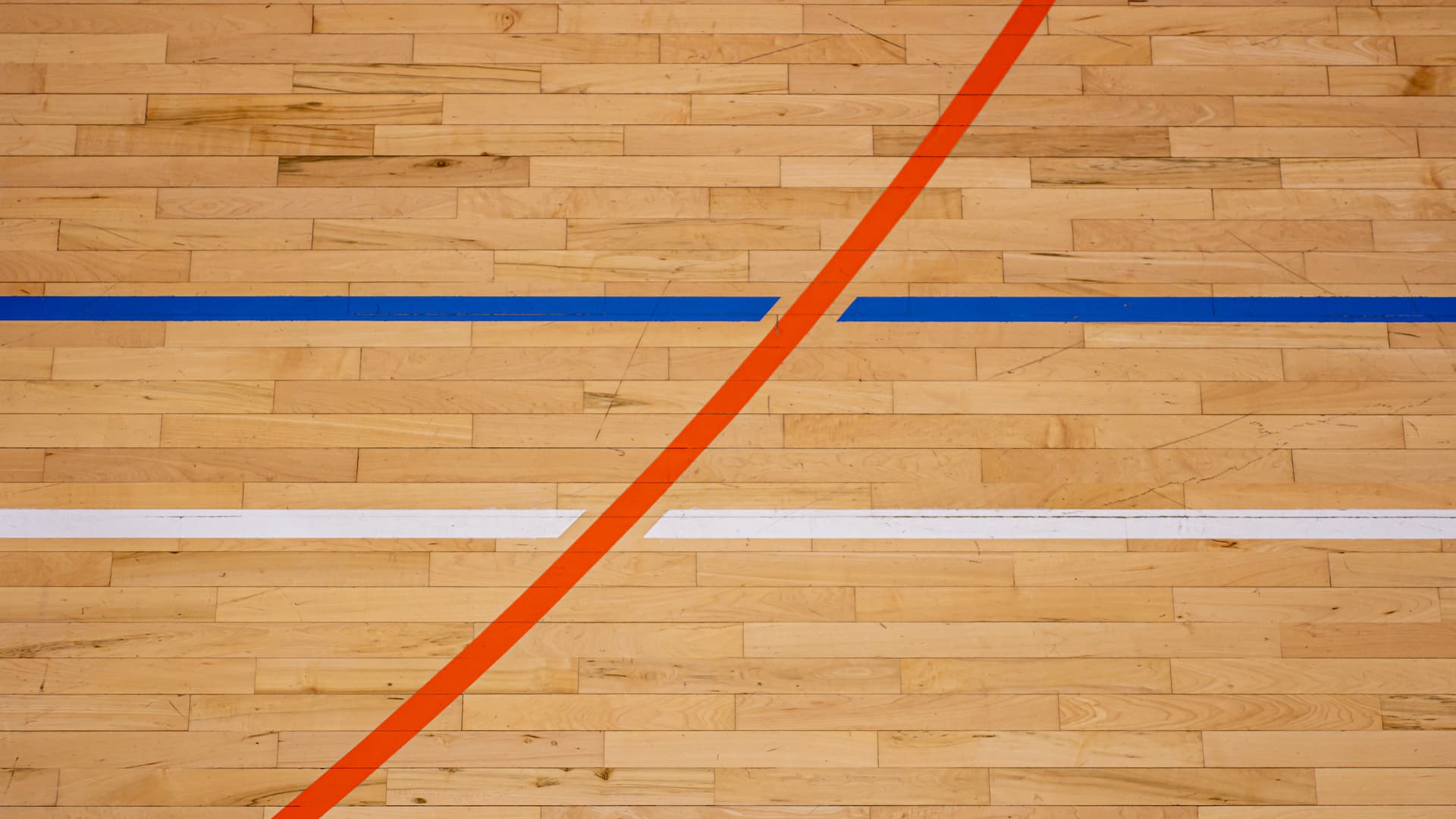
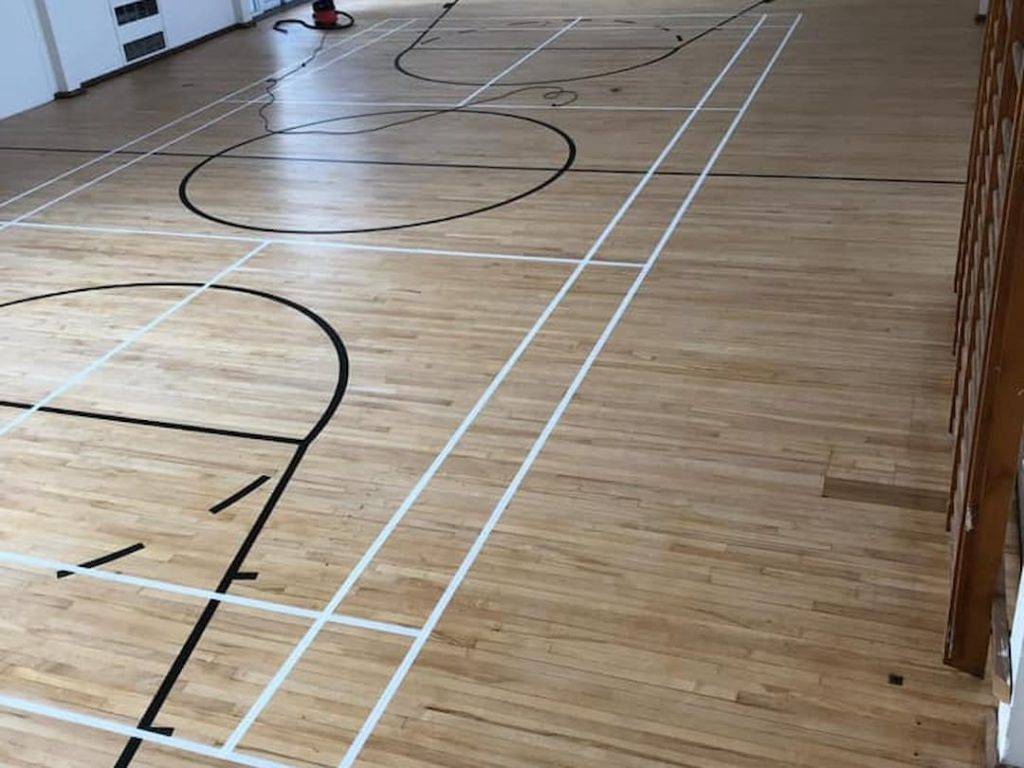
If the seal is in good order and only the markings have gone, there is no need to sand anything. We lightly prepare the marking areas, apply specialist proprietary line paint to the correct dimensions, and seal over the lines so they wear at the same rate as the surface around them.
A single-court hall is usually done in a day or two, including curing. For schools that means a half-term slot; for leisure operators an overnight or weekend visit with no lost sessions.
Relining is the right moment to fix a layout that has drifted. Governing body dimensions have changed over the years, and plenty of halls still carry courts marked to superseded rulebooks. Netball in particular catches schools out.
We mark to current specifications, and where a hall carries four or five sports we replan the layout so the primary court reads instantly and the others sit clearly behind it in their own colours. The full approach is set out on our line marking page.
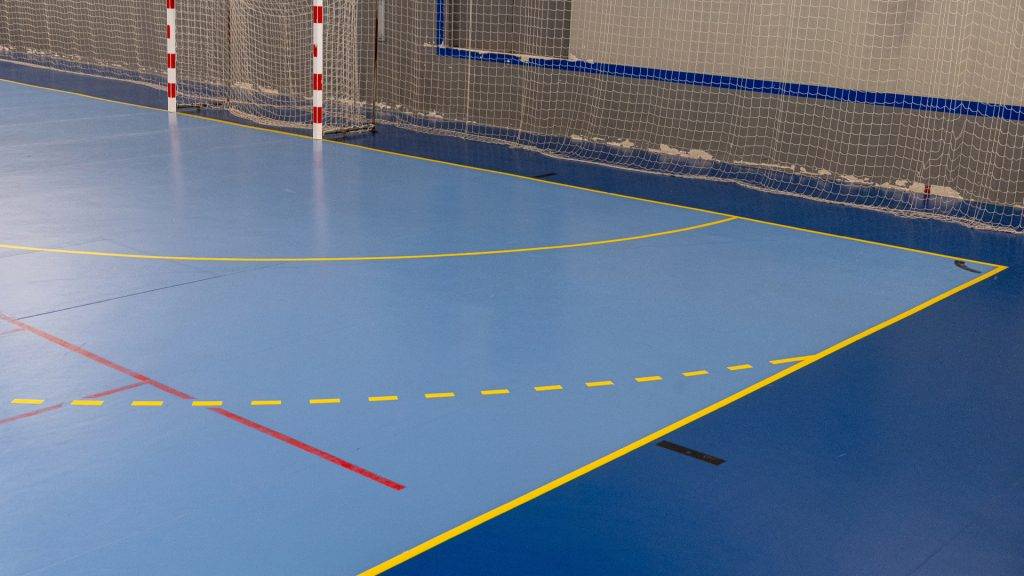
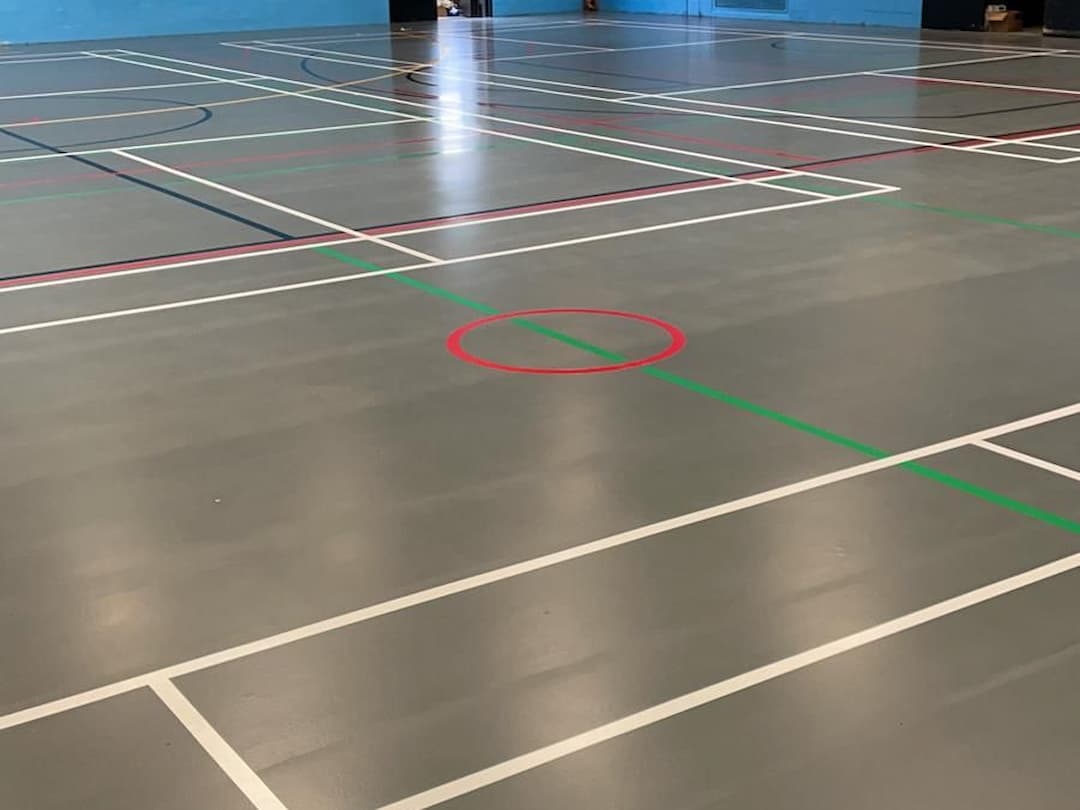
Court marking paint has to bond to a sealed sports surface, survive hundreds of pairs of trainers a day, resist cleaning chemicals, and do all of it without creating a patch of different grip in the middle of a court. That last point is a genuine safety issue rather than an aesthetic one.
We use specialist proprietary systems designed for sports floors, applied between coats of seal wherever the job allows. On synthetic and polyurethane surfaces the products differ again, and using the wrong one is the commonest reason markings lift within a season.
Most halls benefit from relining every two to three years. Left longer, courts become genuinely hard to read and the hall starts to look neglected even when the floor beneath is perfectly sound.
Booked as part of a maintenance plan alongside a deep clean and recoat, relining costs very little and keeps the facility looking cared for between full refurbishments. Logos and crests can be refreshed at the same time.
Court markings almost always wear out before the floor does, and recognising that is what saves facilities a great deal of money.
A timber sports floor might go eight to ten years between full refinishes. The markings on it, particularly in a netball centre third or a basketball key, can look tired in half that time. If the seal is still sound, still gripping properly and still protecting the boards, replacing the whole finish because the lines have faded is an expensive way to solve a cheap problem.
The test we apply at survey is straightforward. If the lacquer is intact across the floor and only the markings have gone, you need relining. If the lacquer has worn through to bare timber in the traffic lanes, you need a refinish and the markings come as part of it. If it is somewhere between, a screen and recoat with fresh lines usually gives the best value, restoring the surface and the markings in one visit without taking the boards down.
We will tell you which of the three your hall needs, and we would rather quote you for the cheaper option and see you again in five years than sell you a full sand you did not need.
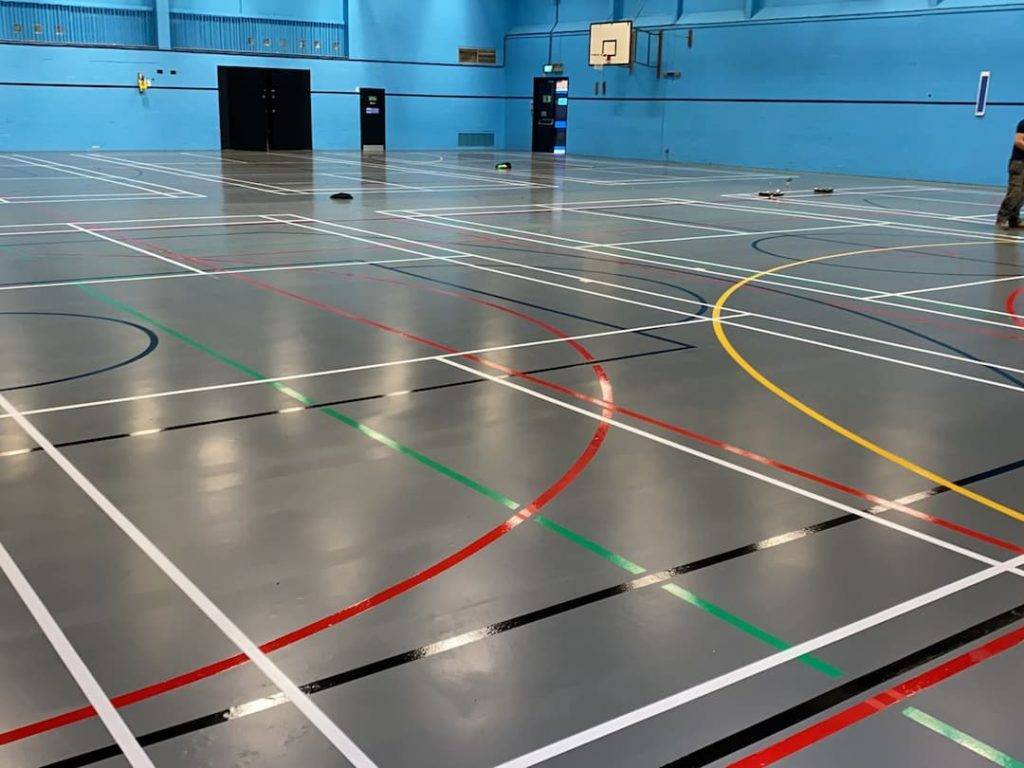
The most common mistake in relining is copying what is already on the floor. It repeats old errors, and it keeps sports on the floor that nobody plays.
Almost every hall we survey carries at least one redundant set of markings, and many carry three or four. Short tennis lines from a scheme that ended a decade ago, five a side markings in a hall that now uses a different layout, or a junior court for a year group the school no longer teaches. Every one of them adds visual noise and makes the sports you do play harder to read.
So we start with a conversation about what actually gets used, and we set out from measured governing body dimensions rather than from the existing paint. Courts that have been copied repeatedly drift, and a surprising number of halls turn out to have thirds that are not equal or arcs that are not true.
The result is usually fewer lines, in better colours, correctly dimensioned. Halls look considerably larger and considerably smarter when the clutter comes off, and it costs less than putting all of it back.
How we reline depends entirely on what your floor is made of, and using the wrong system is the usual reason markings fail early.
On timber the correct approach is to abrade the existing seal, apply the new markings, then seal over the top so the paint is locked beneath the final lacquer. Lines applied onto a finished floor and left exposed will lift under trainers and scrubber driers, whatever the paint claims.
On vinyl and linoleum we use marking systems formulated to bond to those surfaces, applied after a thorough clean and preparation. There is no lacquer over the top, so the paint itself has to be the durable element and the product choice matters more.
On polyurethane and modified epoxy floors we work with coating systems designed for the surface, which is also where we can carry out a full recolour of the hall rather than just the lines. A tired PU floor recoated in a fresh base colour with new markings looks like a new installation for a fraction of the cost.
In every case we set out with laser and tape, and check each court before a drop of paint goes down.
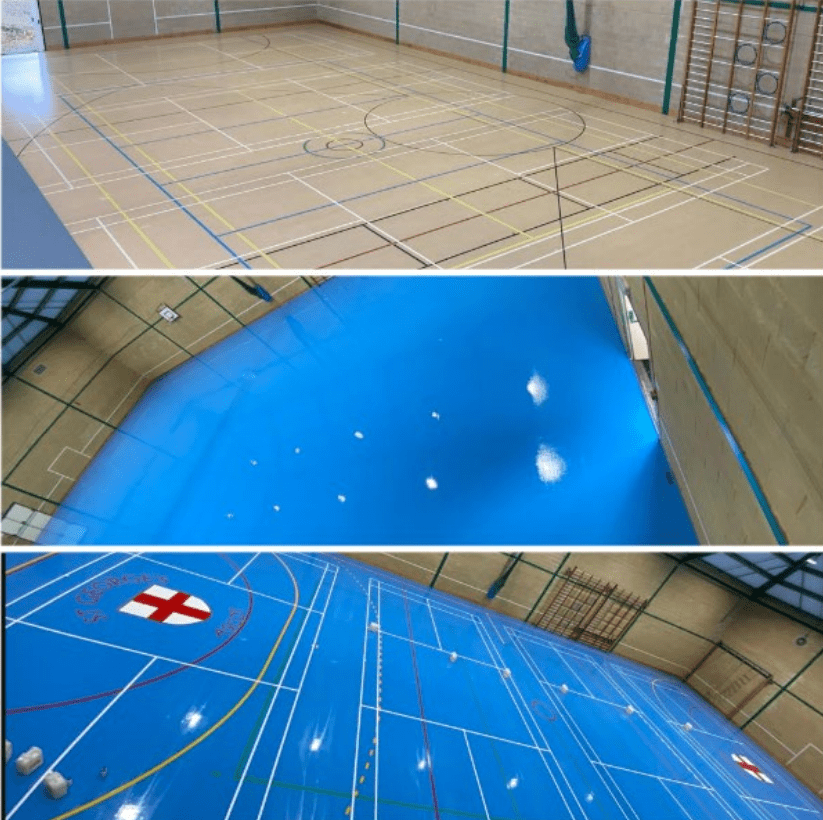
Repainting is often understood as lines only, but on synthetic floors we can change the appearance of the entire hall, and it is one of the highest impact things a facility can do on a modest budget.
A polyurethane or modified epoxy floor that has gone patchy, faded or simply dated can be recoated in a new base colour, with the markings then applied over the fresh coating. The hall goes from looking worn out to looking refurbished, without touching the substrate underneath.
Colour choice is worth thinking about properly. Darker bases show dust and scuffing quickly and can make a hall feel smaller. Mid tone greys, blues and greens hide marks, sit well under LED lighting and let the line colours read clearly. We will bring samples and look at them under your own lights, because hall lighting changes colours dramatically.
Where a school or club wants its identity on the floor, this is the moment to do it. Coloured keys, a contrasting centre circle or a crest at centre court all go down as part of the same visit rather than as a separate job later.
Relining is one of the least disruptive things we do, but it still needs the floor to itself, and the cure times are not negotiable.
A typical multi sport hall takes two to three days for a full reline, including preparation, setting out, painting and the seal coat over the top. A recolour of a synthetic floor takes longer, usually four to six days depending on the number of coats and the drying conditions.
The hall must be empty throughout and stay empty while coatings cure. Foot traffic is normally possible around twenty four hours after the final coat, with full use including equipment and posts at seventy two hours. Walking on a floor too early is the single most common cause of a job needing touching up, and it is entirely avoidable.
We work through school holidays, weekends and overnight as a matter of routine, and for most schools a half term is enough to reline an entire hall. We agree the programme in writing before we start, including the date you get the hall back, and we plan to that date rather than treating it as an aspiration.
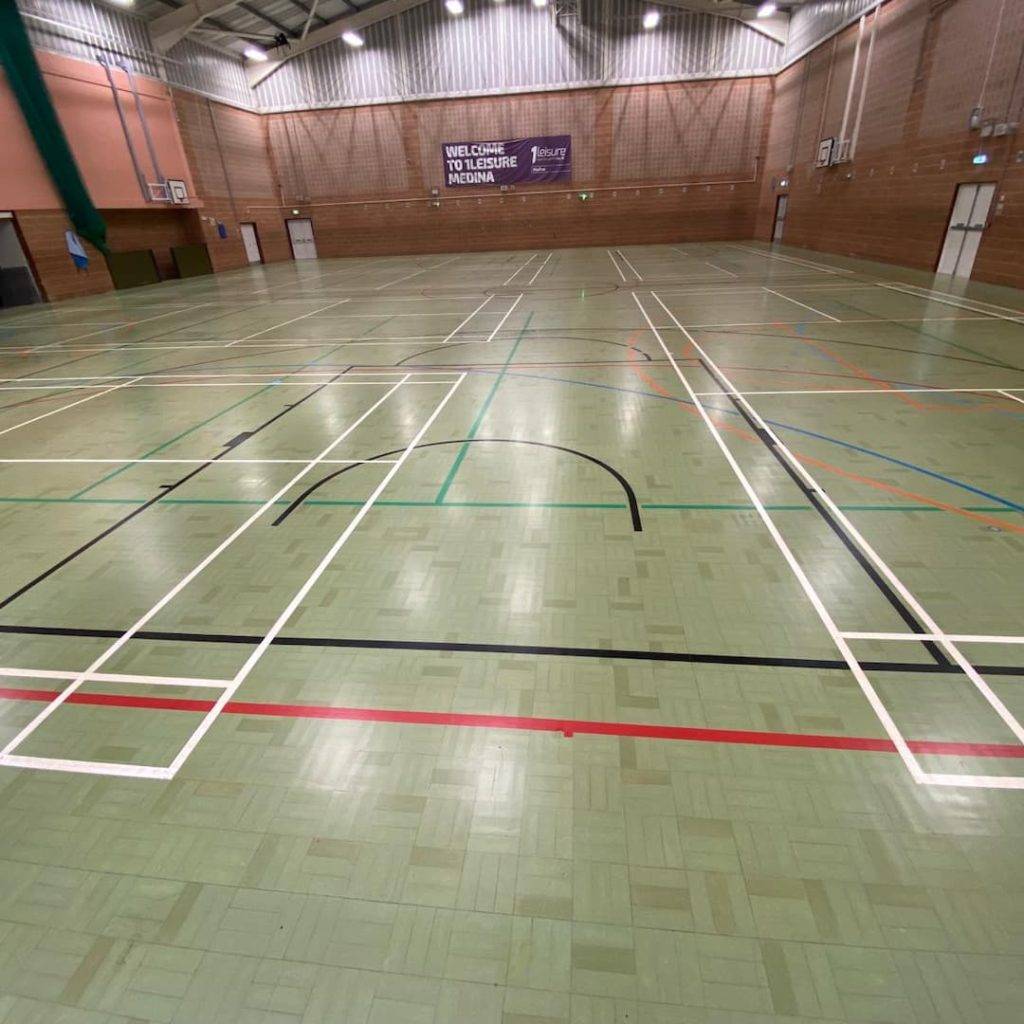
Yes, provided the seal is sound. We prepare the marking areas only, apply the new lines and seal over them. It is far quicker and cheaper than a full refurbishment and is the right answer for most halls whose only real problem is faded courts.
A single-court hall is usually a day or two including curing. Multi-sport halls with several layouts take a little longer. We confirm the programme and the reopening time in writing before starting.
Every two to three years for most halls. Baselines and service areas wear first, so the courts become uneven in appearance long before the floor itself needs attention.
Yes. Adding a sport is straightforward. Removing old lines fully usually requires sanding, so on a sound floor we would normally plan the new layout to work with what is already there and discuss the options honestly.
Relining replaces the court markings on a floor whose seal is still sound. Refinishing sands the floor back to bare timber and rebuilds the finish, with new markings included. Relining is far cheaper and is the right answer more often than people expect.
It varies with use, but most halls need attention every four to six years, and markings almost always wear out before the floor finish does. Netball centre thirds and basketball keys go first.
Yes, and it is often worth doing. We will choose colours that contrast properly under your own hall lighting rather than on a paint chart, and we can drop redundant sports at the same time.
Yes. Synthetic floors can be fully recoated in a new base colour with markings applied over the top, which makes a tired hall look refurbished without replacing the surface.
No, and most halls should not. We will ask what is actually played and remove redundant sets. Fewer, correctly dimensioned lines make a hall easier to use and cheaper to mark.
Typically two to three days for a timber hall including cure time, and four to six days for a full synthetic recolour. We work holidays, weekends and overnight to fit around your bookings.
Send us the hall dimensions and the sports you need marked, and we will price it properly. Standalone visits or part of a wider refurbishment. Call 01823 674562.