
A gymnasium floor tells you when it needs attention: grey traffic lanes down the middle, markings you have to squint at, and a surface that feels slippery within a day of being cleaned. That last symptom is usually a worn seal rather than a cleaning problem, and no amount of extra mopping will fix it.
Courtship Flooring sands and refinishes commercial gymnasium floors across the UK. We take the surface back to clean timber, repair what needs repairing, reseal with a system matched to how hard the room actually works, and re-mark every court. Commercial and institutional facilities only; we do not undertake home or garage gyms.
For larger halls and multi-court floors, see our sports hall floor sanding and sealing service.
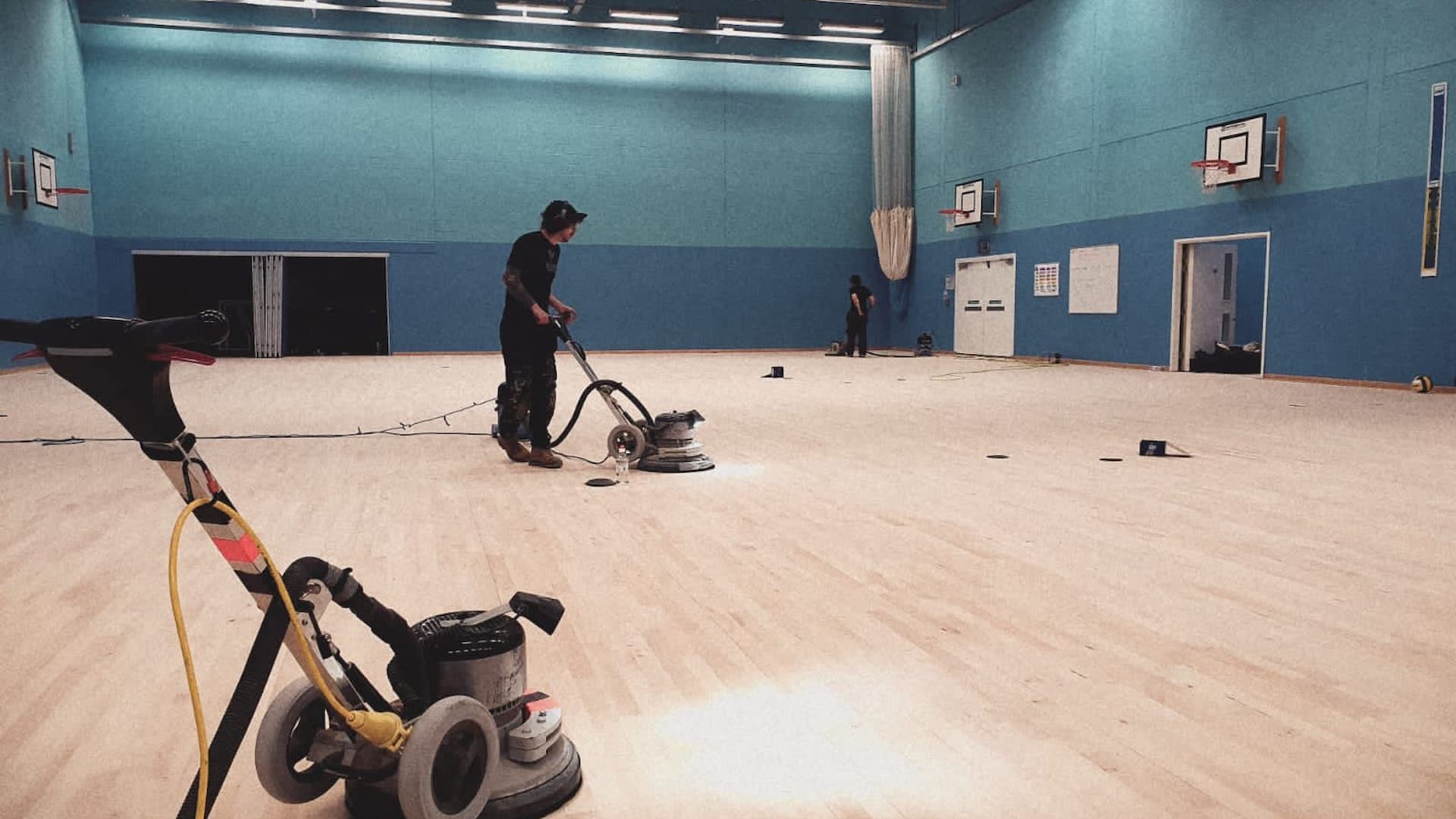
We start with measurement, not machines: moisture readings, board condition, and how much timber is left above the tongue. Then dust-controlled sanding back to clean board, so the rest of the building carries on while we work. Damaged boards are cut out and replaced with matching timber, gaps attended to, and the surface fine-sanded ready for sealing.
Seal systems are chosen for the workload rather than habit, and markings go down between coats so they sit protected within the finish. We tell you precisely when the floor takes foot traffic, when equipment returns and when full use resumes.
Not every tired gym floor needs the full treatment. If the lacquer is worn but unbroken, a screen and recoat abrades the surface lightly and adds fresh seal, at a fraction of the cost and in a couple of days. If the seal has broken through and the timber is taking the wear, a full sand is the honest answer.
The distinction matters because a full sand spends board permanently. A well-maintained gym wants a recoat every two to three years and a full sand roughly every eight to twelve. We measure and tell you which one you are actually looking at.


Gymnasium floors belong to rooms that are rarely empty. School gyms run from breakfast club to evening lettings; university and leisure facilities are busiest at exactly the hours other trades want to work.
So the programme is built around your calendar. Schools are typically done over half term or the summer; leisure and university facilities get overnight shifts or phased sections. Curing times are built in and communicated clearly, and the reopening date is agreed in writing before we start.
A fresh seal restores the friction the surface has lost, which is a safety matter as much as a playing one, and we can document it with a pendulum slip test on completion. It protects the timber underneath from moisture and wear, which is what extends the life of the floor rather than merely improving how it looks.
And it looks transformed. For schools and leisure operators showing facilities to parents, members or funders, that matters more than people admit.
A gym floor takes a beating that a sports hall floor never sees, and it fails in its own particular ways. Understanding that is what separates a sand that lasts from one that looks tired inside a year.
The damage in a fitness suite is almost entirely point loading. Dumbbells dropped from waist height, plate loaded machines dragged rather than lifted, benches shuffled across the boards and racks bolted down and later moved all leave dents, splinters and gouges rather than the even wear you get from running feet. Sanding removes the surface, but a deep dent stays a dent, and part of our survey is telling you which marks will come out and which will not.
Chalk and sweat are the other half of the problem. Both are absorbed by any timber where the seal has worn through, and both stain. Chalk in particular fills open grain and can leave a permanent grey cast in the lifting area even after a full sand.
Then there is rubber. Matting laid straight onto a sealed floor and left down for years traps moisture underneath and can bond to the lacquer, so lifting it pulls the finish with it. We see this constantly, and it is one of the main reasons gym floors come to us in worse condition than the sports hall next door.
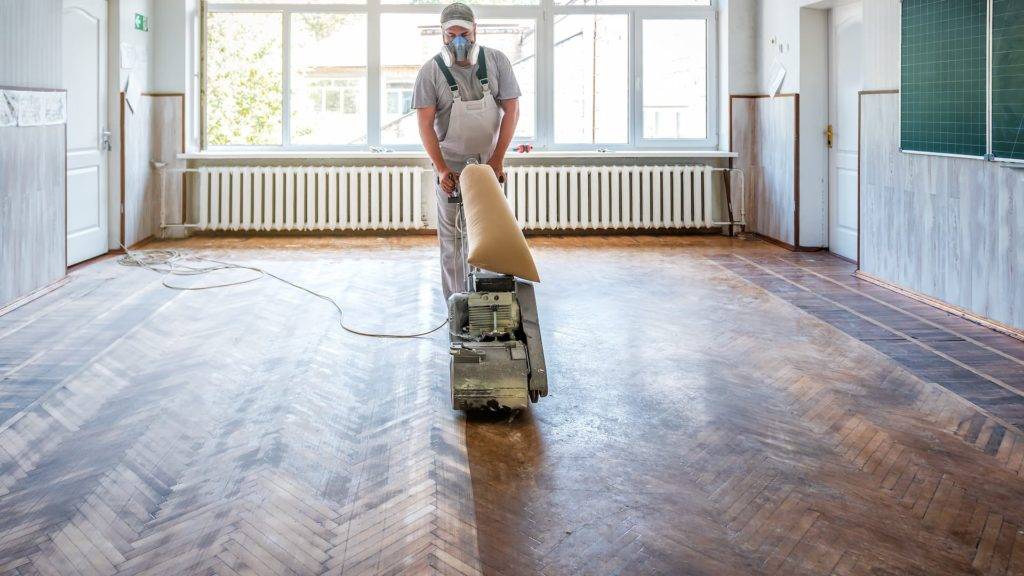
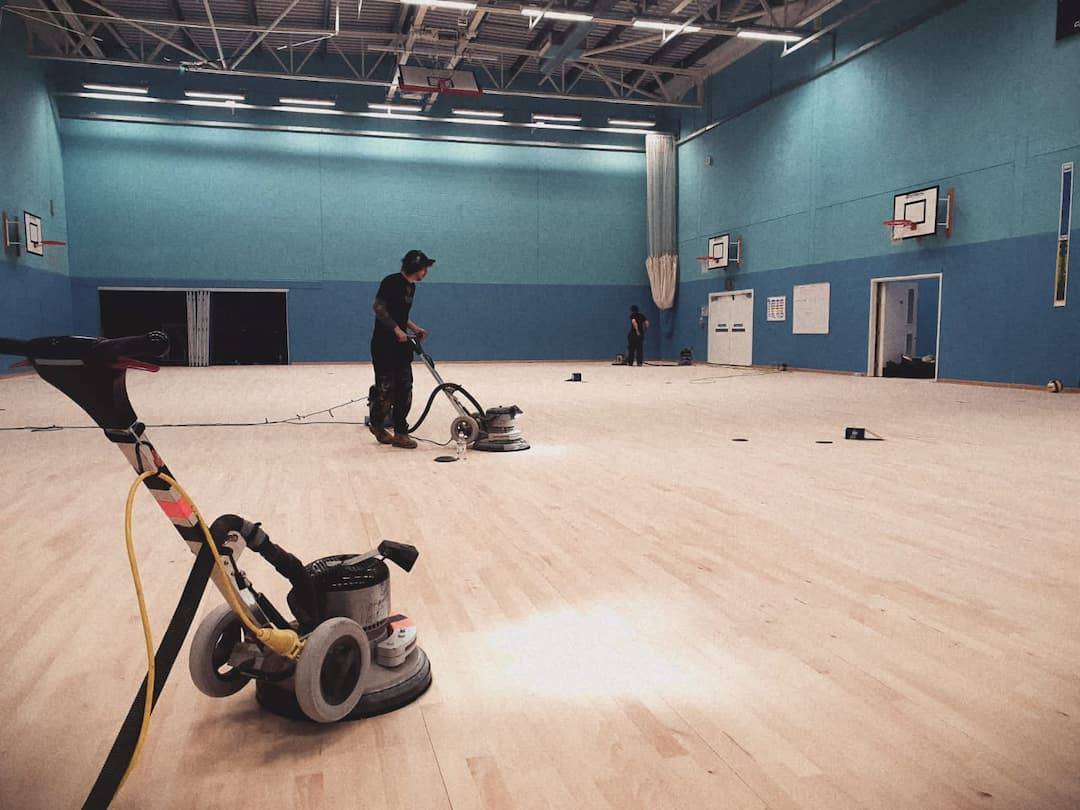
The process follows the same principles as any timber refinish, but the detail is different because the loading is different.
We strip the room first. Racks, platforms, benches and matting all come off the floor, and where equipment is bolted down we lift the fixings and make good the holes rather than sanding around them and leaving a ring. Anything staying in the room is sheeted.
The floor is then sanded back to bare timber. Dents are assessed individually, and where a board is beyond saving we cut it out and let in a new one, matching the species and the grain direction. Splintered edges around old platform positions are repaired properly rather than filled.
Sealing is where we deviate most from a standard hall specification. A fitness floor generally wants a harder, more impact tolerant finish and often an extra coat in the free weight zone, because that is where it will be tested. We usually recommend a satin rather than a gloss, partly for glare under gym lighting and partly because a matt surface hides the inevitable first scuff.
Where the room has a designated lifting area we will talk to you about permanent protection, because no seal survives a dropped bar and the answer is a proper platform rather than a tougher lacquer.
A gym floor is the one surface where aftercare genuinely decides the outcome, so we spend time on it at handover rather than leaving a leaflet.
The single biggest improvement most sites can make is a proper lifting platform. A layered timber and rubber platform under the free weights takes the impact that would otherwise go into your new seal, and it costs a fraction of refinishing the room again in three years.
Matting should be a type intended for use over sealed timber, and it should be lifted periodically rather than left down permanently. Trapping moisture under rubber is what causes the grey bloom and the bonded lacquer we see so often.
Machine feet are worth ten minutes of somebody time. Fitting proper pads to benches, racks and plate trees stops the slow scoring that turns into a full refinish. So does a rule about dragging rather than lifting, though we appreciate that one is easier said than enforced.
Cleaning is straightforward. Dust mop daily to lift chalk and grit, damp mop with a neutral cleaner made for sealed timber, and keep polishes and shine products well away from it.
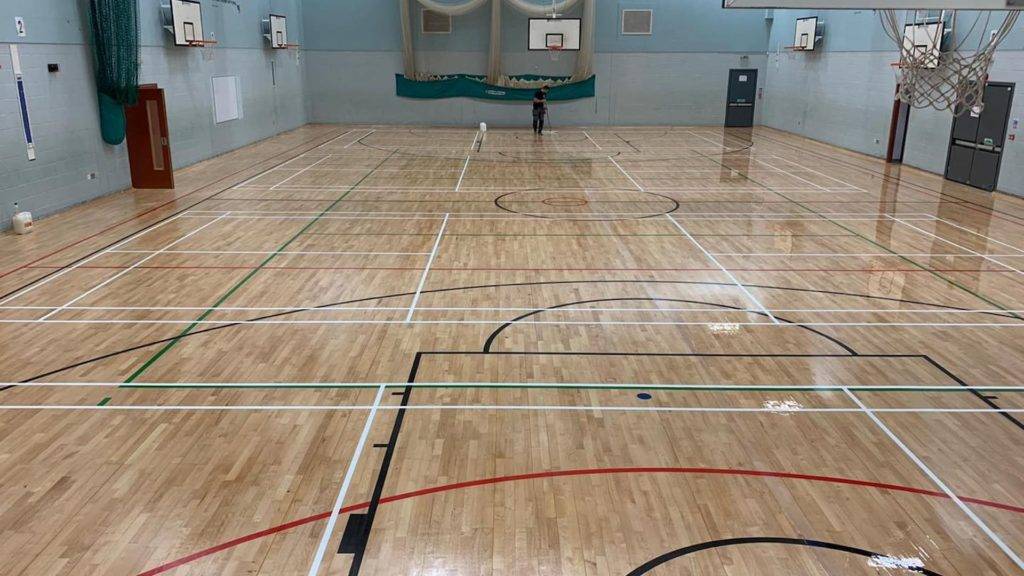

Closing a fitness suite costs money in a way that closing a sports hall usually does not, because members notice immediately and some of them leave. So the programme matters as much as the price.
A typical gym floor of one hundred and fifty to three hundred square metres takes four to seven working days including drying time. Where that is too long to be shut, we split the room and work in halves, keeping part of the suite open while we sand and seal the other. It adds a little to the cost and a day or two to the programme, but it keeps the doors open.
Overnight working is the other option, and it suits sites that run long opening hours. We seal at the end of the shift and the floor is walkable by opening time, with the heavy equipment going back once the seal has hardened properly.
Whichever route you take, the equipment move is the part that catches people out. We will tell you exactly what has to come out, how much space you need to store it and how long it will be off the floor, so it can be arranged rather than improvised on the morning.
It follows the size of the room, the condition of the boards and whether you need a recoat or a full sand and seal. Both cost a fraction of a replacement floor. The survey is free and the quotation is fixed in writing.
Typically four to five days for a single-court hall including sanding, repairs, sealing, markings and curing, which fits inside a school holiday. Overnight and phased working can reduce the impact further where a facility cannot close.
Possibly, but check the cheaper answer first. Slipperiness is often cleaning residue rather than a worn seal, and a professional deep clean fixes that for a fraction of the cost. A pendulum slip test before and after tells you objectively which it was.
No. We are a commercial contractor working on leisure centre fitness suites, school and university gyms, workplace facilities and club training rooms. Domestic work is handled by our sister company Ryan’s Restorations.
No, and anybody who says otherwise is planning to sand around it. The floor has to be clear to be sanded and sealed properly. We can work in sections so only half the room is out of use at a time.
Shallow dents usually sand out. Deep gouges and splintered areas normally need the board cutting out and replacing. We identify them at survey and tell you which is which before you commit.
Light foot traffic at around twenty four hours, and heavy equipment at seventy two hours as a rule. Putting racks back too early presses the fixings into a seal that has not fully hardened and marks it permanently.
If the timber is sound it is nearly always worth keeping, and it is what most members prefer underfoot. Rubber has its place in dedicated lifting zones, and the usual answer is timber throughout with proper platforms where the weights are.
Often, but not always completely. Chalk that has sat in open grain for years can leave a permanent grey cast. We will be honest at survey about what we expect the finished floor to look like.
If the space doubles as a court we will put the markings back under the final seal. Pure fitness suites usually do not need them, though we can lay out zones or a logo if you want the room to look considered.
Send us photographs of the wear or book a free survey, and we will tell you whether your floor needs a recoat, a full sand or simply a proper clean. Call 01823 674562.