
Gym floors work harder than almost any other surface in a building. PE lessons in the morning, clubs in the evening, exam desks in June and a Christmas fair in December. Sooner or later the wear shows: grey traffic lanes, faded courts, boards that move underfoot, and a surface that feels slippery no matter how often it is cleaned.
The good news is that very few gym floors actually need replacing. Courtship Flooring has been refurbishing them since 1987: sanding, resealing, repairing and re-lining floors for schools, universities, leisure centres and clubs across the UK. We are family-run, based in Somerset, and every job is done by our own team with nothing subcontracted.
Whether your floor needs a light recoat or a full restoration with new line markings, we will give you a straight assessment and a price that reflects what the floor actually needs. We also refurbish fitness suites and studio spaces alongside traditional timber gyms.
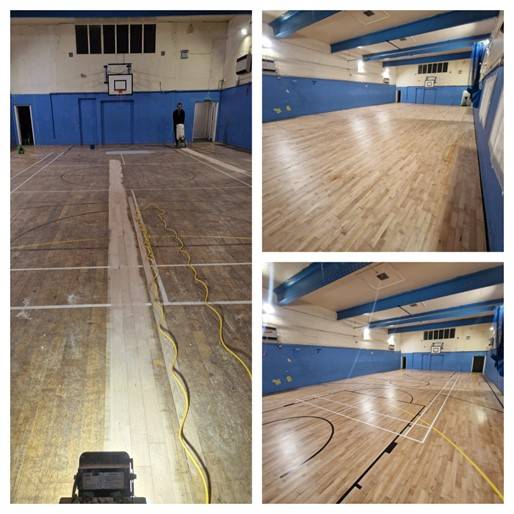
Every refurbishment starts with a proper look at what is going on. We survey the surface, the boards and the moisture levels, because the visible wear is often only half the story. From there we agree a scope: repairs to damaged or water-affected areas, a full sand back to bare timber or a lighter screen and recoat, then sealing with hard-wearing systems from names like Junckers and Bona.
New line markings go down between coats, in whatever combination of sports your timetable demands, and we can add school crests or club logos while we are at it. If the floor is vinyl, lino or polyurethane, not timber, we have repair and deep clean options for those too.
Some signs are obvious, like splinters or a court you can barely see. Others creep up quietly. A floor that feels dusty and slippery within a day of cleaning usually has a worn seal, not a cleaning problem, something our guide to preventing slippery sports hall floors covers in detail. Grey patches along the busiest routes mean the lacquer has worn through and the timber itself is now taking the punishment. Catch it at that stage and a refurbishment is straightforward. Leave it a few more years and boards start needing replacement, which is when the bill grows.
If you are unsure where your floor sits, our refinishing guide is an honest walkthrough of what each stage involves.
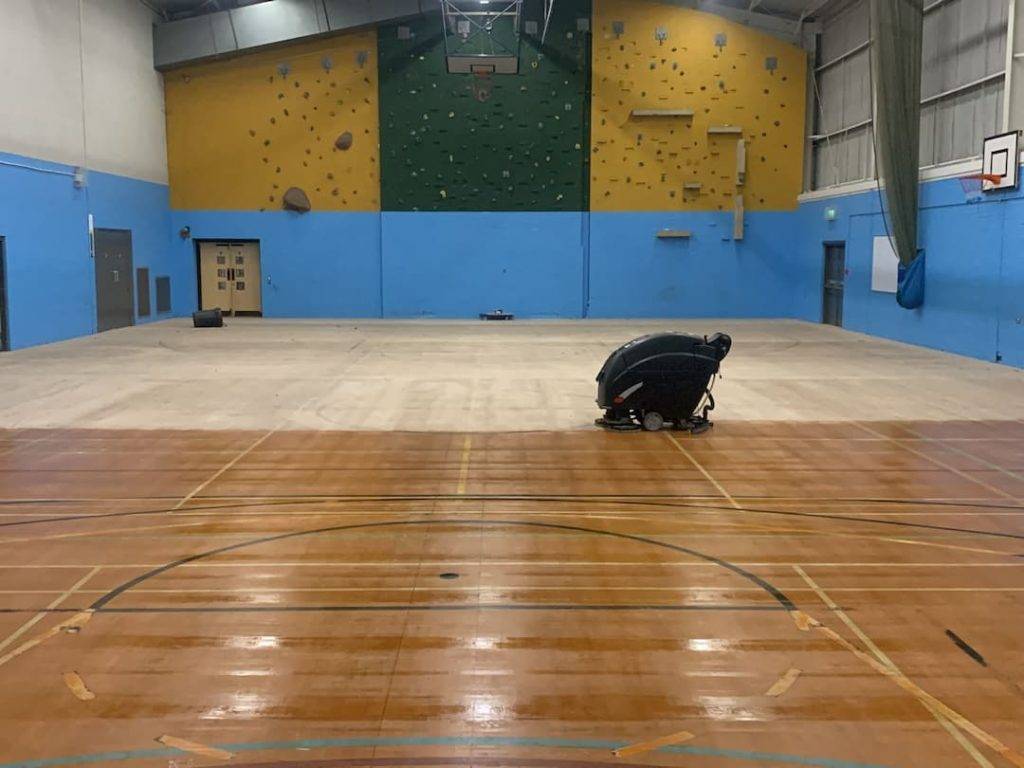
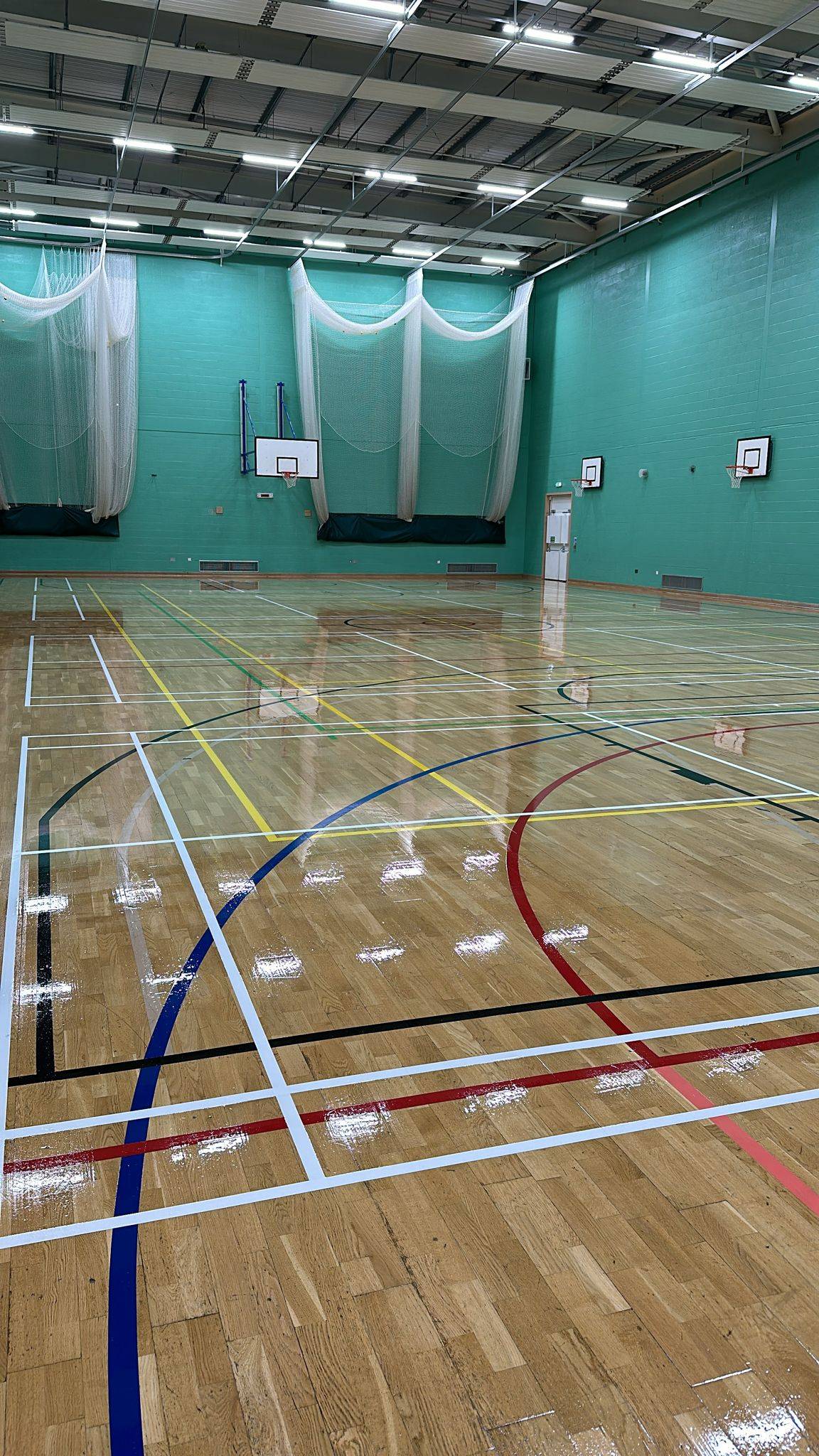
We know what closing a gym costs you in bookings, lessons and goodwill, so we keep downtime to the bare minimum. Overnight working, weekends, half terms and phased programmes are all routine for us, and we agree the schedule before we start so you can plan with confidence. A typical school gym refurbishment fits comfortably inside a holiday week.
Once the work is done, our maintenance and aftercare service keeps the floor at its best, with deep cleaning, cleaning demonstrations for your site team, recommended products and pendulum slip testing when you need documented proof of a safe surface.
Timber, Granwood, vinyl, lino or polyurethane: each surface ages differently and needs a different fix. Because we install, refurbish and maintain all of them, our advice is not skewed towards the one product we happen to sell. If a £3,000 recoat will do the job of a £30,000 replacement, that is exactly what we will tell you. Our cost guide is a useful starting point for budgeting either way.
In schools, colleges and clubs, the gymnasium is often the oldest sports floor on the site: a timber or Granwood floor laid decades ago in a hall smaller than a modern sports hall, used for PE, gymnastics, dance, assemblies and exams. Many of those floors have plenty of life left, because older solid timber often has enough wear layer for several more refinishes.
A gymnasium floor has its own demands. Apparatus is wheeled in and out, wall bars and floor sockets are fixed through it, mats are dragged across it, and it tends to be the room a school uses for everything that will not fit elsewhere. We repair around sockets and fixings, sand and reseal the timber, and remark only the courts the timetable actually uses. At The Bradfield Club that meant bringing a generations-old gymnasium floor back into use. As a guide, a full sand, seal and reline of a gym of around 240 m² takes five to six working days, which fits inside a single holiday week.
Where a gym floor has reached the end of its life, we install new wooden sports flooring or vinyl and PU systems, and our school sports hall flooring page covers new floors for education.
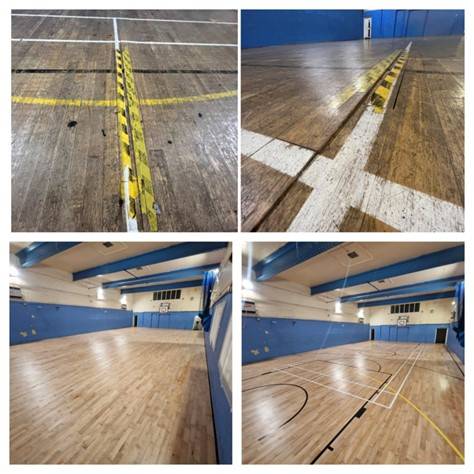
The gymnasium at The Bradfield Club is the kind of project this service exists for: a floor generations old, worn grey by decades of boxing, training and community use, and a club that needed it back fast on a community budget.
We sanded the original timber back to life, made the repairs it needed, then resealed and re-marked the space. The before and after photographs speak for themselves, and the club got its gymnasium back on the date we agreed. Refurbishment first, replacement only when a floor truly demands it: that is the principle on every gym we touch.
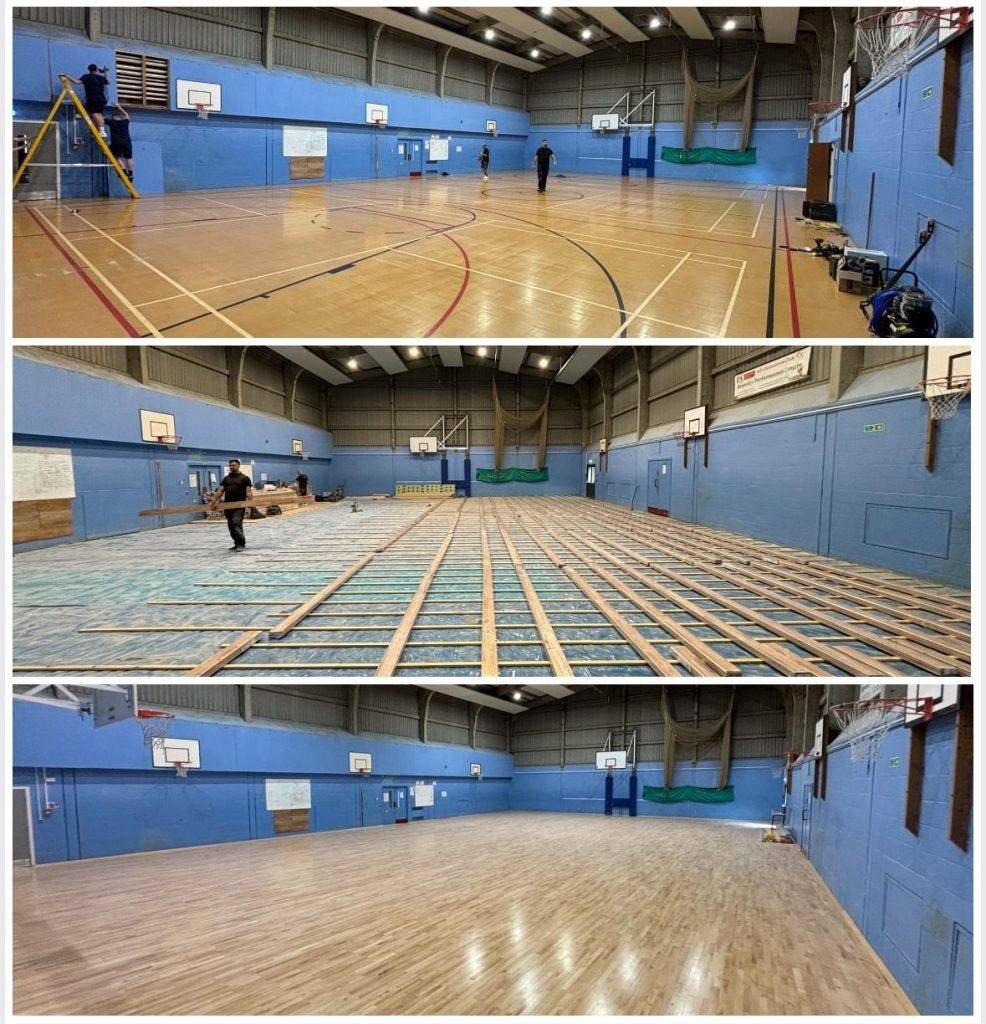
Refurbishment is a broader job than a sand and seal, and it is the right description when the floor needs work below the surface as well as on it.
A typical refurbishment starts with the structure. We lift boards where the floor has gone dead, replace failed pads, battens or cradles, and deal with any movement or squeaking at source. There is no point putting a new finish onto a floor that does not perform, and the components that fail are usually a small proportion of the total.
Board level repairs come next. Damaged, split and water damaged boards are cut out and replaced with matching timber, laid to the same grain direction so the repair disappears once the floor is sanded. Where equipment has been bolted through the floor and later moved, we make those areas good properly instead of simply filling them.
Only then does the floor get sanded back to bare timber, resealed and remarked. Doing it in that order is what separates a refurbishment from a cosmetic exercise, and it is why a properly refurbished floor performs like a new one and does not simply look like one for a while.
Most refurbishment enquiries arrive as a description of a symptom, and a large part of the survey is working back from that to the cause.
A floor that feels hard and lifeless has usually lost its resilience below the boards. A floor that squeaks has loose fixings or shifted battens. Boards that have cupped or domed point to moisture, either historic from a leak or ongoing from the slab. Gaps that open every winter and close every summer are a humidity issue in the building, not a fault in the floor.
We take moisture readings in the boards and, where necessary, in the slab. We measure the remaining wear layer to see how many refinishes the floor has left in it. We lift a vent or a trim to look at the structure underneath instead of guessing from above.
That work takes an hour and it decides everything that follows. It is also how we avoid the two expensive mistakes in this trade: refinishing a floor that needed structural repair, and replacing a floor that only needed refinishing.
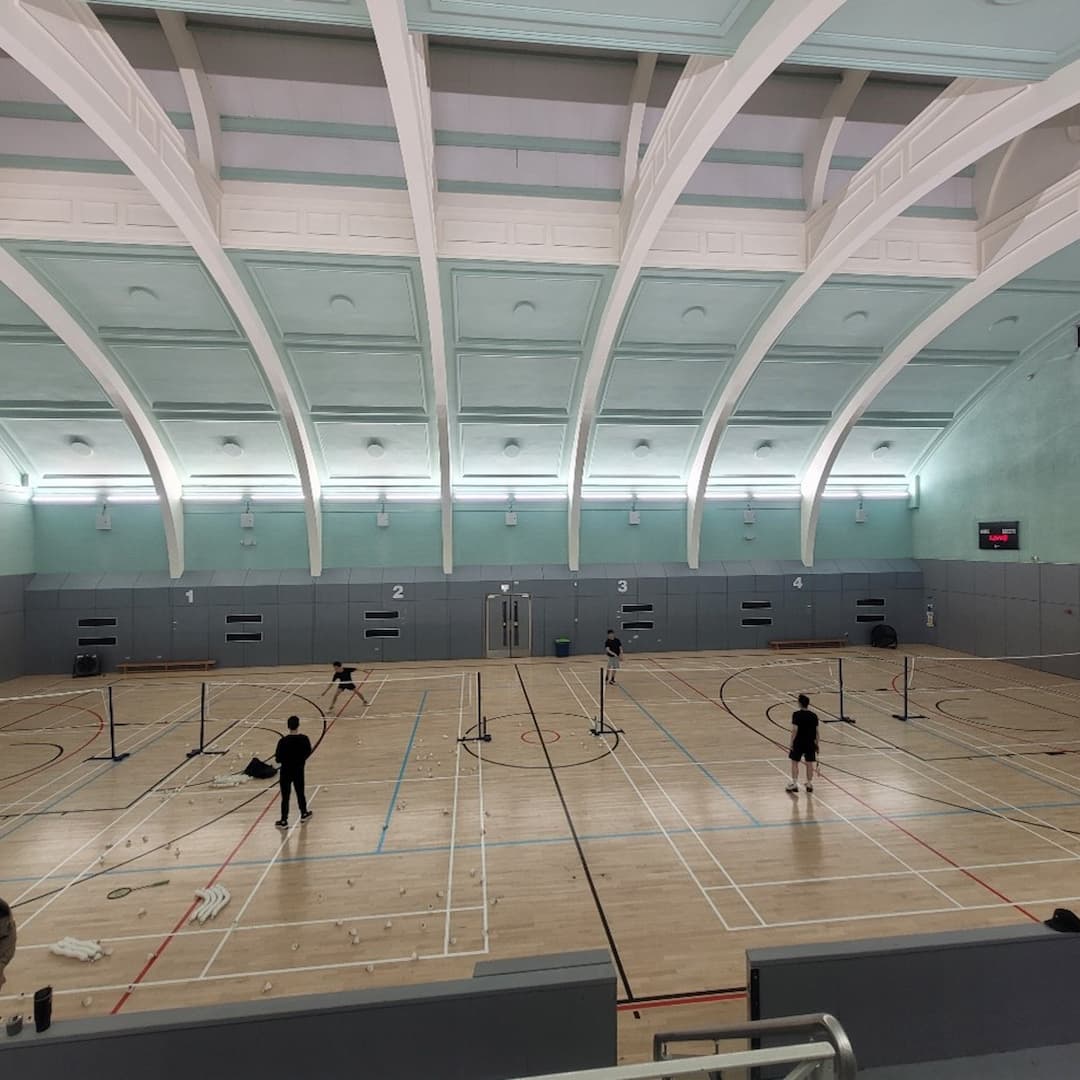
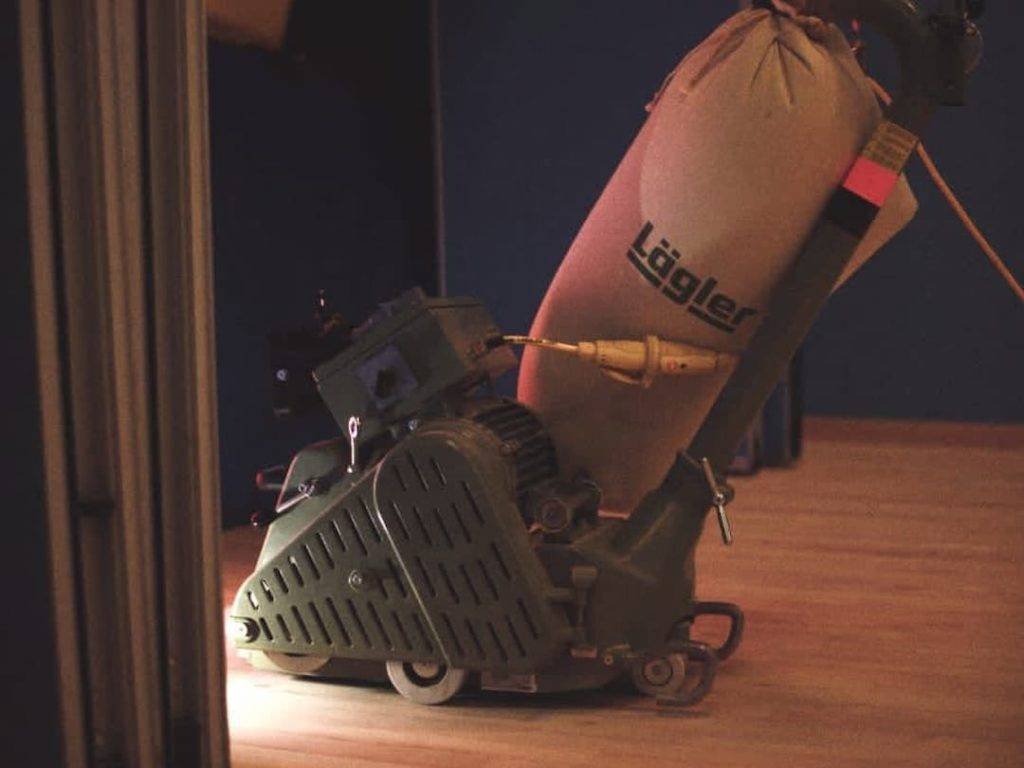
The question we are asked most often, and the honest answer usually comes down to three measurements.
The first is the remaining wear layer. Every full sand takes timber off, and a floor that has been through many cycles may be close to the tongue. Once a sander reaches the fixings the board is finished, and no amount of refurbishment will change that.
The second is the condition of the structure. Isolated failed pads and battens are routine repairs. A system that has failed widely, or one built to a specification that never suited the hall, is a different proposition.
The third is moisture. A slab with an active moisture problem will destroy any floor laid on it, new or refurbished, until the cause is dealt with.
If the wear layer is adequate, the structure is largely sound and the slab is dry, refurbishment is almost always the better value and will give you many more years. Where those things are not true we will tell you plainly, because a refurbishment carried out on a failing floor is money spent twice.
Refurbishment is the natural moment to correct things that have quietly been wrong for years, because the floor is open and the setting out is being done anyway.
The finish is the first decision. We generally specify two pack polyurethane for its durability under heavy timetables and scrubber driers, in a satin sheen that hides scuffing and avoids glare under LED lighting. It is a noticeably better result than the gloss finishes many older halls were given.
Markings are the second. Most halls carry lines for sports nobody plays any more, and courts that have been remarked by copying the previous set often turn out to be dimensionally out. We set out fresh from current governing body dimensions and remove whatever is redundant, which makes the hall clearer to use and cheaper to mark.
This is also when a school crest or club badge at centre court costs least, because it is painted between coats within work already underway. And we can pendulum slip test on completion so the facilities file has documented evidence, not just an assurance.
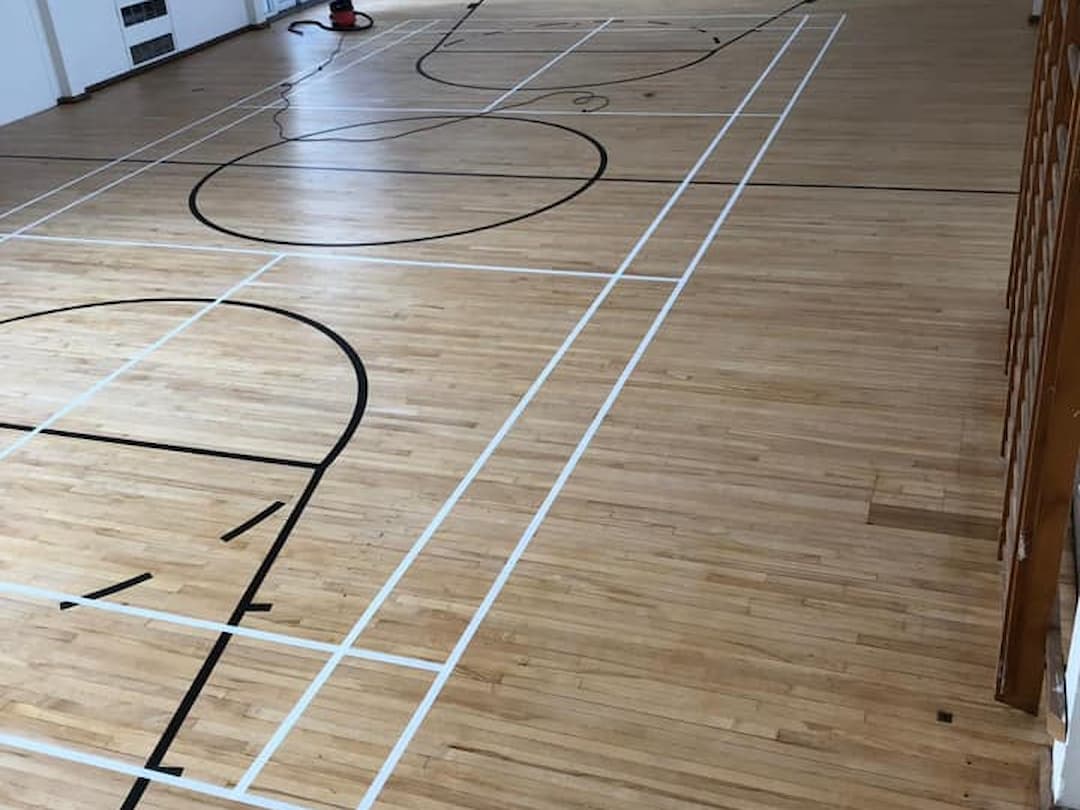
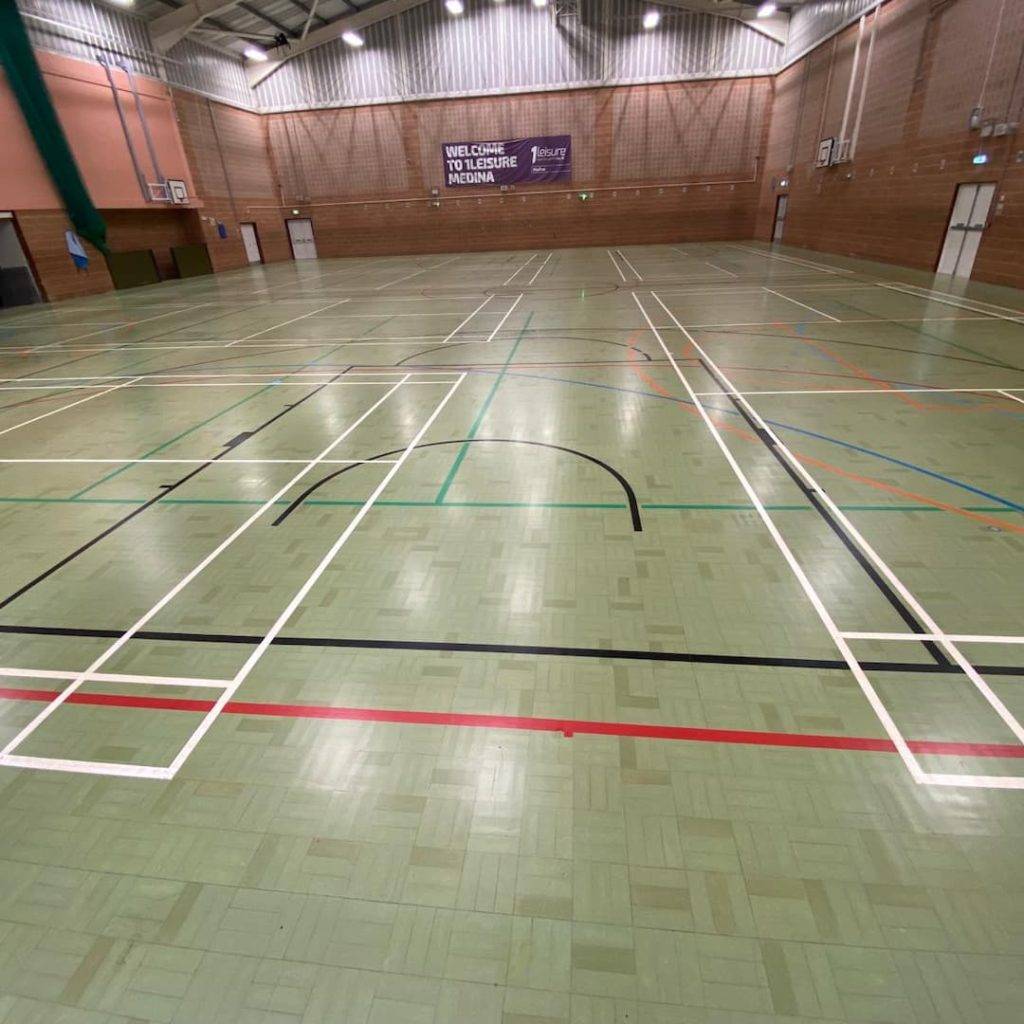
A gym or sports hall refurbishment is a bigger undertaking than a reseal, and the programme needs planning around the building, not the other way round.
A full refurbishment of a typical sports hall runs from two to four weeks depending on how much structural and board repair is involved. Most schools take that in a summer holiday, and most leisure operators phase it around their quietest period. We give you a start and finish date in writing and staff the job to meet it, without spreading one team across too many sites.
On cost, the quotation is broken down by element, not given as a single figure, so if the budget will not cover everything this year you can see exactly which parts to defer. Structural repair and refinishing are the priorities; a centre circle logo can wait.
For multi site clients we will build a rolling programme across several budget years, taking each hall out at the quietest point in its own calendar. That spreads the spend and avoids the situation where every floor in the estate needs doing at once.
It depends on the size of the floor, its condition and whether it needs repairs, a recoat or a full sand and seal. As a guide, refurbishment typically costs a small fraction of replacement. Send us the hall dimensions and a few photos and we will give you a clear quotation, or see our cost per square metre guide for ballpark figures.
Often, yes. Localised water damage on a sprung timber floor can usually be cut out and repaired with matching boards before the whole surface is sanded and sealed, provided the source of the moisture has been fixed. We check moisture levels as part of every survey before recommending the repair route.
Not for long. Most gym refurbishments are completed inside a holiday week, and overnight or weekend working can keep daytime sessions running for parts of the programme. We agree the schedule with you up front, including exactly when the floor can take traffic again.
A sand and seal renews the surface. A refurbishment also puts right what is underneath: failed pads and battens, loose fixings, damaged boards and moisture issues. If your floor has dead spots or squeaks, you need a refurbishment.
It comes down to the remaining wear layer, the condition of the structure and whether the slab is dry. If the timber has depth left, the structure is largely sound and there is no active moisture, refurbishment is nearly always better value.
Usually two to four weeks for a full refurbishment, depending on how much repair is needed. Most schools fit it into a summer holiday and we work to a written start and finish date.
Yes. Dead spots are almost always a local failure of a pad, batten or cradle. We lift the boards over the affected area, replace the failed components and relay, leaving the rest of the floor undisturbed.
Yes, and it is the best moment to do it. Everything comes off with the old finish, so we can remove redundant sports and set out fresh from current governing body dimensions at no extra visit.
For multi site clients, yes. We build rolling programmes that phase halls across several years and take each one out of use at the quietest point in its own calendar.
Yes. Where a floor is beyond refurbishment, we install new timber, vinyl, PU and lino sports floors, including sprung sub-floors, for school, college and club gymnasiums. A survey shows which route is better value before you commit; see our sports hall flooring installation page.
Get a free, honest assessment of your gym floor. Call 01823 674562 or send us a photo of the wear, and we will tell you what it needs and what it will cost, with no obligation.