
Flooring Professionals To The Leisure Industry
Courtship Flooring is a commercial sports flooring contractor working in Leicestershire and across the UK. Centrally placed and easily reached, which makes both single halls and multi-site programmes straightforward to deliver.
Trading since 1987 and family-owned throughout, we handle indoor sports and commercial timber floors from first survey to long-term aftercare, with our own crew and equipment on site at every stage. Domestic and residential projects are the province of our sister company, Ryan’s Restorations.
Whatever the size of the building, work in Leicestershire follows the same survey-first approach as every sports hall flooring project we take on.
Overnight/Weekend Installations
Professional Cleaning Demonstrations
Squash Court Maintenance
Recommended Cleaning Products
Professional Pendulum Slip Testing
Deep Clean & Reseal Service
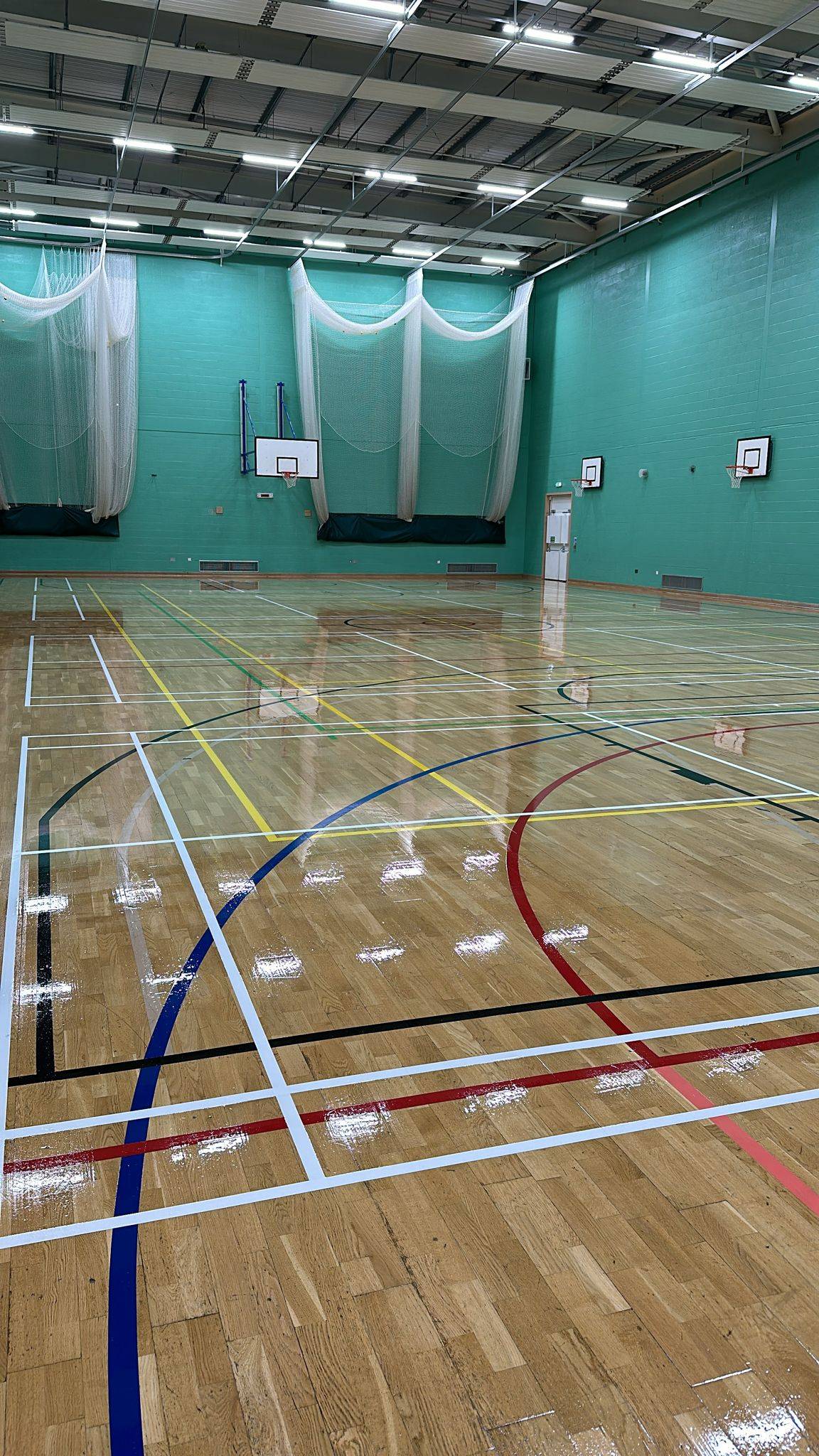
A single-court hall can be sanded, repaired, sealed, marked and cured within a school holiday, provided the programme is planned properly and contingency is built in rather than assumed.
We confirm the sequence and the handover date in writing before starting, and we build in the margin that absorbs the unexpected. A floor that is not ready when term begins is a serious problem, not an inconvenience.
Once a surface comes back, old floors occasionally reveal problems nobody knew about: historic water damage, previous repairs in the wrong timber, or bitumen bleeding through mid-century parquet.
Our approach is simple. We stop, tell you what we have found, and price the options before proceeding. Nothing gets sealed over and no additional work happens without your agreement in writing.
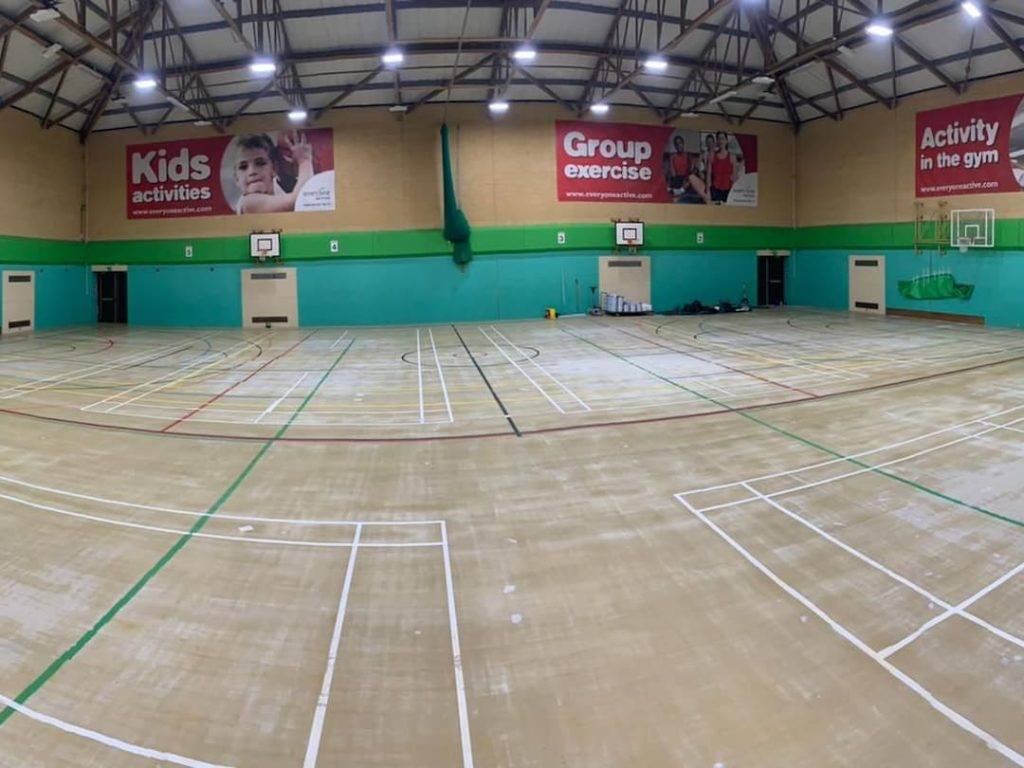
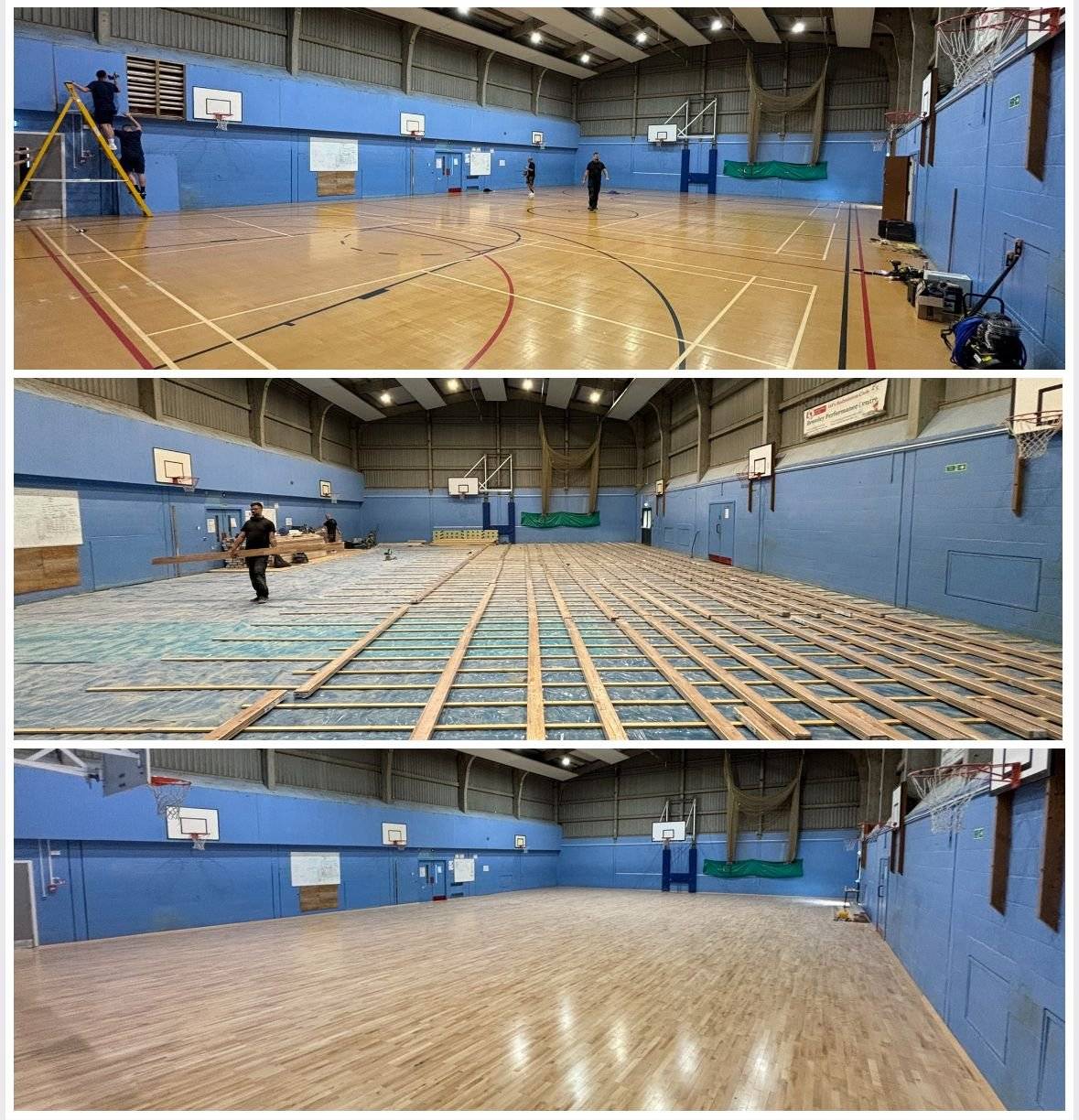
Flooring quotations vary widely because scopes vary widely: coat numbers, sub-floor preparation, marking, waste removal and testing are all included by some contractors and treated as extras by others.
Ours itemise the specification explicitly so you can compare properly. Where a competing quote is markedly cheaper, comparing the itemisation usually explains exactly why, and occasionally the cheaper quote is the right one.
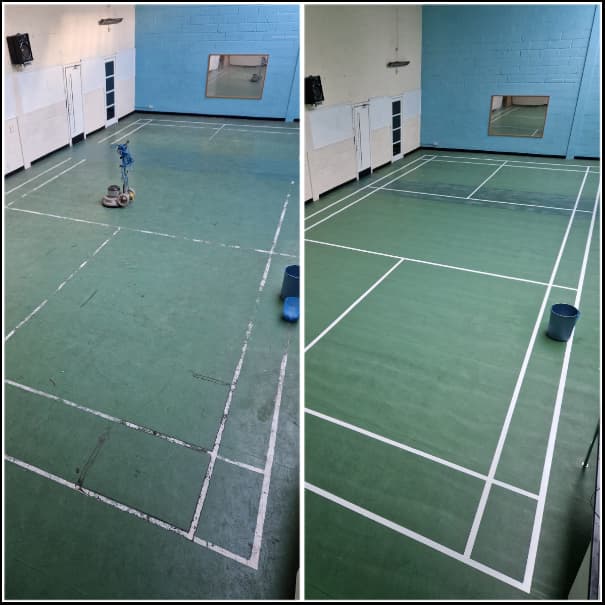
Not every floor we save sits in a sports centre. St Katherine’s had the kind of well-loved, well-worn hall floor that carries badminton one evening and a community event the next, and the committee wanted it rescued rather than replaced.
We restored it completely. The hall is now set for another few decades of everything it is asked to do.
~ Matthew Evans
An outstanding company to deal with and they couldn’t have been better to work with. St George’s Ascot now has a stunning new sports hall floor and we are delighted. From quote, support, delivery and after sales, the Team has been brilliant. Thank you. 
~ James Anderson







Grip is the one property of a sports floor you can put a number on, and a number is what a head of estates in Leicestershire needs when an insurer, a governing body or a parent asks whether the hall is safe.
We use the pendulum test, the recognised method in the UK. A weighted arm with a rubber slider swings across the floor and the friction it meets is read off a scale. We take readings at several points, because the centre of a court and the traffic lane from the door rarely give the same result, and we record everything on a certificate.
If a floor tests low, the cause is nearly always polish build up, a cleaning product left as a film, or a seal worn through. Each is correctable, and knowing which one you have stops money going on the wrong fix.
Testing stands alone or forms part of a refurbishment handover.

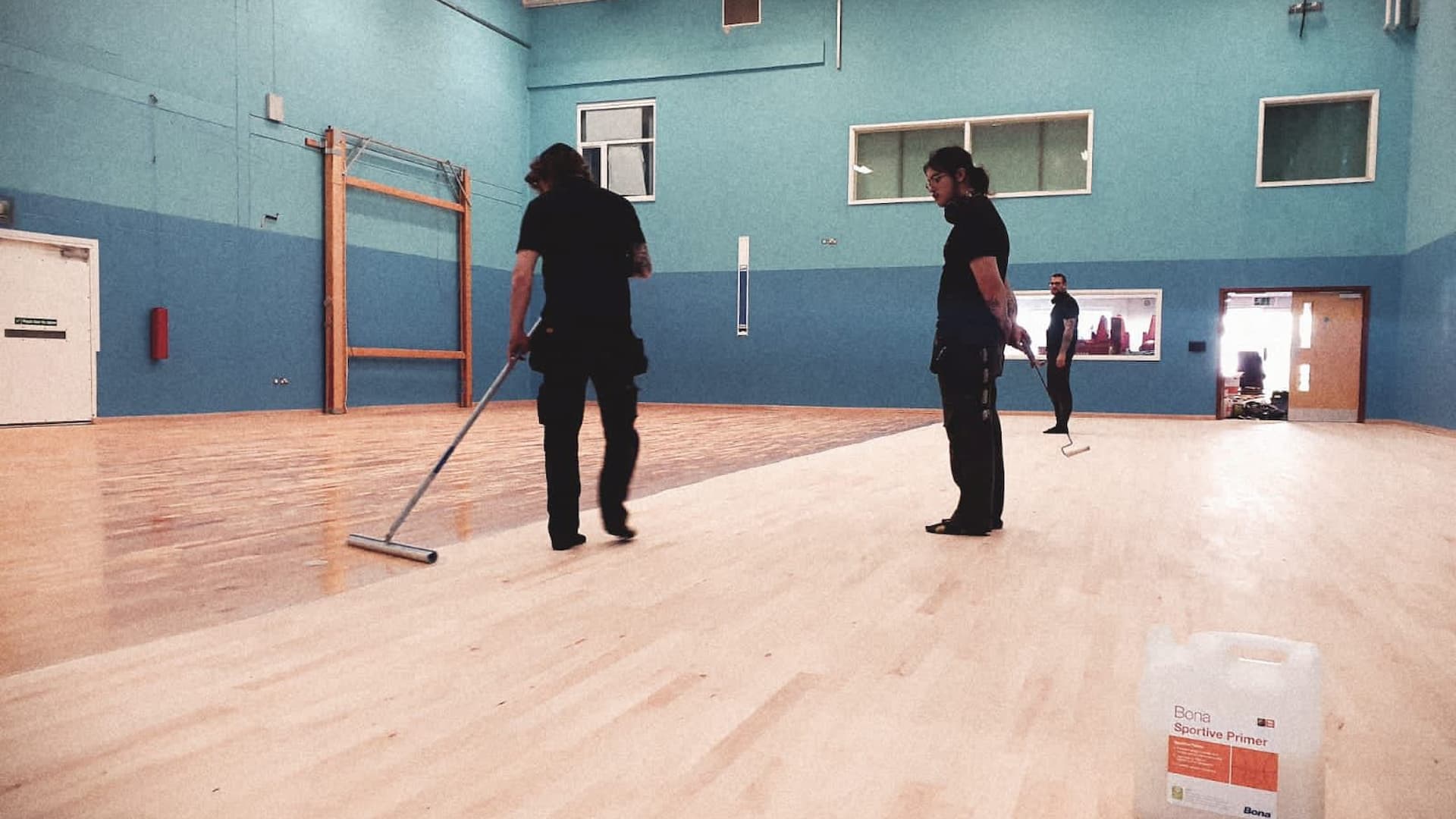
Schools, colleges and universities across Leicestershire run studios that are not sports halls, and a floor specified as though they were produces a room dancers and drama staff quietly avoid.
Dance needs controlled slide as well as grip. A floor finished for basketball is too grabby for a turn and stops the foot when the body keeps moving, which is how ankles and knees get hurt. Ballet and contemporary usually want a vinyl performance surface over a sprung timber base. Tap and musical theatre want the timber itself.
Resilience matters more than in a hall, because dancers land repeatedly in the same spot. Where a studio sits above a classroom, the sprung floor also has to work acoustically.
Drama studios take a matt black finish that hides scuffs and absorbs light. We specify the surface for the discipline that has priority and say plainly what the compromise is for the others.
How a floor is cleaned decides when it next needs us, and the routine that works is simple enough to fit on one sheet, which is what we leave with every hall in Leicestershire.
Each day, a dry mop lifts the grit that would otherwise grind through the seal under every trainer. Each week, a damp mop with a neutral pH cleaner at the dilution on the label removes sweat and rubber marks. A scrubber dryer is fine on a sealed timber floor if the water is kept low and the pads are not abrasive.
The products to keep out of the hall are polish, wax and anything sold as a shine restorer. They build a slippery film, hide the true state of the seal, and stop the next coat from bonding, so a cheap screen and recoat turns into a full sand.
We brief your cleaning team in person.
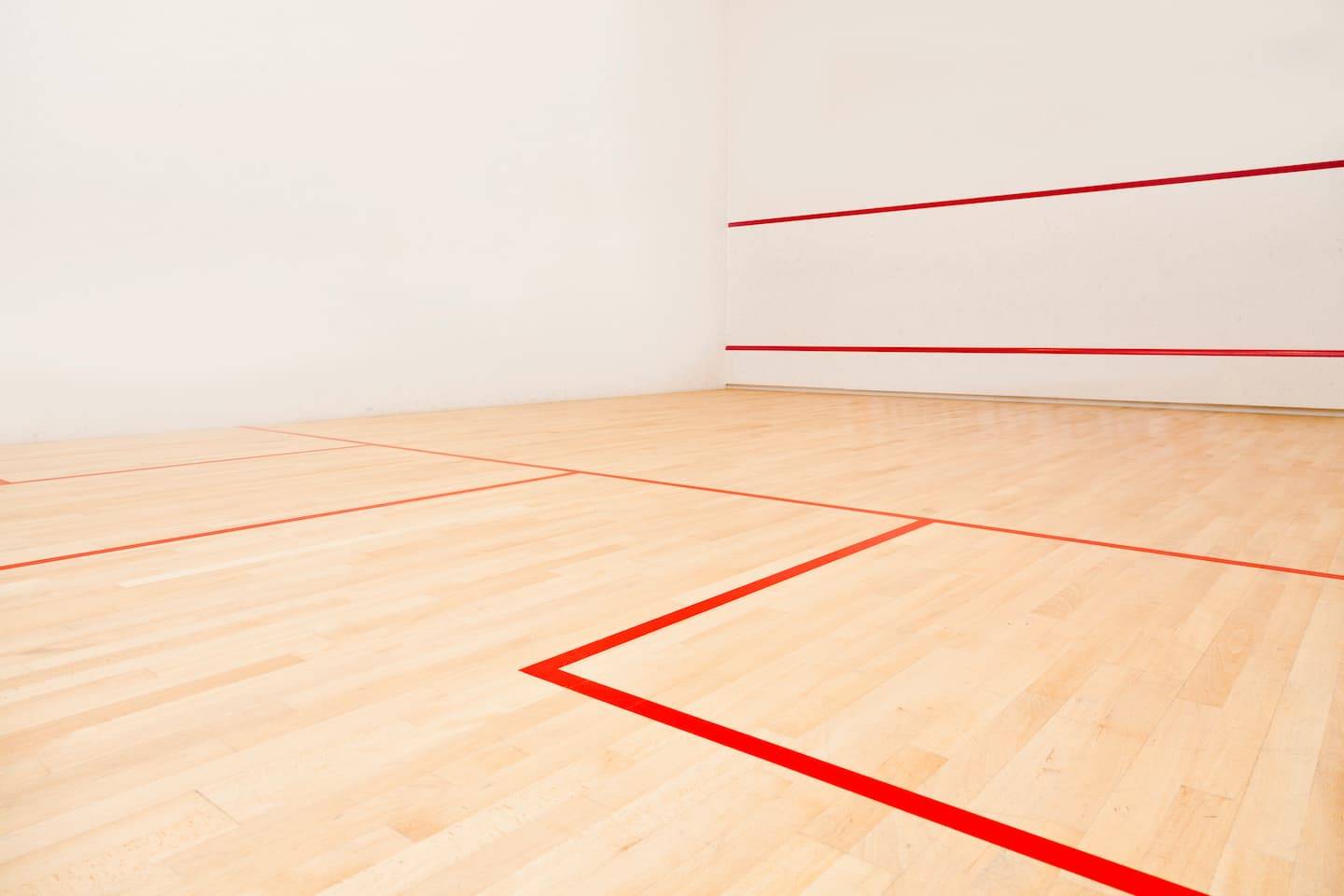
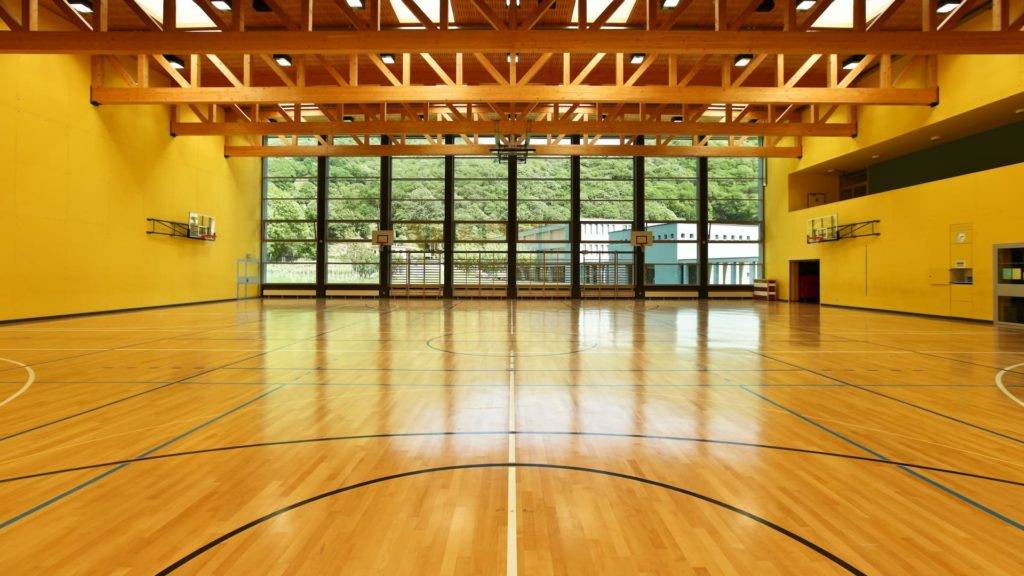
Leicestershire brings us a mix of academy trust estates, university sport, leisure facilities and a considerable amount of older community building stock.
Trust work is the largest strand. Where one organisation holds a dozen or more sports halls, the useful first step is a condition survey across the estate producing a costed priority order, because very few trusts have a single record of what condition their floors are in. From there the work phases across budget years rather than arriving as a series of emergencies.
University and college sport follows, with the year round timetable pressure that every campus has and the narrow fixed windows that come with it.
The older stock is the third group. School halls and church halls in the county frequently have Granwood or mid century timber floors, and both are regularly written off when they should not be. A Granwood floor with sound blocks and an intact bed is almost always worth restoring, at a fraction of the cost of replacement.
Village halls make up the rest, and those transform for surprisingly modest sums.
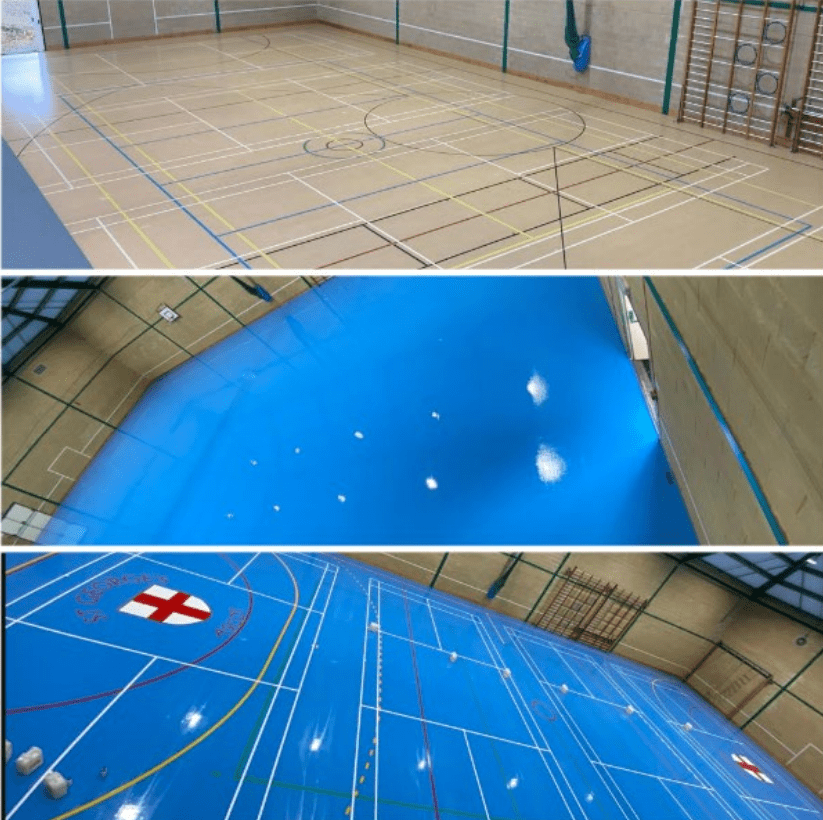
Leicestershire has a good deal of older school and church hall stock, so the most useful comparison is St George School in Ascot.
That hall had a Granwood floor which more than one contractor had said was beyond saving and due for replacement. Granwood is a composite of wood flour and cement pressed into blocks and laid in a bitumen bed. It is not timber, it has no grain, and sanded like timber it is permanently damaged. We assessed the blocks, rebedded the loose ones, replaced those that had broken up, prepared the surface with appropriate abrasives and coated it with a modified epoxy system with the line markings applied within the system rather than sitting on top.
The result is a floor with years of life left at a fraction of the cost of replacement, which would also have meant lifting a bitumen bed that may require specialist handling.
For trusts with several halls, a survey across the estate is the more useful starting point.
No. Our sanders and edge machines run on sealed vacuum extraction and the dust is bagged on site. We seal the hall doors, agree with your caretaker how the ventilation is isolated and screen any opening onto a dining area, so lessons in adjoining rooms continue without interruption.
Light foot traffic in soft shoes is fine after twenty four hours. Allow seventy two hours or more before goals, mats, trampolines or staging return, because the two pack polyurethane is still hardening and heavy items leave permanent impressions. We confirm the exact timings for your system in writing.
Yes. DBS details for every operative attending are supplied before the start date, together with site specific risk assessments and method statements, COSHH sheets and our insurance certificates. Our teams sign in, wear identification and keep to the areas agreed with your site manager throughout the job.
Always. We set out from the current governing body measurements, so netball at 30.5 by 15.25 metres, basketball at 28 by 15 metres and badminton at 13.4 by 6.1 metres, measured from a datum and squared with diagonals. Where a hall cannot take a full court with run off, we tell you.
Yes, and you should. Exam desks and stacking chairs cause most of the scoring we later sand out. A roll out protective covering laid before the furniture arrives takes that damage instead of the seal, and we advise on the right product and how to store and handle it.
Yes. We sand and seal in overnight shifts so the hall is handed back cleaned and ventilated before the first booking, with coats timed to reach light traffic strength by morning. It costs slightly more in labour and usually saves far more in bookings kept.
Because heating dries the air and the timber gives up moisture and shrinks. Small gaps that open in January and close by summer are normal seasonal movement, not a defect. Wide or one sided gaps point to a humidity or moisture problem in the building, which we can investigate.
Workmanship and materials on the repairs, sanding, sealing and marking we carry out, with the terms stated on your quotation. It assumes the cleaning guidance we leave is followed and that no polish or wax is used. If something is wrong, we return and correct it.
Book a free survey of your sports hall floor in Leicestershire. We will measure it, take the readings and give you a written report, a fixed price and a programme that works around your timetable. Call 01823 674562 or send us a message.