
Squash courts are not sports halls with walls. The floor is traditionally left unsealed so the timber itself provides grip, which means everything about how it is prepared, sanded and maintained differs from a lacquered sports floor. Treat a squash court like a sports hall and you will ruin the very quality players rely on.
Courtship Flooring sands, repairs and restores squash court floors across the UK for clubs, leisure trusts, schools and universities. We have been doing this since 1987, with our own team and rigorous dust control, and we work to the standards competitive play demands.
The same team carries out sports hall floor sanding and sealing, so courts and main halls can be programmed in one visit.
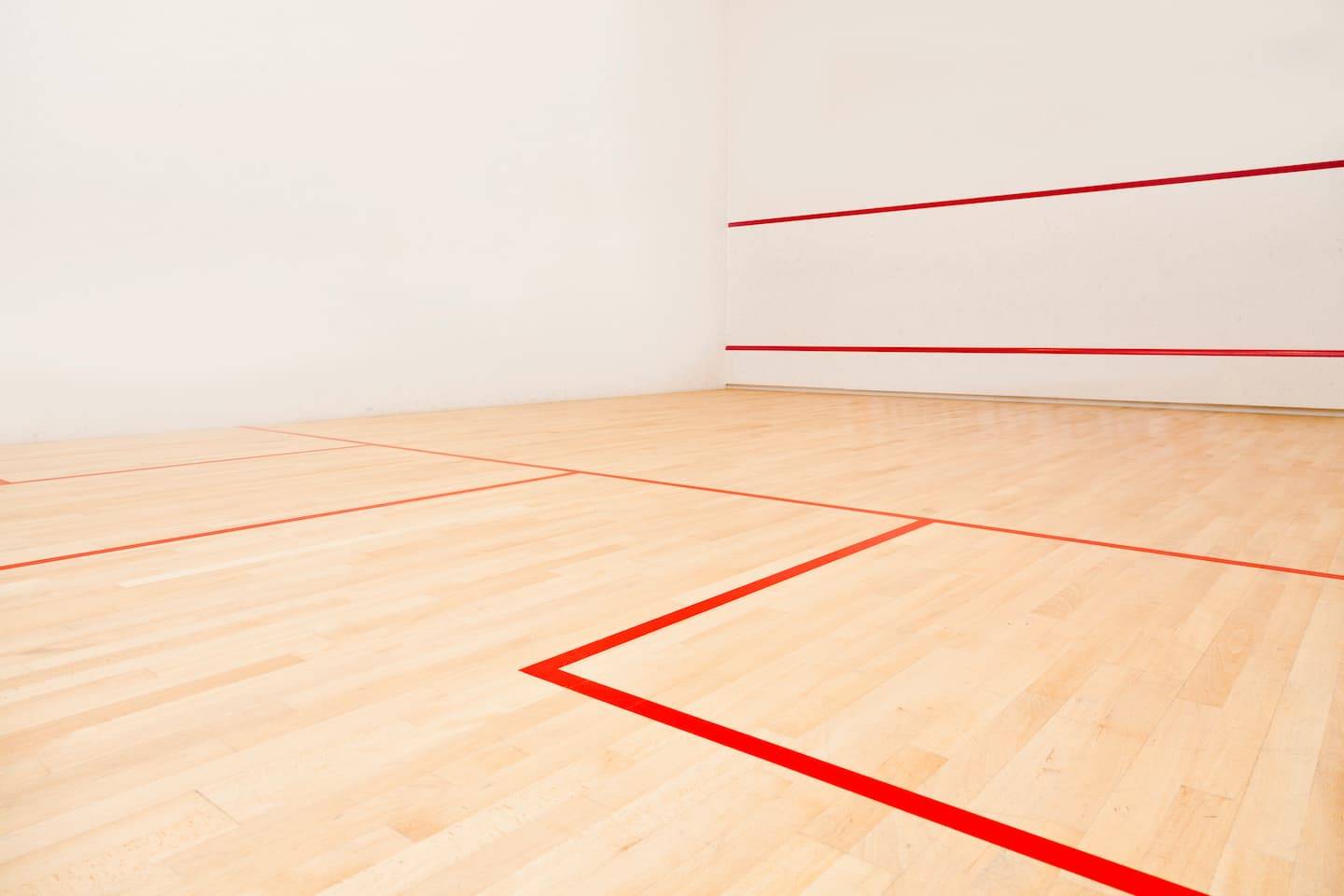
An unsealed court relies on the bare timber for friction. Dust is therefore the enemy in a way it never is elsewhere: a fine layer across the surface reduces grip exactly when a player is lunging at full stretch, which is how ankles turn.
Our sanding uses rigorous dust extraction and leaves the surface prepared to grip rather than shine. We assess board condition, remaining thickness and the state of the boundary lines, and we will tell you honestly if a court has been over-sanded in the past and has little left to give.
Court floors take punishment in specific places: the service boxes, the T, and the area behind the short line. Localised wear and damaged boards are cut out and replaced with matching timber so the repair disappears into the floor rather than announcing itself underfoot.
Boundary and service lines are reapplied to specification as part of the work. Where a club is also dealing with wall scuffing or general court condition, we can advise on the whole picture through our squash court service.
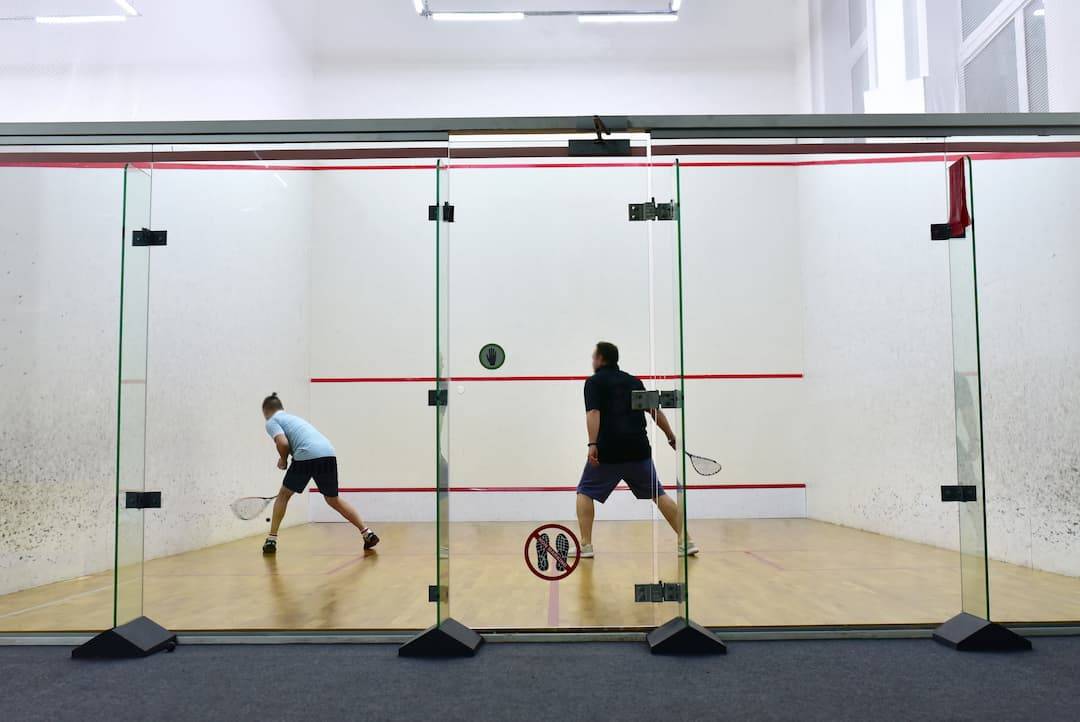
Most squash court problems are maintenance problems. Courts sanded too frequently lose timber they never get back; courts cleaned with the wrong products end up slippery and then get sanded unnecessarily as a result.
We set out the routine your own team should follow, recommend suitable products, and provide maintenance visits at sensible intervals. Done properly, the gap between full sandings stretches considerably, which is the cheapest saving available on a court floor.
Clubs with several courts rarely want them all closed at once, and leisure trusts have league fixtures and bookings to protect. We phase multi-court work so play continues on the remaining courts, or take the whole block in a quiet period where that suits better.
Either way the schedule and the reopening dates are agreed in writing before anything starts, and a multi-court programme priced together costs less per court than booking them one at a time.
A squash court is a small room with a very specific job, and it wears in a pattern you see nowhere else in a sports building.
The traffic concentrates in the middle. Players return to the T after every shot, so a court that looks fine at the front and back can be polished smooth through the centre. That polished band is the reason most courts come to us, because a slick T is both unpleasant to play on and a genuine injury risk when somebody lunges and the foot goes.
The front corners take the opposite kind of punishment. Repeated lunging into the nick scuffs and scores the boards, and over years it opens the grain so dirt gets in and the timber greys.
Sweat is the third factor and the one people forget. A squash court is hot, humid and enclosed, and a floor with a worn seal absorbs moisture readily. That leads to staining, cupping at the board edges and, in bad cases, movement in the floor itself.
All of which means a squash court is not simply a small sports hall. The specification, particularly the finish, has to be chosen for what actually happens in that room.
On most sports floors slip resistance is one consideration among several. On a squash court it is the consideration, because the game is played almost entirely on sudden changes of direction.
World Squash guidance is for a light coloured, matt finished timber floor with high slip resistance, and that is what we specify. A gloss finish on a squash court is simply wrong: it looks impressive for a week and then plays like ice as soon as the first film of dust and sweat settles on it.
We use matt or dead matt seal systems formulated for high grip, applied to a floor sanded to the right degree of openness. Sand too fine and you polish the timber before the seal even goes on, which is a mistake we are often called in to correct after somebody has treated a squash court like a domestic floor.
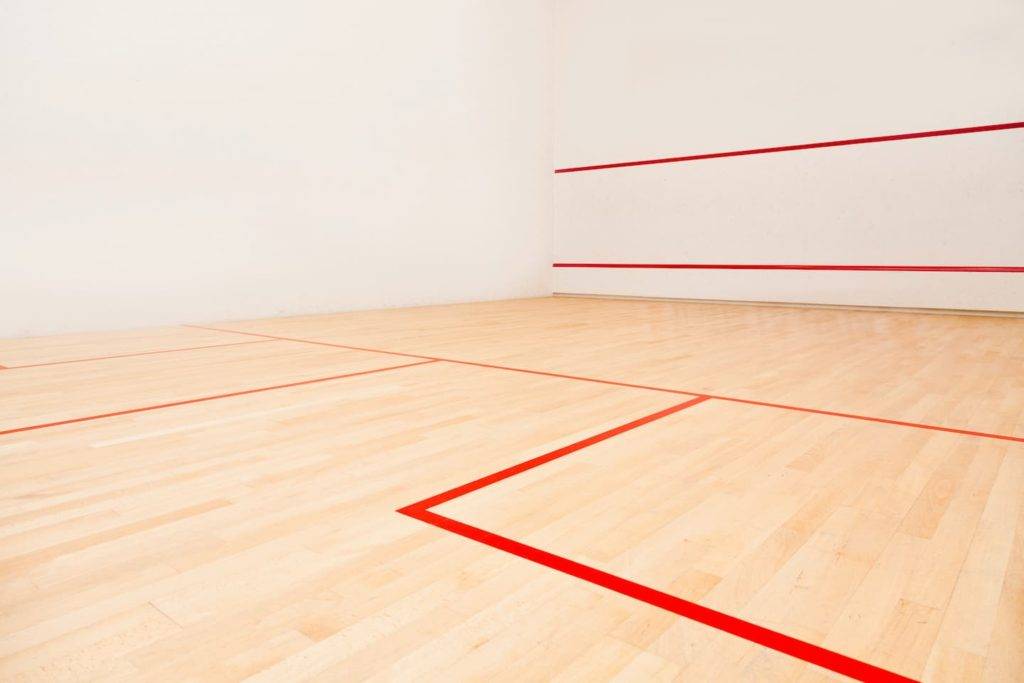
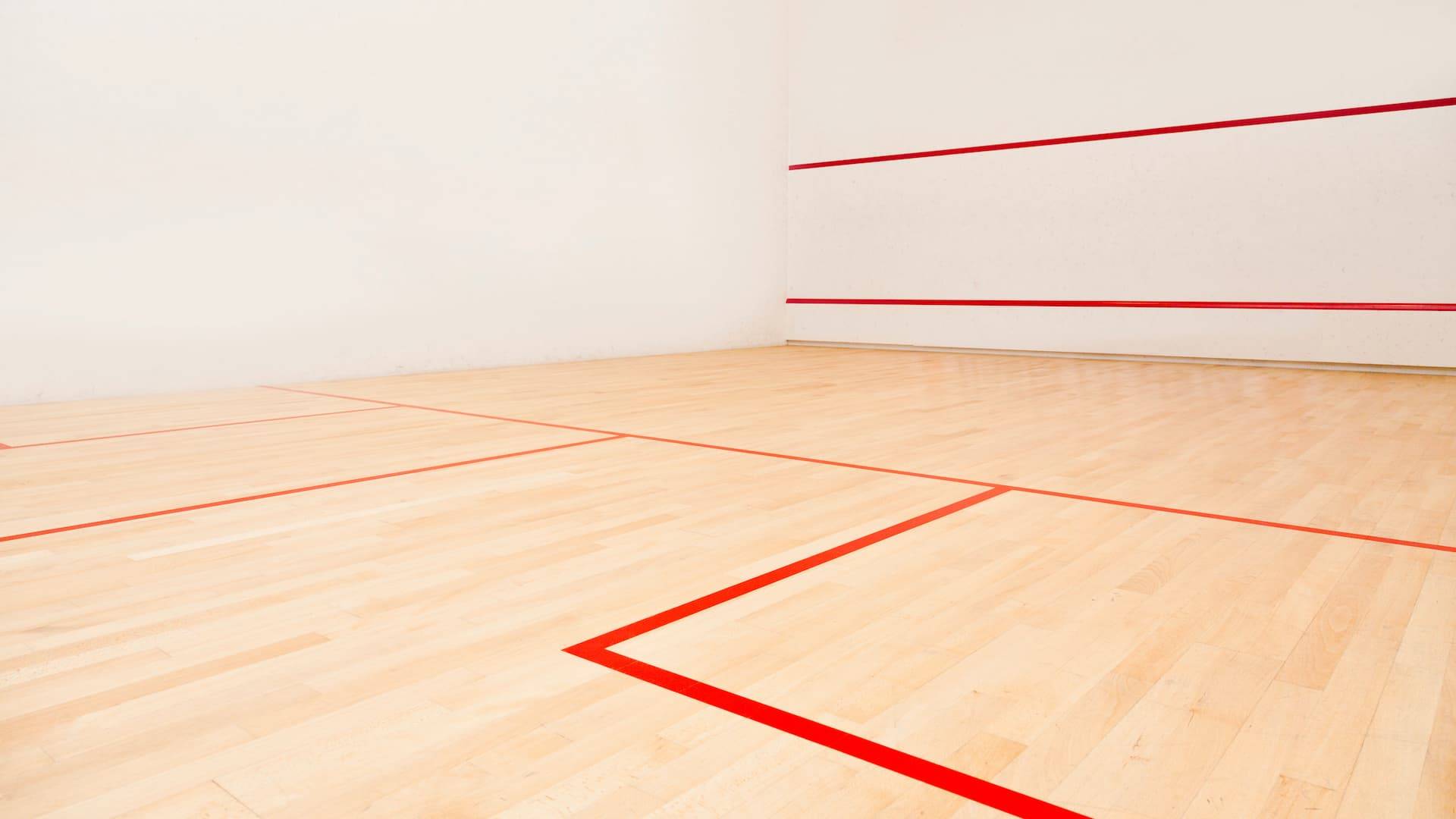
Colour matters too. Squash courts are marked in red on a pale timber background for visibility of the ball, and keeping the floor light is part of the specification rather than a matter of taste. We can pendulum test the finished floor so you have documented slip resistance for your insurers and your governing body.
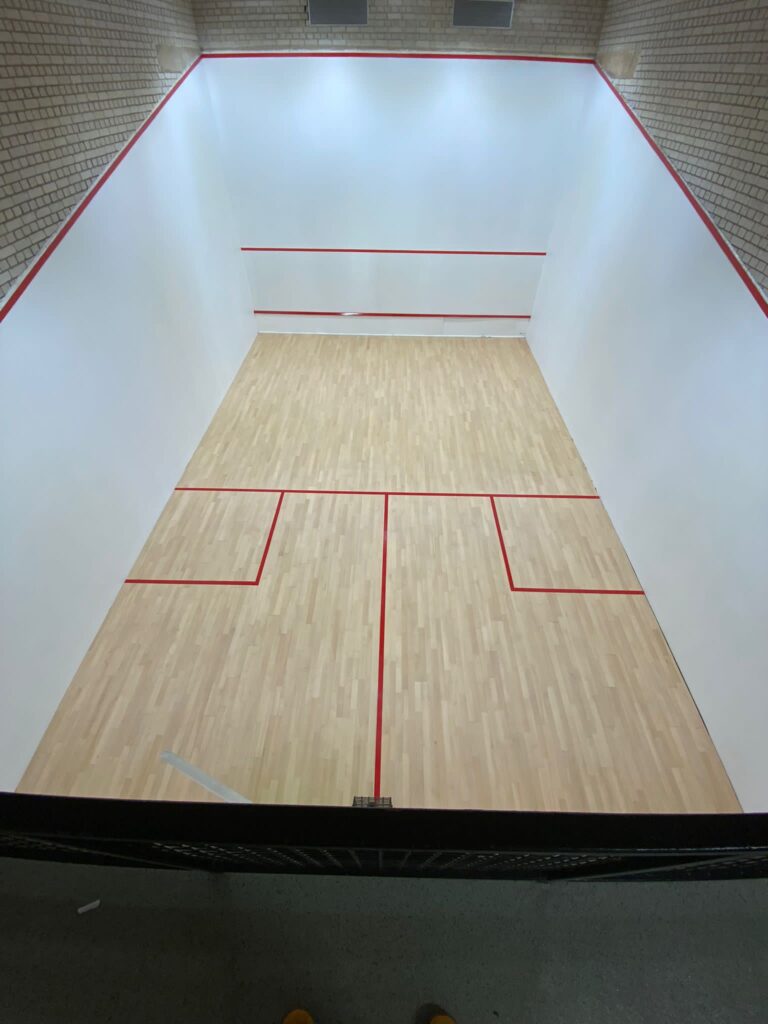
Squash court markings are simple in number and unforgiving in accuracy. There is a short line, a half court line and two service boxes, and every one of them affects play directly.
The short line sits 4.26 metres from the front wall. The service boxes are 1.6 metre squares in each rear quarter. The lines are 50 millimetres wide and marked in red, and unlike the wall markings they are painted onto the floor rather than being part of the plaster.
We set out from measured dimensions rather than from the existing lines, because courts that have been remarked repeatedly drift, and a service box that is a few centimetres out changes where players stand. On a court being sanded, the old lines disappear with the finish and everything goes back down fresh under the seal.
Applying markings between coats is particularly important in squash. The lines sit in the busiest part of a very small room, and paint left exposed on top of a finish will be scuffed off by shoes within a season.
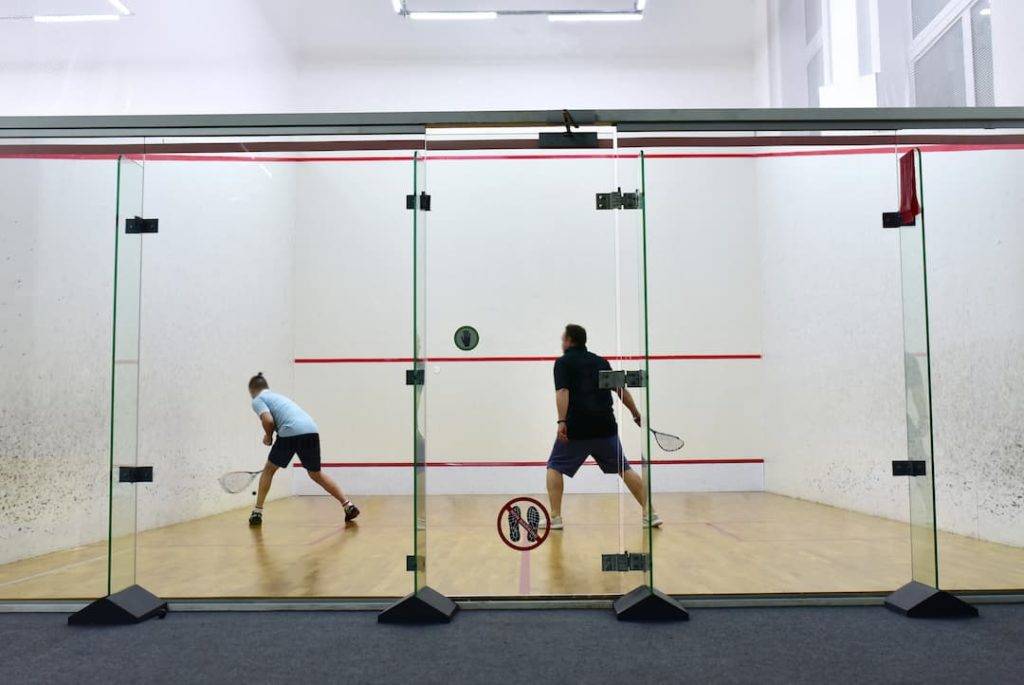
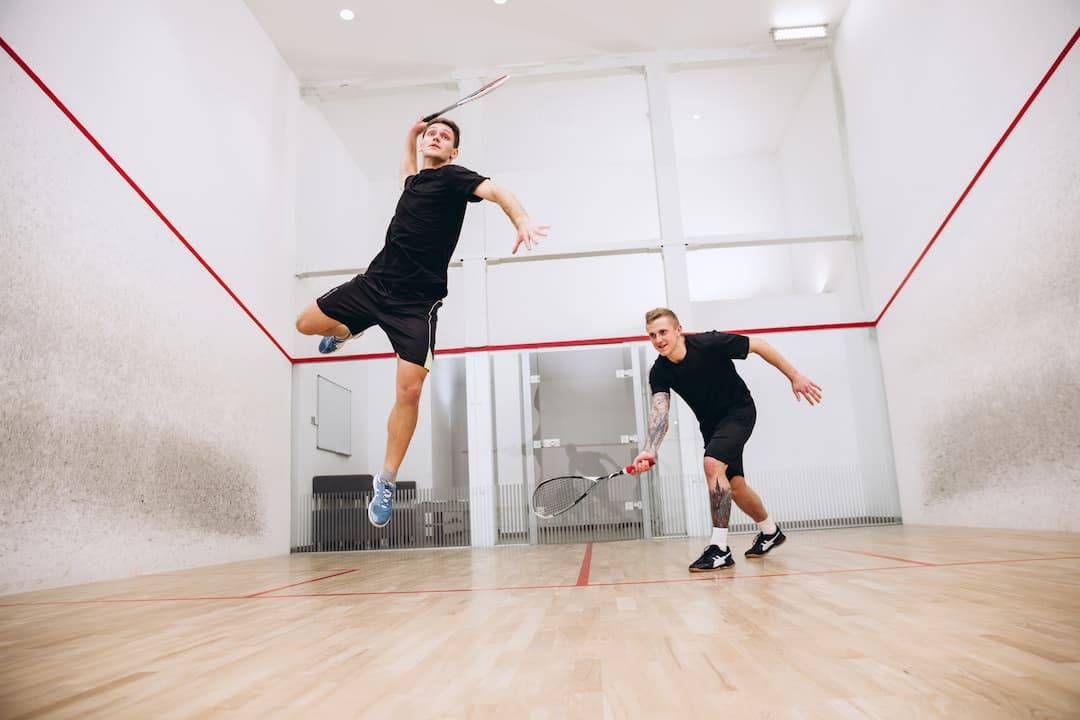
Most squash courts come in pairs or blocks, and clubs rarely want the whole facility shut at once, so we phase the work.
Because each court is a separate room, we can sand and seal them one or two at a time and leave the rest playable. A single court typically takes three to four working days including cure time, so a four court block can be turned round in stages across two to three weeks with courts coming back into use as we go.
Access is the practical challenge. Squash courts have small doors, often at the back of a corridor, and getting sanding machinery in takes planning. We survey the route before quoting so there are no surprises on the morning, and we protect the corridor and any glass back wall throughout.
Ventilation matters more here than anywhere else. A sealed room with a curing finish needs air movement, and we set up extraction rather than relying on an open door. It shortens the cure time and it keeps the rest of the club usable while we work.
Squash courts respond well to a small amount of routine attention, and badly to the wrong cleaning products.
The daily job is dust. Grit walked in from the corridor is what abrades a matt finish and turns it shiny in the middle, so a dust mop before play does more good than anything else on the list. Damp mopping should use a neutral cleaner intended for sealed sports timber, and nothing that promises shine. Polish on a squash court is dangerous, not just undesirable.
Humidity control is the other half. Courts that are hot and unventilated between sessions stay damp, and damp timber moves. Running the ventilation after play, rather than only during it, makes a measurable difference to how long a floor lasts.
Beyond that, courts benefit from a light screen and recoat every two to three years, which restores the grip in the centre before the seal wears through to bare timber. Doing that keeps a court on a full sand cycle of a decade or more rather than needing one every few years.
Because the grip comes from the bare timber. A lacquer system would make the surface slick and change how the court plays entirely. Squash floors are prepared to grip, which is a different job requiring different preparation and dust control.
Yes, and it is cheaper per court. We usually phase the work so play continues on the remaining courts, or take a whole block during a quiet period. Dates are agreed in writing before we start.
We advise on the whole court and carry out the flooring work ourselves. Where wall or structural work is needed we will tell you plainly what is required so you can plan the full project.
A full sand and seal is typically needed every eight to ten years. Between those, a light screen and recoat every two to three years restores grip through the T and greatly extends the life of the boards.
Almost always because the finish has been polished smooth by the constant return to the T, sometimes helped along by the wrong cleaning product. A screen and recoat with a matt high grip seal restores it.
A matt or dead matt seal with high slip resistance on a light coloured timber floor. Gloss finishes are unsuitable for squash and are a common cause of slippery courts.
Usually three to four working days per court including cure time. In a multi court facility we work court by court so the rest of the club stays open.
Yes. The short line, half court line and service boxes are set out from measured dimensions and painted in red between coats of seal so they sit under the final finish.
Yes. We carry out pendulum slip resistance testing and provide the certificate, which is worth having on file for your insurers and for governing body requirements.
Tell us how many courts you have and how they are playing, and we will give you an honest assessment and a fixed price. Call 01823 674562.