
Flooring Professionals To The Leisure Industry
Courtship Flooring is a commercial sports flooring contractor working in Staffordshire and across the UK. Much of our work is for leisure operators running seven-day timetables where closing a hall is a revenue decision.
Established in 1987 and still family-run, we install, refurbish, sand, seal, mark and maintain indoor sports floors for schools, academies, colleges, universities, leisure trusts, local authorities and clubs. Every stage is carried out by our own team. We do not undertake domestic work; that is handled by our sister company Ryan’s Restorations.
Projects in Staffordshire are carried out by the same in-house team that delivers all of our sports hall flooring work across the UK.
Overnight/Weekend Installations
Professional Cleaning Demonstrations
Squash Court Maintenance
Recommended Cleaning Products
Professional Pendulum Slip Testing
Deep Clean & Reseal Service

Closing a leisure hall for a week is rarely acceptable, so most of our work in this sector is phased. A hall can be split into sections, with one area worked while the remainder stays in use, or the whole floor can be taken overnight across a series of shifts.
Both approaches need careful planning around curing times, and both cost slightly more than a straight closure. They almost always cost less than the lost bookings.
A public leisure hall sees a volume and variety of use no school hall matches: casual sessions, clubs, junior coaching, five-a-side leagues, events and parties, seven days a week.
Polyurethane and vinyl systems frequently outperform timber in that environment, tolerating trolleys, furniture and constant traffic while cleaning easily. Where sporting feel takes priority, timber remains the right answer. We fit all of them and will set out the honest trade-off.
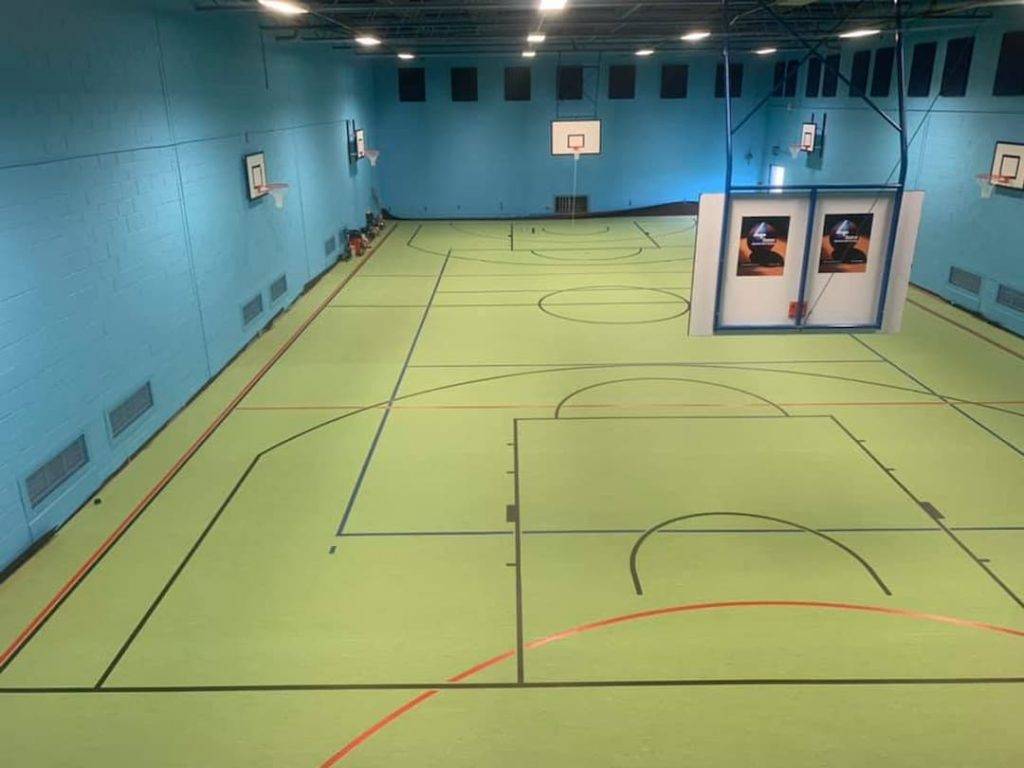
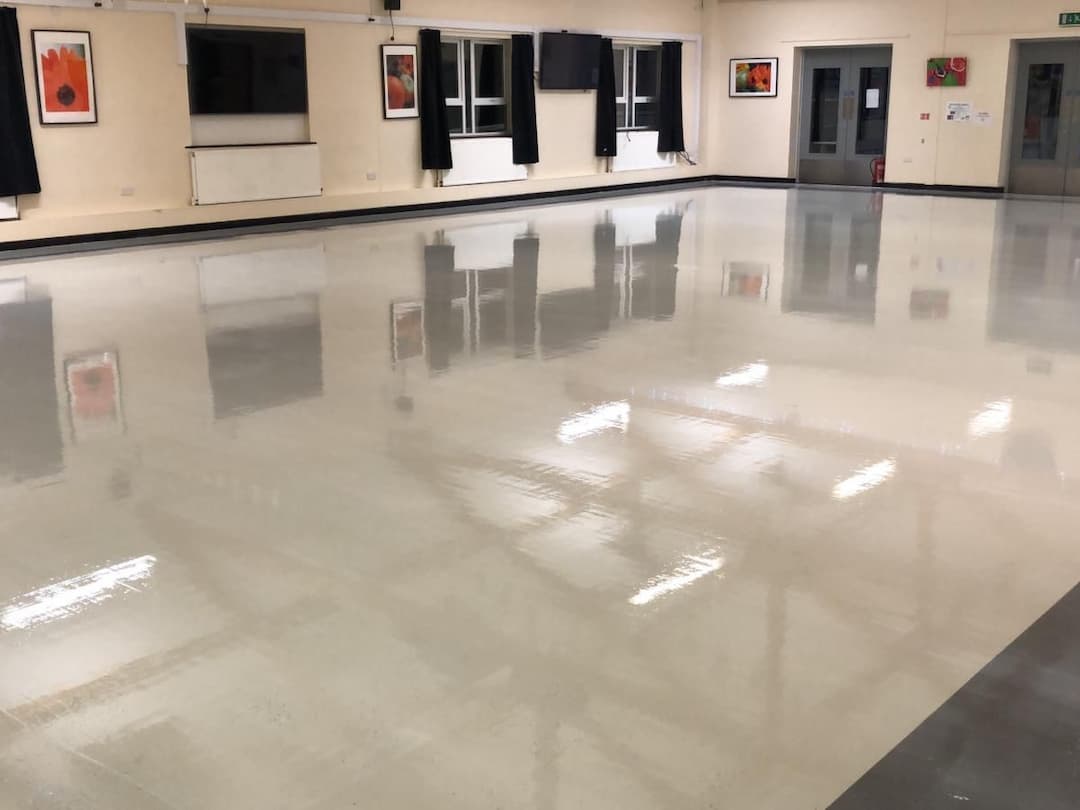
Reactive maintenance is the most expensive way to run a floor. Planned maintenance covers an annual deep clean, condition inspection, recoating at the right moment, repairs, relining and slip testing on a fixed schedule and a predictable budget.
For an operator with several centres it also produces a consistent standard across the portfolio, and a documented record that satisfies both insurers and internal reporting.
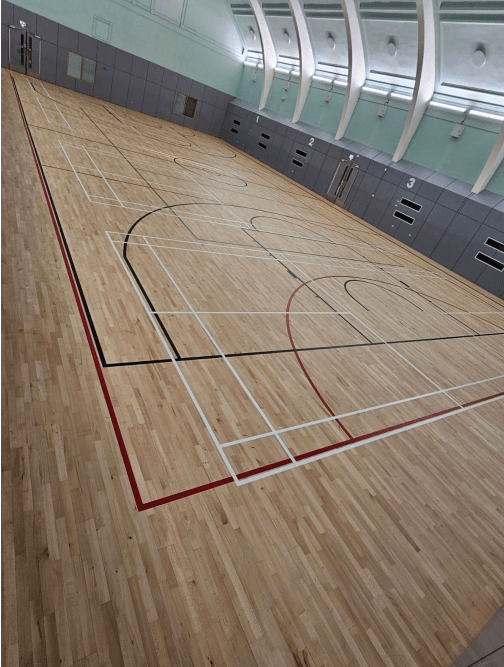
Years of heavy use had left the sports hall floor at Aston University dull, patchy and worn along every busy lane. Our team sanded it back to bare timber, made good the damage, then rebuilt the finish with a durable seal and a full set of new markings, working around a demanding academic timetable.
The before and after photographs show what a properly executed refurbishment delivers: a floor that looks and plays like new, for a fraction of replacement cost and without weeks of disruption.
~ Matthew Evans
An outstanding company to deal with and they couldn’t have been better to work with. St George’s Ascot now has a stunning new sports hall floor and we are delighted. From quote, support, delivery and after sales, the Team has been brilliant. Thank you. 
~ James Anderson







A fitness suite in a Staffordshire leisure centre takes a different kind of punishment from the sports hall next door. Dropped dumbbells, racked plates, treadmills that vibrate through the same square metre for years, and members walking in from the car park in whatever they arrived in.
Sprung timber is the wrong answer here, and so is thin vinyl. Free weight zones need a dense rubber tile or roll, thick enough to absorb a dropped bar without cratering and bonded so it does not creep. Cardio areas suit a point elastic vinyl or rubber that cleans easily and does not mark under machine feet. Studios for classes want a sprung or cushioned surface with more give.
We lay all of these, and where a suite is being refitted we coordinate with the equipment supplier so plinths, power and floor loadings are agreed before the first roll goes down.
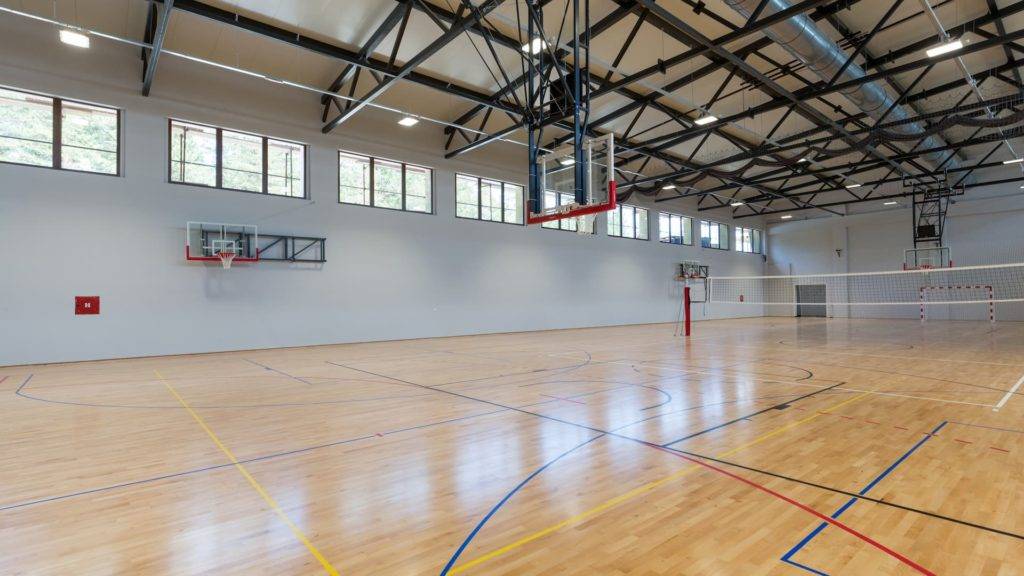

Every set of lines we paint starts from the governing body drawing, not from what is already on the floor. A netball court is 30.5 by 15.25 metres in three equal thirds. Basketball is 28 by 15 with the three point arc at 6.75 metres. Badminton is 13.4 by 6.1 for doubles. Those numbers are set out with laser and tape, checked corner to corner, and only then masked.
The reason matters. Halls that have been remarked by tracing the previous set drift a little each time, and after three or four cycles the thirds are unequal or the arc is not true. Players who move between venues feel it without being able to say why.
In a Staffordshire leisure centre with league fixtures, a court that measures correctly is also a court a governing body will accept for competition, which protects bookings.
A leisure trust or academy cannot let a contractor on site without the paperwork, and we would rather it arrived early than held up a start date.
Before every job you receive a risk assessment and method statement written for your building, not a generic template with the name changed. It covers access, isolation of ventilation, fire routes while screens are up, manual handling, noise and the sequence of work. COSHH data sheets go with it for every abrasive, filler, seal and line paint we intend to use. Insurance certificates for public and employer liability are attached, and for schools and leisure sites where children are present we supply DBS details for each member of the team.
If your Staffordshire site runs a permit to work or induction system, tell us at survey and we build it into the programme.
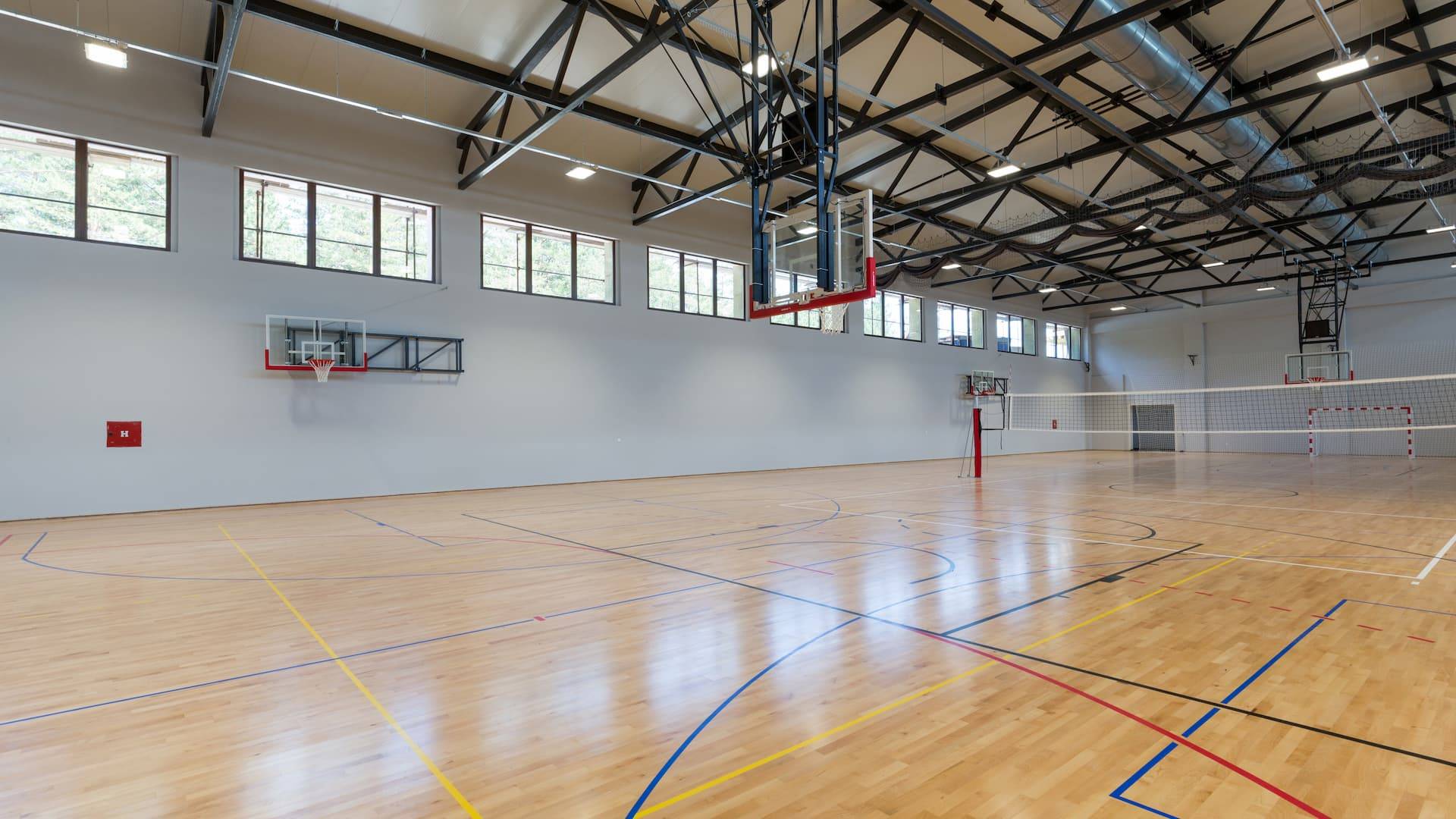
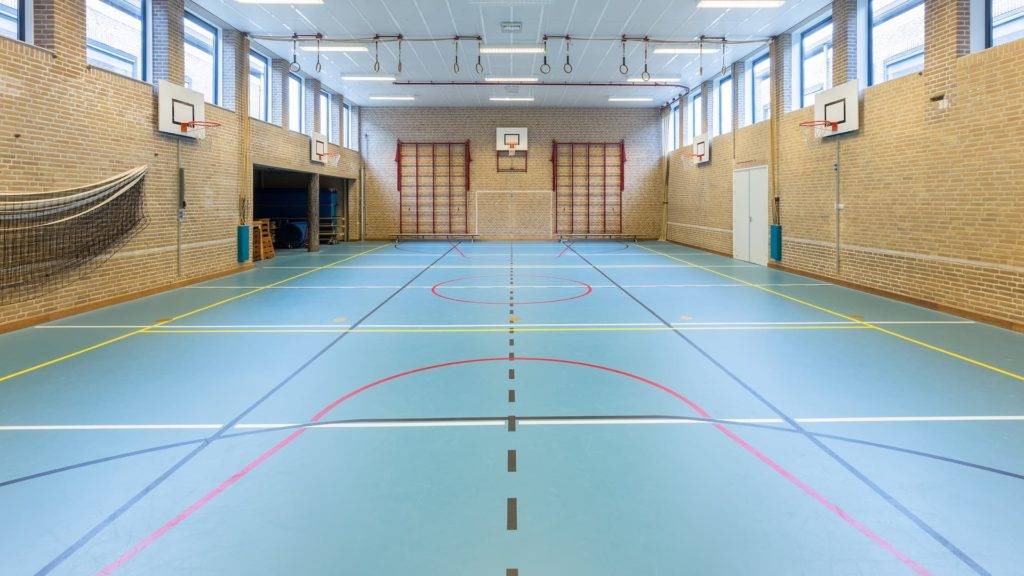
Staffordshire gives us a mix of academy trust estates, school sports halls, leisure facilities and a considerable amount of older community building stock.
School and academy halls are the largest group. Many date from the nineteen sixties and seventies with sprung timber floors that are structurally sound but have gone too long between refinishes. Those are almost always better restored than replaced, and a proper survey usually finds considerably more life left than the school has been told.
Granwood turns up regularly in this part of the country, in school halls and church halls alike, and it is frequently written off when it should not be. A Granwood floor with sound blocks and an intact bitumen bed is worth restoring at a fraction of the cost of replacement, particularly once the cost of lifting a bitumen bed is taken into account.
Leisure centres and community sports facilities follow, where keeping the building trading means overnight working.
Village halls and club buildings make up the rest, and those restore for surprisingly modest sums.
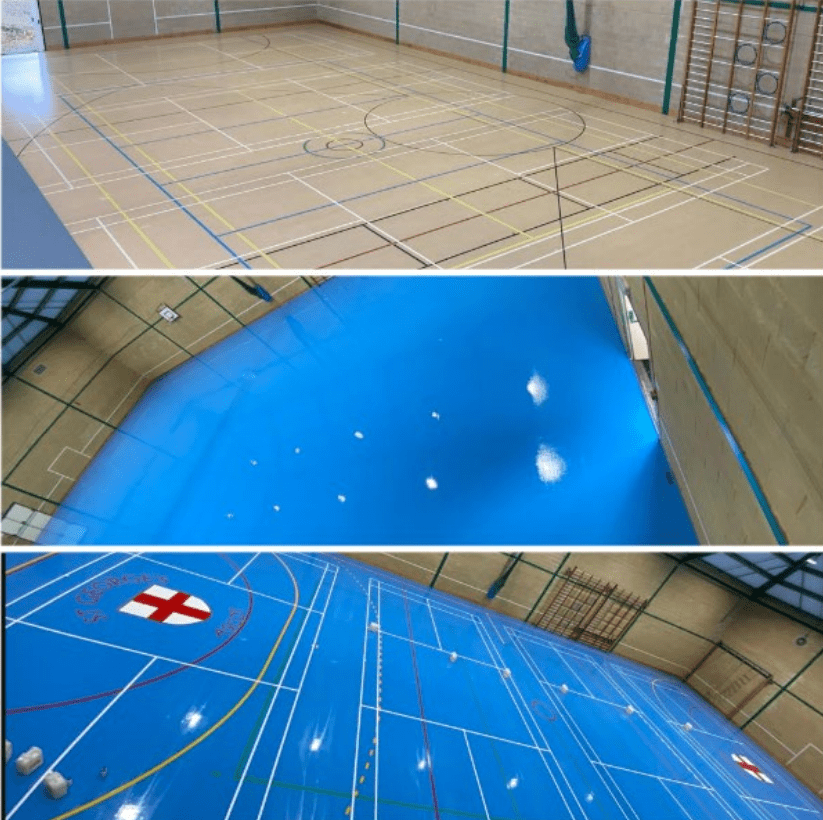
Staffordshire has a great deal of older school and church hall stock, so the project worth knowing about is St George School in Ascot.
The hall there had a Granwood floor which more than one contractor had condemned. Granwood is a composite block of wood flour and cement laid in a bitumen bed. It has no grain and no wear layer in the timber sense, aggressive sanding removes block that cannot be replaced, and the bed softens with heat. We assessed the blocks, rebedded the loose ones, replaced those that had broken up, prepared the surface appropriately and coated it with a modified epoxy system with the markings sealed within it.
The floor has years of life left at a fraction of the cost of replacement, which would have meant lifting a bitumen bed as well.
For post war school halls, Hornbury Academy in Wakefield is the closer comparison: an overdue finish, a fixed term date, and markings reset from measured dimensions.
The cost follows the area of the hall, what condition the survey finds, and how much of the finish you want rebuilt. Restoring a sound floor costs far less than replacing it, so we price that route first and set out any alternative alongside it. Surveys are free.
Yes, from the Peak District edge to the southern boroughs, and well beyond. Where a trust or council has several centres, we book them in sequence so mobilisation is shared and each site pays less. Travel is already inside the figure we quote.
Yes. Socket positions are coordinated with the court layout so posts land where the lines are, covers are reset flush with the new surface, and any redundant socket is filled with matching timber. It is part of the job, not an extra.
Refurbish, in most cases. Sanding, repairing and resealing gives a floor that plays like new for a fraction of a replacement and with days of disruption instead of weeks. We only recommend a new floor where moisture, a failed subfloor or an exhausted wear layer rules restoration out.
Most halls want relining every two to three years, usually at the same time as a screen and recoat so the paint sits under fresh seal. Baselines and service areas fade first, and a leisure centre running league fixtures wears through them faster than a school.
Because we survey before we quote, we usually know what is coming and price it as expected work. If something unforeseeable appears once the lacquer is off, you hear about it that day with a cost, and nothing goes ahead until you have agreed it.
Worn lacquer and surface marks come out with the first pass. Deep water staining that has soaked into open grain may stay faintly visible even after a full sand, and we say so at survey. Sometimes the answer is cutting out the worst boards.
One to two weeks for a typical hall from the first machine to the last coat, plus cure. The length depends on size, how many boards need repair and how many coats the seal takes. You get a day by day programme before we start.
Book a free survey of your hall floor anywhere in Staffordshire. We inspect, measure and report in writing, then price the work with a programme that keeps your centre or school trading. Call 01823 674562 or send us a message.