
Timber is the only floor that can be renewed rather than replaced, again and again across its life. That single fact is why so many of the floors we restore were laid before anyone working on them today was born, and why restoration almost always beats replacement on cost, disruption and waste.
Courtship Flooring restores commercial and institutional wooden floors of every kind: sports hall floors, gymnasium floors, school and church hall floors, stage floors, squash courts, dance studios and parquet. We sand, repair, reseal and re-mark, all with our own team and our own machinery. Commercial work only since 1987.
Where the floor is a sports hall, our sports hall floor sanding and sealing service covers lacquer choice, grip and line marking in detail.
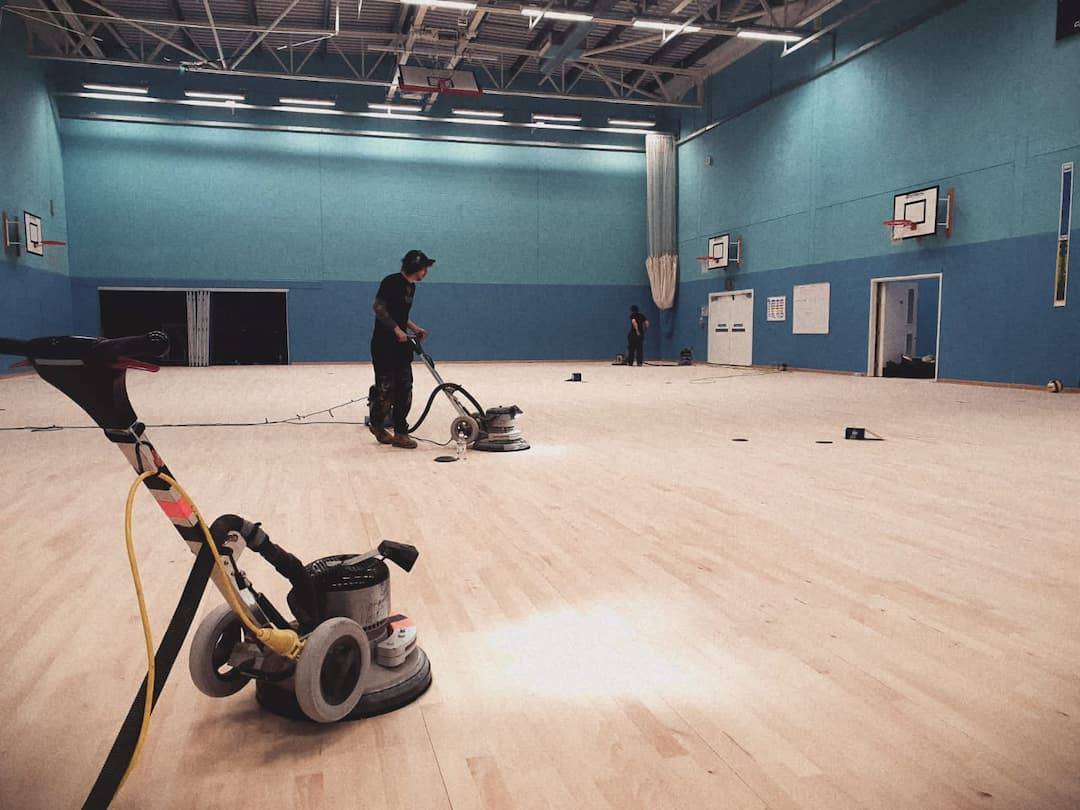
Any commercial timber floor is fair game: solid and engineered sports floors, sprung systems, gymnasium and hall floors, stage and performance floors, squash courts, dance studios, parquet and block floors, and the multi-use hall floors that do all of the above in a single week.
The process adapts to the surface. Sports floors are sanded and sealed with systems built for grip and ball response. Parquet demands a lighter touch and careful board matching. Squash courts are traditionally left unsealed so the timber grips, which changes everything about how they are prepared. What does not change is that we survey first and price honestly.
This is the question that should drive every decision, and almost nobody asks it. A timber floor has a finite amount of board above the tongue, and every full sand spends some of it permanently. Sand too often and you shorten the life of the floor while believing you are maintaining it.
So we measure remaining thickness before recommending anything. Where the lacquer is worn but intact, a screen and recoat keys the surface and adds fresh seal without touching the timber, which is far cheaper and buys several years. A full sand back to clean board is reserved for when the timber itself is genuinely taking the wear.

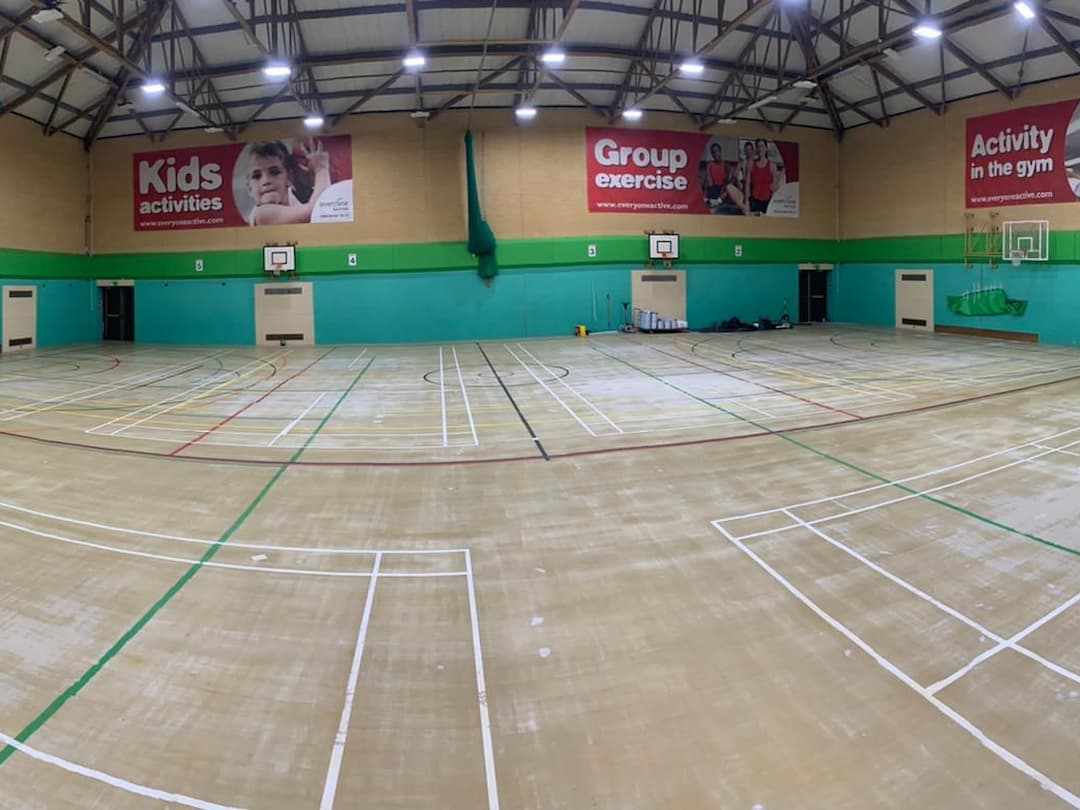
Old floors keep secrets. Once a surface comes back we routinely find water damage tracked from a long-forgotten leak, boards lifting where a sub-floor has moved, bitumen bleeding up through mid-century parquet, or previous repairs done in the wrong timber entirely.
Almost all of it is fixable. Localised water damage is cut out and replaced with matching boards so the repair disappears into the finish. Movement and squeaking usually trace to fixings or sub-floor ventilation rather than the boards. Where something genuinely cannot be saved we say so and price the alternative, rather than sealing over a problem so it returns as yours.
A full sand and seal typically costs a small fraction of a new floor, and takes days rather than weeks. There is no strip-out, no skips, no waiting for a new system to arrive, and no sub-floor works. For a school or leisure operator the saving is not only financial: the hall is back in use inside a holiday window instead of a term.
Where a floor genuinely has reached the end we will tell you, with the moisture readings and board measurements to back it up, and quote the replacement honestly. But that is the exception, not the default.
Commercial timber floors cover a wider range than most people expect, and each type behaves differently under a machine.
Solid strip is the most common in sports and assembly halls. Long boards, usually maple, beech or oak, either fixed to battens or laid over a sprung structure. These sand well and have a generous wear layer, which is why so many are still in use decades after installation.
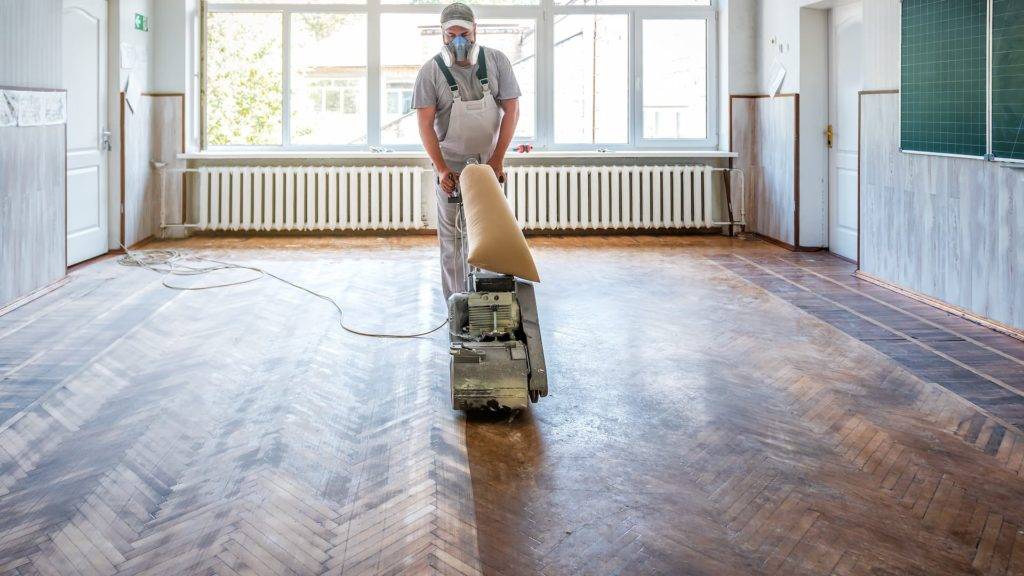
Block and parquet floors turn up constantly in older halls, libraries, town halls and church buildings. They are laid in patterns with the grain running in several directions, which means a machine driven the wrong way tears rather than cuts. They are also usually bedded in bitumen, which brings its own considerations.
Engineered board is now common in newer installations. It has a thinner wear layer over a stable core, and the critical question is how much of that layer is left, because there is far less margin than in solid timber.
Then there are stages, which are often a different construction and a different timber from the hall they sit in, and which usually need a harder finish because of what gets dragged across them.
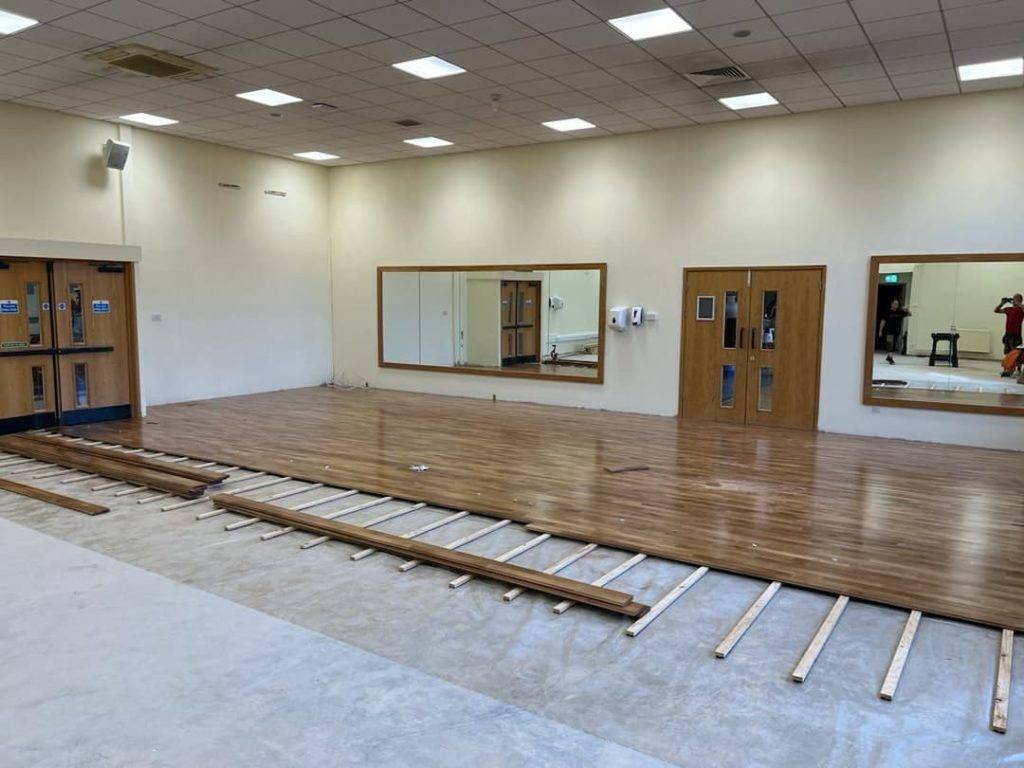

A commercial restoration follows a sequence, and skipping stages is what produces floors that look good for a season and then fail.
We survey first, taking moisture readings and measuring the remaining wear layer, and we look underneath wherever we can get access. Then we clear and protect the room, lifting fixtures rather than sanding around them.
Sanding is done in progressive stages, from a coarse cut that removes the old finish through to a final grade that leaves the timber correctly open for sealing. Edges and corners are done by hand, because a floor sanded only with the big machines leaves an obvious border of old finish at the perimeter.
Repairs happen once the floor is bare and we can finally see it. Split and damaged boards are cut out and replaced, gaps are dealt with, and nail heads are punched below the surface.
Sealing follows, usually a two pack polyurethane in multiple coats, with any line markings applied between coats so they finish under the lacquer. Finally the room is put back and you get the cure times and aftercare in writing.
Every commercial floor holds something, and part of our job is anticipating it at survey rather than discovering it on day three.
Water damage is the most common. Historic leaks from roofs, radiators and pipework leave cupped boards and dark staining that may not be visible under an old finish. Cupping can often be sanded flat once the timber has dried; deep staining sometimes cannot be removed at all.
Previous bad repairs are next. Boards let in the wrong way round, filler used where a board should have been replaced, and screws driven flush where they should have been punched are all routine finds.
Then there are the coatings. Floors that have been sealed over the top repeatedly build up layers that go cloudy and peel, and floors that have been polished for years hold a wax that has to be removed chemically before sanding, or it clogs every abrasive we put on it.
We flag all of this in the quotation as expected rather than as a variation, so the price you agree is the price you pay unless something genuinely unforeseeable appears.
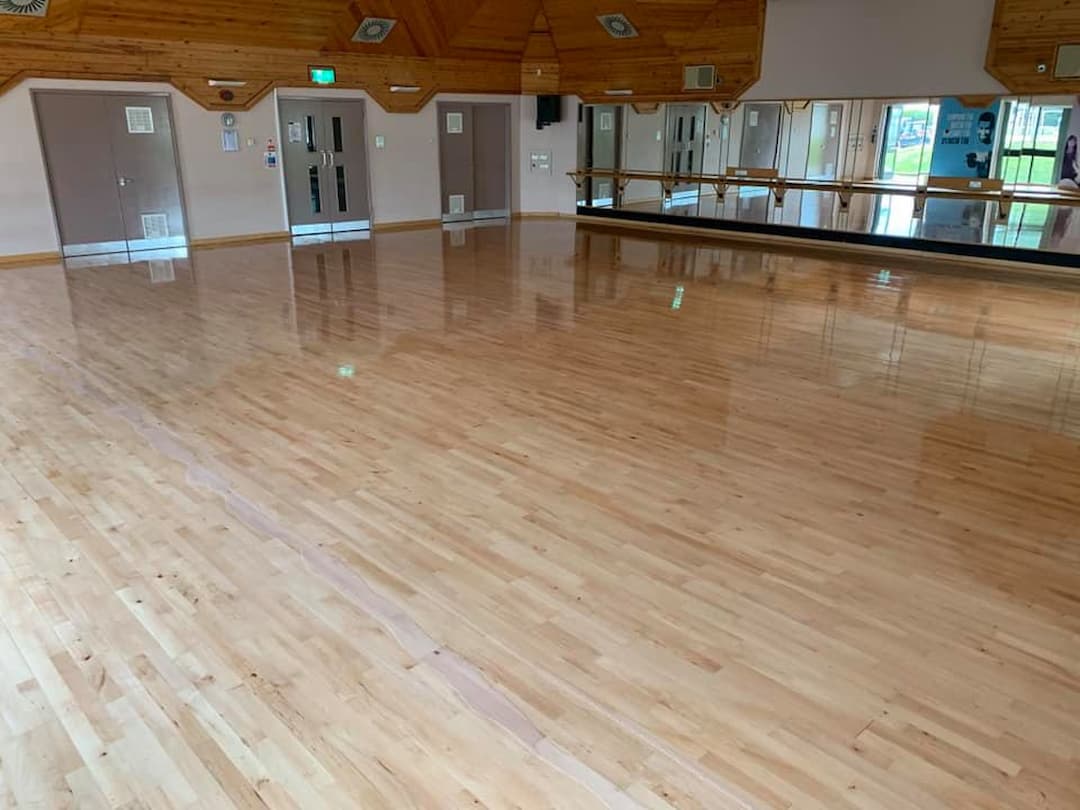
The finish should be chosen for what the room actually does, and commercial rooms do a great deal more than sport.
Sports and assembly halls generally want a two pack polyurethane, which holds slip resistance and appearance under heavy use. Where a hall also serves as a dining room or exam space, that specification matters more rather than less, because chairs and tables punish a floor in ways sport does not.
Stages and drama spaces are often better with a matt or dead matt finish, partly to kill reflections under stage lighting and partly because scuffing from scenery shows less. Some venues want a stage floor that can be painted, which changes the specification again.
Rooms used for dance need grip that is consistent and predictable, and a finish that is neither slippery nor sticky. Getting that balance right is a genuine skill, and it is worth saying that the correct answer for a dance studio is different from the correct answer for a basketball court.
We will bring samples, look at them under the room lighting and tell you what we would specify and why.
Almost every commercial floor we restore is in a building that has to keep functioning, and managing that is as much a part of the job as the sanding.
Dust extraction is the first requirement. Our machines run on sealed vacuum systems, and we screen the working area and agree with your site team which doors and air handling routes need isolating. The room we are in will be dusty. The rest of the building should not be.
Noise and hours are the second. Sanding is loud, and in schools, offices and civic buildings that usually means working evenings, weekends or holidays. We staff for that rather than treating it as an exception.
Fumes and cure times are the third. Modern water based systems are far better than the solvent finishes of twenty years ago, but a room being sealed still needs ventilation and still needs to be kept clear. We agree access arrangements, signage and key holding before we start so nobody walks onto a wet floor.
All of it goes into a method statement and risk assessment issued before the job, not on request afterwards.
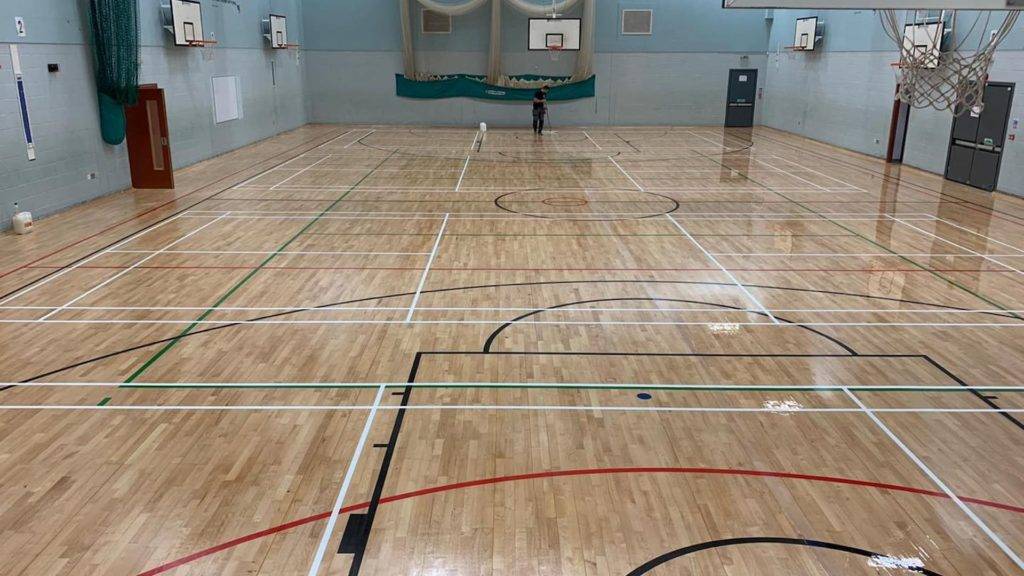
Commercial and institutional timber floors of every type: sports halls, gymnasiums, school and church halls, stage floors, squash courts, dance studios, parquet and block floors. We do not undertake domestic work.
By measuring what is left above the tongue rather than guessing. We check this at survey. A floor sanded sparingly over decades may have several cycles remaining; one machined every few years may have none, and we will tell you plainly if that is the case.
A single-court hall is typically four to five days including sanding, repairs, sealing, markings and curing. Larger areas take longer. The full programme and a fixed reopening date are confirmed in writing before we start.
Substantially, in almost every case, and it is faster. Restoration also avoids strip-out, waste and sub-floor works. We only recommend replacement where moisture ingress or sub-floor failure genuinely rules restoration out.
Solid strip, block and parquet, engineered board, sprung sports systems and stages. In sports halls, assembly halls, church and village halls, universities, town halls, theatres and clubhouses.
No. We are a commercial contractor and work only on commercial and public buildings. The machinery, finishes and insurance are different, and firms that try to cover both rarely do either well.
Yes. Parquet needs particular care because the grain runs in several directions and the blocks are usually bedded in bitumen. It is a specialist job rather than a variation on strip floor sanding.
Cupping can usually be sanded flat once the timber has dried out. Deep dark staining may not fully disappear, and we will tell you at survey what we realistically expect to be left.
Sealed vacuum extraction on all machines, screening of the working area, and agreement with your site team on isolating doors and air handling. The room being sanded will be dusty; the rest of the building should not be.
Yes, routinely. Evenings, weekends, school holidays and overnight are all standard for us, and for most commercial buildings that is the only practical way to do the work.
Not sure whether your floor can be saved? Send a few photographs or book a free survey and we will tell you honestly what it needs and what it will cost. Call 01823 674562.