
Indoor volleyball court flooring has to handle two different loads: a blocker landing on one foot after a jump at the net, and a defender sliding across the court to keep a dig alive. The floor needs shock absorption for the first, a controlled, low-abrasion finish for the second, and markings that follow FIVB and Volleyball England rules.
Courtship Flooring installs, refurbishes and marks volleyball courts in schools, universities, leisure centres and club venues across the UK. We lay sprung timber, vinyl, PU and lino systems, plan the court around your other sports and keep the surface in playing condition. Commercial and institutional facilities only.
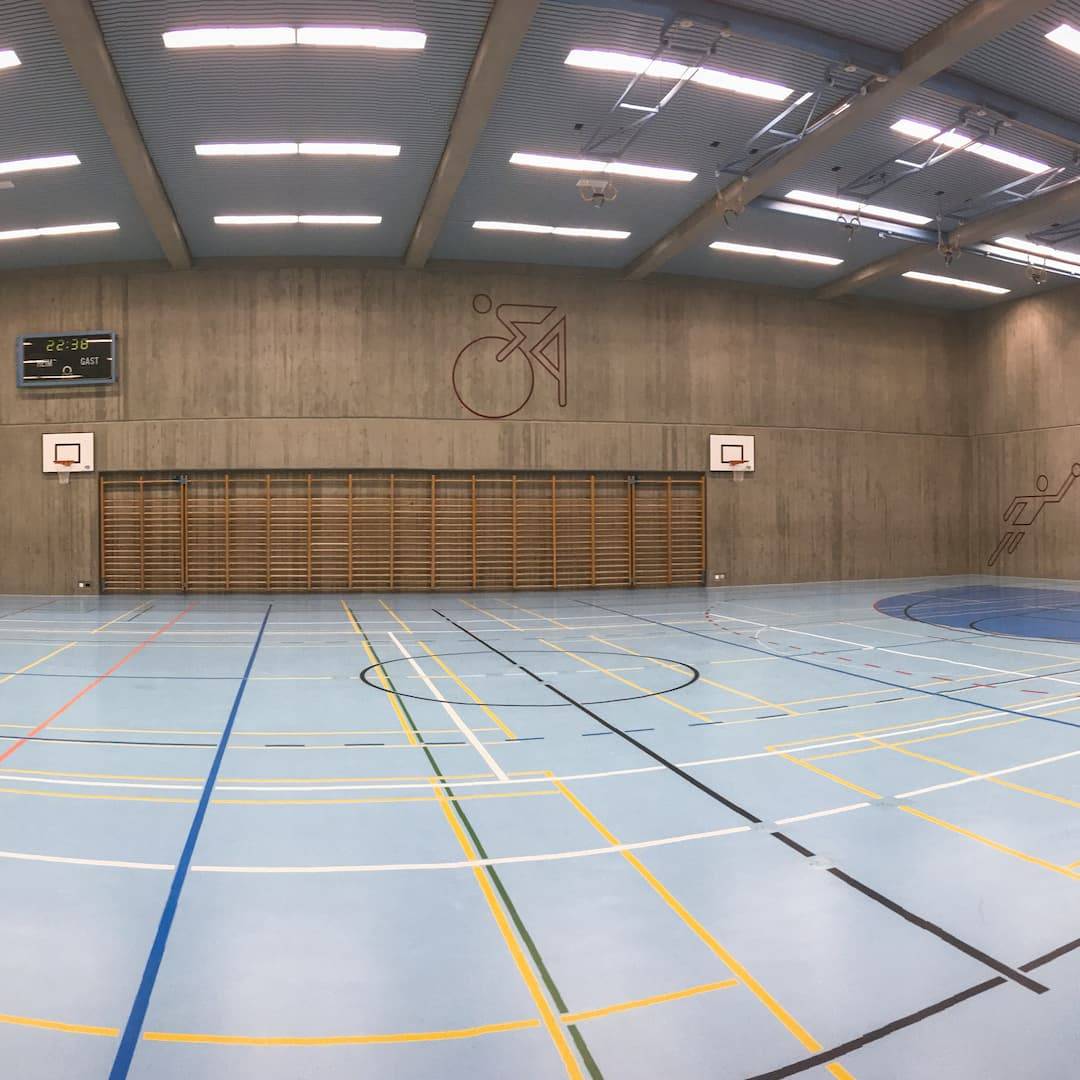
Each type of venue asks something different of a volleyball floor. Schools need a hall that moves from a PE lesson to an after-school club and an evening let, so durability and easy cleaning come first. Universities often run several clubs through one hall, with late training and weekend fixtures. Community clubs usually hire time elsewhere, so their court has to sit within a line scheme someone else controls. We plan each floor around who books the hall and how often.
Sitting volleyball is played on a 10 m by 6 m court, with the attack line 2 m from the centre line and the net at 1.15 m for men and 1.05 m for women. With a 3 m free zone, each court occupies 16 m by 12 m. Players must keep a buttock in contact with the floor whenever they play the ball, so every rally is spent moving on hands and hips. A clean, smooth finish and tight board joints matter even more than on a standing court.
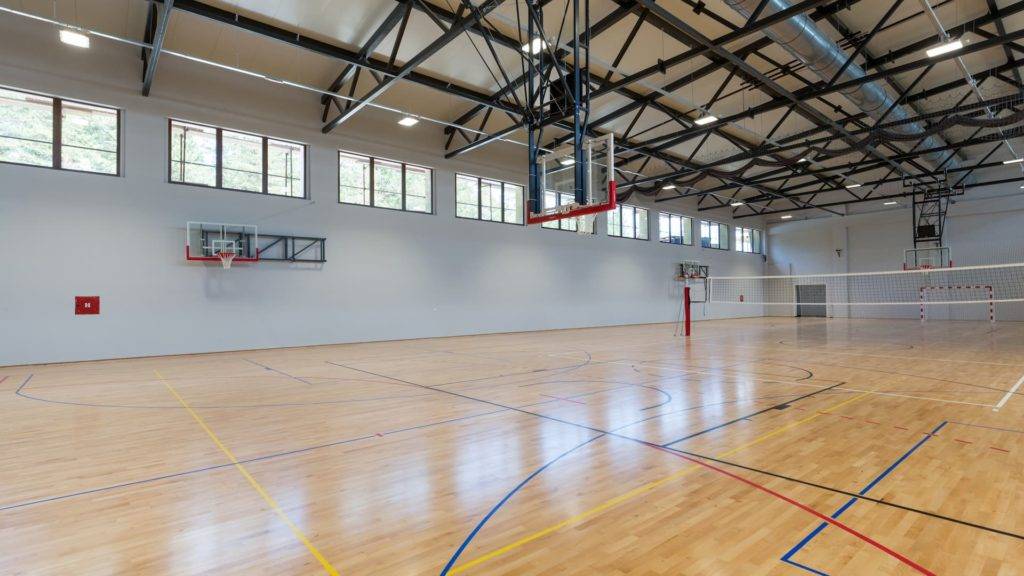

Many halls already have a volleyball court marked, but the finish has worn, the lines have faded or the layout no longer matches the current rulebook. In most timber halls, sanding and sealing removes the worn lacquer and old paint, and the court is then relined to current dimensions. Before quoting we check the remaining wear layer, any boards lifting near socket covers and whether the sub-floor still performs. If the timber has life left, refurbishment usually makes better use of the budget than replacement.
BS EN 14904 sets a dry pendulum friction range of 80 to 110 for multi-sport floors, and the volleyball rules forbid rough or slippery playing surfaces. In practice the finish has to hold a landing foot while letting a diving player slide on forearm, hip or knee without the skin dragging. Over-grippy coatings cause friction burns; sweat left on the floor causes slips. The rules even provide for quick moppers to dry the court during matches.
The playing court is a rectangle 18 m long and 9 m wide, split by the centre line into two 9 m halves. The boundary lines are drawn inside those dimensions, so the 18 m is measured to the outer edges of the end lines. Around the court sits the free zone, at least 3 m wide on every side. FIVB, world and official competitions extend this to 5 m from the sidelines and 6.5 m from the end lines, and Volleyball England recommends a 5 m end zone for national league fixtures.
Height is often the limiting factor in UK halls. The FIVB minimum is 7 m of clear space above the playing area, rising to 12.5 m for FIVB and world events, while Volleyball England’s guidance works to 7.6 m for national, local and training use. The clearance applies over the free zone as well as the court, so folded backboards, lighting, beams and heaters all count. We measure them on survey, because a ball touching the ceiling is out and a low obstruction can rule out your preferred layout.
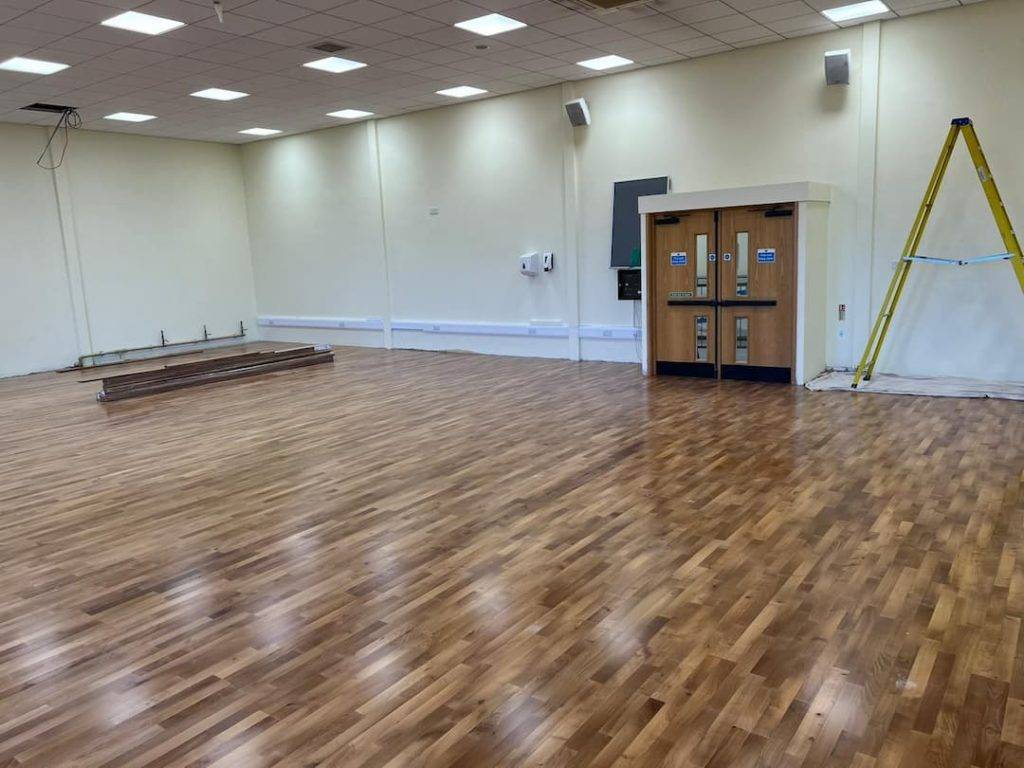

Area-elastic timber, the wood floor most people picture for indoor volleyball, is the traditional choice for a main sports hall. Solid hardwood boards on a sprung sub-floor spread an impact over a wide area, suit the basketball and netball that usually share the hall, and can be sanded and resealed several times over their life. We install systems from Junckers and Boen, and our wooden sports flooring page covers board and sub-floor options.
Point-elastic synthetics, usually vinyl sheet on a foam backing, deform only where the load lands. That local give feels softer when a player hits the floor after a dive, and vinyl is quick to clean. It cannot be sanded, and performance varies widely with backing thickness, so compare tested figures, not product names. Combined systems lay a vinyl, PU or lino surface over a sprung sub-floor, pairing broad support with a softer top layer. Our vinyl and PU sports flooring page explains those surfaces.
Whichever system you choose, the rules ask for a light-coloured surface on indoor courts, which narrows the colour range for vinyl and PU.
Blocking and attacking mean repeated jumps and one-footed landings at the net, and a hard floor passes that load straight back into ankles, knees and backs. BS EN 14904, the European standard for indoor multi-sport surfaces, puts numbers on the protection. A compliant floor reduces impact force by 25% to 75% compared with concrete, deflects no more than 5 mm under the test load, returns at least 90% of the ball rebound seen on concrete and carries a 1,500 N rolling load without damage. Volleyball England’s facilities guidance treats the standard as the minimum for volleyball halls.
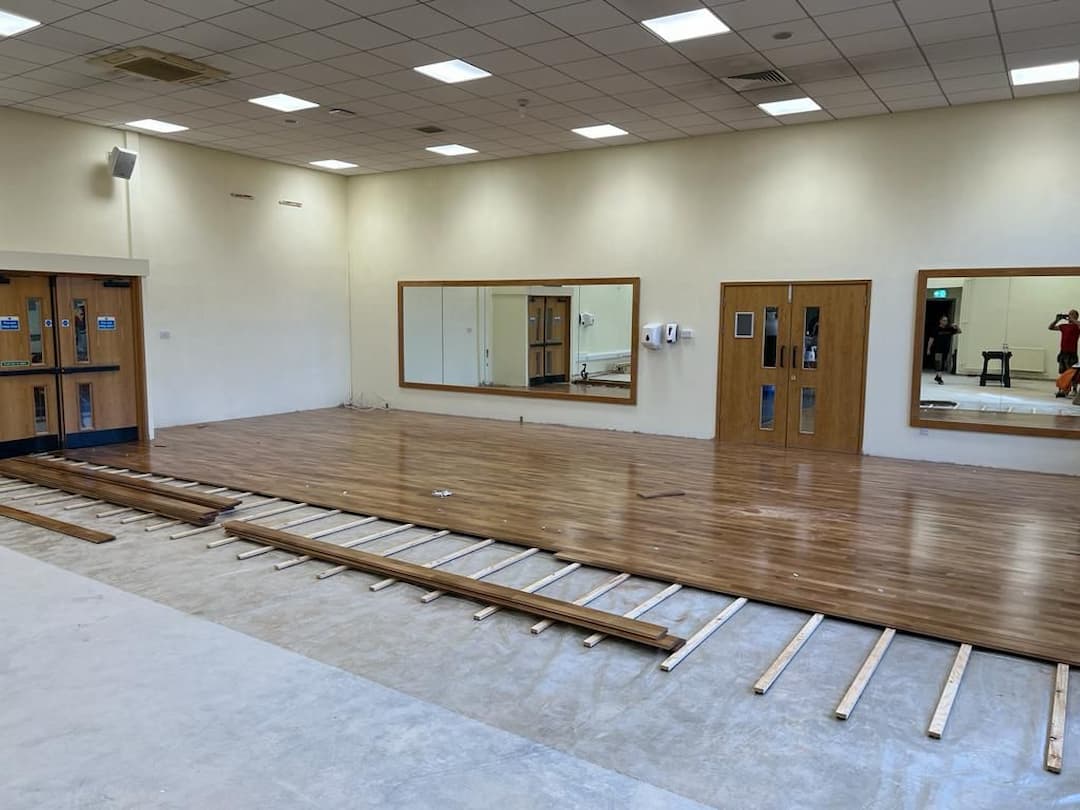
Those figures only hold if the base is right. Before any sprung system goes down we test the slab for moisture and check its flatness, because a damp or uneven base undermines any system. Where the slab is out of level, a packable batten system can take up the difference without a levelling screed. Our sprung floors page explains how these systems spread load. Ask for test results covering the whole system as laid, not the top surface alone.
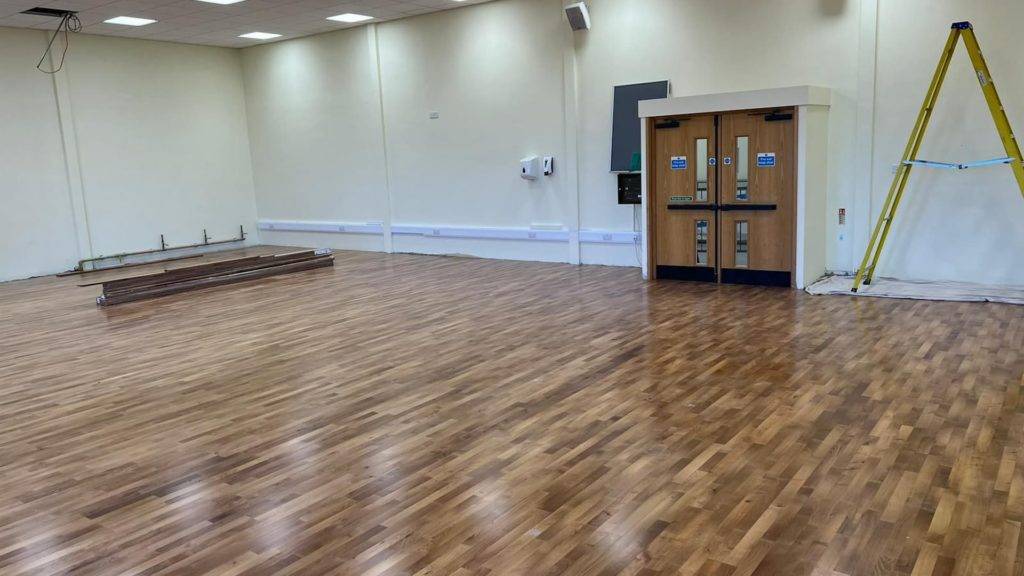
Volleyball posts stand 0.5 to 1 m outside the sidelines, exactly 1 m and padded at FIVB and world events, and must be fixed to the floor without wires. Volleyball England’s facilities guidance goes further: weighted or guyed posts are not acceptable indoors, drop-in floor sockets are recommended for all new builds, and covers must sit flush when closed. Floor fixings with a padded base plate remain acceptable for school and practice courts.
Sockets take real load once a net is tensioned, so they are anchored into the structural slab and the sports floor is built up around them. On a sprung timber floor the cover plate must finish level with the boards while the floor keeps its freedom to move, otherwise the housing becomes a hard spot or a trip edge. We agree socket positions with you and your equipment supplier at the planning stage, so one pair can serve volleyball and, where the layout allows, badminton or tennis nets too. Retrofitting through a finished floor is possible, but it means cutting into a completed surface.
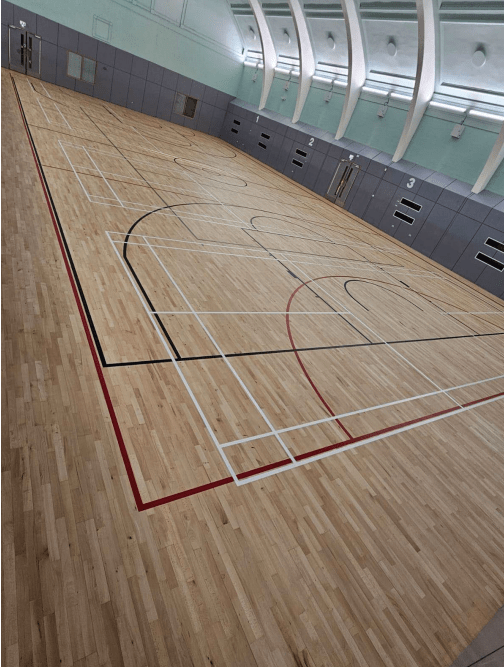
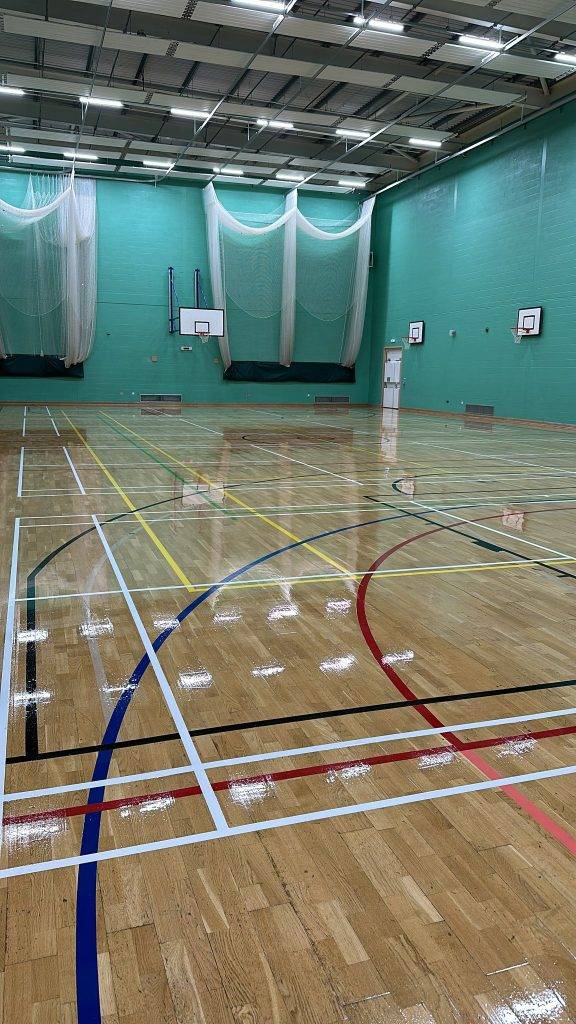
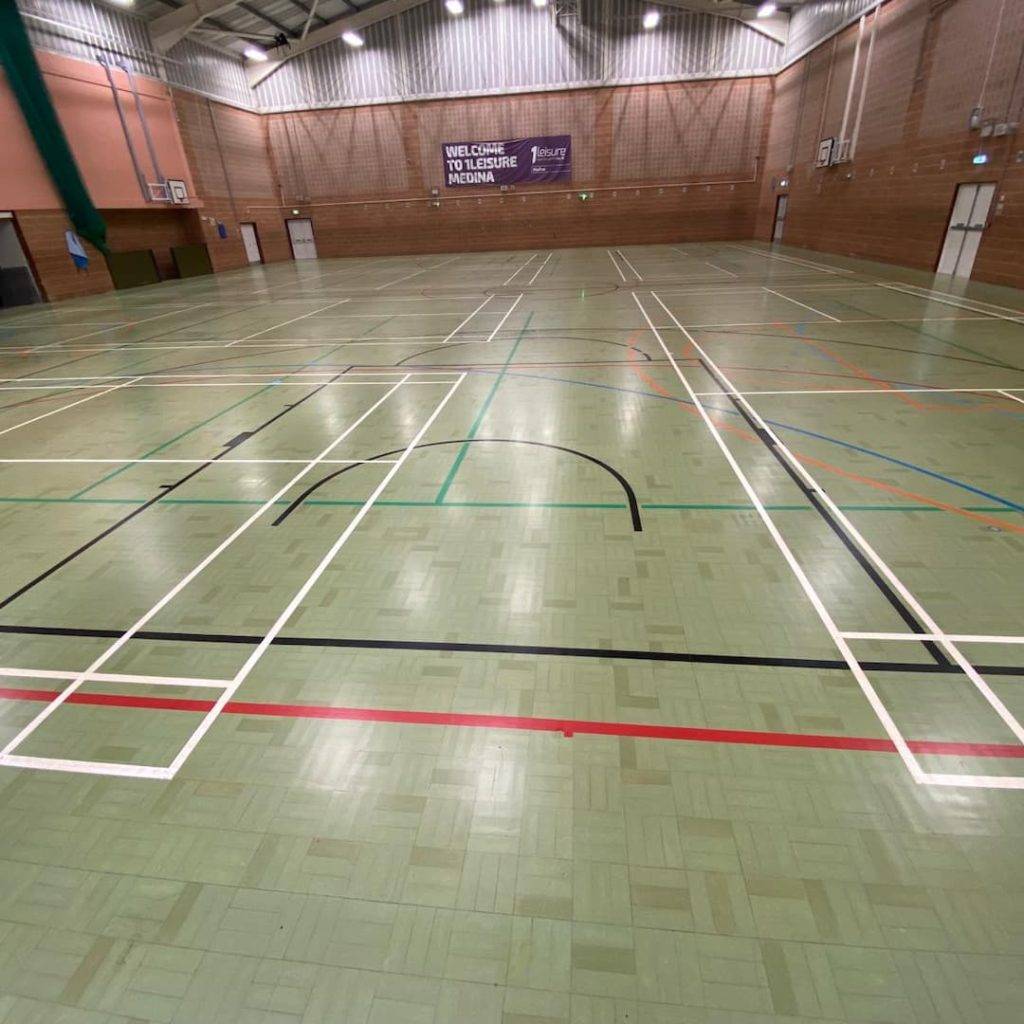
All volleyball lines are 5 cm wide, light in colour and different from both the floor and the other lines. The attack line is set with its rear edge 3 m from the axis of the centre line, and the service zone is shown by two 15 cm marks drawn 20 cm behind each end line. In UK multi-sport halls volleyball is normally marked in green, so it reads apart from the red, black and white used for netball, basketball and badminton, and from the wider lines of a futsal court.
The hierarchy of lines matters as much as the colour. We set the hall’s main sport first and give it the clearest lines, then fit volleyball around it, avoiding parallel lines a few centimetres apart that players misread at speed. Where a club wants FIVB-style presentation, the rules call for white lines and a court colour that contrasts with the free zone, which suits a dedicated arena better than a shared school hall. On timber floors the paint goes down between seal coats, so it wears with the lacquer. Our sports hall line marking service covers complete multi-sport layouts.
Dust is the main reason a volleyball court turns slippery, and it builds up faster in halls that double as exam rooms or dining spaces. Daily dry mopping and regular damp cleaning with products approved for the finish keep the surface close to its tested grip. General floor cleaners and polishes leave residues that make players stick in some places and skid in others.
Timber floors benefit from a periodic screen and recoat, a light abrasion and fresh lacquer that restores grip and appearance without taking the floor back to bare wood. Kept on that cycle, a solid hardwood floor can go many years between full sands. On vinyl and PU, the equivalent is a periodic deep clean and refinish. Ask your site team to report damp patches, lifting boards or worn lines early, because small faults cost less to fix before a full season of play. Annual pendulum testing to BS 7976-2 gives a measured record of grip, and our sports hall floor maintenance and pendulum slip testing services cover both sides of that work.
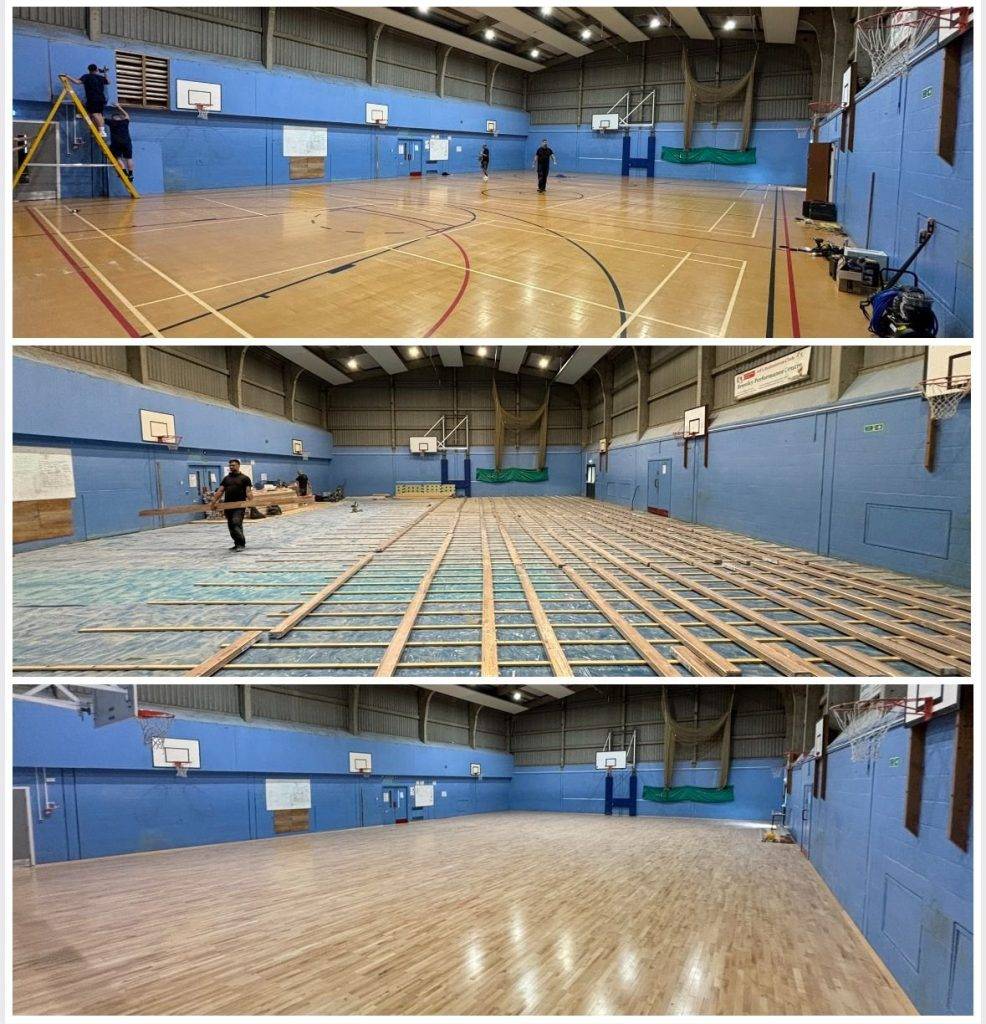
Downtime is usually the first concern for bursars and centre managers, so these are timings from our own work. A full sand, seal and reline of a gym of around 240 m² takes 5 to 6 working days. A four-court hall of around 550 m² takes 9 to 10 working days for the same work. A deep clean, abrade and reseal is a 2-day job that can be completed over a weekend, so lettings and fixtures carry on during the week. Deep cleaning starts from £4.50 per m².
New installations are priced individually after a survey, because the figure depends on the hall area, the condition of the slab, the system chosen, the number of socket positions and how many sports share the line scheme. Lacquer and line paint also need curing time before play, which we build into the programme. For schools the summer holiday is the natural window for a new floor or full sand, while clubs and leisure centres often prefer the close season between leagues. Booking early gives you the widest choice of dates.
Courtship Flooring is a family-run business established in 1987 and based in Wellington, Somerset. We work across the UK and internationally with our own teams, and nothing is subcontracted, so the firm that surveys your hall is the one that lays, marks and maintains it.
A volleyball project starts with a survey: hall dimensions, clear height, the existing floor, slab moisture and the sports already marked. From that we draw a layout showing the court, free zones, socket positions and how volleyball sits within the wider line scheme, and recommend a surface for the way the hall is used. Once you approve the plan, our teams carry out the installation or refurbishment, mark the courts and hand over the floor with cleaning guidance. A pendulum slip test before and after the work can give a measured starting point for future maintenance.
Our work includes a Junckers solid maple installation at Surrey Sports Park, a new Junckers floor at Harris Academy, Wakefield, and a full sand, reline and reseal at Liskeard Leisure Centre, Cornwall. More are in our sports flooring case studies.
A full court with the minimum 3 m free zone on every side needs a clear area of 24 m by 15 m. Sport England’s four-court hall of 34.5 m by 20 m takes one, while Volleyball England’s double-module hall of 37 m by 40 m provides two match courts or four tournament courts.
FIVB approval is required only for FIVB, world and official competitions, where any wooden or synthetic surface must be approved by the federation. School, university and club volleyball carries no such requirement, but leagues can set their own facility conditions, so check the competition handbook before you specify a new floor.
Usually, yes. The first check is whether a full court and free zone fit among the existing lines without confusing overlaps. The second is whether the current lacquer is sound enough for paint to bond. If it is worn, we abrade and recoat the hall as part of the job, which is why relining often pairs with a recoat.
A new sprung system often changes the finished floor level, so existing socket housings have to be extended or reset until their covers sit flush with the new surface. It is also the right moment to check positions against the current rules and add any sockets the hall is missing.
Yes, if you want fixed posts. Sitting volleyball posts are only 1.25 m high and stand 0.5 to 1 m outside the sidelines of a court that is 6 m wide, so they will not line up with standing volleyball sockets. If sitting volleyball is on your programme, plan both sets of positions together.
Yes, and many older school and leisure halls still do. Granwood is a composite of wood particles and cement bonded to the slab, so it lacks the deflection of a sprung system and feels firm on landing. A worn Granwood floor can often be restored, as we did at St George’s, Ascot.
Rarely the ball. Most damage comes from net posts dragged across the floor, trolley wheels and heavy equipment set down on the court. Lift posts rather than sliding them, store them on proper trolleys and close the socket covers before play so nothing catches a player sliding for a dig.
It can. Net height is 2.43 m for men and 2.24 m for women, measured at the centre of the court, and must be equal over both sidelines and no more than 2 cm above the official figure. A dipped floor or a slab that falls across the hall makes that harder to achieve.
Clean indoor court shoes with non-marking soles, kept for the hall and changed on arrival. Outdoor shoes bring in grit that scratches lacquer, and the same applies to coaches and spectators crossing the court. A barrier mat at the entrance and a clear changing point do more for floor life than any cleaning product.
Send us your hall size, current floor and the sports you run, and we will recommend a surface, layout and programme.