
Futsal court flooring has to cope with a fast, technical game played almost entirely at floor level. Players stop, turn and accelerate in tight spaces, goalkeepers go to ground, and a small, low-bounce ball is passed along the surface all session, so grip, ball roll and shock absorption must all be right.
Courtship Flooring installs, refurbishes and marks futsal courts in school sports halls, leisure centres, universities and club venues, usually as one layer of a multi-sport floor. Our own teams plan the layout, carry out the sports hall flooring installation or restoration, and apply the lines. Commercial and institutional facilities only.

Many UK halls were first marked for indoor five-a-side, where the walls often form part of play and the goal area is a large D. Futsal works differently. The ball goes out of play over the touchlines and restarts with a kick-in, the penalty area is drawn from two quarter circles, and each team has a marked substitution zone. The floor therefore needs a continuous pitch boundary, a clear strip between the touchlines and the walls, and markings that follow the FIFA Futsal Laws of the Game.
The same court serves very different users. In schools and academy trusts, futsal usually sits within PE lessons and after-school clubs, so the floor also has to suit gymnastics, badminton and assemblies. Leisure centres often let the hall to evening leagues, concentrating long sessions of use on the same areas of the pitch. Universities and clubs hosting fixtures need markings that match competition rules exactly. We ask how the court will be used before recommending a surface or line scheme, because the answer changes both.
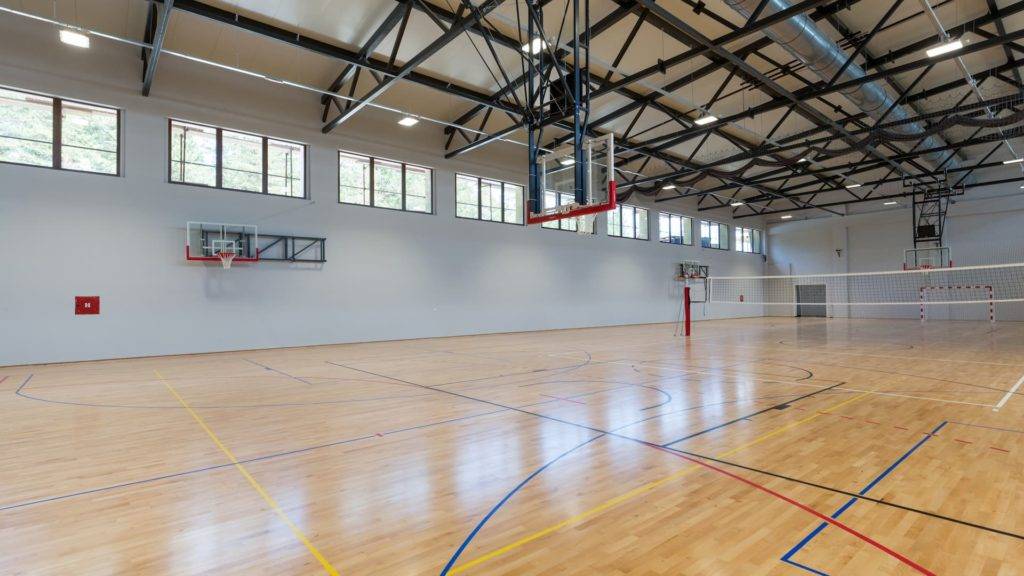
Not every venue needs an adult-size pitch. The FA’s pitch guidance for its youth futsal competitions sets maximum sizes of 18 m by 11 m for under-9s, 20 m by 12.5 m for under-11s and 30 m by 15 m for players aged 12 to 16, each with at least 1 m of run-off. That brings junior futsal within reach of smaller halls and gyms that could never take a senior pitch, provided the markings are planned so they do not crowd the lines already on the floor.
The most useful thing you can send at enquiry stage is the internal length and width of the hall, measured wall to wall, with the current floor type and the sports already marked. Photos of the walls, doors and fixed equipment help too. From that we can tell you what size of futsal pitch will fit, how much run-off it leaves and which line colour will stand out against your existing scheme.
The FIFA Futsal Laws of the Game allow a pitch 25 to 42 m long and 16 to 25 m wide for non-international matches, and 38 to 42 m by 20 to 25 m for international play. Every line is 8 cm wide and continuous, and measurements run to the outside edges because lines belong to the area they enclose. The main markings are:
Goals are 3 m wide and 2 m high inside, so each penalty area spans a little over 15 m of the end line. A penalty arc struck from the wrong point is obvious to any referee.
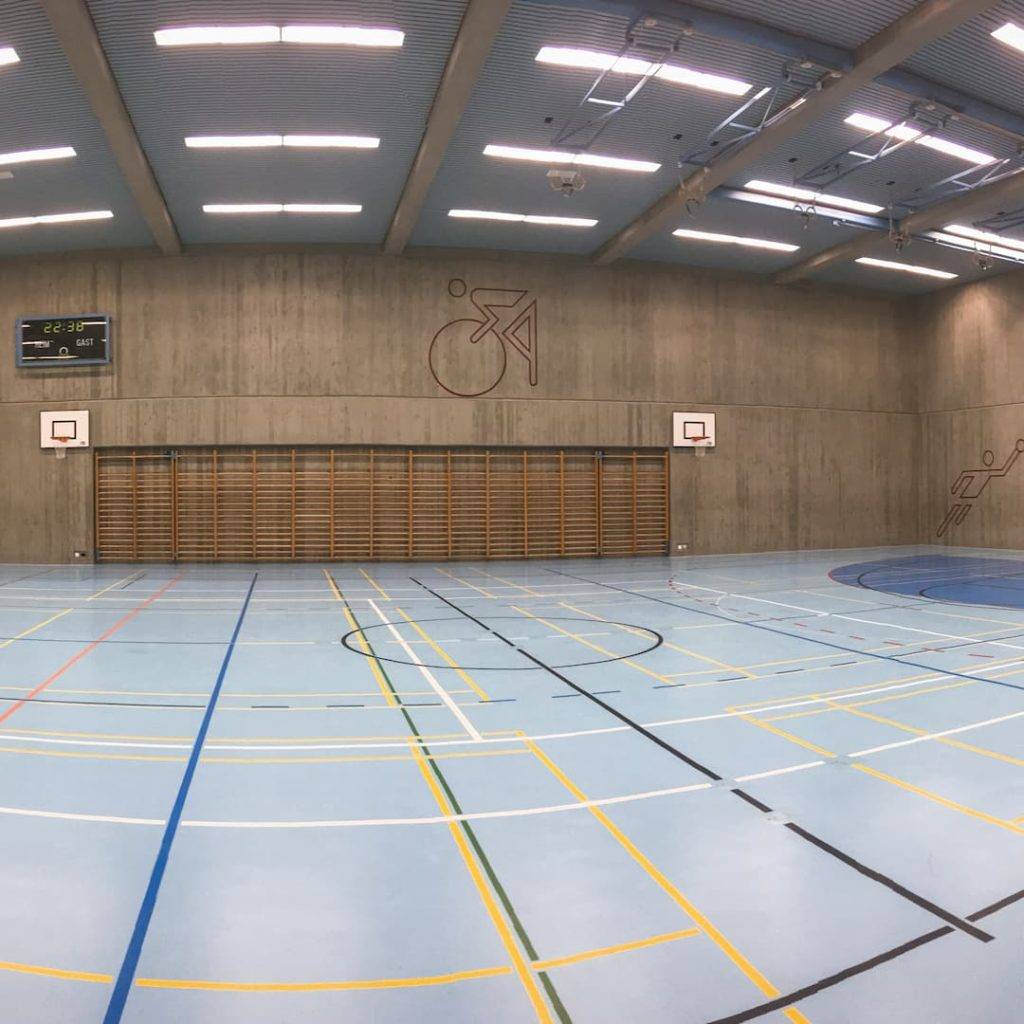
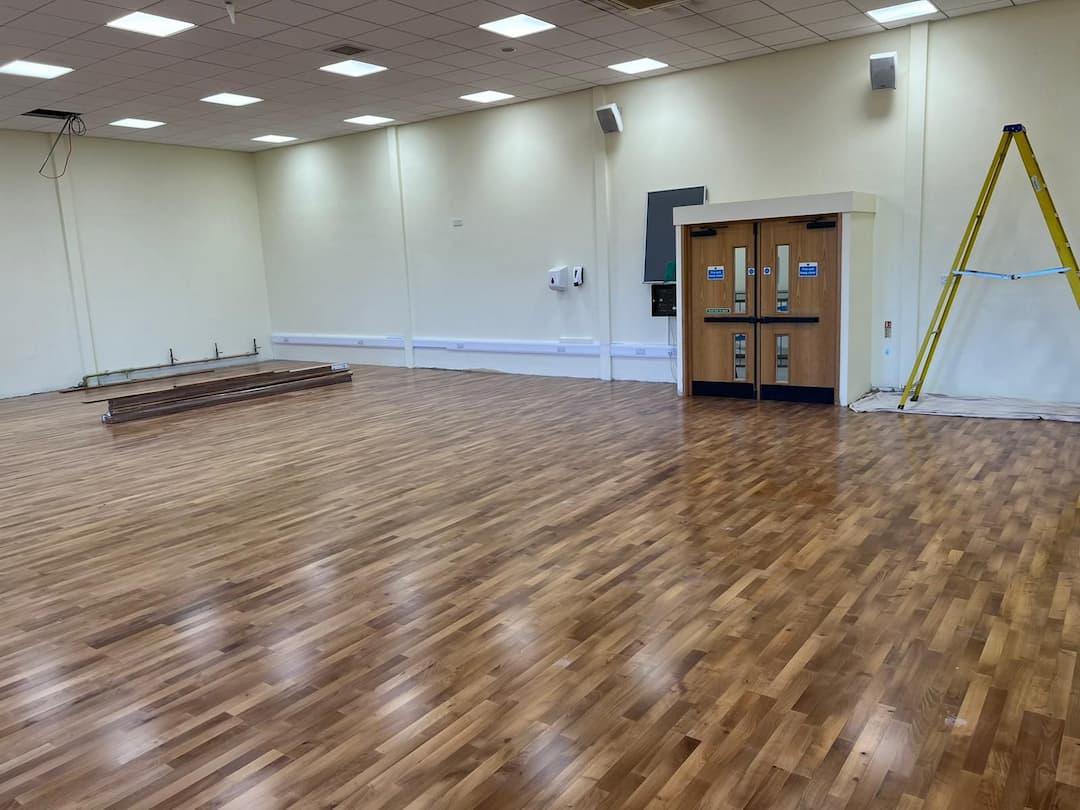
Sport England’s recommended four-court hall measures 34.5 m by 20 m, the size it treats as the minimum for school competitions. That footprint takes a futsal pitch of around 31 m by 16 m, inside the FIFA range for non-international matches, with about 1.75 m clear at each end and 2 m along each side. The FA describes 1 m of run-off as an absolute minimum and prefers 2 m, and benches, a timekeeper’s table and officials need space on top of that. Where benches sit along one side, offsetting the pitch towards the opposite wall, while keeping the minimum margin there, frees a usable strip. International dimensions are another matter: a 38 m pitch plus run-off will not fit a 34.5 m hall, and six-court halls usually gain width, not length.
Because futsal is not played off the walls, the run-off needs the same surface as the pitch and no obstructions. School sports hall design guidance favours flush walls without low-level projections, so review radiators, door furniture and stored equipment near the touchlines before the court is marked.
The Futsal Laws ask for a surface that is flat, smooth and non-abrasive, with wood named as a preferred material. Four surface types suit indoor futsal in UK halls.
Grip decides a lot for futsal users. Players change direction constantly, so the floor needs enough friction to stop feet sliding out, but not so much that the foot locks while the body turns. Goalkeepers also spend time on the floor, which is why a non-abrasive finish matters. Compare wooden sports flooring options with vinyl and PU sports flooring before settling on a system.

BS EN 14904 is the European standard used to test indoor multi-sport surfaces, and its figures translate well to futsal. A compliant floor must give force reduction of 25 to 75 per cent, vertical deformation under 5 mm, ball rebound of at least 90 per cent of the rebound on concrete, a sliding value between 80 and 110 and resistance to a 1,500 N rolling load. How a floor reaches those figures depends on its construction. Area-elastic systems, typically timber on sprung floors, flex over a wide area and are widely specified for multi-sport halls with heavy adult use. Point-elastic floors such as PU and foam-backed vinyl deform locally under the foot, while combined systems blend the two.
For futsal, ball roll matters as much as bounce. The Laws require a ball that rebounds only 50 to 65 cm when dropped from 2 m, so it spends most of its time rolling, and any ridge, cupped board or soft patch shows up quickly. Dead spots from failed battens or pads, and timber movement caused by damp or poor ventilation, are the usual culprits on older floors.
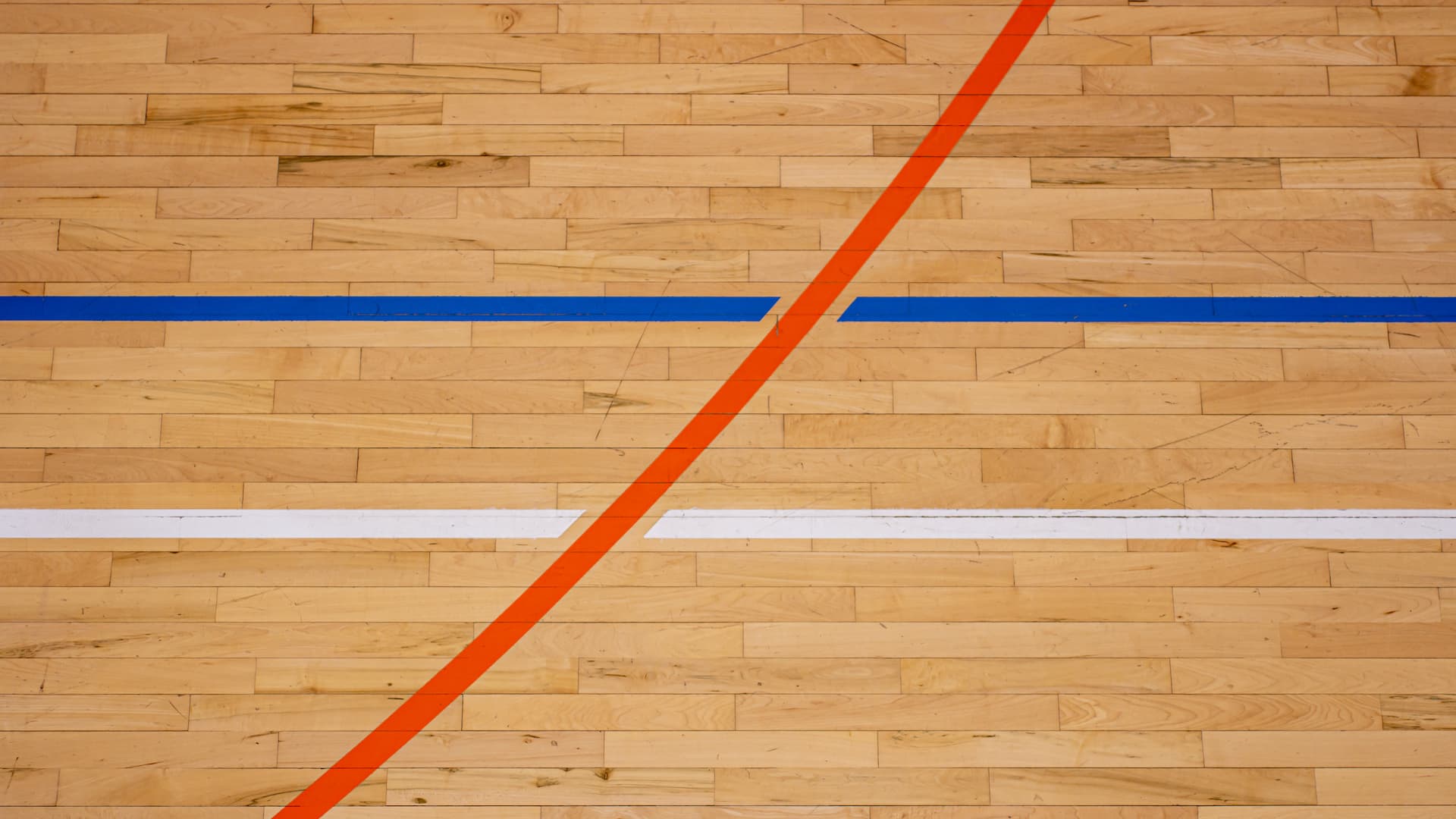
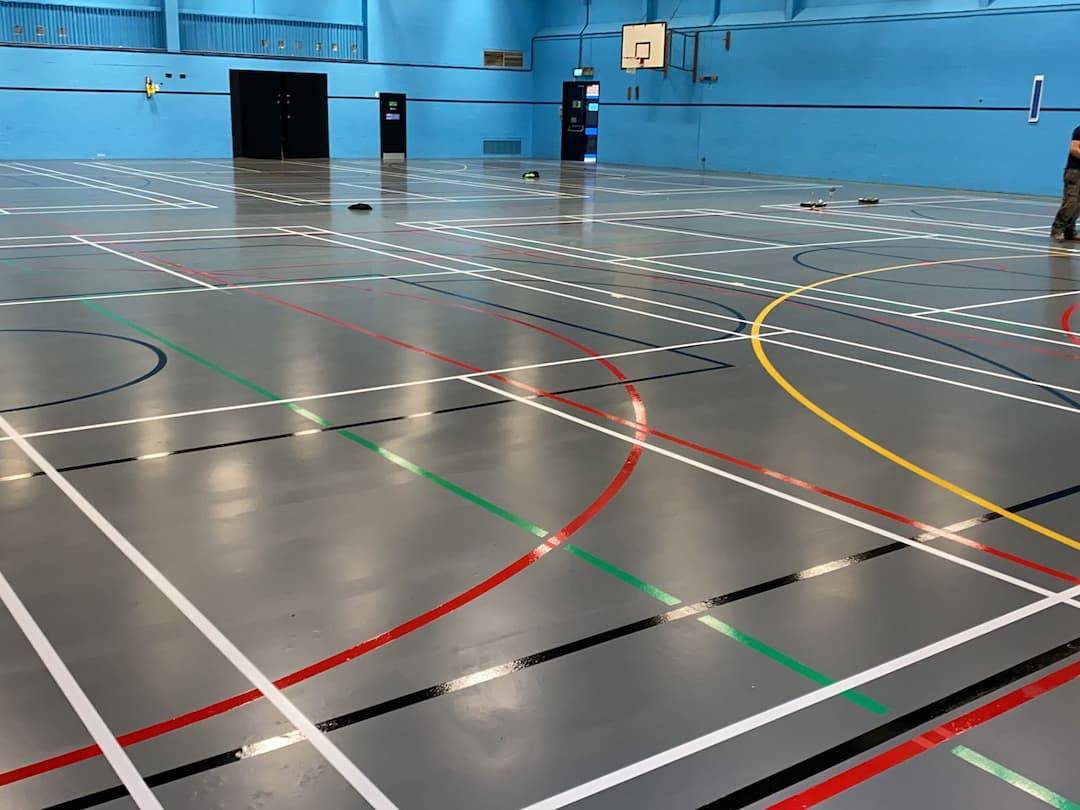
The Futsal Laws accept other lines in a multipurpose hall, provided they are a different colour and clearly distinguishable from the futsal markings. Orange and blue are common futsal colours in UK halls, but the right choice depends on what is already on the floor. Basketball is often black, netball red, badminton white and volleyball usually green, so a hall where hockey or cricket already uses blue or orange needs a different answer.
Line width is the next issue. Futsal lines are 8 cm wide, twice the 40 mm of badminton lines, so they dominate the floor unless the colour is chosen with care. Footprint matters too. A netball court is 30.5 m by 15.25 m, close enough to a 31 m by 16 m futsal pitch that the two sets of touchlines can run within centimetres of each other and confuse players and officials. We set courts out so parallel lines stay clearly apart.
The FA notes that a netball circle or basketball three-point line can stand in as a penalty area for social games, but that is not a Laws-compliant pitch. Our netball court flooring page covers that sport’s own requirements.
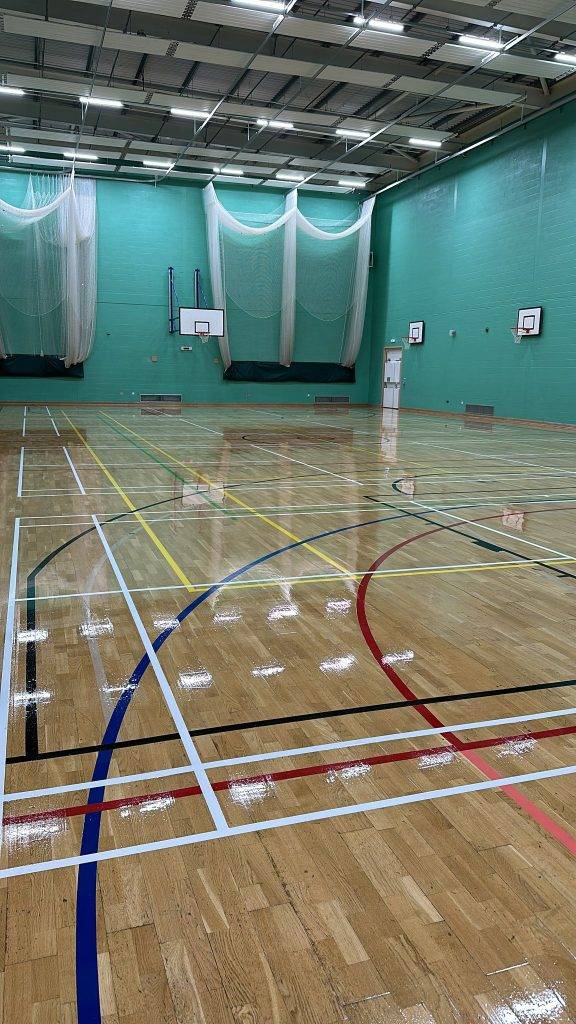
The Futsal Laws require goals to have a stabilising system, such as weight at the back, to stop them overturning. Where old five-a-side goal sockets are no longer used, they should be capped flush with the surface. Weighted goals bring their own risk: dragged into position they scratch lacquer and paint, so carry them or use trolleys with non-marking wheels, keep pads under the frames and store them off the playing area.
Wear follows the game. Goalmouths, the penalty and 10 m marks, the centre circle and the substitution zones take the most traffic, and the finish thins there first. Dust cuts grip, which matters more in futsal than in most hall sports, so daily dust control and good entrance matting belong in the routine. When routine cleaning no longer restores the surface, a deep clean brings it back, and a screen and recoat before the lacquer wears through protects both the timber and the lines. Our sports hall floor maintenance service can set a programme to match how often the court is booked.
Programme length depends mostly on floor area and the type of work. As a guide from our own projects, a full sand, seal and reline of a gym of around 240 m² takes 5 to 6 working days, and a four-court hall of around 550 m² takes 9 to 10. A deep clean, abrade and reseal is a two-day job that can be completed over a weekend, so the hall is back in use for the following week.
New installations are programmed after a survey, because sub-floor condition, moisture readings and the size of the hall all affect the timetable. Lines go on as part of the installation or refurbishment, so a futsal layout planned from the start fits within the same programme.
On cost, the main drivers are area, the condition of the existing floor, the number of sports to be marked and whether the sub-floor needs work. Deep cleaning starts from £4.50 per m²; everything else is quoted after a site survey. Schools and colleges usually book around holiday periods, and we plan programmes to fit those windows.
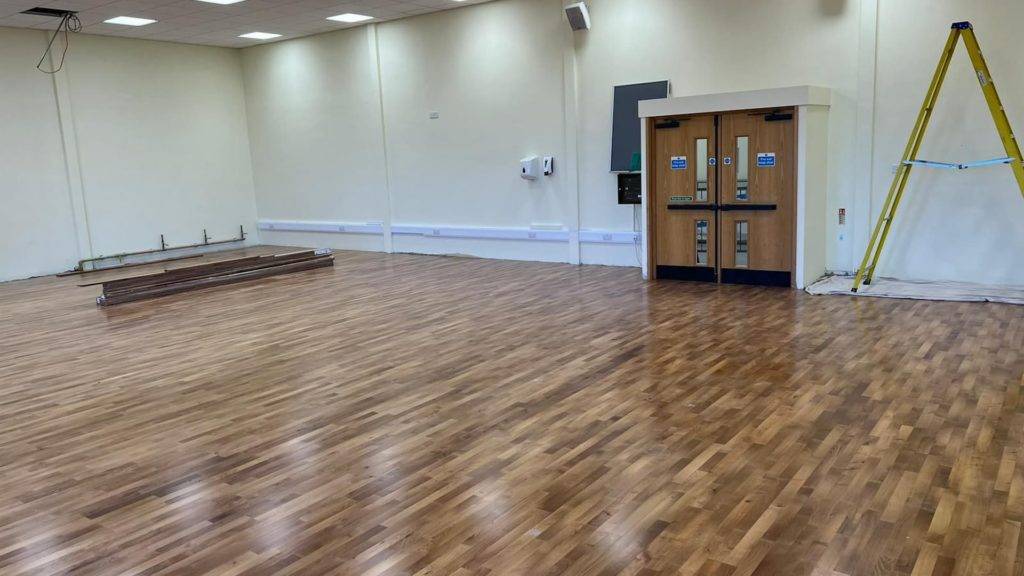
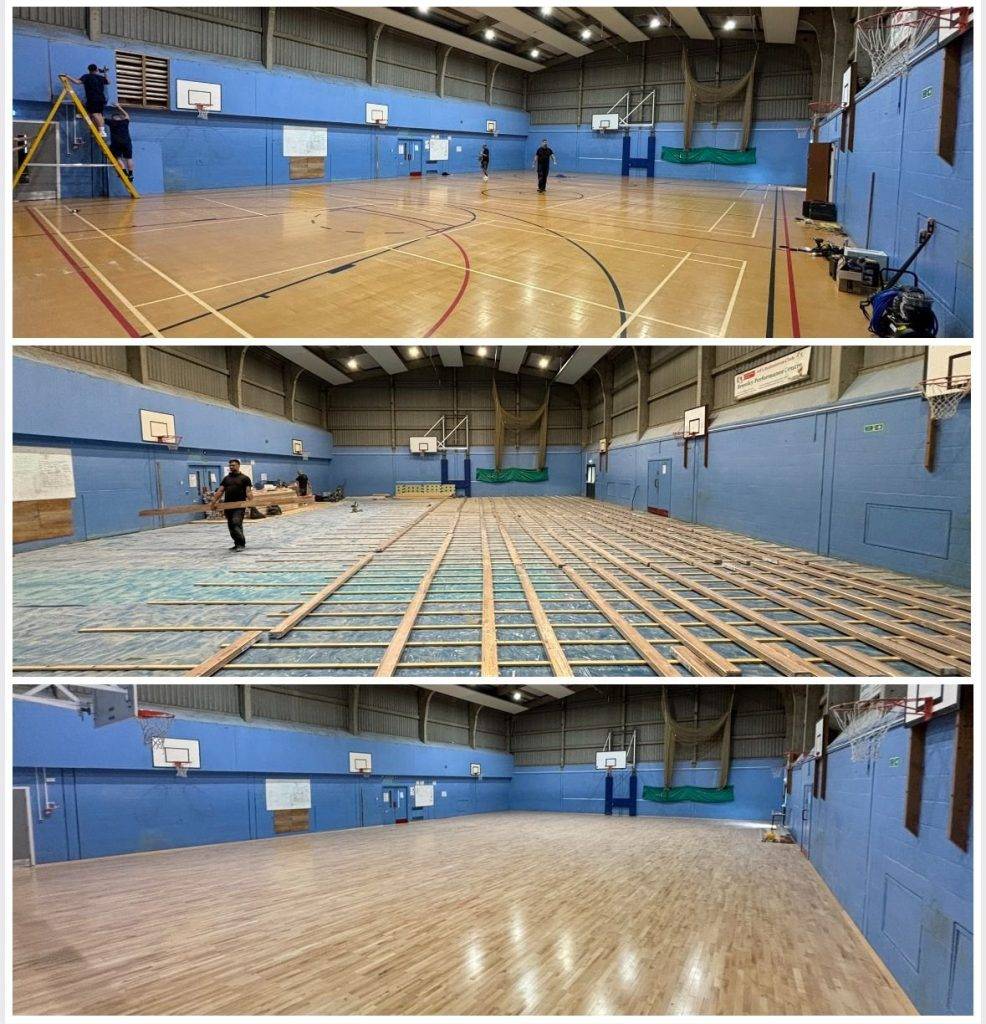
Every project starts with a site survey. We measure the hall, record the existing surface and line scheme, check fixtures along the run-off and, on new installations, test moisture and sub-floor condition before recommending a system. We then agree the layout with you: pitch size, run-off, line colours and which sport takes priority where markings sit close together.
On timber, the floor is installed or sanded back to bare wood and sealed. The futsal and other court lines are set out from measured reference points and painted between seal coats, so the final coats protect them. On PU and vinyl we use line products suited to the surface. The finished floor can then be checked with pendulum slip testing, and we hand over with care guidance for its users. Standalone visits for sports hall line marking are available too.
The work is done by our own teams, with nothing subcontracted. We are a family-run business, established in 1987, and our projects include a Junckers solid maple installation at Surrey Sports Park, a new Junckers floor at Harris Academy, Wakefield, and a full sand, reline and reseal at Liskeard Leisure Centre in Cornwall.
Usually, yes, provided the floor is sound. We check first for wear, dead spots and lifting boards, because a futsal pitch shows flatness problems quickly. On timber, the lines can go on during a refurbishment or a separate marking visit. If the floor is near the end of its life, replacing it before paying for new lines makes more sense.
The Futsal Laws set 8 cm for every line, and halls hosting league or cup fixtures should follow that. For PE lessons and recreational sessions, some multi-sport halls use a narrower line so futsal does not overpower the other markings. Check the rules of any competition you plan to host first.
The Futsal Laws describe the surface in general terms and do not cite the standard. Because a futsal court almost always shares the hall with other sports, the multi-sport figures in BS EN 14904 are a sensible benchmark for any new floor or major refurbishment, and we can talk them through with your specifier.
Yes. Granwood composition blocks are common in older school and community halls, and once restored they carry futsal markings like any other sports floor. Granwood does not flex like a sprung timber system, so consider how much adult play it will see. Our Granwood work includes St George’s, Ascot.
On timber, yes. Old lines come off when the floor is sanded back, and the whole surface is then resealed, so the futsal layout starts clean. On PU and vinyl the options depend on the product and the paint originally used, and we assess them on site before recommending a way forward.
Yes. Crests and logos can be painted into the centre of the floor and sealed beneath the final coats. For competition use, the Futsal Laws keep floor branding off most pitch markings and at least 0.75 m from the boundary lines, so we position artwork clear of every sport’s lines.
Flat indoor shoes with non-marking rubber soles. Studded or moulded boots damage the finish, and dark soles leave scuffs that hide the lines and build up on the surface. Many venues ask players to change shoes at the door, which keeps playing conditions consistent between maintenance visits.
A pendulum slip test to BS 7976-2 gives you a measured record of the floor’s slip resistance, which is useful if a player reports a fall or the surface starts to feel greasy. We can test after installation or refurbishment, and it is worth repeating when cleaning products change.
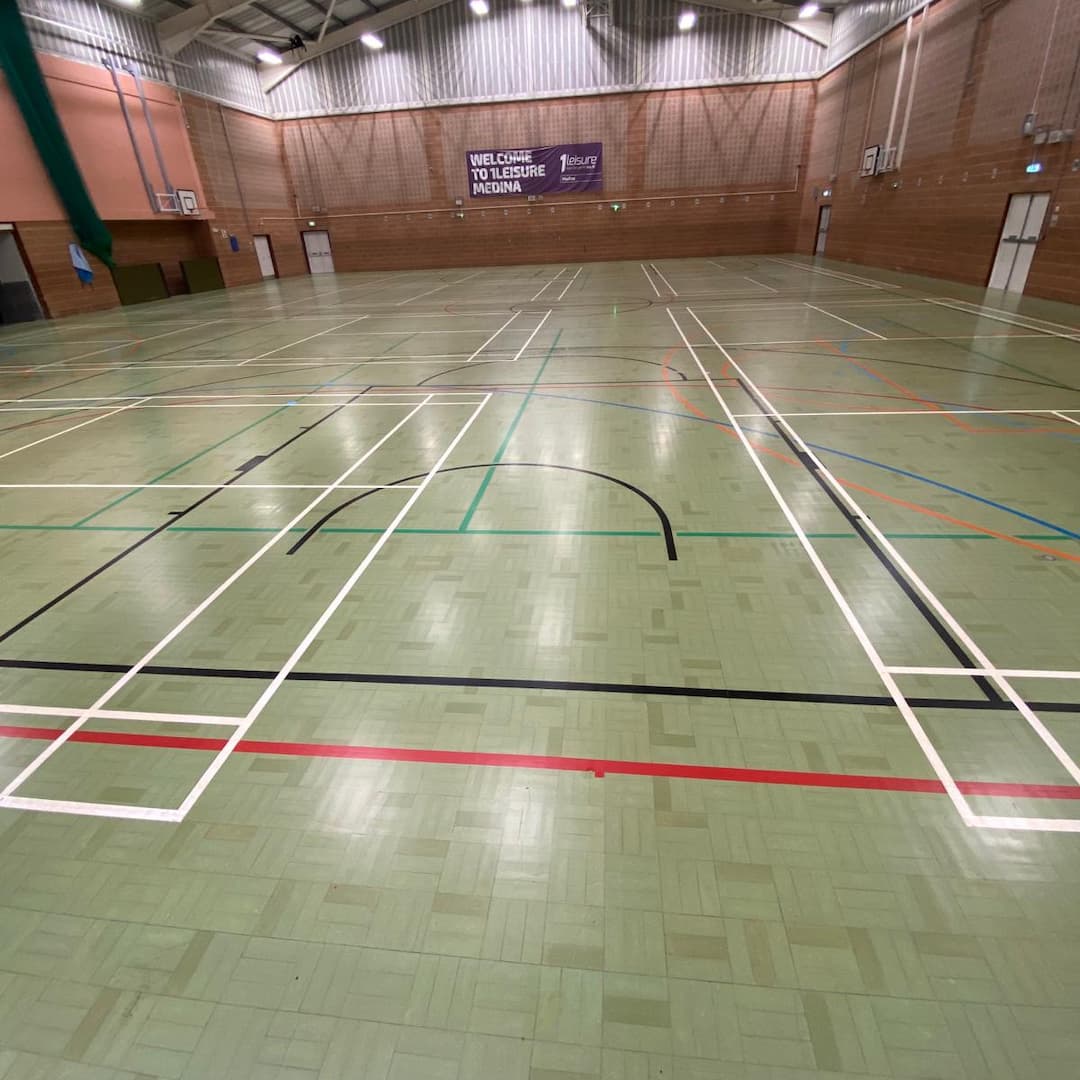
Yes. We are based in Wellington, Somerset, and our own teams work across the UK and internationally, from the university hall we refurbished at Aston University in Birmingham to Medina Leisure Centre on the Isle of Wight. The survey, layout and marking process stays the same wherever the hall is.
Tell us about your hall and how futsal will be played there, and we will recommend a surface and line scheme.