
Portable sports flooring gives a hall a proper playing surface on the days it hosts sport, then comes up when the room is needed for worship, an exhibition, examinations or a ticketed event. Panels, rolls or tiles go down over the existing base and are lifted and stored afterwards, so the space never commits to one purpose.
Courtship Flooring supplies and lays portable sports floors, surveys the base floor first, and keeps timber panels playable through sanding, sealing, relining and pendulum slip testing. Where a permanent floor makes more sense for a hall’s calendar, our own teams install that instead. Commercial and institutional facilities only.
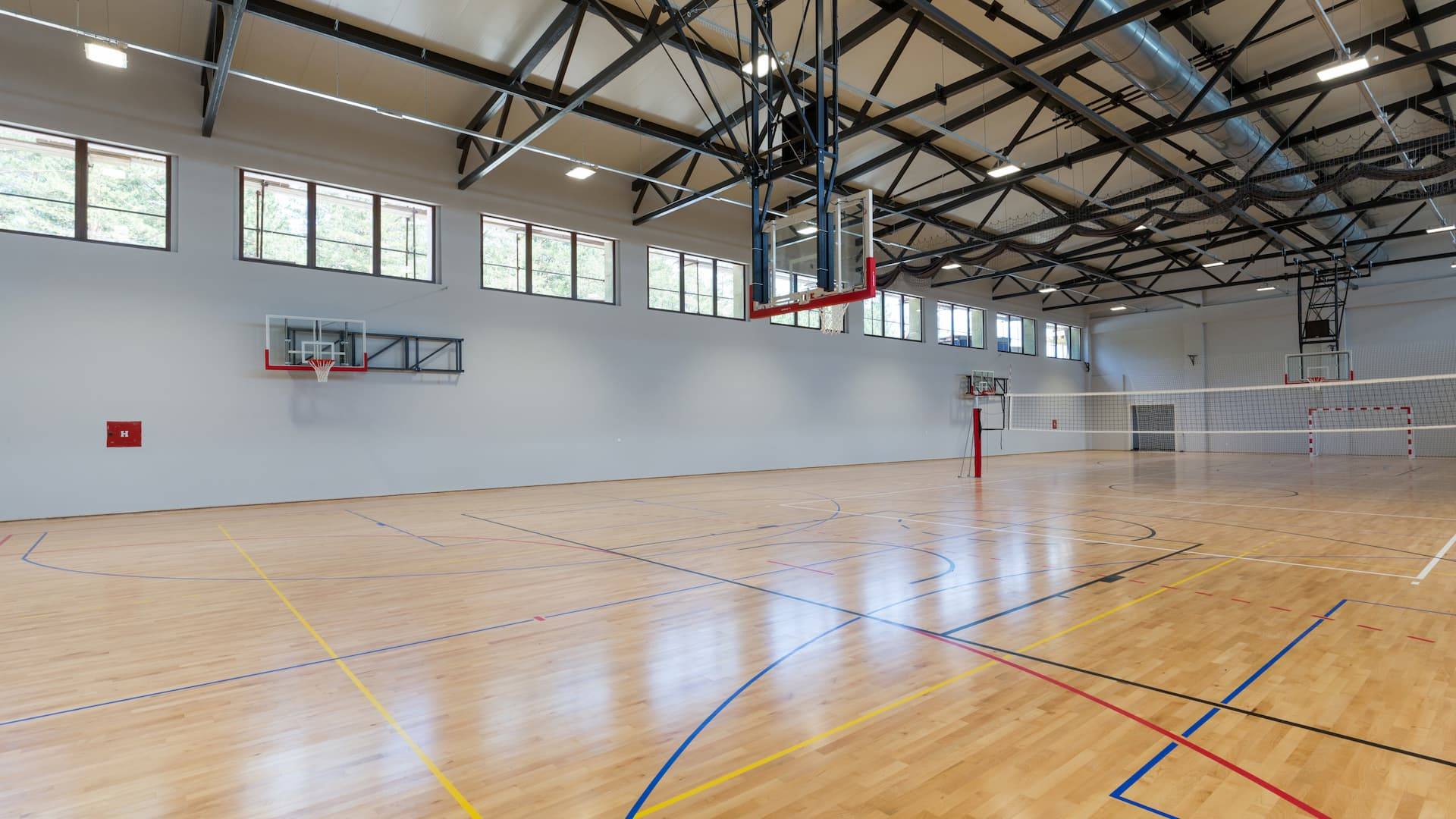
The buildings that rely on portable floors share one trait: sport is only part of their week. A faith centre may run youth basketball on Tuesday and hold prayers on Friday. An exhibition hall hosts a badminton tournament between trade shows, a school gives its hall to examinations each summer, and a club may play in a temporary venue while its own building is rebuilt. Arenas lay courts over concrete or covered ice for a weekend. The real question is how cleanly the room switches between uses, and what each switch costs.
Portable sports floors and protective floor covers are often confused, and the difference matters. Covers such as heavy-duty matting or interlocking boards shield a sports floor from chairs, staging and footfall, and nobody should play on them. A portable sports floor does the opposite job: it supplies the shock absorption, ball response and grip the base floor lacks, then comes up so the room can be used for something else. Some venues need both, a portable court for tournaments and sports hall floor protection to cover the base floor during events.
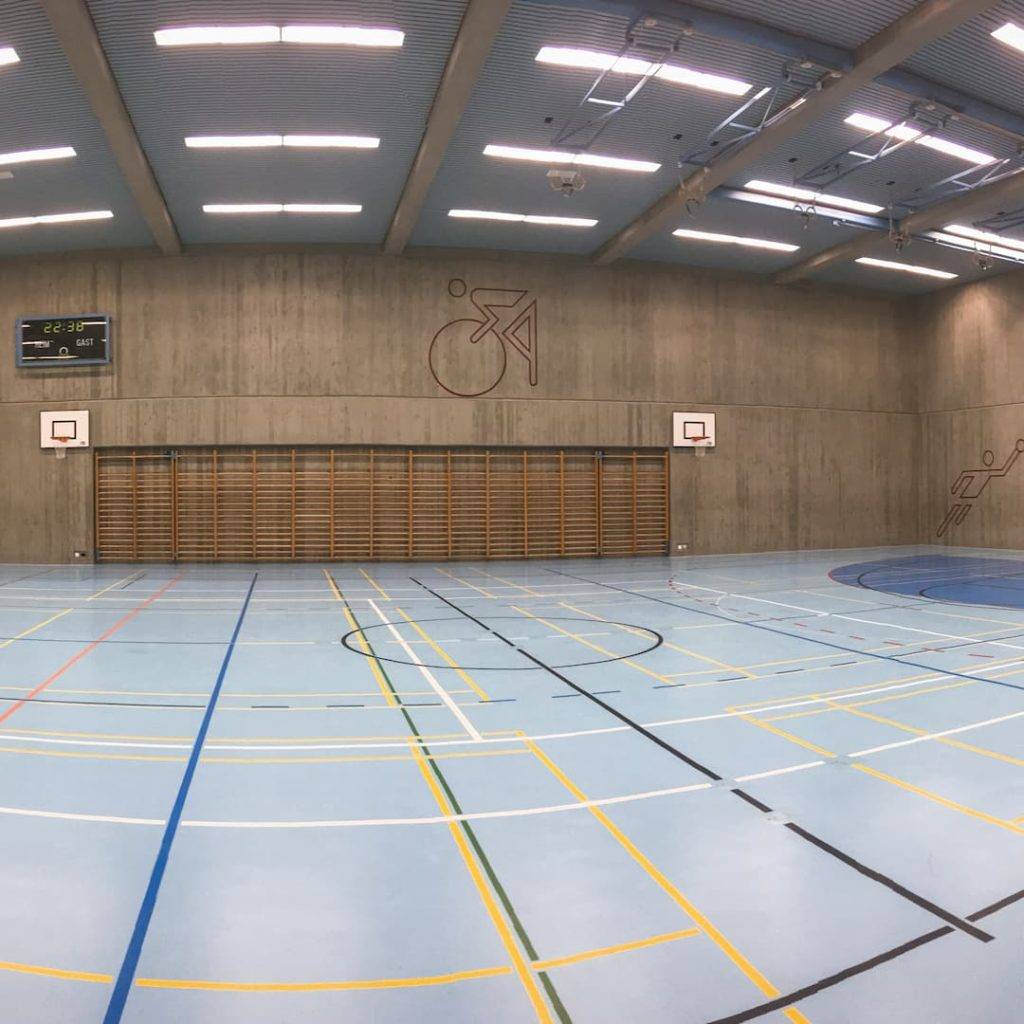
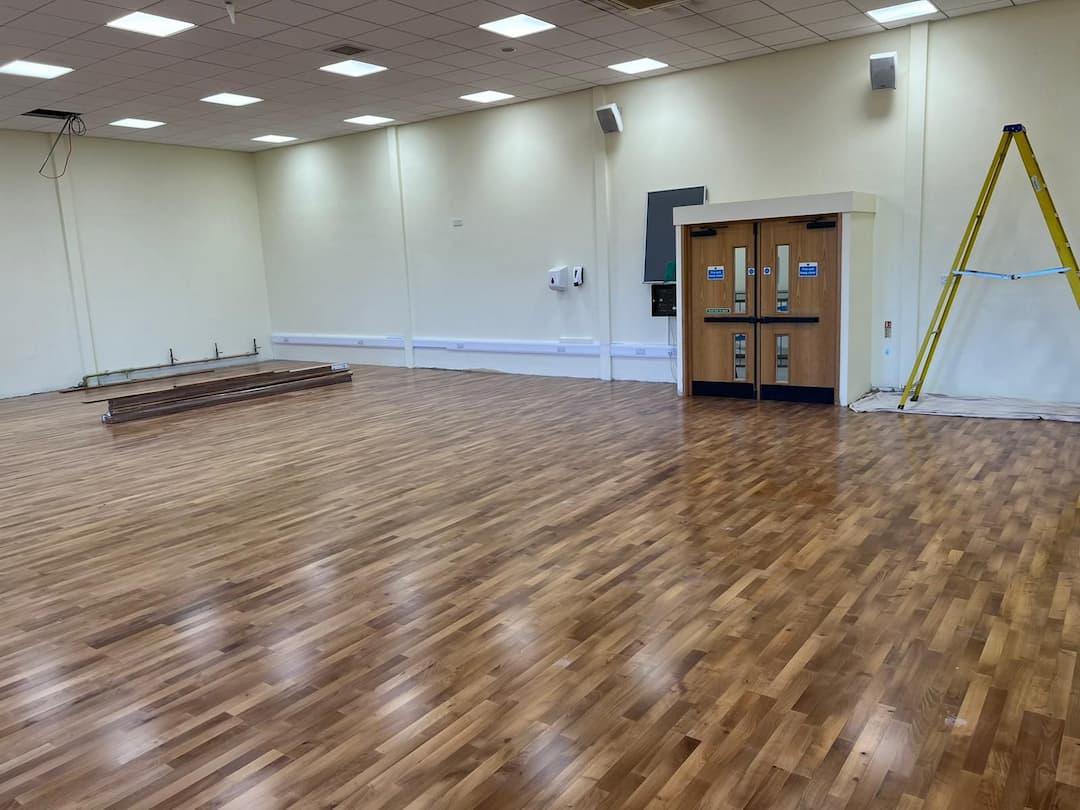
Every portable floor sits proud of the base, so its edges need bevelled ramps or transition profiles to remove trip hazards and let wheelchairs, trolleys and mobility aids cross onto the court. Ramps belong around the full perimeter, not only where players enter. For wheelchair sports such as wheelchair basketball and wheelchair rugby, the system type matters too. British Wheelchair Basketball favours area-elastic construction and advises against foam-backed surfaces, which raise rolling resistance and tire players. If wheelchair clubs book the hall, ask the supplier about rolling resistance before buying.
The right portable system is usually decided by the diary, not the brochure. Before comparing products, list every occasion in a typical year when the floor would go down and come up, who would do the work, how long each changeover window is and where the floor would live in between. A hall that changes use twice a term needs something very different from one that switches every weekend, and the numbers often point towards a fixed floor.
Three broad families of portable sports flooring are used in UK halls. Interlocking timber panels are the closest match to a permanent sports floor. A hardwood or engineered wear surface is factory-fixed to battens or a foam layer, and the panels lock together with tongues, metal brackets or spring clips. Each panel is numbered so it returns to the same position every time. Our page on wooden sports flooring explains how the same timbers behave in fixed floors.
Roll-out surfaces are sheets of sports vinyl or a similar synthetic, delivered on rolls and loose-laid with taped seams. They are quick to deploy and are used for badminton, netball and basketball events, often on top of an existing hall floor. The fixed equivalents are covered on our vinyl and PU sports flooring page.
Modular tiles are rigid polymer squares that clip together. They are forgiving to lay and easy to replace one at a time, but their feel underfoot and ball response differ from timber, so check test data for the intended sport before relying on them for competition.

BS EN 14904 is the European standard for indoor multi-sport surfaces and the benchmark that UK sports floor specifications commonly refer to. It tests a floor as a complete system for force reduction, vertical deformation, ball rebound, sliding behaviour, rolling load, wear and indentation. A compliant floor must return at least 90 per cent of a basketball’s bounce on concrete and carry a 1,500 N rolling load without lasting damage.
Some portable timber panel systems are tested to the standard and hold area-elastic classifications, so they can perform close to a fixed sprung floor. Roll-out sheets and tiles are different, because much of their performance comes from whatever lies underneath. A thin vinyl laid on a concrete slab offers little shock absorption, while the same sheet laid over an existing sprung floor inherits that floor’s behaviour.
When comparing systems, ask for the test report for the build-up that will actually be laid on your base, including any underlay. A certificate for a different construction tells you little. Fixed floors keep one advantage: nothing shifts or opens up between sessions.
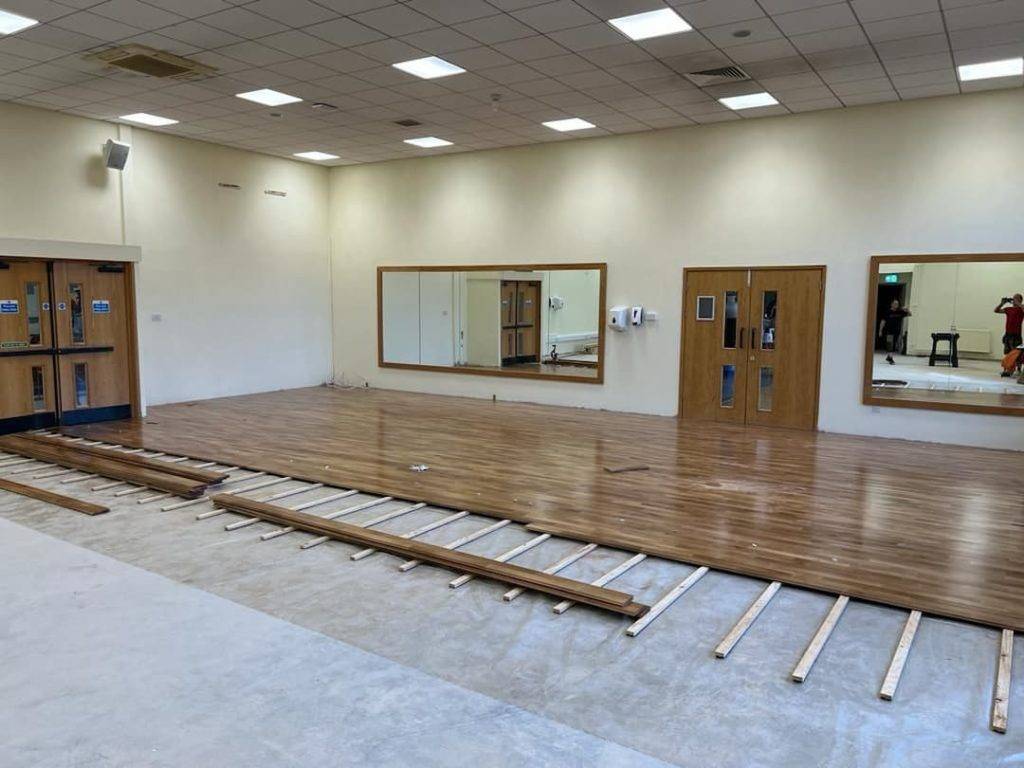
A portable floor can only be as flat and dry as the surface it sits on. Manufacturers set flatness tolerances, and one maker’s portable timber system allows no more than 3 mm under a 2 m straight edge in the UK. High spots are ground down and hollows filled with levelling compound before the first lay, because a panel bridging a dip will rock and its joints will open.
Moisture is the second check. Where there is any moisture risk, timber panels on concrete or screed go over a polythene membrane with overlapped, taped joints, and the slab must meet the manufacturer’s dryness limit. Damp from an unprotected slab can cup boards and push joints apart.
Then look at the details: floor boxes, door thresholds, columns and underfloor heating. Each one affects where the first row starts, where edge ramps go and whether a particular system can be laid at all. Where the portable floor goes over an existing sports floor, that surface must be clean, since grit trapped between the two scratches it whenever the portable floor flexes.
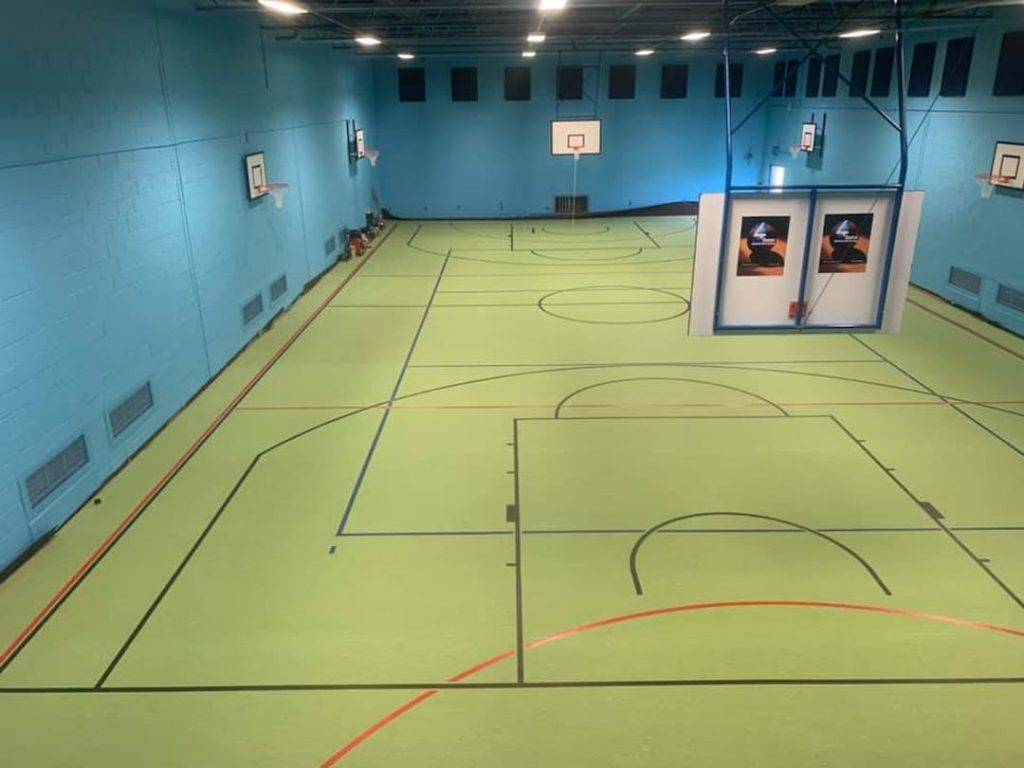

Portable floors take more space and labour than most buyers expect. In one manufacturer’s range a full timber panel covers just under a square metre and weighs about 15 kg. The same maker’s guidance for a FIBA basketball court with a 2 m safety zone calls for around 700 panels, and its storage carts hold 40 each. A governing-body hire floor of around 630 m² weighs more than 12 tonnes.
The store needs level floor space, doorways wide enough for the carts and the same temperature and humidity as the hall, because panels kept in a cold or damp room move once they are laid. Batten-backed panels are stacked face to face and back to back, so battens bear on battens and the underlay is never crushed.
Laying starts from a set-out line, with the first row checked for straightness before the rest follows. Some systems allow two teams to work outwards from a centre row. Laying times vary widely with crew size, access and the system chosen, so ask the supplier for a demonstrated changeover time and allow extra for the first few lays.
Markings are where portable floors differ most from fixed ones. Because the floor is reassembled each time, lines only stay true if every panel goes back in its numbered position, and a single swapped panel puts a break in the boundary. Many portable courts carry one sport’s markings, which is often the point: a clean single-line court for competition, laid over a busy multi-sport hall floor.
Painted lines on timber panels are applied across the assembled floor and sealed under lacquer, so the film bridges every joint. Before the first lift after painting or recoating, that film is cut along the joints, or the lacquer tears at the panel edges. Manufacturers set a window for that lift, because lacquer left to cure in the joints can glue panels together and split tongues.
Tape lines suit one-off events, but adhesive residue can stop later lacquer coats bonding, so remove tape promptly. Badminton’s world governing body operates a certification programme for court mats. Where a hall keeps its fixed floor and simply needs clearer courts, sports hall line marking is often the cheaper answer.
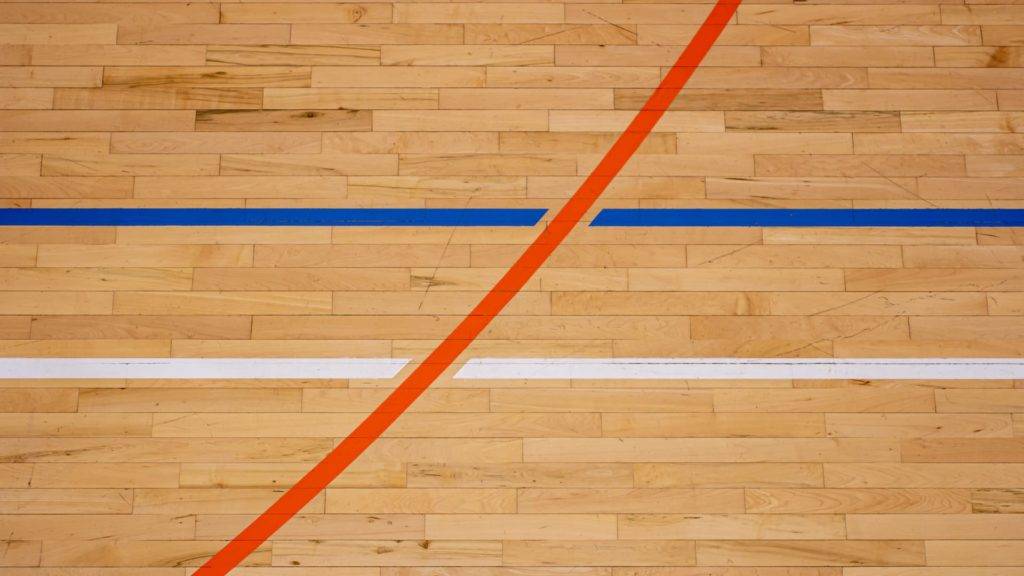
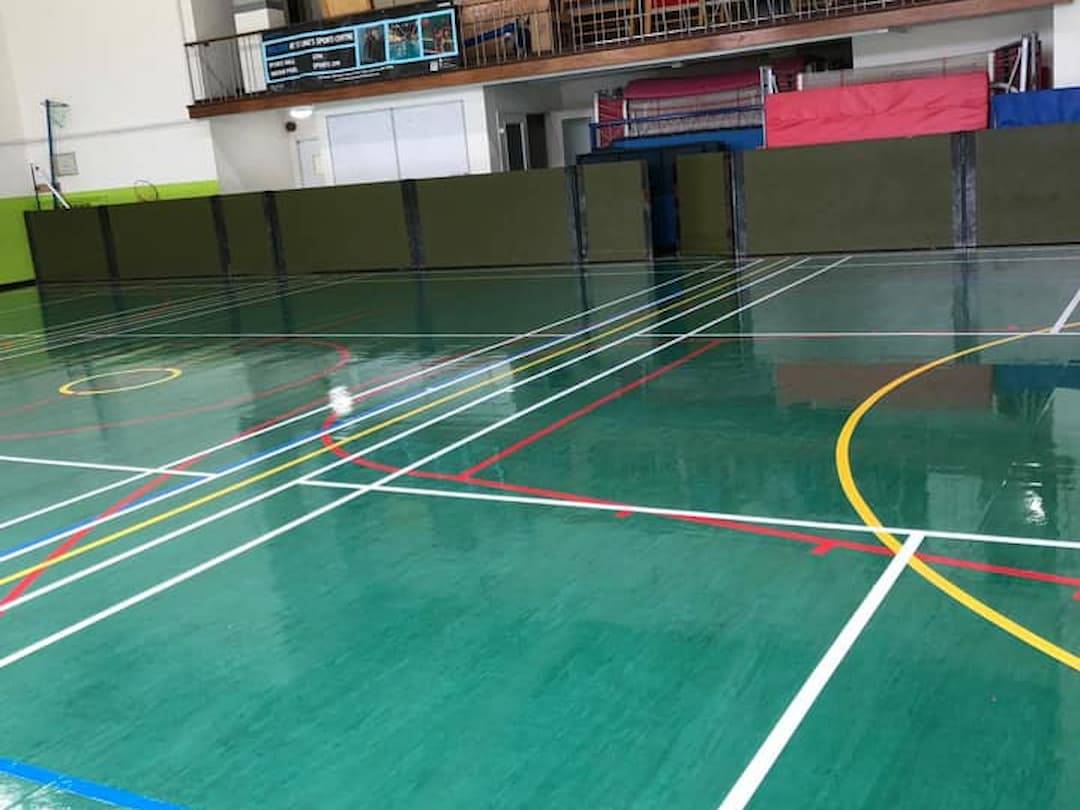
Most wear on a portable floor happens during handling, not play. Sweep or dust-mop the surface before every lift, because grit trapped between stacked faces scratches the finish in storage. Lift panels in the reverse of the laying order with the proper extraction tools, and never lever them up by their edges. Keep a log of damaged tongues, brackets and edge profiles so replacements arrive before the next event.
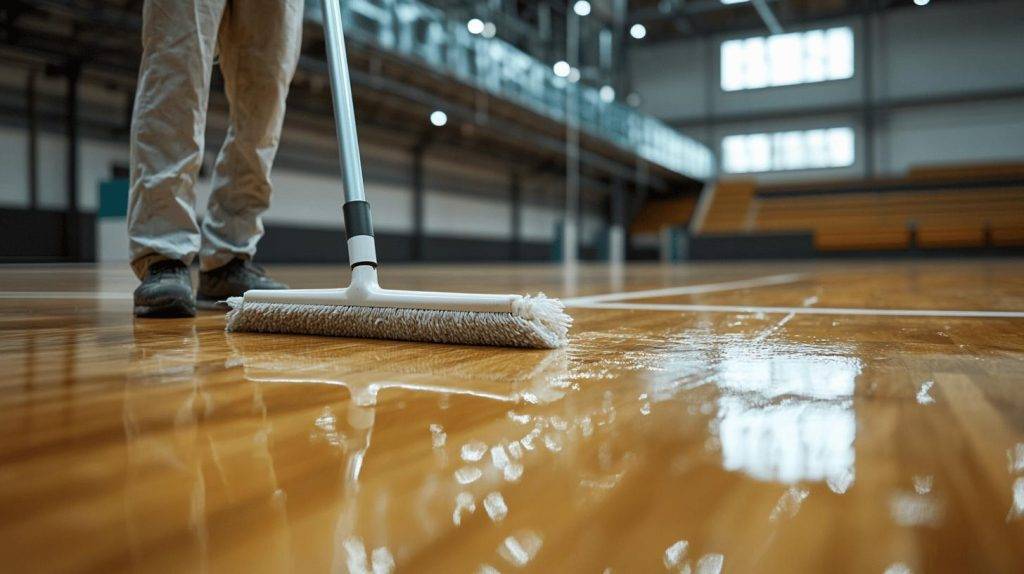
Routine cleaning follows the same rules as a fixed floor: a pH-neutral cleaner, a well-wrung mop and no standing water near the joints. Avoid polishes and waxes. Like handball resin and tape adhesive, they leave residues that prevent new lacquer bonding when the floor is next recoated.
A screen and recoat refreshes worn lacquer while it is still intact. The panels are laid out and locked together, cleaned, lightly abraded, coated and left to cure before being cut free along the joints. Where the finish has worn through to bare timber across larger areas, the panels need full sanding and sealing before relining.
Portable floors earn their keep in halls that change use every week or two. They become poor value when the floor rarely moves. If panels stay down most of the year and only come up for a few weeks of examinations, the hall pays for a portable system, its store and its handling damage without using the flexibility.
A fixed timber or synthetic floor on a sprung sub-floor gives consistent performance, no joints to open, no changeover labour and no store to heat. Exams and events can still take place on it with suitable protection. Refurbishment programmes are predictable too: a full sand, seal and reline of a gym of about 240 m² takes five to six working days, a four-court hall of about 550 m² takes nine to ten, and a deep clean, abrade and reseal is a two-day job that can be done over a weekend.
If the diary shows sport most days, our sports hall flooring installation teams can quote for a permanent floor to compare against the portable option. Smaller venues may find our community hall flooring guidance useful.
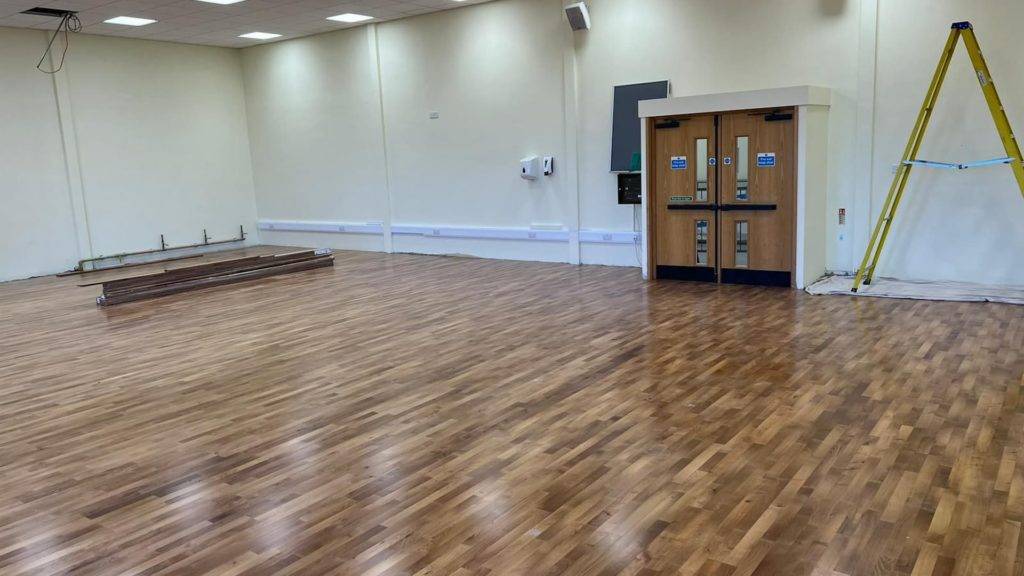
We start with a site visit. We measure the base floor’s flatness, check slab moisture, note thresholds, floor boxes and access routes, and walk through the hall’s calendar with whoever runs the building. That tells us whether a portable system is realistic, which type suits the mix of uses and how large the store needs to be. We then supply and lay the system, and show your team how to change it over safely. If a fixed floor is the better answer, we say so and quote for it.
Where a hall already owns portable timber panels, the sanding, sealing and relining our own teams carry out on fixed floors can be done with the panels laid out and locked together, then cut free once cured and returned to the store in numbered order. Nothing is subcontracted, and deep cleaning starts from £4.50 per m².
Once the floor is down, pendulum slip testing to BS 7976-2 gives a measured slip resistance value for the surface as players will meet it. We work with schools, colleges, universities, leisure centres, sports clubs, local authorities and academy trusts across the UK.
Generally not. Carpet compresses unevenly under load, so panels rock, joints open and the floor’s tested performance no longer applies. Tiles and roll-out sheets also creep on a soft pile. The usual approach is to lift the carpet within the court area, or to use the portable floor only in rooms with a hard, flat base.
Yes. Some governing bodies and specialist suppliers hire portable courts for events. Check whether the hire price includes transport and the labour to lay and lift the floor, as these are often extra. Before delivery, confirm door widths and vehicle access. We can survey the hall’s base floor beforehand and slip test the court once it is down.
It is worth doing after a recoat, after a change of cleaning product, or when players say the surface feels unpredictable. The pendulum test measures the floor as laid, so the result reflects the finish, any contamination and the cleaning regime together. A test before a long event series also gives a baseline if a complaint follows.
Panels with a solid hardwood wear layer can be fully sanded several times over their life, and one manufacturer quotes eight to ten full sandings for its system. Panels with a thin engineered veneer allow far fewer. Find out the wear layer thickness before planning a full sand, because an abrade and recoat may be the only safe option.
That depends on the system. Some are designed for events lasting days, and manufacturers set a maximum continuous laying period. One timber system, for example, recommends consulting the maker before leaving it down for longer than 12 weeks. Ask for the limit in writing before planning a long run, and lift the floor to inspect the base if it is exceeded.
The damaged panel is lifted out and replaced from a stock of spares, which is why buying a few extra full and half panels with the floor is sensible. The replacement takes the old panel’s number, and any line marking across it is repainted and sealed to match. Split tongues, bent brackets and crushed underlay deserve the same treatment.
Walk the whole surface before every session. Look for joints that have not closed, panels that rock, loose or missing edge ramps, lifted tape on seams and dust carried in from the store. Check that court lines run straight across the panels. Record the date and who made the check, as evidence the floor was fit for use.
Timber panels swell in humid air and shrink in warm, dry air. One manufacturer supplies different panel widths for venues above and below 70 per cent relative humidity. Roll-out vinyl moves with temperature and should be unrolled and allowed to relax before seams are taped. Marquees, unheated exhibition halls and newly built spaces carry the greatest risk.
Some venues train their own staff, while others book a contractor for every changeover. Either way, use a consistent, trained team, carry out a manual handling assessment for panels and rolls, and provide carts or lifting aids. Rotating untrained volunteers through the job leads to chipped edges, lost spares and panels laid out of sequence. When we supply a floor, we train the team that will handle it.
Cost depends on the system type, the area covered, whether the floor is bought or hired, and extras such as edge ramps, storage carts and spare panels. Changeover labour over the life of the floor matters as much as the purchase price, so we compare both with the cost of a permanent floor before you decide.
Book a base floor survey, ask about a portable system for your hall, or compare the case for a permanent sports floor.