
Flooring Professionals To The Leisure Industry
Courtship Flooring is a commercial sports flooring contractor working in Glasgow and across the UK. Projects here are planned as complete visits: surveyed, agreed and priced in full before we travel, then delivered in one concentrated programme.
Trading since 1987 and family-owned throughout, we handle indoor sports and commercial timber floors from first survey to long-term aftercare, with our own crew and equipment on site at every stage. Domestic and residential projects are the province of our sister company, Ryan’s Restorations.
Whatever the size of the building, work in Glasgow follows the same survey-first approach as every sports hall flooring project we take on.
Overnight/Weekend Installations
Professional Cleaning Demonstrations
Squash Court Maintenance
Recommended Cleaning Products
Professional Pendulum Slip Testing
Deep Clean & Reseal Service
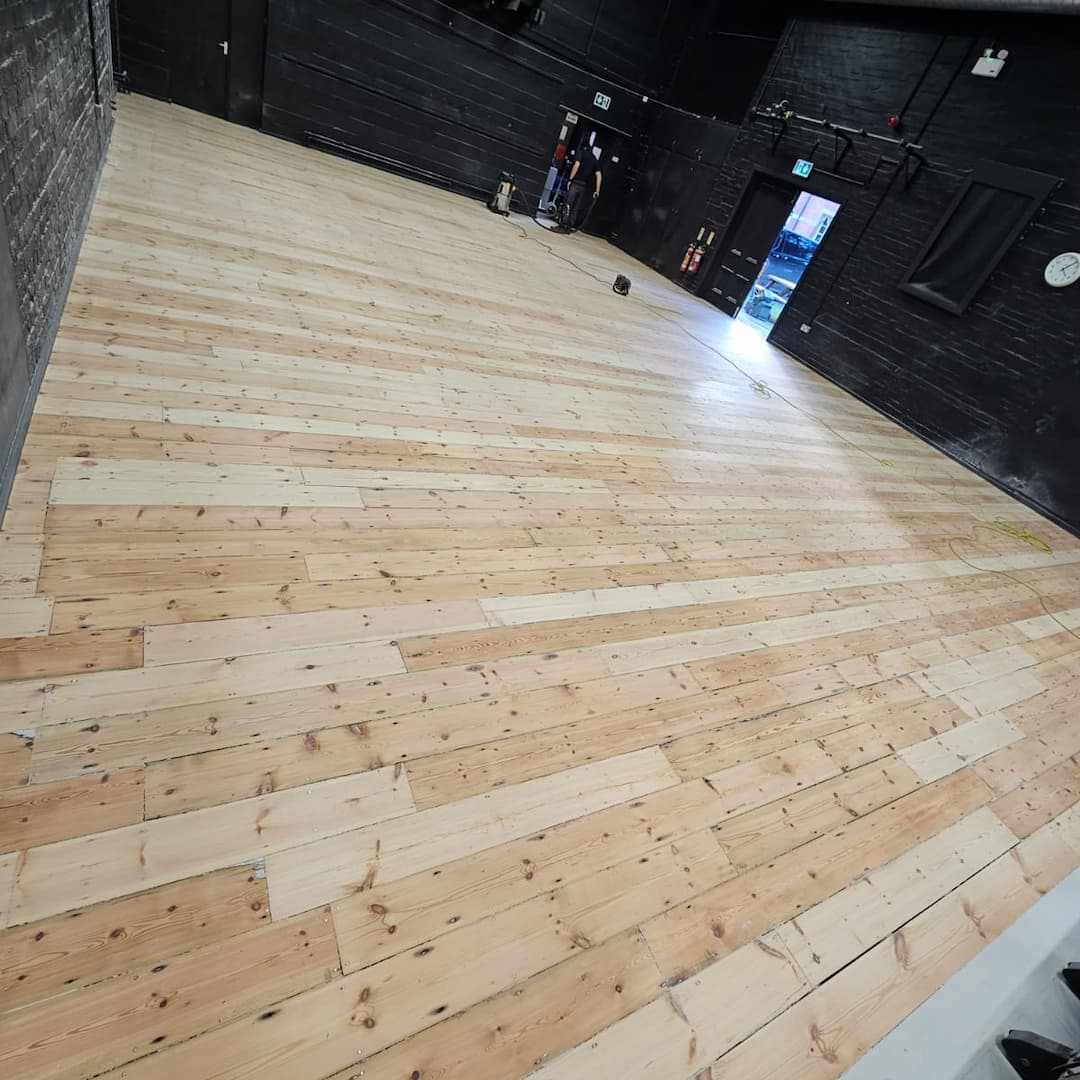
Performance floors carry a different responsibility from sports floors. Every landing sends force through ankles, knees and hips, and a properly engineered sprung construction absorbs a meaningful share of it before it reaches the performer.
The surface above matters just as much. Ballet and contemporary generally want a vinyl performance layer offering controlled slide; tap needs a harder, more responsive top; gymnastics needs consistent recovery across the whole area. We build and refurbish sprung studio floors tuned to the discipline rather than to a catalogue.
Distance changes logistics, not standards. Projects further from our base are planned as complete residencies: survey, repairs, sanding, sealing, marking and any testing completed inside one agreed window, with everything priced before we set off.
That approach means no partial jobs waiting on a return trip and no surprise costs appearing mid-programme. Neighbouring facilities booking together share the mobilisation, which brings the price down for all of them.
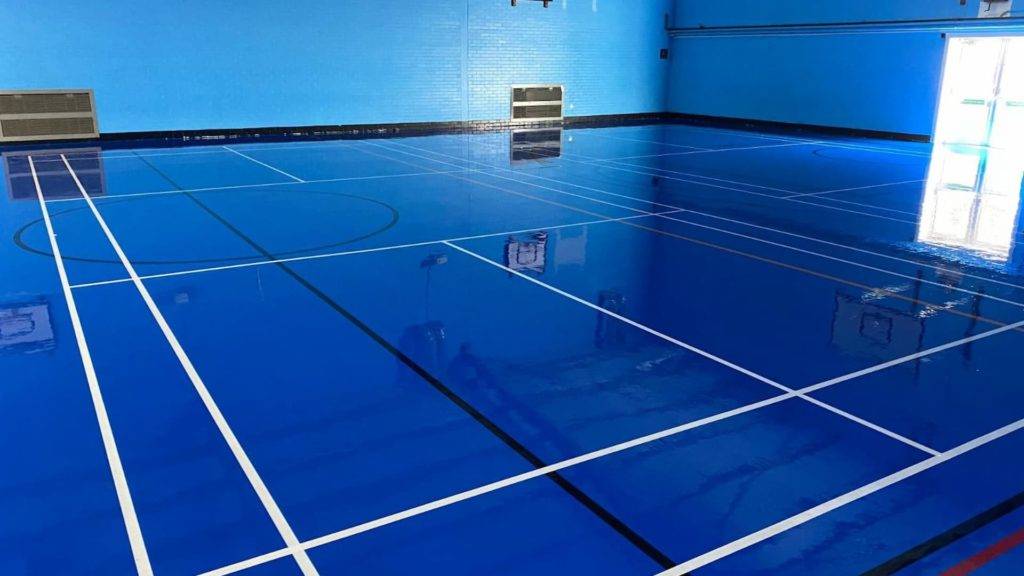
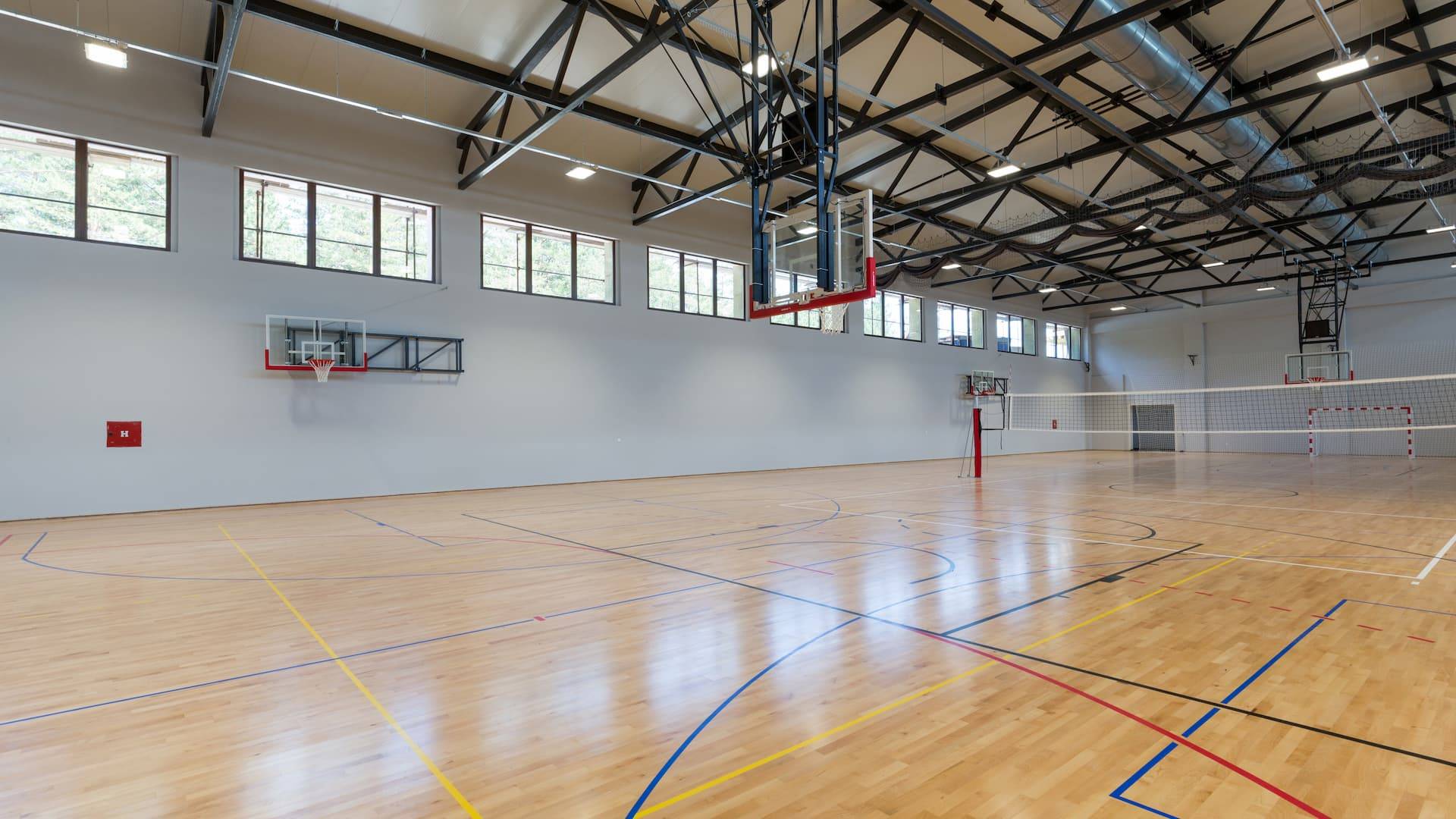
BS EN 14904 is the European standard for indoor sports surfaces, covering shock absorption, vertical deformation, ball behaviour, friction and durability. It is what a specifier, a governing body or an insurer will reference when asking whether a floor is fit for purpose.
We install and refurbish with the standard in mind and can arrange testing on completion, alongside pendulum slip testing to BS 7976-2, so you hold documented evidence rather than an assurance.
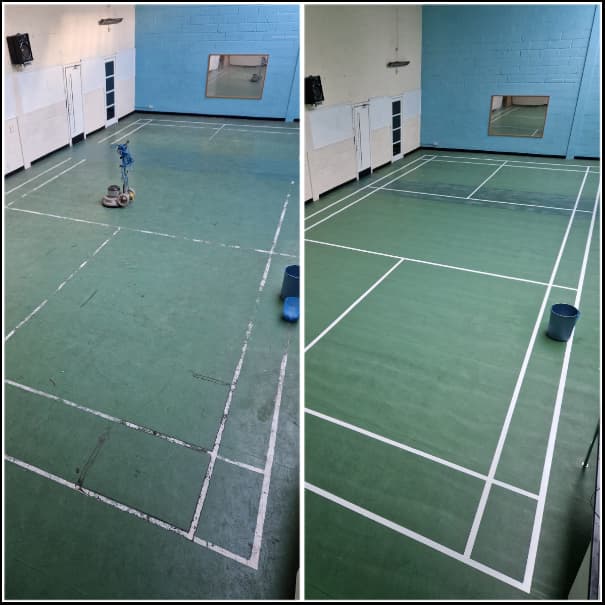
Not every floor we save sits in a sports centre. St Katherine’s had the kind of well-loved, well-worn hall floor that carries badminton one evening and a community event the next, and the committee wanted it rescued rather than replaced.
We restored it completely. The hall is now set for another few decades of everything it is asked to do.
~ Matthew Evans
An outstanding company to deal with and they couldn’t have been better to work with. St George’s Ascot now has a stunning new sports hall floor and we are delighted. From quote, support, delivery and after sales, the Team has been brilliant. Thank you. 
~ James Anderson







A council leisure service or a college group in Glasgow may be responsible for a dozen halls, studios and courts, laid at different times by different contractors and now all competing for the same maintenance budget. Treating each as a separate emergency is the most expensive way to run them.
We survey the estate as a whole and produce one document that ranks every floor by condition, remaining life and risk. Some need nothing this year. Some need a recoat before the wear lanes go through. One or two may need a full sand or a repair to the structure beneath, and those go to the top of the list.
From that ranking we build a phased programme over two or three financial years, with one specification and one point of contact, so the standard is the same in every building and the spend is spread where it does the most good.
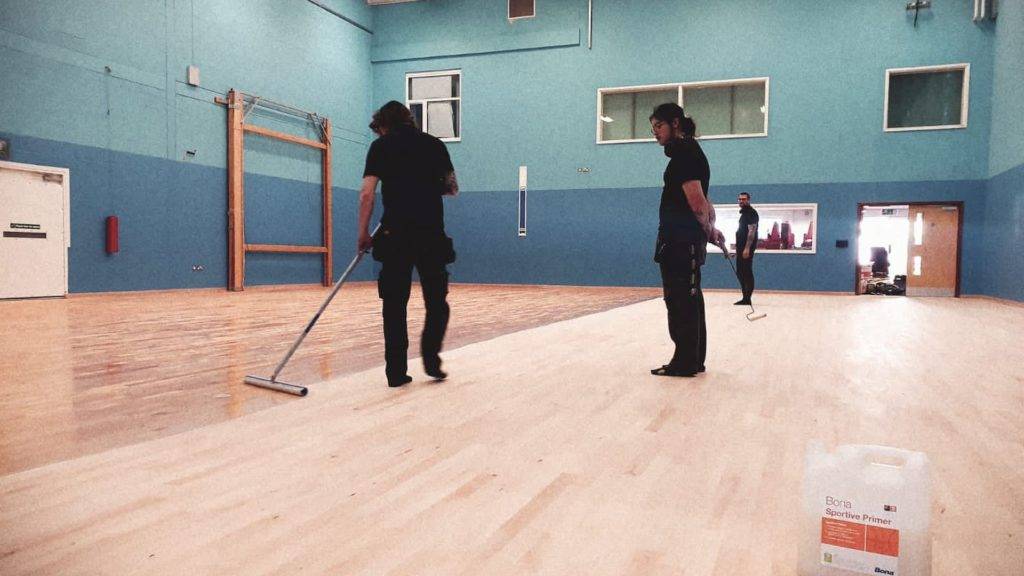
When a sprung floor develops a soft patch, a hollow sound or a board that clicks underfoot, the fault is almost never in the surface. It is a batten that has split, a rubber pad that has perished or a cradle that has dropped, and no amount of sanding will change how that spot feels.
We open the floor locally. A run of boards is lifted from the tongue side, the failed component is exposed and replaced with a matching part, packers are set so the level runs true with the surrounding floor, and the same boards go back down where they are sound. Where they are not, matched timber is cut in.
Done during a refinish, the repair vanishes under the new seal. Left until the next full sand, a single failed pad becomes a cluster, because the load moves to its neighbours and they follow.
Much of the public sector work we do in Scotland comes through formal procurement, whether a mini competition under a framework, a quick quote through a council portal or a full tender for a leisure estate. The paperwork is part of the job and we treat it that way.
We supply the documents a buyer expects to see: method statements and risk assessments written for the site, insurance certificates, health and safety accreditations, product data and environmental sheets, references from comparable public bodies and a clear priced schedule that matches the specification line by line.
Where a specification has been written by someone who has not seen the floor, we say so in the clarification period rather than pricing something that will not work. A tender won on a flawed specification helps nobody, least of all the facility that has to live with the result.
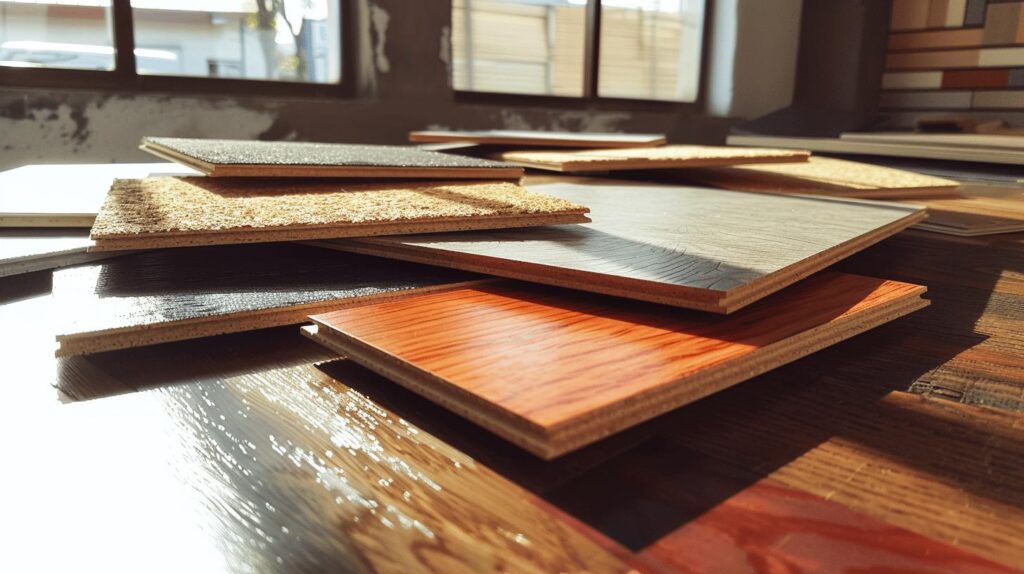

Glasgow weather is hard on sports floors for a simple reason: wet shoes carry grit, and grit under a trainer is sandpaper. The seal along the entrance line of a hall wears through years before the rest of the floor, and it is usually the first place a slip complaint comes from.
The defence is a proper run of barrier matting, at least two or three metres deep and preferably in two stages, a coarse scraper mat outside and an absorbent mat inside. It needs to be cleaned as often as the floor, because a saturated mat sheds water and dirt straight back onto the timber.
We look at the entrance arrangement at every survey and will tell you when the matting, not the floor, is the problem. It is the cheapest fix we ever recommend.
Glasgow gives us a broad mix, with university and college sport, a large council leisure estate and a substantial number of school sports halls.
University facilities are busy across the full year, with the summer filled by conferences and external hire rather than standing empty. The working windows are therefore narrow and fixed, and these projects are planned months ahead and staffed to finish inside them.
The leisure estate is the second strand and by volume a large one. Booking income makes long closures expensive, so most of that work happens overnight or across an agreed quiet period.
School and academy halls follow, many of them from the nineteen sixties and seventies with sprung timber floors that are structurally sound but overdue a refinish. Those are almost always better restored than replaced.
Granwood appears regularly in the older school and church halls here, and it is worth repeating that most Granwood described as beyond saving is not. It needs a specialist approach rather than timber sanding, and the difference in cost against replacement is substantial.
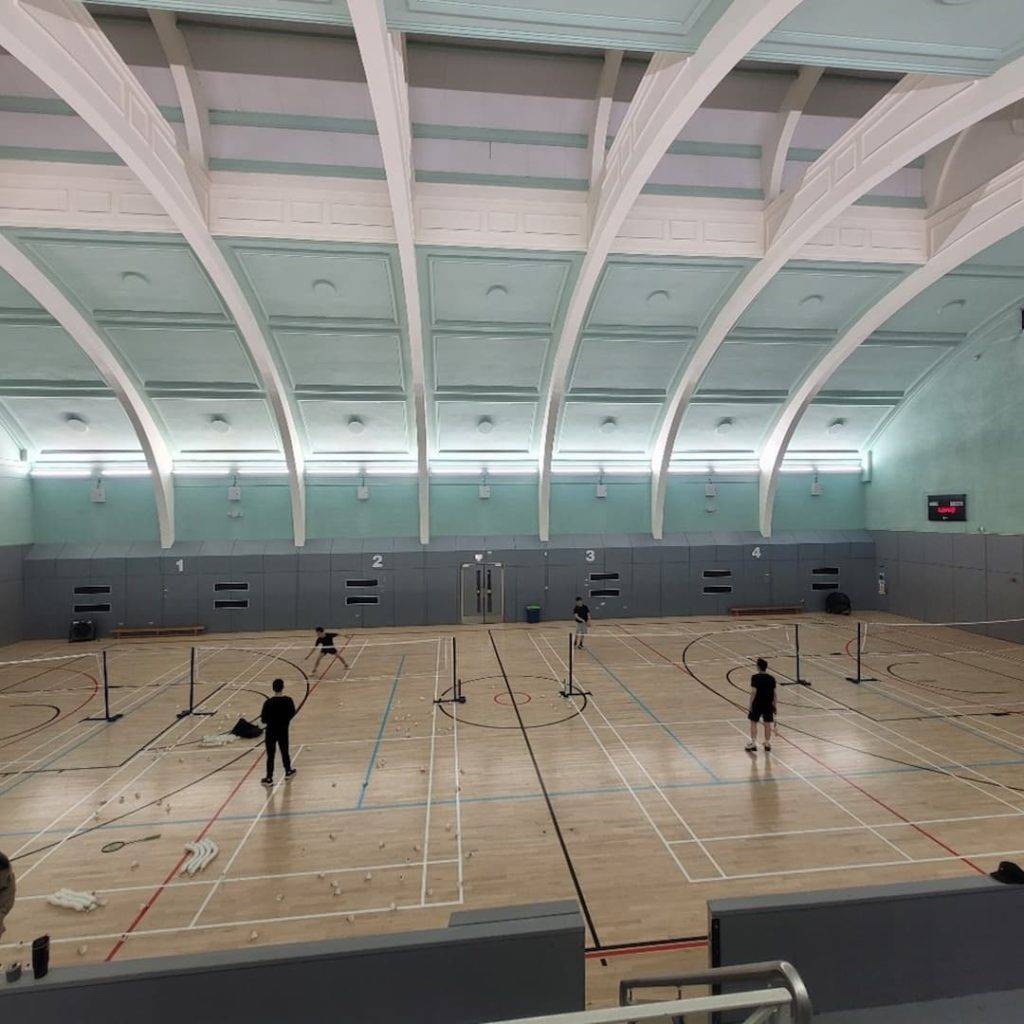
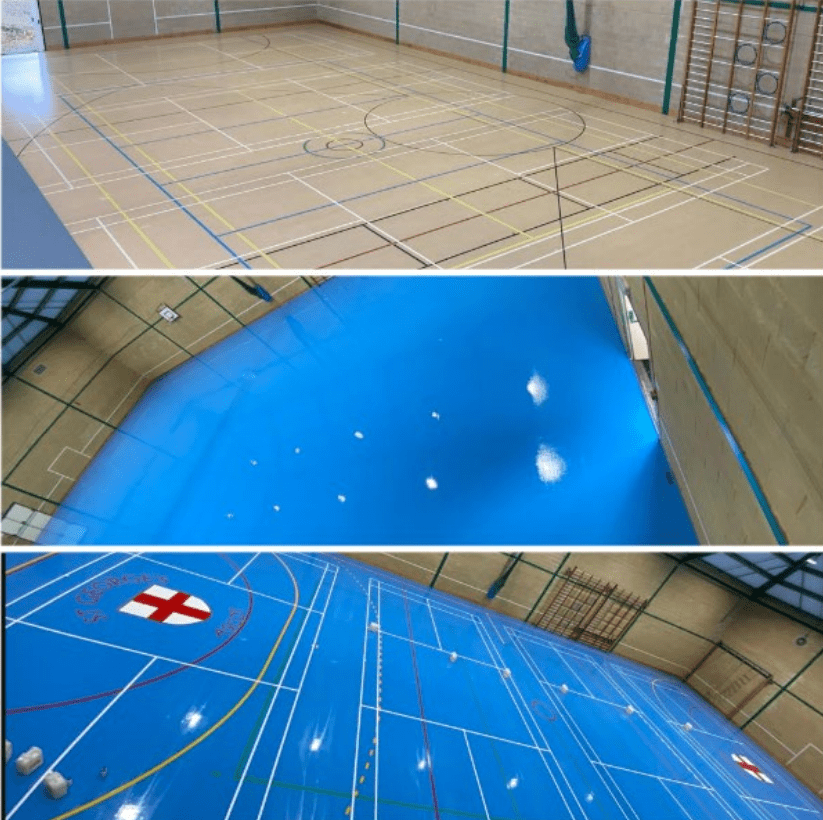
Glasgow enquiries often involve older halls, and the project most worth knowing about is St George School in Ascot.
That hall had a Granwood floor which more than one contractor had condemned as beyond saving. Granwood is a composite block of wood flour and cement laid in a bitumen bed, not timber, and sanded like timber it is permanently damaged. We assessed the blocks, rebedded the loose ones, replaced those that had broken up, prepared the surface with appropriate abrasives rather than aggressive sanding, and coated it with a modified epoxy system designed for composite substrates with the markings applied within the system.
The hall looks renewed and has years left in it, at a fraction of the cost of a replacement that would also have meant lifting a bitumen bed.
For university and leisure facilities the closer comparisons are Aston University and Medina Leisure Centre, both busy buildings with narrow fixed windows.
Not every sports hall in Glasgow has a timber floor, and the synthetic ones need looking after in their own way. Point elastic vinyl, linoleum and poured polyurethane surfaces are common in leisure centres, primary schools and multi use halls, and they fail in different ways from timber.
Vinyl and lino wear through their factory coating first, after which dirt sinks into the surface and cleaning stops working. Seams open, blisters form where the adhesive has let go and the markings fade under the scrubber dryer. Polyurethane surfaces harden and dull, and the colour lifts in the traffic lanes.
Most of that is recoverable. We deep clean, reweld seams, cut out and patch damaged areas, apply a fresh sacrificial coating in the existing or a new colour and remark the courts. A tired PU hall recoated this way looks new for a fraction of the price of replacement.
It depends on the size of the hall, the state of the finish and whether the boards or the structure beneath need repair. After a free survey we give a fixed, itemised price, with travel from our base already included, so the figure quoted is the figure invoiced.
Yes. We work throughout Scotland, from the central belt to the Highlands and the islands where the ferry allows. Each project is planned as one complete visit so everything from survey to final coat is agreed and priced before the team travels north.
Normally within two or three weeks, and faster where a floor has been closed on safety grounds. The visit takes under an hour for a typical hall, costs nothing, and you receive a written report and price shortly afterwards.
Surface marks, worn lacquer and light discolouration sand out completely. Deep water staining that has soaked into the open grain may remain faintly visible after refinishing, and where it matters we cut out the affected boards and let in new timber instead.
Yes, and most of our school work in Scotland does happen then. Scottish term dates differ from England, with the summer break starting in late June, so we plan those windows separately and book them early. Speak to us in the spring for a summer slot.
No. We only work on commercial and institutional floors, such as school halls, university sports centres, leisure facilities, clubs and community buildings. Domestic floors are handled by our sister company Ryan’s Restorations, who take those enquiries directly.
Yes, and we always do. Socket covers are lifted, the sockets cleaned out and protected from sealer, then reset flush with the new floor level. Sanding around a proud socket cover leaves a ring that catches feet and machinery, so we treat it as part of the job.
Yes, and we recommend it. Stages are usually more worn than the hall because of what gets dragged across them, and they often need a matt finish to reduce glare under stage lighting. Doing both in one visit costs far less than coming back.
We cover the west of Scotland from the same trips, including Ayrshire, Lanarkshire, Stirling and the Highlands. See all areas we cover.
Book a free survey of your floor in Glasgow and we will explain what it needs, what it will cost and how the work can be programmed in a single visit. Call 01823 674562 or send us a message.