
Flooring Professionals To The Leisure Industry
Courtship Flooring is a commercial sports flooring contractor working in Manchester and across the UK. Much of our work here involves maple performance courts and the racquets facilities that sit alongside them, both of which reward restraint rather than aggressive treatment.
Founded in 1987 and still run by the same family, we specialise in commercial sports and timber flooring: new installations, full refurbishments, sanding and resealing, court markings, pendulum testing and maintenance contracts. Domestic enquiries are passed to Ryan’s Restorations.
Our sports hall floor refurbishment work in Manchester covers timber, Granwood, vinyl and PU, each with the method that suits the surface.
Overnight/Weekend Installations
Professional Cleaning Demonstrations
Squash Court Maintenance
Recommended Cleaning Products
Professional Pendulum Slip Testing
Deep Clean & Reseal Service
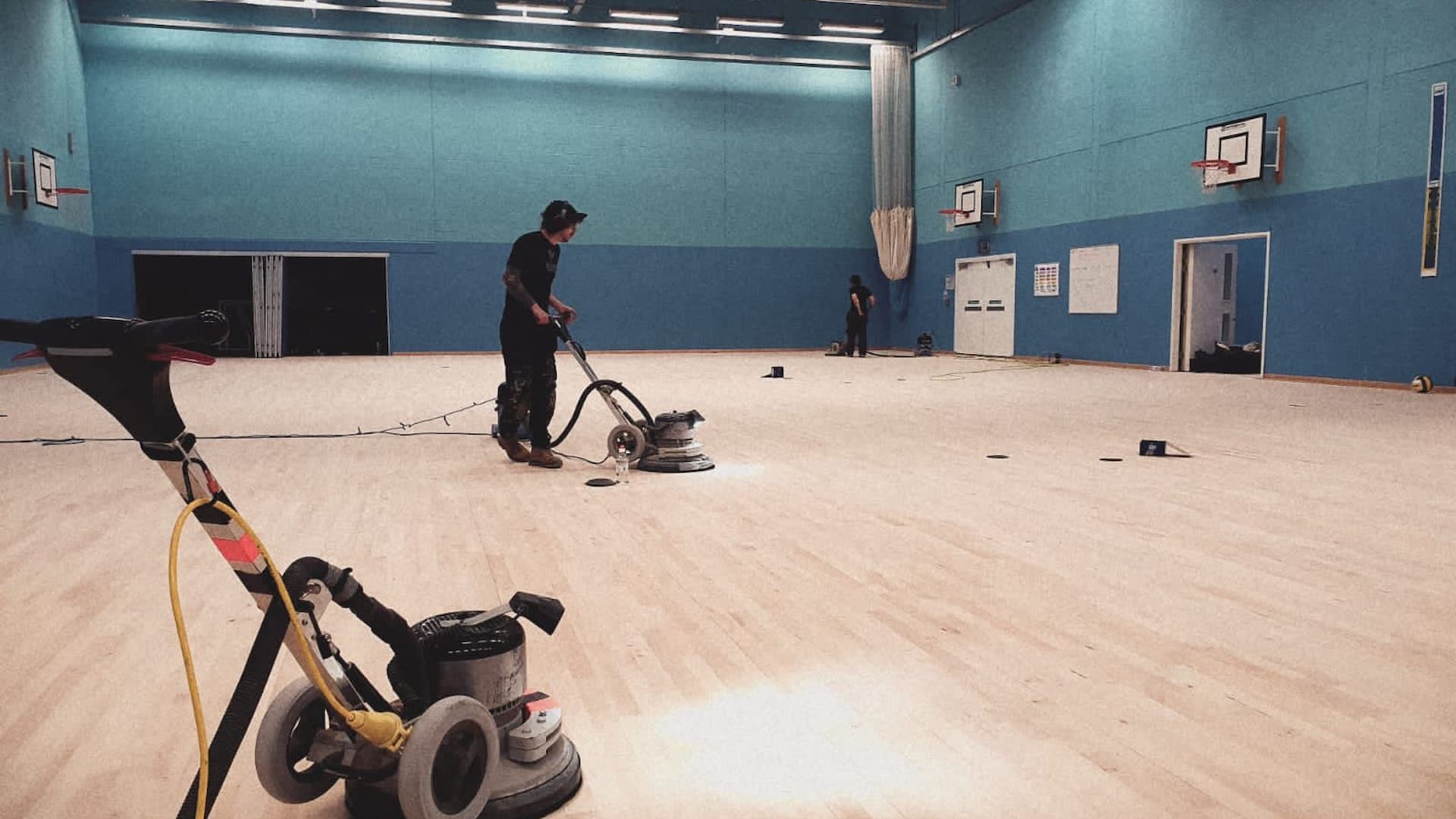
Hard maple is dense, pale and beautifully consistent, which is why it remains the benchmark for basketball. It is also finite: every full sand removes timber that never comes back, and a court machined every few years will run out of floor decades early.
We measure the depth remaining above the tongue before recommending anything. In practice a well-maintained maple court wants a screen and recoat every two to three years and a full sand roughly every eight to twelve. Contractors who only sand will tell you otherwise.
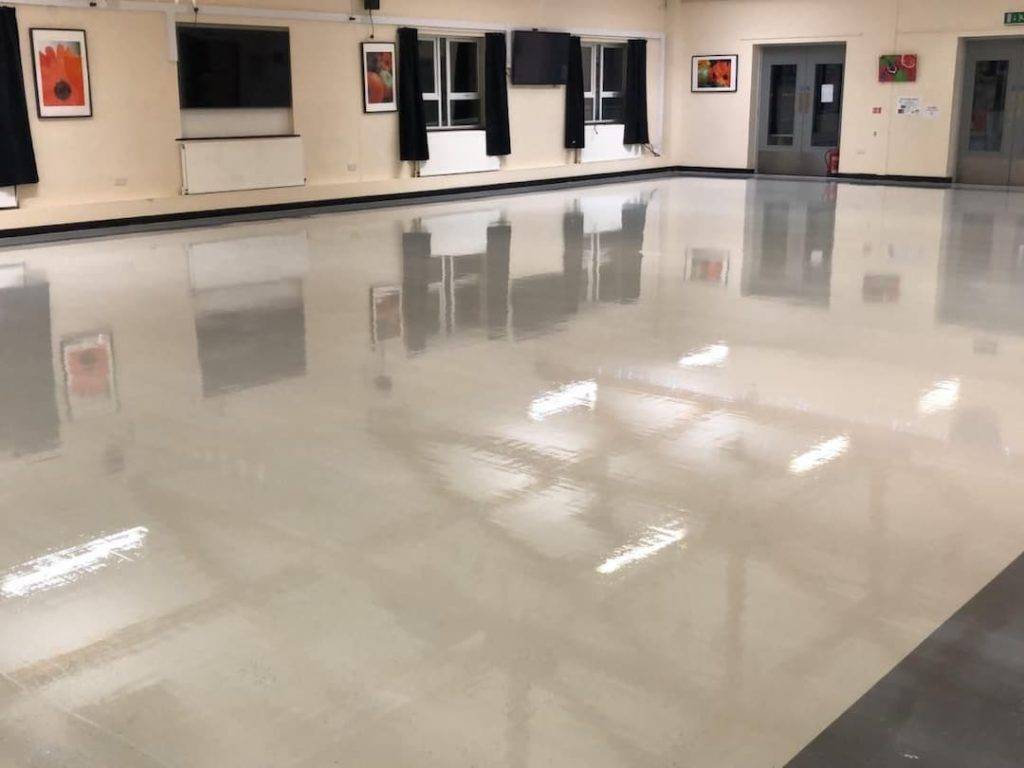
The most common complaint we hear is that a floor has become slippery, and the most common cause is not a worn seal but the residue left behind by cleaning. Over-strength product, the wrong pH or hard water leaves a film that reduces friction, and facilities respond by cleaning harder, which makes it worse.
A professional deep clean lifts that residue and normally restores grip without touching the seal. A pendulum slip test before and after tells you objectively whether the problem was the floor or the routine.
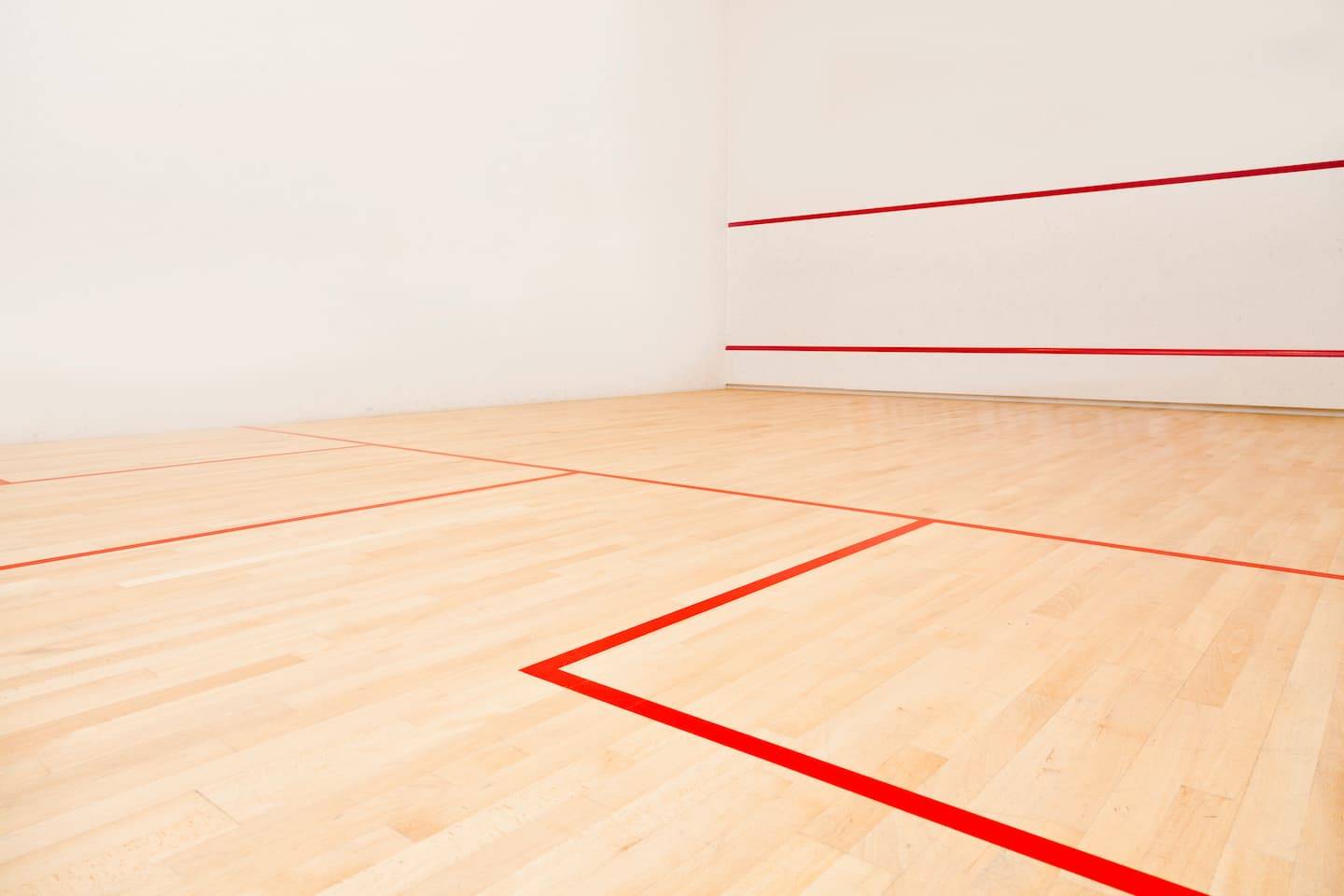
Squash courts follow different rules entirely. The floor is traditionally left unsealed so the bare timber provides grip, which makes dust control and board condition far more critical and rules out the lacquer systems used in a sports hall.
We sand, repair and maintain squash court floors to the standard competitive play demands, and where a club has several courts we phase the work so play continues throughout. Doing courts alongside the main hall in one visit costs considerably less than two mobilisations.
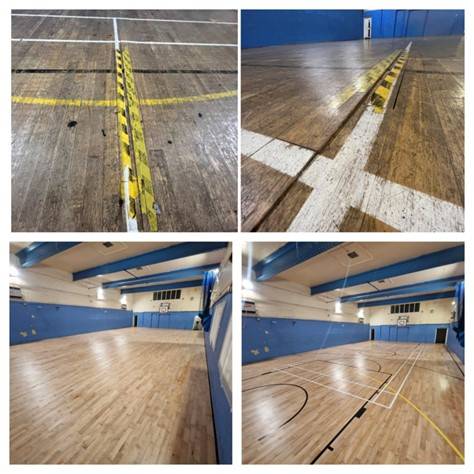
The gymnasium at The Bradfield Club had served generations and its floor wore every year of it. We sanded the original timber back to life, made the repairs it needed, then resealed and re-marked the space.
Community facilities work to tight budgets and cannot lose their halls for long, so the programme was planned accordingly and finished on the date agreed.
~ Matthew Evans
An outstanding company to deal with and they couldn’t have been better to work with. St George’s Ascot now has a stunning new sports hall floor and we are delighted. From quote, support, delivery and after sales, the Team has been brilliant. Thank you. 
~ James Anderson







A price built from a floor plan is a guess. Before we quote for a Manchester hall we walk the floor and take readings, because the numbers decide the specification and the specification decides the cost.
We measure the depth of timber remaining above the tongue at several points, since a maple court that has been sanded many times may not have enough left for another full sand. We take moisture readings in the boards and, where possible, in the subfloor beneath. We check the perimeter for an expansion gap, lift a socket cover to see the build up, and look for the dead spots and lifted boards that point to trouble underneath.
We also record the room: door widths, the route from the car park, the power supply for our machines, the heating and the timetable around the closure. Each of those changes how many days the job takes, and the days are what you pay for.
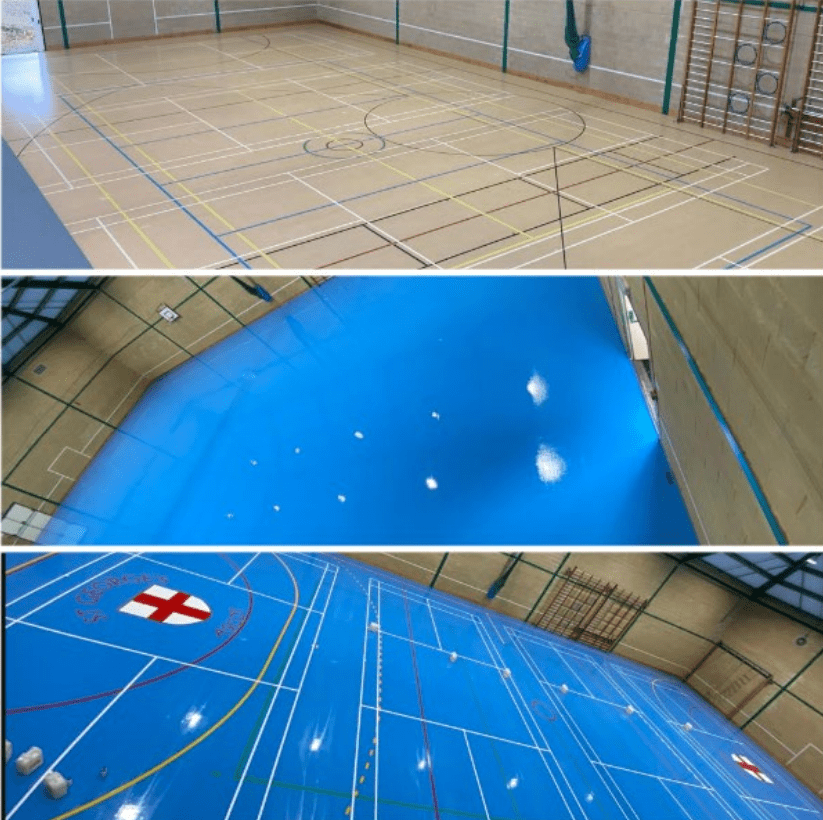
Timber and water do not get on, and most of the floors we are asked to rescue in the north west have a moisture story behind them. A leaking roof, a failed gutter, a burst pipe in a plant room next door or simply a concrete slab that was never given a damp proof membrane.
The symptoms are cupped boards, a dark tide mark, a floor that has lifted along one wall or a persistent musty smell under the stage. Sanding those boards flat hides the evidence for a year and then the cupping returns, because the water is still arriving.
We find the source before touching the surface. Readings are taken in the boards and in the slab, and where the slab is wet we specify a liquid damp proof membrane or a ventilated build up before the new floor goes down. Replacement boards only go in once the readings have settled.
The greenest sports floor is the one that is already down. A solid maple or beech floor laid in the 1960s has decades of use left in it, and refinishing keeps that timber in service instead of sending it to a skip and importing new boards to replace it.
A full sand removes about a millimetre of surface. On a 22 millimetre solid strip board with the tongue sitting roughly a third of the way down, that leaves room for several more sands over the life of the floor. Add a screen and recoat between them and the interval between full sands stretches out further still.
Many of the schools and universities we work with in Manchester now report on carbon and waste. A refurbishment specification with the volumes of timber retained, waste diverted and product data sheets attached helps with that reporting, and we provide it with the handover pack.

A fitness suite is a different job from a sports hall, and the wrong floor in one shows quickly. Fixed cardio kit, racks and dropped dumbbells all load a floor in ways a badminton court never sees, and a timber finish in a free weight zone is chewed up within months.
We separate the room by use. Cardio and stretching areas take a point elastic vinyl or PU surface that is comfortable underfoot and easy to clean. Free weight and rack zones take a dense rubber tile or roll, thick enough to protect the slab and absorb the impact of a loaded bar, laid over a level, dry base.
Where a leisure operator in Manchester is converting an old squash court or studio into a gym, we check the existing floor and the subfloor first. A sprung floor under a rack is a problem, and it is cheaper to solve at survey than after the equipment arrives.
Manchester gives us a substantial mix of university sport, academy trust estates and city leisure facilities, across building stock that spans well over a century.
University and college facilities are among the most demanding to programme. They run year round, with summer conference and external hire filling the period a school would be closed, so the working windows are narrow, fixed and planned well in advance.
Academy and school halls are the largest group by number. Many are from the nineteen sixties and seventies with sprung timber floors that are structurally sound but have gone too long between refinishes. Those are usually strong restoration candidates, and a survey often finds considerably more life left than the school expects.
Leisure centres follow, where the priority is always keeping the doors open and most of the work happens overnight.
We have completed work at Harris Academy in Wakefield and elsewhere in the north, and the pattern is consistent: survey properly so nothing unexpected appears once the finish comes off, plan to the holiday window, and hand the hall back on the agreed date.
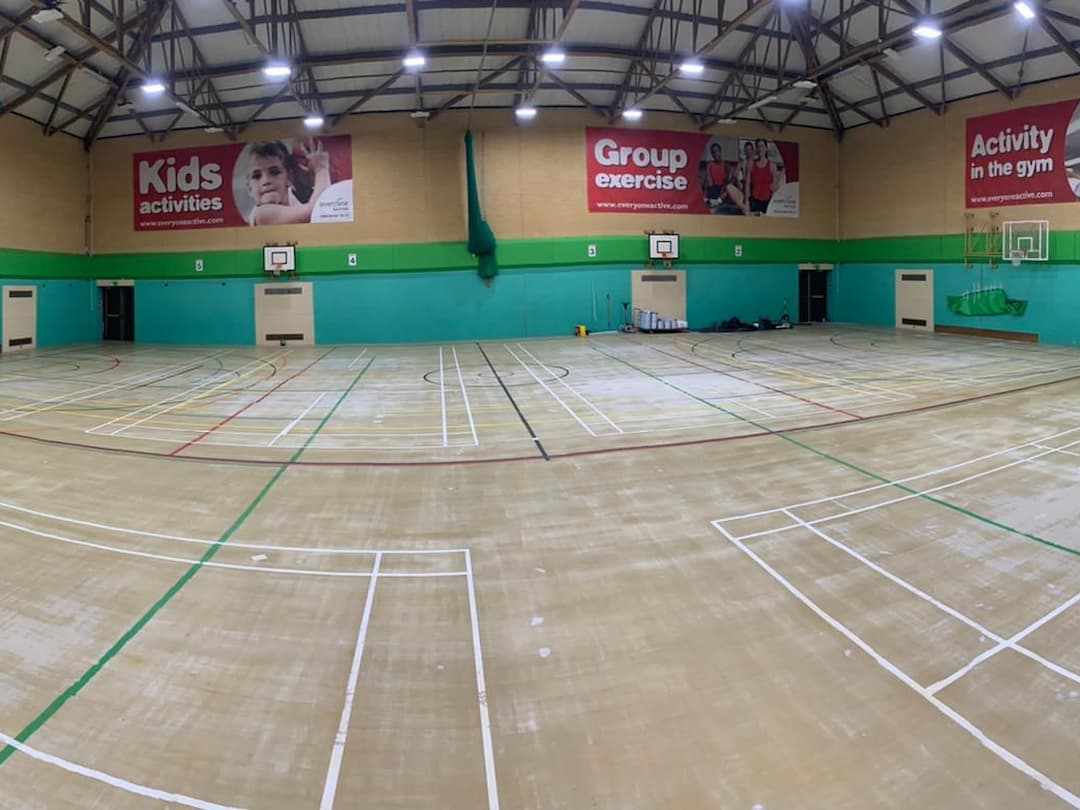
The enquiries we take from Manchester cover a wide range, but three recur.
The first is a post war sprung floor that has lost its response in patches. Dead spots mean a failed pad, cracked batten or tired cradle beneath the boards, and no amount of surface work will change how that area feels. The repair is local: lift the boards, replace the components, relay.
The second is floors that have been coated repeatedly rather than refinished. Layer on layer eventually clouds, peels and lifts, and the answer is to take it back properly rather than add another coat over the top.
The third is markings that have accumulated. Halls carrying six sports, several no longer played, in colours that merge under modern lighting are common. Rationalising down to what is actually used is the cheapest improvement available and it makes the hall look considerably larger.
Condition drives the price more than size. A hall that only needs a screen and recoat sits at the low end; one that needs board repairs, a full sand and a complete set of new markings costs more, though still far less than a new floor. You get a fixed, itemised figure after the free survey.
Yes. We work nationally from one base, so travel and accommodation are built into the programme and the quote from the start. Nothing is added later, and the same team that surveys the floor is the team that arrives to do the work.
A two pack polyurethane seal in a satin sheen. It is hard wearing, holds its slip resistance under trainers and cleaning, and the satin finish avoids the glare that gloss produces under LED lighting. Matt options exist where a specification or a governing body calls for them.
Yes. Repairs are cut in with boards of the same species, grade and thickness, machined to the same profile, so after sanding and sealing the new timber sits within the floor as a slight variation in tone rather than a patch. Over a year it darkens to match.
Yes. We paint the crest from your own artwork between coats of seal, sized to the centre circle or the zone you choose, so it wears at the same rate as the surrounding finish. It costs least when the floor is already open for a refinish.
No. We are a commercial contractor and our work is limited to sports halls, studios, courts and institutional timber floors. If you have a domestic floor, our sister company Ryan’s Restorations covers that work and can be contacted directly.
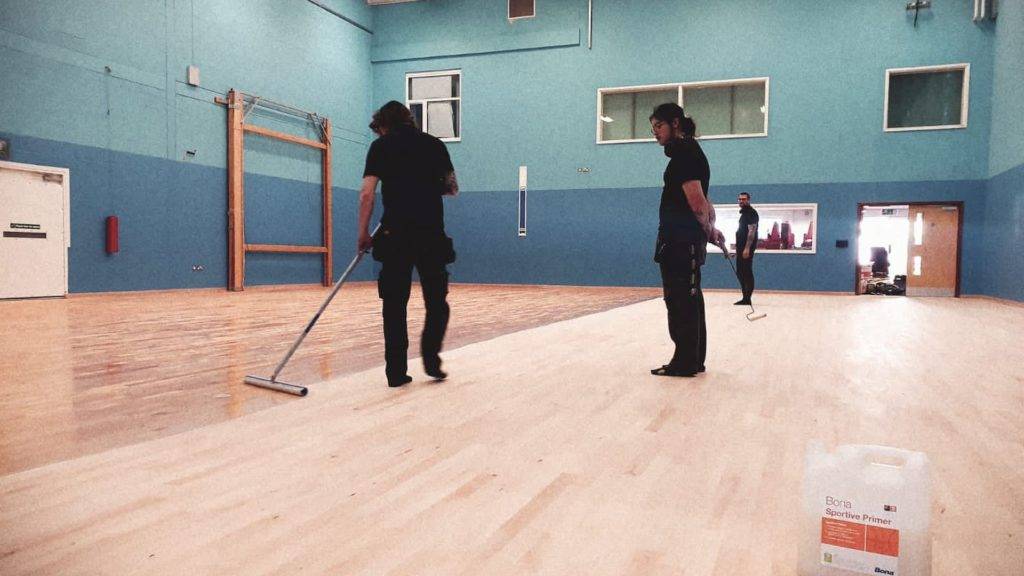
Yes. Many of our leisure centre programmes run overnight, with each coat applied at the end of the shift so the floor is walkable by opening time and heavy equipment kept off until the finish has hardened. Key holding and alarm arrangements are agreed in writing beforehand.
A good run of barrier matting, ideally two or three metres deep, so grit from the car park is shed before it reaches the timber. Grit under trainers is an abrasive, and a hall without matting wears through its seal along the entrance line long before the rest.
We cover the north of England widely, including Sheffield, Leeds, Liverpool, Lancashire and Newcastle. See all areas we cover.
Book a free survey of your floor in Manchester and we will explain what it needs, what the work will cost and how soon we can fit it into your programme. Call 01823 674562 or send us a message.