
Flooring Professionals To The Leisure Industry
Courtship Flooring is a commercial sports flooring contractor working in North Wales and across the UK. A largely rural region where complete single-visit programmes and honest advice matter most.
A family business established in 1987, working exclusively on commercial indoor sports and timber floors. We survey, install, restore, mark, test and maintain, keeping every stage in our own hands so one warranty covers the whole system. Domestic work is handled separately by Ryan’s Restorations.
For halls in North Wales that are worn but structurally sound, our sports hall floor refurbishment service restores grip, appearance and line markings, usually within a school holiday.
Overnight/Weekend Installations
Professional Cleaning Demonstrations
Squash Court Maintenance
Recommended Cleaning Products
Professional Pendulum Slip Testing
Deep Clean & Reseal Service
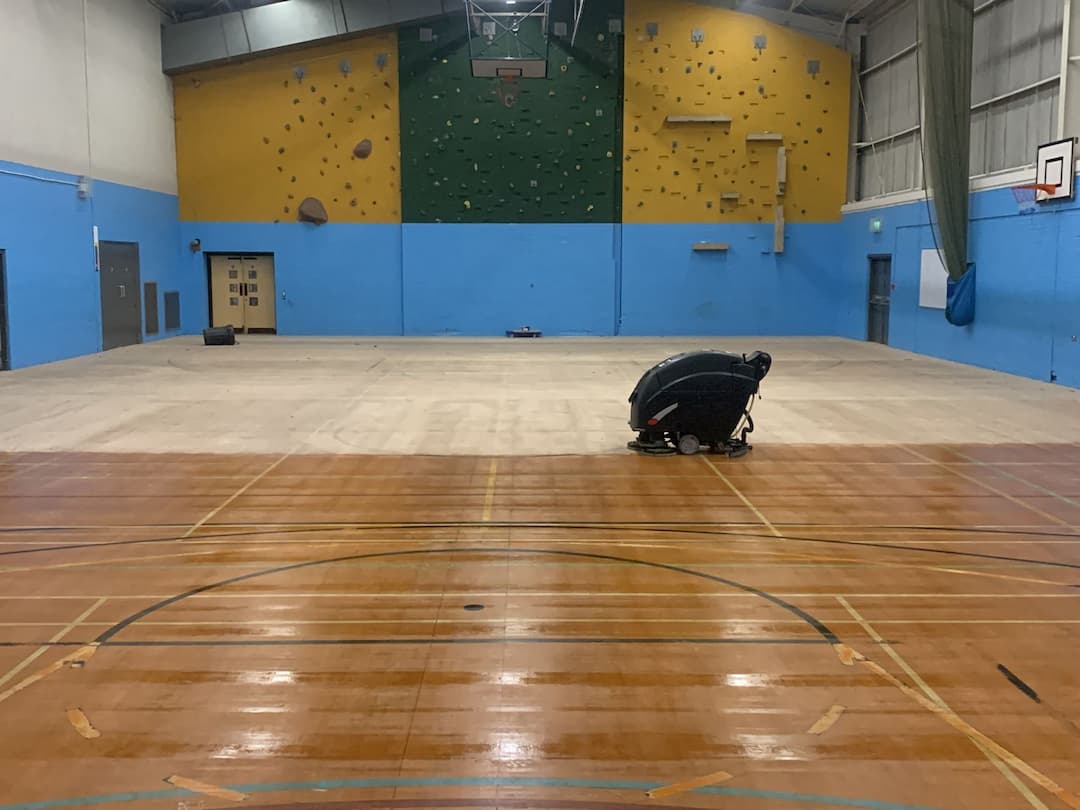
Facilities spread across a wide rural area suffer most from contractors who work in stages, because every return trip carries its own mobilisation cost.
We plan work here as a single complete programme: survey, repairs, sanding, sealing, marking and testing, with all machinery and materials arriving at the outset and the full cost fixed before we travel.
Where wet weather is routine and users arrive in outdoor footwear, the first few metres inside the door take more punishment than the rest of the hall combined. It is also where slip incidents actually happen.
Effective matting, properly sized barrier zones and a cleaning routine that removes grit rather than redistributing it will comfortably extend the life of a finish. We advise on all three and concentrate slip testing where the real risk sits.
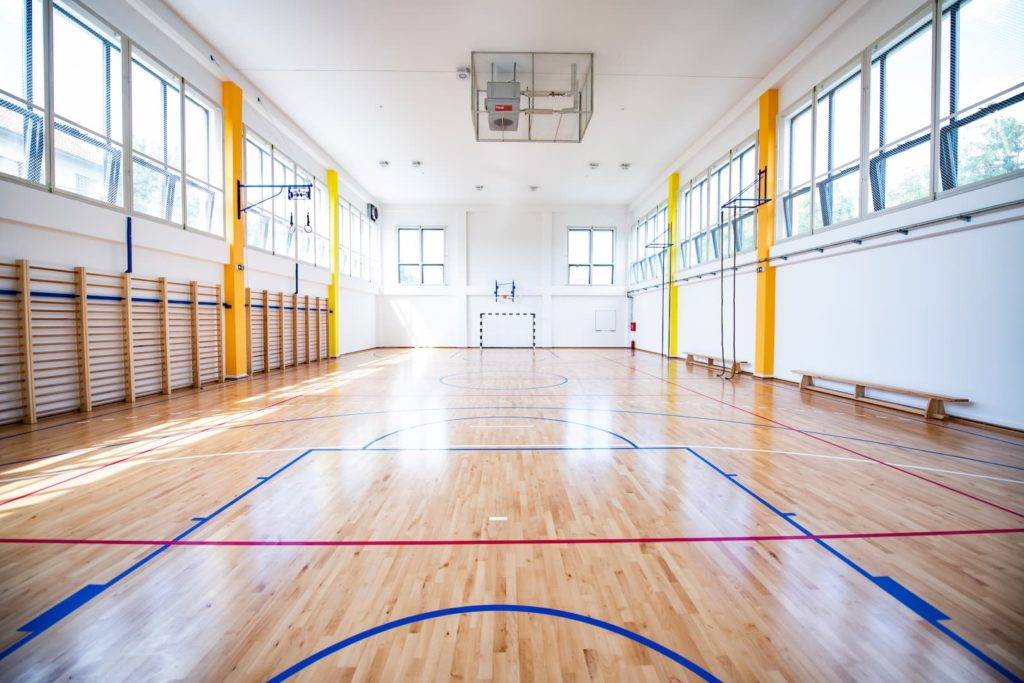

Rural facilities frequently operate on tight funding and are sometimes sold work they do not need. We would rather give the inexpensive answer and be trusted with the larger job later.
Where a deep clean or a recoat will do, that is what we will quote. The survey report sets out every realistic option with firm costs so a committee can decide on evidence rather than pressure.
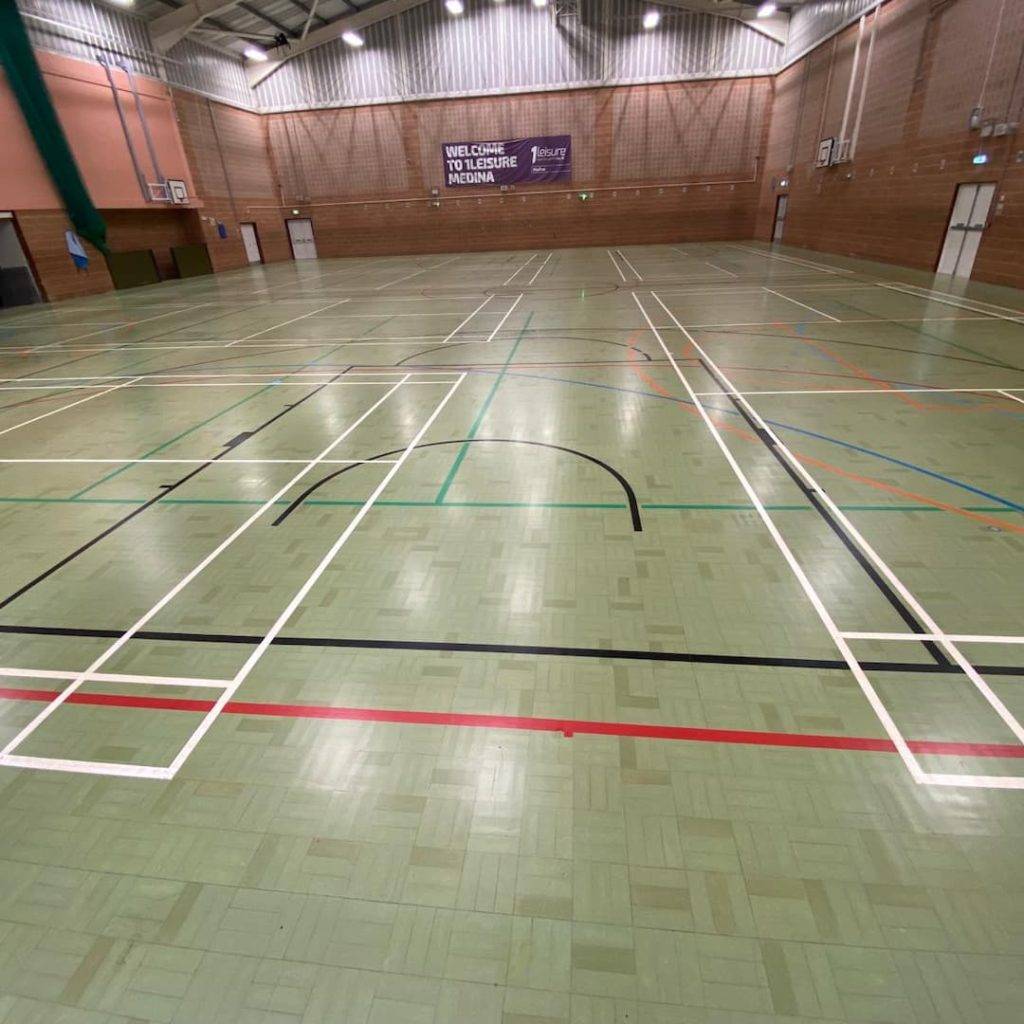
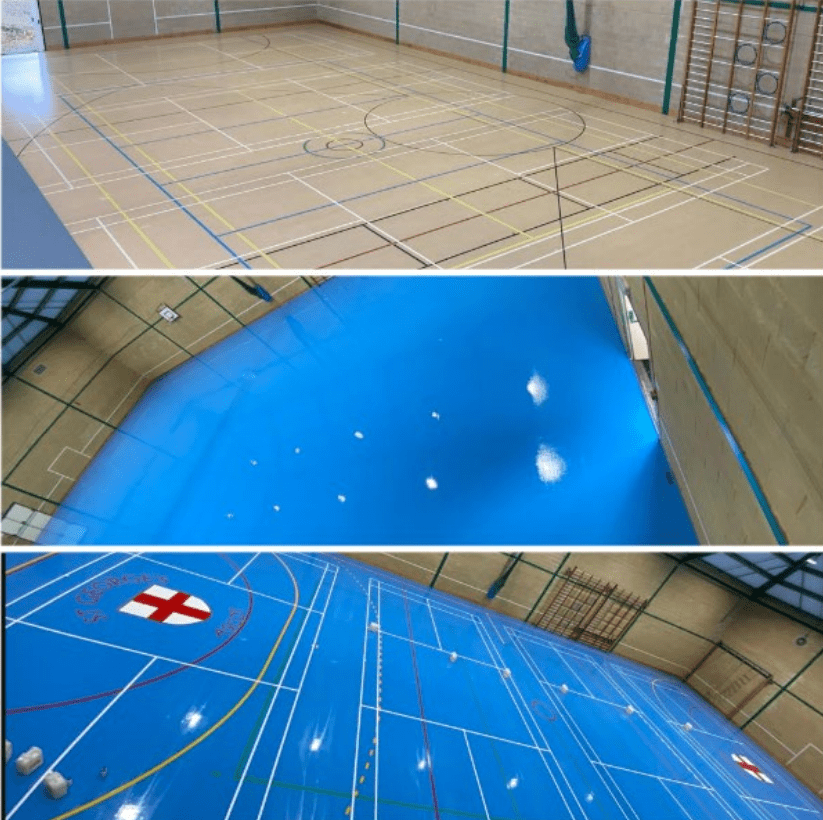
At Medina Leisure Centre we refurbished the main sports hall floor completely: sanding, repairs, resealing and a full set of new markings, with the logistics planned down to the last detail so the centre lost as little bookable time as possible.
The after photographs show a hall transformed, and the programme finished on the date agreed at the outset.
~ Matthew Evans
An outstanding company to deal with and they couldn’t have been better to work with. St George’s Ascot now has a stunning new sports hall floor and we are delighted. From quote, support, delivery and after sales, the Team has been brilliant. Thank you. 
~ James Anderson







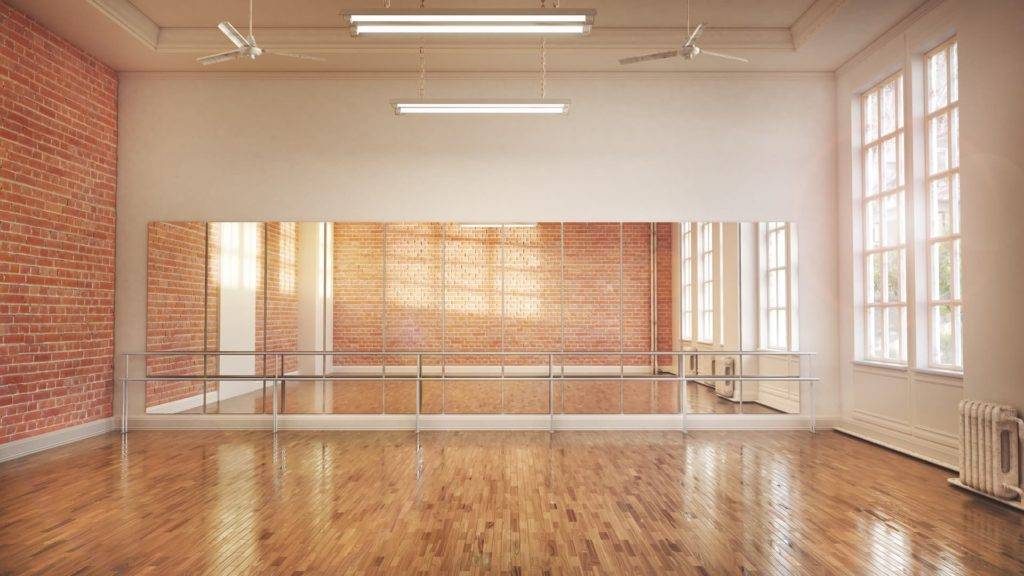
A dance studio asks different things of a floor from a sports hall. Dancers need a surface with controlled give under the foot, a consistent grip that neither sticks nor slides, and no dead spots where a landing jars. Drama spaces add scenery, staging and bare feet to the list.
The usual answer is a sprung timber base with either a sealed hardwood surface or a dance vinyl bonded over it. The sprung layer absorbs impact and the surface determines the feel. We match the surface to the styles taught, because ballet, contemporary and tap have different needs.
In North Wales many studios sit in school and college buildings and double as rehearsal rooms, so we specify for both uses and set out a cleaning routine that keeps the grip consistent through the year.

A hall in a small North Wales town carries badminton, netball, basketball, five a side and often volleyball on the same surface, and the markings only work if there is a clear order of importance. We agree which sport leads, mark it in the boldest colour and the full line width, then work the other courts in behind with lighter or narrower lines.
Colour is chosen on the floor under the hall lights, because LED lighting renders shades differently from a paint chart and two colours that look distinct in the office can blur on the boards.
Courts that nobody uses are taken off while the floor is open, and the layout is drawn and agreed with you before a single line goes down. Every court is set out from measured governing body dimensions.
A great many school and village halls across North Wales built in the decades after the war have Granwood floors, and they are often mistaken for timber. The blocks are a compressed mix of wood flour and cement, laid in a bitumen bed in a patterned bond, and they are extraordinarily hard wearing.
What they cannot take is a conventional sanding machine. The refurbishment route is a mechanical clean back to sound material, re bedding any loose blocks and applying a specialist epoxy or polyurethane coating system built for the composite, with markings laid within it.
Before any block is lifted we consider the age of the bitumen, because older beds can contain asbestos and need testing first. Handled that way, a Granwood floor that looks beyond saving comes back with fresh colour and grip for a fraction of the cost of replacement.
Underfloor heating and timber sports floors can live together, but only when the two are designed as one. Heat dries the boards from below and drives moisture out, so the timber has to be conditioned to the room and the system commissioned and running before the floor goes down.
We take slab readings, check the surface temperature limit set by the timber and seal manufacturers and specify a system that keeps the heat spread evenly. A sprung floor with an air gap needs particular care, because the air layer insulates and the heating must be balanced to suit.
Once in use, the rules are simple: warm the room gradually at the start of the season, never run the slab above the agreed limit and keep humidity within a sensible range. Follow those and the floor stays flat and the seal stays sound.
North Wales work reaches us from school sports halls, community leisure centres, university and college sport, and a large number of village and church halls.
The region covers a lot of ground and journeys take longer than the map suggests, so we programme this work as continuous blocks and bring everything we need with us rather than expecting to collect materials locally. In practice that makes these projects more thoroughly planned than a job an hour from base.
School halls are the largest group. In many communities the school hall serves as the principal indoor sports facility for the surrounding area, which means a great deal more traffic than curriculum use alone would produce.
Leisure centres follow, where keeping the building trading usually means overnight working.
Village and church halls make up the rest, and those old timber floors are almost always in far better condition than they look. Restoration transforms them for a modest sum, and much of that work reaches us by recommendation from one hall committee to the next.

North Wales enquiries usually resemble one of two projects.
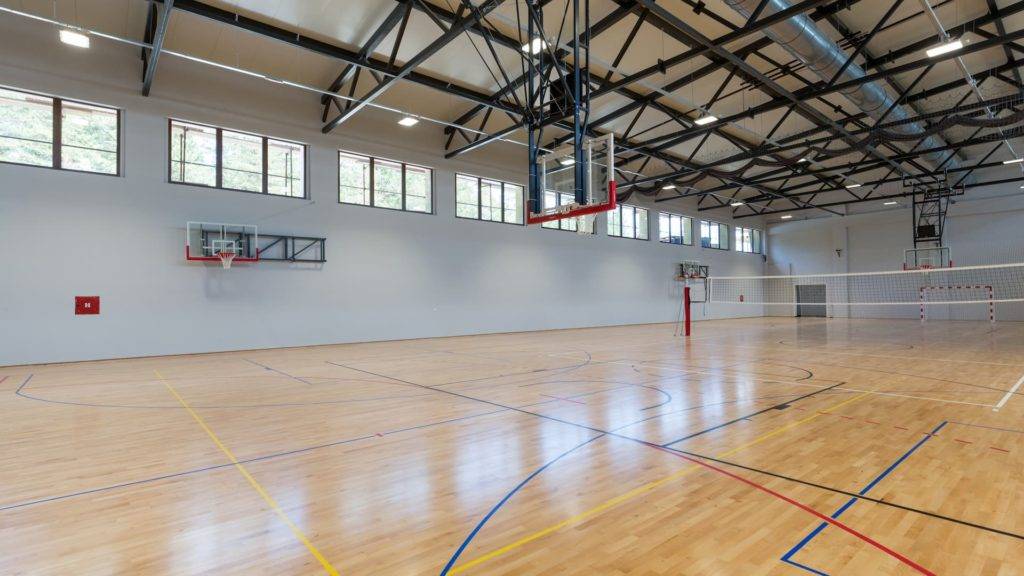
For school halls that double as the community sports facility, De Wint School is the closest comparison. Curriculum sport, club training and evening lettings all on one floor, a finish worn through where the traffic runs, and a fixed term date. The floor went back to bare timber, damaged boards were replaced, and the markings were set out fresh from measured dimensions with redundant sports removed while the floor was open.
For village and church halls, St Katherine Hall is the better parallel. An old timber floor under decades of polish, scored by chairs and tables, with plenty of board depth left underneath. The polish came off chemically before sanding, and the hall is now set for another few decades of everything it is asked to do.
Both illustrate that remote projects are planned more thoroughly rather than less, because everything is resolved before we set off.
A squash court floor is a specialist piece of timber work. The boards are narrow strip hardwood, usually beech or maple, laid over a resilient batten system that gives the court its feel, and the surface is left unsealed in the traditional way or finished with a specific matt seal where the governing body allows.
The common faults are worn and greyed boards in the T and along the service boxes, loose or squeaking boards from failed fixings, and a surface that has become polished and slippery through years of dust and hand sweat. All of those are recoverable with the right sanding sequence and a careful approach to the finish.
Clubs and leisure centres across North Wales usually run two or more courts, so we work court by court and keep the others in play while each is refinished.
Yes, and it is the most cost effective way to work in North Wales. One team moves between sites with the same machinery, the mobilisation cost is shared and every hall gets a fixed date. Academy trusts and councils use it to cover an estate in a single holiday.
Regularly. We are used to framework paperwork, purchase orders, itemised quotations and the approvals a trust or council needs before committing. Where an estates manager wants a single report covering several halls with priorities and budget figures, we produce it after surveying each floor.
Yes. Structural repairs and any moisture work can be done in one year with sanding, sealing and marking in the next, or the halls in an estate can be split across years. Each phase is quoted on its own so the figures land in the right budget.
Dust mop or vacuum daily, damp mop with a neutral cleaner as needed and keep water to a minimum. Never apply polish, wax or a shine product, because they build up, cause slips and have to be stripped before the next recoat. We leave written guidance with the handover.
Yes. A typical agreement is an annual inspection with a written report, a screen and recoat every two to three years and slip testing where the operator wants the certificate. It keeps a floor off the replacement list and spreads the cost into predictable annual sums.
Every project comes with a site specific RAMS, COSHH sheets for the coatings and copies of our public and employer liability insurance. Our team hold DBS certificates for school work. The pack is issued with the order so it is on file before we arrive.
A dead spot means the structure under the boards has failed at that point, usually a crushed pad, a broken batten or a cradle that has parted from the slab. The surface is not the problem. The boards are lifted locally, the part is replaced and the area is refitted and sealed.
Speak to us in the winter term. Summer slots across North Wales fill by spring because every school wants the same six weeks, and the earlier we survey the better the programme fits around your other holiday works. Half term slots are easier but shorter.
Across Wales and the Irish Sea we also cover Cardiff, Swansea, Wrexham, Belfast and Northern Ireland. See all areas we cover.
Book a free survey anywhere in North Wales and we will tell you exactly what your floor needs, what it will cost and how the work fits your calendar. Call 01823 674562 or send us a message.