
Crisp, accurate line marking is what turns a floor into a court. Courtship Flooring provides sports hall line marking across the UK, from a single badminton court refreshed overnight to a full multi-sport layout designed from scratch, as part of a refurbishment, a new installation or a standalone visit.
Every court is marked to its governing body specification, each sport in its own colour so the busiest halls stay legible, and the lines are sealed to last. School crests and club logos can go in at the same time. Family-run since 1987, with our own team on every job.
Sport-specific layouts, from futsal penalty areas and volleyball attack lines to cricket creases, are covered on our futsal court flooring, indoor volleyball court flooring and indoor cricket flooring pages.

Whether this is part of your new installation or refurbishment with us, or you simply wish to restore/replace your current line markings with a new court, we can help.
No matter the court you require, we will have a solution for you. Choose from:
We will carefully plan your court design to make sure that the court fits the sports hall correctly with no overlining issues. We will also make sure that we have incorporated any bespoke designs including your logo (if requested).
To maximise your floor’s performance, we follow updated guidelines from Sport England, making sure your new lines are executed with precision and accuracy. Our experienced team can add line markings to a variety of sports floors and so you can rest assured that your floor will be fit for purpose, visibly clear and aesthetically pleasing.

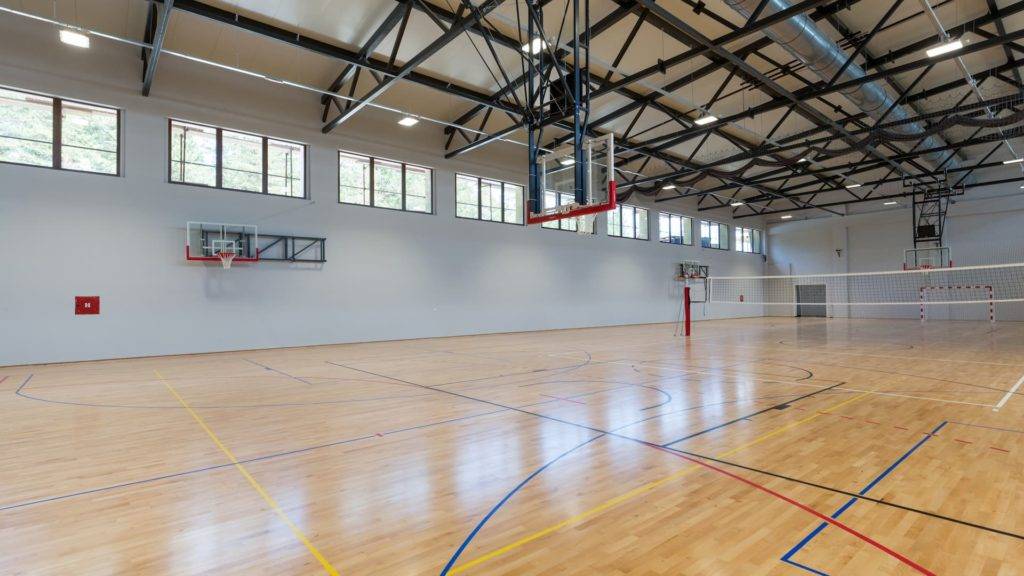
The size of the hall shapes your sports hall markings. Sport England’s design guidance treats the four-court hall, nominally 34.5 m by 20 m with 7.5 m clear height, as the recommended minimum for school and multi-sport projects. The older 33 m by 18 m hall is no longer considered suitable for new projects, yet Sport England reports that 83% of halls are small halls with three or four badminton courts.
At club and community level, the four-court hall takes four badminton courts plus one basketball, one netball and one volleyball court, all sharing the same floor. A five-court hall (40.6 m by 21.35 m) adds a fifth badminton court, while an eight-court hall (40 m by 34.5 m) takes two each of basketball, netball and volleyball.
We measure the hall as built and match court sizes and safety margins to the level of play you host, which in an older hall can mean the minimum sizes Sport England allows for community and club play.
Netball, basketball, badminton, volleyball, futsal, tennis and pickleball: each sport has its own court dimensions, line widths and colour conventions, and getting them right matters more than people think. Netball is a good example. School courts across the UK are frequently marked to outdated dimensions, an issue we unpacked in our guide to netball court line marking regulations.
We plan multi-sport layouts so the primary sport reads instantly and the rest never clash, and where a hall hosts competition play we mark to the current governing body rulebook, not the one from twenty years ago.
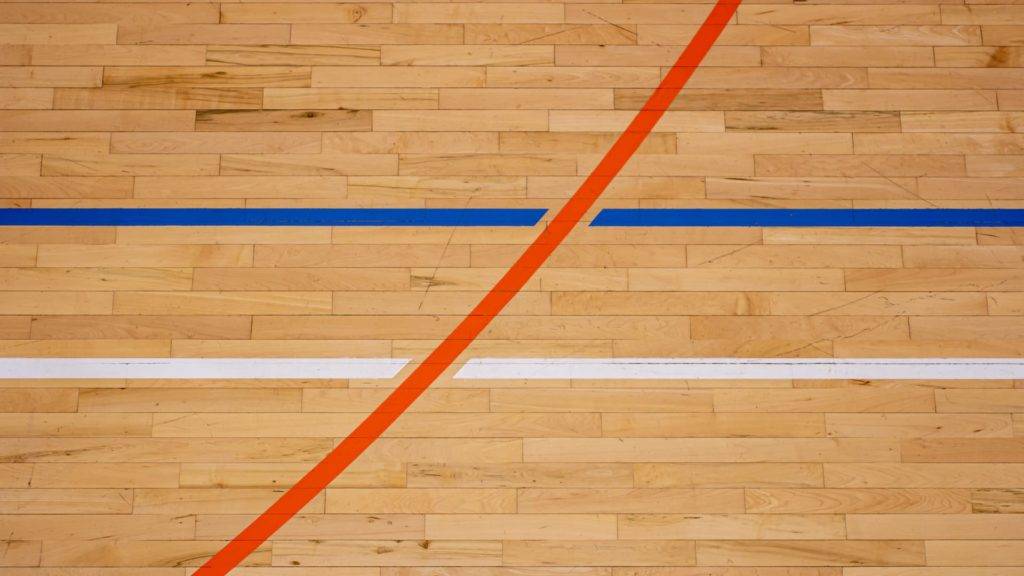
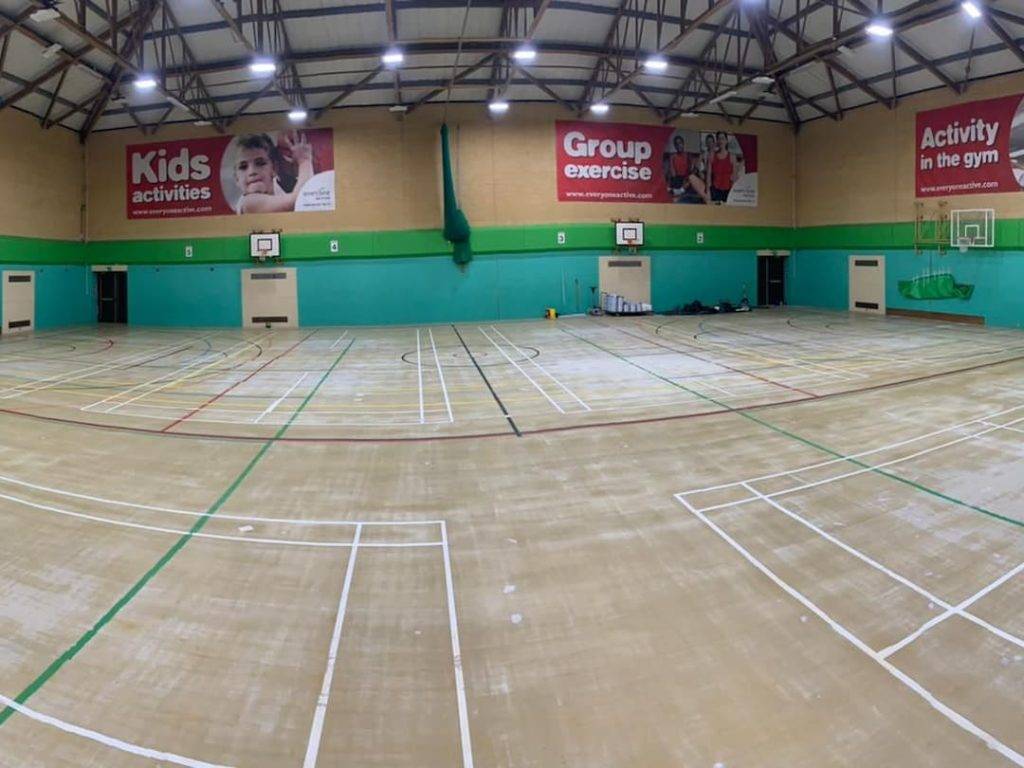
Our paints are specialist proprietary high-traffic line paints that come in a range of colours to suit all sports courts. These paints are specifically designed for floor use, they’re high-quality and durable, lasting between 5 and 7 years.
Each colour has been specifically created to distinguish between sports. The colours are usually:
The colour list above broadly follows the court marking table in Sport England’s design guidance. That table is a recommendation, not a mandatory scheme, and it also sets widths: 50 mm for most sports and 40 mm for badminton. Badminton World Federation laws specify 40 mm lines, preferably white or yellow; FIBA basketball and FIVB volleyball both call for 5 cm lines; and netball lines are 50 mm. Court detail is on our badminton court marking page and its sister pages.
Sport England’s floors guidance calls for visual contrast between the floor and its markings, with a matt finish to avoid glare, and FIVB asks for volleyball lines in a light colour that differs from the floor and other lines. We judge each colour against your floor under your hall’s lighting.
For major competitions, Sport England notes that most sports require white lines, and FIBA requires every basketball line to be one colour, so tell us early if your hall hosts higher-level fixtures.
If you own a school or sports club and would like to incorporate your logo or emblem into your court marking design, this is something that we can offer you. Add that finishing touch to your indoor sports floor with your own logo or bespoke design in your chosen colours.
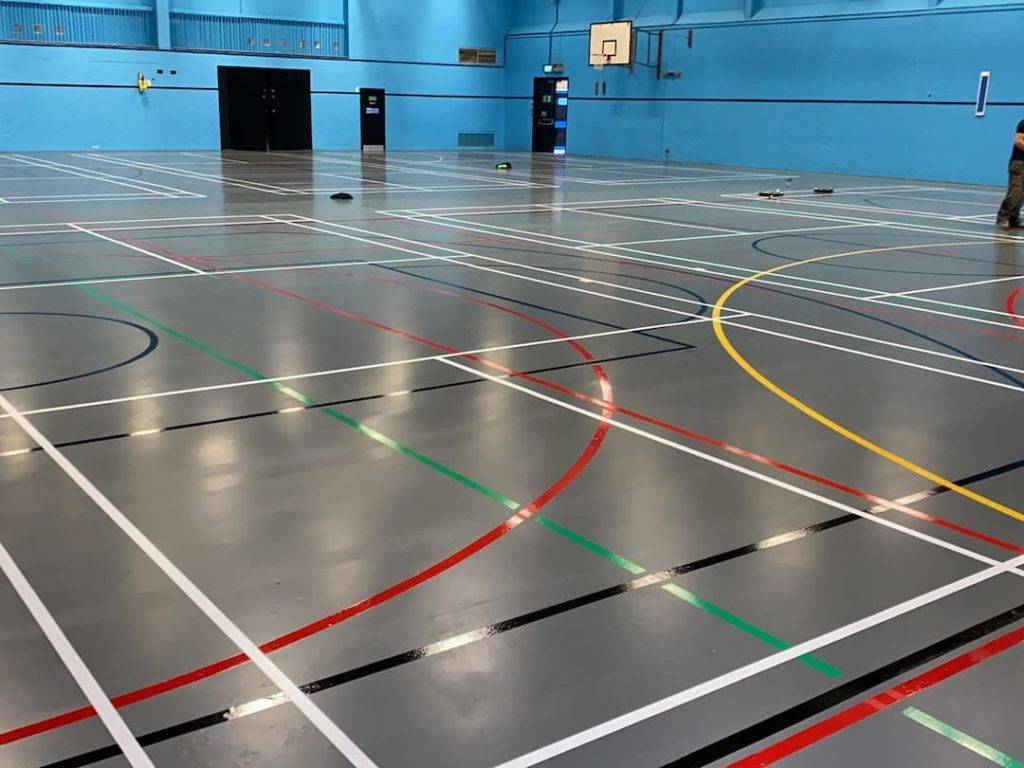
Marking one sport on a floor is straightforward. Marking five without turning the hall into a plate of spaghetti is where the skill lies. A typical school or leisure hall carries netball, basketball, badminton, volleyball and five-a-side lines at once, each to its own governing body dimensions, and every one of them has to be readable at speed by a player who is not looking for it.
We plan the layout around your primary sport, so those lines read instantly, then work the others in behind them using colour and line weight to create a clear hierarchy. Sports that share a run of the floor are separated deliberately, never by accident. Where a hall hosts competition play we mark to the current rulebook, not the one that was current when the floor was last done, which is a common problem in school netball courts.
Precise sports hall line marking starts with tolerances. Sport England’s floors guidance asks for line widths within 2 mm either way and overall court dimensions within 0.1 per cent, which is less than 3 cm along a full-size basketball court.
Each court is set out from a measured centre line using laser and tape, squared by checking its diagonals, and checked again before painting. The governing bodies also differ on where a line sits: badminton, netball and volleyball lines form part of the court they mark, whereas FIBA treats basketball boundary lines as outside the court. Paint on the wrong side of the string and the court is out by a line width on each side. Sport England also notes that computer-drawn layouts help when planning court positions.
On timber, lines go down between seal coats, so setting out and painting must fit the drying times of the sealing programme. We plan that sequence around school terms, half-terms and evening or weekend access.
A school crest or club badge at centre court changes how a hall feels, and it photographs beautifully for prospectuses, websites and open days. We apply logos directly into the floor finish and seal them beneath the final coats, so they wear at exactly the same rate as the surface around them and never peel like a sticker.
Artwork is usually straightforward: send us what you have and we will advise on sizing, placement and how it will sit against the court lines. The best moment to do it is during a refurbishment or a new installation when the floor is already open, though we can retrofit into a sound floor as a standalone visit.

Court marking paint is not decorating paint. It has to bond to a sealed sports surface, survive being walked on by hundreds of pairs of trainers a day, resist cleaning chemicals, and do all of that without creating a patch of different grip in the middle of a court, which is a safety issue, not a cosmetic one.
We use specialist proprietary line marking systems designed for sports floors, applied between coats of seal so the markings sit protected within the finish, not on top of it. On synthetic and polyurethane surfaces the products differ again, and using the wrong one is a common cause of markings that lift within a season.
Once the lines are down we can carry out slip resistance testing across both the marked and unmarked areas, so you have written evidence that the whole playing surface performs consistently.
Sport England’s guidance says paint and preparation must be matched to the surface type, so each floor has its own route to durable sports hall floor markings.
Timber. On a wooden sports floor that is not being sanded, the lacquer is cleaned and abraded first, and Junckers advises trial patches to confirm the paint will bond. If they fail, the floor must be sanded to bare wood before marking.
Granwood. These composition blocks cannot be sanded like timber. They are restored with a modified epoxy coating system, and the new lines are applied as part of that system, so a Granwood floor restoration is the moment to correct the layout.
Vinyl and lino. These cannot be sanded back, so marking relies on thorough degreasing and a paint the manufacturer approves for that product. Gerflor, for example, names approved two-part paints for each of its sports floors.
PU. Sport England notes that markings on polyurethane floors are applied in polyurethane paint. When a worn PU floor receives a new colour coat, the old lines are covered and the layout can be redrawn. Our vinyl and PU sports flooring page has more.
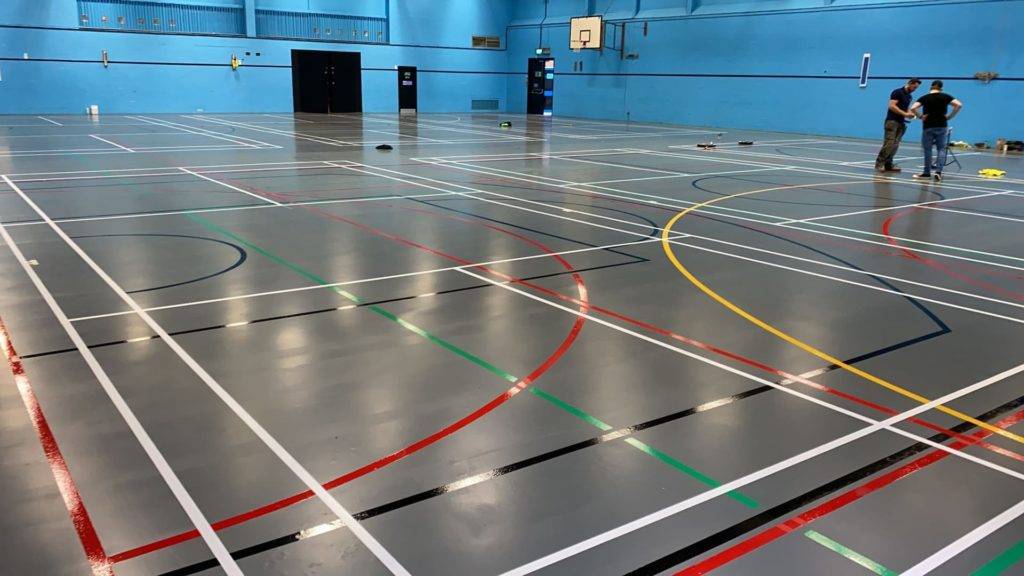
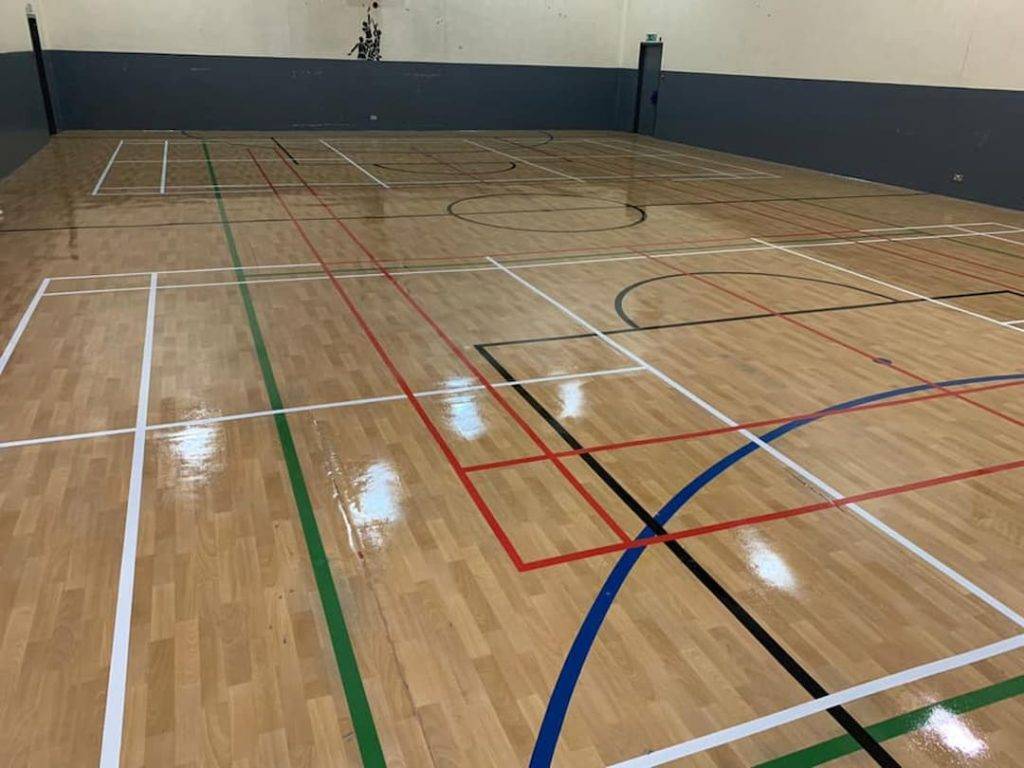
Worn lines are the obvious prompt for new indoor sports hall line markings, but there are others:
On a sound finish, relining means cleaning, abrading, setting out, painting and sealing over; where the lacquer has worn through, the job becomes a full refinish. Our sports hall repainting and relining page covers that decision, and a sports hall floor inspection will show which route your floor needs.
Every hall is priced individually, but the same factors drive the cost of any sports line marking job:
Photographs of the current floor and markings help us price the work accurately and spot problems early.
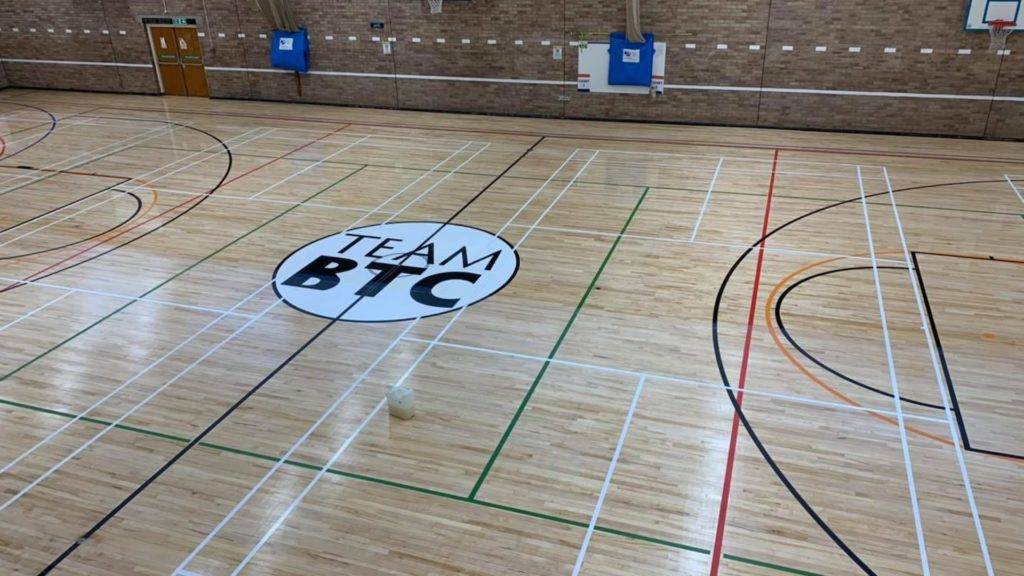
Yes. We can sand back your current lines and repaint them, or set out a completely new court, then reseal the whole floor so the lines and the surface beneath them are protected. If the existing finish is sound and you only need an extra court, we will tell you whether it can go on without a full sand.
Yes we can. Whether it is your company logo, sports emblem or even school logo, we can create a design that incorporates this. Usually, we will add this to the centre of your court.
Yes. We carry out pendulum slip resistance testing to BS 7976-2, either as a standalone visit on an existing floor or alongside an installation, refurbishment or relining project when you request it. The results give you a measured record of how the surface performs, which supports your risk assessments and helps identify whether cleaning or wear is affecting grip.
It depends on how many courts you need and whether the floor is being resealed at the same time. Marking during a refurbishment is far more economical than a standalone visit, because the floor is already prepared. Send us the hall dimensions and the sports you need and we will price it properly.
On timber, yes: old lines come off during sanding and the floor is re-marked from scratch, which is the ideal moment to correct a layout that has drifted out of specification. On synthetic surfaces removal is more limited, so we will assess the floor and explain the options before promising anything.
Applied properly and sealed within the finish, markings last as long as the seal above them, typically several years of heavy use. They wear fastest along baselines and service areas. When the floor is next recoated the lines are refreshed as part of the job.
Yes, provided the paint suits the floor and the conditions are right. Gerflor’s guidance for its water-based line paint, for example, rules out application below 15°C air or 12°C floor temperature and asks for 72 hours without foot traffic at 15°C, so winter work needs planning.
A single court on a sound finish can often be refreshed overnight. As part of a full sand, seal and reline, a gym of around 240 m² takes 5 to 6 working days and a hall of around 550 m² takes 9 to 10.
Partly. Lines can be painted out in a colour matched to the floor, or abraded and recoated locally, but neither is invisible on timber: wood ambers under light while boards covered by paint usually stay paler, leaving a faint outline. For a clean result, drop the court at the next full sand.
Yes, and in most halls they have to. Sport England’s guidance asks that layouts avoid lines coinciding or sitting too close, and allows small adjustments to court positions to prevent conflicts. Guidance from sportscotland adds that marking more than about four or five sports usually becomes too confusing.
We set out and paint courts to current governing body dimensions. See badminton court marking, basketball court marking, netball court marking, pickleball courts and full sports hall repainting and relining.
For sports hall markings on an existing or as part of a new installation or refurbishment with us, get in touch.